第1章関数とグラフ
1.1 Review of Functions1.1 関数の復習
Learning Objectives学習目標
- Use functional notation to evaluate a function.関数の記法を使い、関数の値を求める。
- Determine the domain and range of a function.関数の定義域と値域を求める。
- Draw the graph of a function.関数のグラフを描く。
- Find the zeros of a function.関数の零点を求める。
- Recognize a function from a table of values.値の表から関数を読み取る。
- Make new functions from two or more given functions.与えられた2つ以上の関数から、新しい関数を作る。
- Describe the symmetry properties of a function.関数の対称性の性質を説明する。
In this section, we provide a formal definition of a function and examine several ways in which functions are represented—namely, through tables, formulas, and graphs. We study formal notation and terms related to functions. We also define composition of functions and symmetry properties. Most of this material will be a review for you, but it serves as a handy reference to remind you of some of the algebraic techniques useful for working with functions.
英語のヒント
この節では、関数を厳密に定義し、関数を表すいくつかの方法、すなわち表・式・グラフによる表現を調べる。関数に関する正式な記法と用語を学び、関数の合成や対称性の性質も定義する。大部分はこれまでに学んだことの復習になるだろう。それでも、関数を扱う際に役立つ代数的手法を思い出すための、手元で参照できる資料になる。
Functions関数
Given two sets and a set with elements that are ordered pairs where is an element of and is an element of is a relation from to A relation from to defines a relationship between those two sets. A function is a special type of relation in which each element of the first set is related to exactly one element of the second set. The element of the first set is called the input; the element of the second set is called the output. Functions are used all the time in mathematics to describe relationships between two sets. For any function, when we know the input, the output is determined, so we say that the output is a function of the input. For example, the area of a square is determined by its side length, so we say that the area (the output) is a function of its side length (the input). The velocity of a ball thrown in the air can be described as a function of the amount of time the ball is in the air. The cost of mailing a package is a function of the weight of the package. Since functions have so many uses, it is important to have precise definitions and terminology to study them.
英語のヒント
2つの集合とを考える。がの要素、がの要素であるような順序対を要素とする集合を、からへの関係という。からへの関係は、この2つの集合の間の対応を定める。関数は関係の特別な一種であり、最初の集合の各要素が、2番目の集合のちょうど1つの要素に対応する。最初の集合の要素を入力、2番目の集合の要素を出力という。数学では、2つの集合の間の対応を記述するために、関数がごく普通に使われる。どの関数でも、入力がわかれば出力が定まるので、出力は入力の関数であるという。たとえば、正方形の面積は辺の長さによって定まる。そこで、面積(出力)は辺の長さ(入力)の関数であるという。空中に投げたボールの速度は、ボールが空中にある時間の関数として記述できる。荷物を郵送する料金は、荷物の重さの関数である。関数にはこれほど多くの用途があるため、その学習には正確な定義と用語が重要になる。
For example, consider the function where the domain is the set of all real numbers and the rule is to square the input. Then, the input is assigned to the output Since every nonnegative real number has a real-value square root, every nonnegative number is an element of the range of this function. Since there is no real number with a square that is negative, the negative real numbers are not elements of the range. We conclude that the range is the set of nonnegative real numbers.
英語のヒント
たとえば、定義域を実数全体の集合とし、入力を2乗するという規則を持つ関数を考えよう。入力には出力が対応する。0以上の実数はどれも実数の平方根を持つため、0以上の数はすべてこの関数の値域の要素である。2乗すると負になる実数は存在しないので、負の実数は値域の要素ではない。したがって、値域は0以上の実数全体の集合である。
For a general function with domain we often use to denote the input and to denote the output associated with When doing so, we refer to as the independent variable and as the dependent variable, because it depends on Using function notation, we write and we read this equation as equals of For the squaring function described earlier, we write
英語のヒント
定義域を持つ一般の関数では、入力を、に対応する出力をで表すことが多い。このとき、を独立変数、を従属変数という。後者はに依存するからである。関数の記法を用いてと書き、この式を「は、に対するの値に等しい」と読む。先ほどの2乗する関数については、と書く。
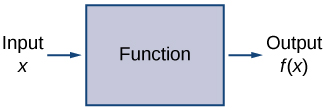
OpenStax, Rice University; Calculus Volume 1. · CC BY-NC-SA 4.0
Figure 1.2図 1.2
A function can be visualized as an input/output device.
関数は、入力を受け取って出力を返す装置として図示できる。
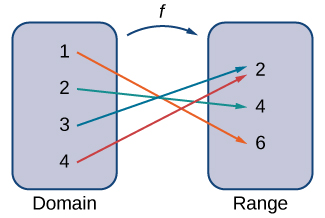
OpenStax, Rice University; Calculus Volume 1. · CC BY-NC-SA 4.0
Figure 1.3図 1.3
A function maps every element in the domain to exactly one element in the range. Although each input can be sent to only one output, two different inputs can be sent to the same output.
英語のヒント
関数は、定義域の各要素を値域のちょうど1つの要素に対応させる。各入力から対応する出力は1つだけだが、異なる2つの入力が同じ出力に対応してもよい。
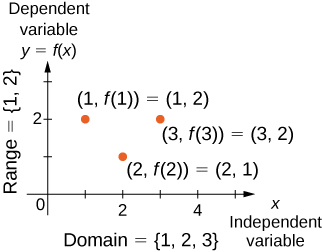
OpenStax, Rice University; Calculus Volume 1. · CC BY-NC-SA 4.0
Figure 1.4図 1.4
In this case, a graph of a function has a domain of and a range of The independent variable is and the dependent variable is
この関数のグラフでは、定義域は、値域はである。独立変数は、従属変数はである。
We can also visualize a function by plotting points in the coordinate plane where The graph of a function is the set of all these points. For example, consider the function where the domain is the set and the rule is In Figure 1.5, we plot a graph of this function.
英語のヒント
を満たす点を座標平面上に打つことによっても、関数を図示できる。関数のグラフとは、このような点すべてからなる集合である。たとえば、定義域が集合、規則がである関数を考えよう。図1.5に、この関数のグラフを描く。
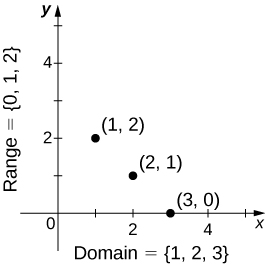
OpenStax, Rice University; Calculus Volume 1. · CC BY-NC-SA 4.0
Figure 1.5図 1.5
Here we see a graph of the function with domain and rule The graph consists of the points for all in the domain.
定義域が、規則がである関数のグラフ。このグラフは、定義域のすべてのに対する点からなる。
Every function has a domain. However, sometimes a function is described by an equation, as in with no specific domain given. In this case, the domain is taken to be the set of all real numbers for which is a real number. For example, since any real number can be squared, if no other domain is specified, we consider the domain of to be the set of all real numbers. On the other hand, the square root function only gives a real output if is nonnegative. Therefore, the domain of the function is the set of nonnegative real numbers, sometimes called the natural domain.
英語のヒント
すべての関数には定義域がある。しかし、のように、定義域を特に指定せず、式だけで関数を表すこともある。その場合、定義域は、が実数になる実数すべての集合とする。たとえば、どの実数も2乗できるので、別の指定がなければの定義域は実数全体の集合とする。これに対して、平方根関数は、が0以上の場合に限って実数の出力を与える。したがって、関数の定義域は0以上の実数全体の集合であり、このように式から自然に決まる定義域を自然な定義域と呼ぶこともある。
For the functions and the domains are sets with an infinite number of elements. Clearly we cannot list all these elements. When describing a set with an infinite number of elements, it is often helpful to use set-builder or interval notation. When using set-builder notation to describe a subset of all real numbers, denoted we write
英語のヒント
関数との定義域は、無限個の要素を持つ集合である。当然、その要素をすべて書き並べることはできない。無限個の要素を持つ集合を記述する際には、条件を使った集合の記法や区間の記法が役に立つことが多い。で表される実数全体の集合の部分集合を、条件を使って記述する場合には、次のように書く。
We read this as the set of real numbers such that has some property. For example, if we were interested in the set of real numbers that are greater than one but less than five, we could denote this set using set-builder notation by writing
これは「ある性質を持つ実数、すなわちその性質を満たすの集合」と読む。たとえば、1より大きく5より小さい実数の集合を考えるなら、条件を使って次のように表せる。
A set such as this, which contains all numbers greater than and less than can also be denoted using the interval notation Therefore,
このようにより大きくより小さい数をすべて含む集合は、区間の記法でも表せる。したがって、次のようになる。
The numbers and are called the endpoints of this set. If we want to consider the set that includes the endpoints, we would denote this set by writing
英語のヒント
数とを、この集合の端点という。端点も含む集合を考える場合には、次のように書く。
We can use similar notation if we want to include one of the endpoints, but not the other. To denote the set of nonnegative real numbers, we would use the set-builder notation
端点の一方だけを含み、もう一方を含まない場合にも、同様の記法を使える。0以上の実数の集合を条件で表すなら、次のように書く。
The smallest number in this set is zero, but this set does not have a largest number. Using interval notation, we would use the symbol which refers to positive infinity, and we would write the set as
この集合の最小の数は0だが、最大の数は存在しない。区間の記法では、正の無限大を表す記号を使い、次のように書く。
It is important to note that is not a real number. It is used symbolically here to indicate that this set includes all real numbers greater than or equal to zero. Similarly, if we wanted to describe the set of all nonpositive numbers, we could write
英語のヒント
が実数ではないことに注意してほしい。ここでは、この集合が0以上のすべての実数を含むことを、記号によって表している。同様に、0以下の数すべてからなる集合は、次のように書ける。
Here, the notation refers to negative infinity, and it indicates that we are including all numbers less than or equal to zero, no matter how small. The set
ここで記号は負の無限大を表し、どれほど小さい数でも、0以下の数をすべて含めることを示す。次の集合は、
refers to the set of all real numbers.
実数全体の集合を表す。
Some functions are defined using different equations for different parts of their domain. These types of functions are known as piecewise-defined functions. For example, suppose we want to define a function with a domain that is the set of all real numbers such that for and for We denote this function by writing
英語のヒント
定義域の部分ごとに異なる式を使って定義する関数もある。これを区分的に定義された関数という。たとえば、実数全体を定義域とし、では、ではとなる関数を定義したいとしよう。この関数は次のように書く。
When evaluating this function for an input the equation to use depends on whether or For example, since we use the fact that for and see that On the other hand, for we use the fact that for and see that
英語のヒント
この関数の入力に対する値を求めるときは、かかによって使う式が変わる。たとえばなので、ではという規則を使い、を得る。一方、の場合には、ではという規則を使い、を得る。
Example 1.1例題 1.1
Evaluating Functions関数の値を求める
For the function evaluate
関数について、次の値を求めよ。
Solution解き方
Substitute the given value for x in the formula for
英語のヒント
の式のxに、与えられた値を代入する。
Example 1.2例題 1.2
Finding Domain and Range定義域と値域を求める
For each of the following functions, determine the i. domain and ii. range.
次の各関数について、i. 定義域、ii. 値域を求めよ。
Solution解き方
- Considerを考える。
- Since is a real number for any real number the domain of is the interval任意の実数に対しては実数なので、の定義域は区間である。
- Since we know Therefore, the range must be a subset of To show that every element in this set is in the range, we need to show that for a given in that set, there is a real number such that Solving this equation for we see that we need such that
英語のヒント
なので、とわかる。したがって、値域はの部分集合でなければならない。この集合のすべての要素が値域に入ることを示すには、その集合から与えられたに対し、を満たす実数が存在することを示す必要がある。この方程式をについて解くと、には次の条件が必要になる。
This equation is satisfied as long as there exists a real number such that英語のヒント
次の条件を満たす実数が存在すれば、この方程式は成り立つ。
Since the square root is well-defined. We conclude that for and therefore the range is英語のヒント
なので、この平方根は実数として定義できる。となるので、値域はである。
- Considerを考える。
- To find the domain of we need the expression Solving this inequality, we conclude that the domain isの定義域を求めるには、条件が必要である。この不等式を解くと、定義域はとなる。
- To find the range of we note that since Therefore, the range of must be a subset of the set To show that every element in this set is in the range of we need to show that for all in this set, there exists a real number in the domain such that Let Then, if and only if
英語のヒント
の値域を求めるために、に注目する。したがって、の値域は集合の部分集合でなければならない。この集合のすべての要素がの値域に入ることを示すには、この集合のどのについても、を満たす実数が定義域に存在することを示す必要がある。としよう。このとき、であるための必要十分条件は次の式である。
Solving this equation for we see that must solve the equationこの方程式をについて解くと、は次の方程式を満たす必要がある。
Since such an could exist. Squaring both sides of this equation, we have
Therefore, we needなので、そのようなは存在しうる。両辺を2乗するととなる。したがって、次の条件が必要である。
which impliesこれより、
We just need to verify that is in the domain of Since the domain of consists of all real numbers greater than or equal to andあとは、このがの定義域に入ることを確かめればよい。の定義域は以上の実数全体であり、また、
there does exist an in the domain of We conclude that the range of isなので、の定義域内に、そのようなが確かに存在する。したがって、の値域はである。
- Considerを考える。
- Since is defined when the denominator is nonzero, the domain is
英語のヒント
は分母が0でないときに定義されるので、定義域はである。 - To find the range of we need to find the values of such that there exists a real number in the domain with the property thatの値域を求めるには、次の条件を満たす実数が定義域に存在するようなの値を求める。
Solving this equation for we find thatこの方程式をについて解くと、
Therefore, as long as there exists a real number in the domain such that Thus, the range isしたがって、であれば、を満たす実数が定義域に存在する。よって、値域はである。