第1章関数とグラフ
Hyperbolic Functions双曲線関数
The hyperbolic functions are defined in terms of certain combinations of and These functions arise naturally in various engineering and physics applications, including the study of water waves and vibrations of elastic membranes. Another common use for a hyperbolic function is the representation of a hanging chain or cable, also known as a catenary (Figure 1.49). If we introduce a coordinate system so that the low point of the chain lies along the -axis, we can describe the height of the chain in terms of a hyperbolic function. First, we define the hyperbolic functions.
英語のヒント
双曲線関数は、との特定の組合せによって定義される。これらは水面の波や弾性膜の振動など、工学・物理学のさまざまな応用に自然に現れる。よく知られた別の用途は、垂れ下がった鎖やケーブルの形を表すことである。この曲線は懸垂線とも呼ばれる(図1.49)。鎖の最も低い点が軸上に来るように座標系をとると、その高さを双曲線関数で表せる。まず、双曲線関数を定義しよう。
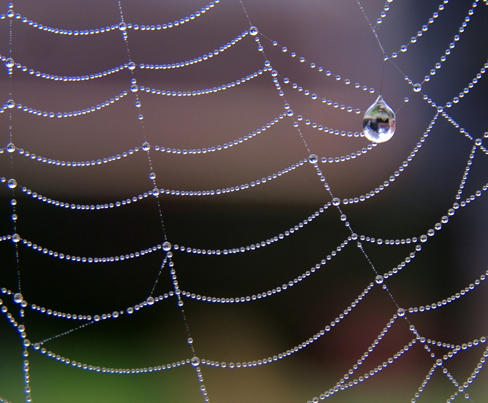
Mtpaley, SpiderCatenary; reproduced by OpenStax. · CC BY 3.0
Figure 1.49図 1.49
The shape of a strand of silk in a spider’s web can be described in terms of a hyperbolic function. The same shape applies to a chain or cable hanging from two supports with only its own weight. (credit: “Mtpaley”, Wikimedia Commons)
クモの糸の形は双曲線関数で表せる。2つの支点から吊るされ、自分自身の重さだけを受ける鎖やケーブルも同じ形になる。(写真提供:「Mtpaley」、Wikimedia Commons)
The name cosh rhymes with “gosh,” whereas the name sinh is pronounced “cinch.” Tanh, sech, csch, and coth are pronounced “tanch,” “seech,” “coseech,” and “cotanch,” respectively.
英語では、coshはgoshと韻を踏む「コシュ」、sinhはcinchと同じ「シンチ」と読む。tanh、sech、csch、cothはそれぞれ「タンチ」「スィーチ」「コウスィーチ」「コウタンチ」と読む。
Using the definition of and principles of physics, it can be shown that the height of a hanging chain, such as the one in Figure 1.49, can be described by the function for certain constants and
の定義と物理の原理を使うと、図1.49のように垂れ下がる鎖の高さは、定数、を用いた関数で表せることが示される。
But why are these functions called hyperbolic functions? To answer this question, consider the quantity Using the definition of and we see that
では、なぜ双曲線関数というのだろうか。これを考えるため、を調べよう。との定義から、次の式を得る。
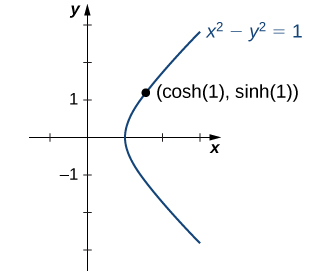
This identity is the analog of the trigonometric identity Here, given a value the point lies on the unit hyperbola (Figure 1.50).
英語のヒント
この恒等式は、三角関数の恒等式に対応するものである。の値を与えると、点は単位双曲線上にある(図1.50)。
OpenStax, Rice University; Calculus Volume 1. · CC BY-NC-SA 4.0
Figure 1.50図 1.50
The unit hyperbola
単位双曲線。
Graphs of Hyperbolic Functions双曲線関数のグラフ
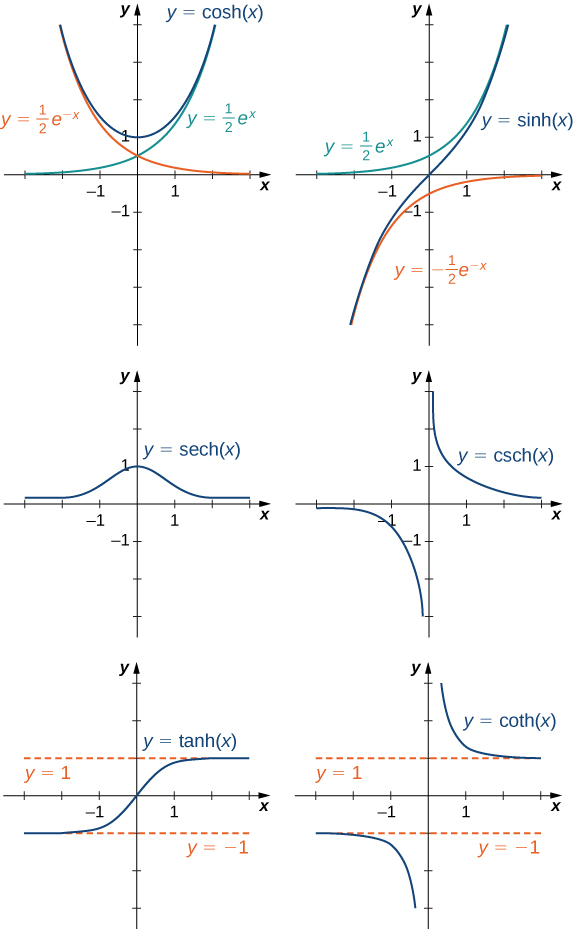
To graph and we make use of the fact that both functions approach as since as As approaches whereas approaches Therefore, using the graphs of and as guides, we graph and To graph we use the fact that for all as and as The graphs of the other three hyperbolic functions can be sketched using the graphs of and (Figure 1.51).
とのグラフを描くには、のとき、どちらもへ近づくことを使う。のときとなるためである。逆に、はへ近づき、はへ近づく。したがって、とのグラフを目安として、とを描ける。を描くには、を使う。すべての(のとき)、(のとき)である。残り3つの双曲線関数のグラフは、とのグラフを利用して描ける(図1.51)。
OpenStax, Rice University; Calculus Volume 1. · CC BY-NC-SA 4.0
Figure 1.51図 1.51
The hyperbolic functions involve combinations of and
双曲線関数は、との組合せでできている。
Identities Involving Hyperbolic Functions双曲線関数の恒等式
The identity shown in Figure 1.50, is one of several identities involving the hyperbolic functions, some of which are listed next. The first four properties follow easily from the definitions of hyperbolic sine and hyperbolic cosine. Except for some differences in signs, most of these properties are analogous to identities for trigonometric functions.
英語のヒント
図1.50で示したという恒等式は、双曲線関数が満たす恒等式の1つである。そのいくつかを次にまとめる。最初の4つは、双曲線正弦と双曲線余弦の定義からすぐに導ける。符号の違いを除けば、多くは三角関数の恒等式に似ている。
Example 1.40例題 1.40
Evaluating Hyperbolic Functions双曲線関数の値を求める
- Simplifyを簡単にせよ。
- If find the values of the remaining five hyperbolic functions.のとき、残り5つの双曲線関数の値を求めよ。
Solution解き方
- Using the definition of the function, we writeの定義から、次のように書ける。
- Using the identity we see that恒等式を使うと、次の結果を得る。
Since for all we must have Then, using the definitions for the other hyperbolic functions, we conclude that andすべてのについてなので、でなければならない。ほかの双曲線関数の定義を使うと、、となる。
Inverse Hyperbolic Functions逆双曲線関数
From the graphs of the hyperbolic functions, we see that all of them are one-to-one except and If we restrict the domains of these two functions to the interval then all the hyperbolic functions are one-to-one, and we can define the inverse hyperbolic functions. Since the hyperbolic functions themselves involve exponential functions, the inverse hyperbolic functions involve logarithmic functions.
英語のヒント
双曲線関数のグラフを見ると、と以外はすべて一対一である。この2つの定義域を区間に制限すれば、すべて一対一となり、逆双曲線関数を定義できる。双曲線関数が指数関数を含むため、その逆関数は対数関数を含む。
Let’s look at how to derive the first equation. The others follow similarly. Suppose Then, and, by the definition of the hyperbolic sine function, Therefore,
第1の式の導き方を見てみよう。ほかの式も同様に導ける。とすると、であり、双曲線正弦の定義からとなる。したがって、
Multiplying this equation by we obtain
この式にを掛けると、次のようになる。
This can be solved like a quadratic equation, with the solution
これは2次方程式と同じように解け、その解は次のようになる。
Since the only solution is the one with the positive sign. Applying the natural logarithm to both sides of the equation, we conclude that
なので、正の符号を選んだものだけが解になる。両辺の自然対数をとると、次の結果を得る。
Example 1.41例題 1.41
Evaluating Inverse Hyperbolic Functions逆双曲線関数の値を求める
Evaluate each of the following expressions.
次の各式の値を求めよ。
Solution解き方