第12章戦間期The Interwar Period
12.4 Old Empires and New Colonies12.4 古い帝国と新たな植民地
Learning Objectives学習の目標
By the end of this section, you will be able to:
この節を学び終えると、次のことができるようになる。
Describe the breakup of the Ottoman Empire at the end of World War I
第一次世界大戦末期のオスマン帝国の解体を説明する。
Explain the division of Germany’s colonies among the Allied Powers
連合国の間で、ドイツの植民地がどのように分割されたかを説明する。
Describe resistance to colonization in Africa and Asia
アフリカとアジアでの植民地化への抵抗を説明する。
It was not just Europe that underwent major changes in the interwar years. The Ottoman Empire ceased to exist, and the region it had dominated now became a multitude of various powers, of which Turkey retained the largest Ottoman legacy. The colonies Germany had held in Asia and Africa were distributed among the victorious countries and came under new governments. The rhetoric of self-determination of nations was not applied equally around the world, but its focus on nationalist ideologies filtered through many societies, spurring the growth of nationalist movements around the globe.
英語のヒント
戦間期に大きな変化を経験したのは、ヨーロッパだけではなかった。オスマン帝国は消滅し、それまで帝国が支配していた地域には、さまざまな勢力が割拠するようになった。その中で、オスマン帝国の遺産を最も多く受け継いだのはトルコだった。ドイツがアジアとアフリカに持っていた植民地は戦勝国に配分され、新たな政府の支配下に入った。民族自決という言葉は、世界中で等しく適用されたわけではない。それでも、民族主義の思想を重視するその考えは多くの社会に浸透し、各地で民族運動の成長を促した。
To the Victors Go the Spoils戦利品は勝者のもの
Already beset by internal problems and increasing difficulty controlling its holdings throughout Arabia and the Middle East, the Ottoman Empire had signed the Armistice of Mudros on October 30, 1918, bringing its participation in World War I to an end. During the war, a number of proposals for dismembering the empire had been considered. In 1919, Allied forces seized areas in the former Ottoman Empire, Greece captured Western Anatolia, and other Allied forces moved into Istanbul. The Turkish National Movement that resisted these occupations was led by Mustafa Kemal, later renamed Atatürk (“father of the Turks”) and already a Turkish hero for his performance at the Battle of Gallipoli.
英語のヒント
オスマン帝国は、すでに国内問題に悩まされ、アラビアや中東各地の領域を支配することも難しくなっていた。1918年10月30日にムドロス休戦協定へ署名し、第一次世界大戦への参戦を終えた。戦時中には、この帝国を分割するさまざまな案が検討されていた。1919年、連合国軍は旧オスマン帝国の各地を占領し、ギリシアは西アナトリアを奪い、ほかの連合国軍はイスタンブルへ進駐した。こうした占領に抵抗するトルコ国民運動を率いたのは、ムスタファ・ケマルである。彼はガリポリの戦いでの活躍によって、すでにトルコの英雄であり、のちに「トルコ人の父」を意味するアタテュルクという名を与えられた。
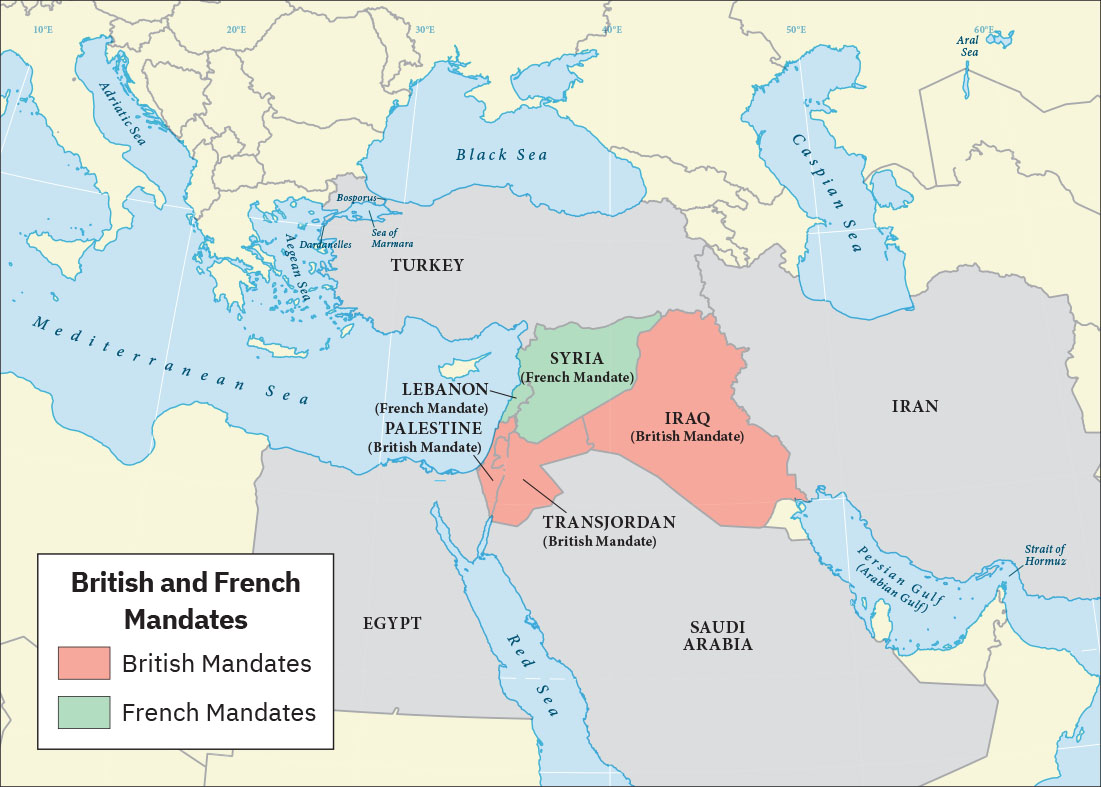
The 1920 Treaty of Sèvres partitioned the empire, leaving the Ottomans with control over only Istanbul and Thrace. The Turks led by Mustafa Kemal won battles on several fronts, however, and forced a renegotiation of the treaty. The Treaty of Lausanne in 1923 provided for an independent Turkey to succeed the Ottoman government. It also established League of Nations mandates in the Middle East. Under the mandate system, the administration of territories once controlled by the Ottomans was transferred to France or Britain, which were expected to govern these regions until some unspecified point in the future when the people there were deemed ready to govern themselves. Among the mandated areas were modern Iraq, Israel, Syria, Jordan, Lebanon, and Palestine (Figure 12.14).
英語のヒント
1920年のセーヴル条約は帝国を分割し、オスマン側に残された支配地はイスタンブルとトラキアだけとなった。しかしムスタファ・ケマル率いるトルコ人は複数の戦線で勝利し、条約の再交渉を迫った。1923年のローザンヌ条約は、オスマン政府に代わる独立したトルコを認めた。また、中東に国際連盟の委任統治領を設けた。委任統治制度の下では、かつてオスマン帝国が支配していた領域の行政が、フランスかイギリスに移された。両国は、現地の人々が自分たちで統治する準備が整ったと判断される、将来の定められていない時点まで、これらの地域を統治するものとされた。委任統治領には、現在のイラク、イスラエル、シリア、ヨルダン、レバノン、パレスチナに当たる地域が含まれた(図12.14)。
The Mandate System.委任統治制度。
(attribution: Copyright Rice University, OpenStax, under CC BY 4.0 license) · CC BY 4.0
Figure 12.14 This map shows the British and French mandates in the Middle East and their proximity to the new nation of Saudi Arabia. (attribution: Copyright Rice University, OpenStax, under CC BY 4.0 license)
図12.14 中東の英仏委任統治領と、新しく成立したサウジアラビアとの地理的な位置関係を示す地図。(帰属表示:著作権はライス大学・OpenStaxに帰属。CC BY 4.0ライセンス)
Arabia was not easily controlled by the European powers. Warfare continued to break out over access to sites such as Mecca and Medina, both holy places in the Islamic faith. By the mid-1920s, the Saud family had taken control of areas of the Nejd (the bulk of the Arabian Peninsula) and the Hejaz (the peninsula’s western region), and soon after they consolidated that control by forming a new nation, Saudi Arabia, which came into being in 1932.
英語のヒント
アラビアをヨーロッパ列強が支配することは容易ではなかった。イスラム教の聖地であるメッカやメディナなどの場所への出入りをめぐって、戦いが続いた。1920年代半ばまでに、サウード家はアラビア半島の大部分に当たるナジュドと、半島西部のヒジャーズの各地を支配した。その後まもなく、新しい国家を形成してその支配を固めた。1932年に成立したサウジアラビアである。
During the war, Britain and France had each begun to outline spheres of influence for themselves in the defunct Ottoman Empire. A French mandate covered Syria and Lebanon, and a British mandate the area of Iraq, Palestine, and the Transjordan (the East Bank). Despite their talk of self-determination, Europe’s surviving imperial powers clearly planned no deviation from the traditional course of empires in this region. Neither Britain nor France consulted the people who lived in the mandate areas about the decisions their governments would be making for them.
英語のヒント
戦時中からイギリスとフランスはそれぞれ、崩壊するオスマン帝国の中で、自国の勢力圏を定め始めていた。フランスの委任統治領はシリアとレバノンを、イギリスの委任統治領はイラク、パレスチナ、トランスヨルダン、すなわちヨルダン川東岸を覆った。民族自決を口にしてはいても、存続したヨーロッパの帝国主義列強は、この地域で従来の帝国支配の道筋を変えるつもりがないことを明確に示していた。イギリスもフランスも、自国政府が現地の人々のために下すことになる決定について、委任統治地域の住民に相談しなかった。
It soon became clear that the mandate system would not ensure full European control. For example, the British mandate over Mesopotamia, renamed Iraq, came under pressure from nationalists throughout the 1920s and 1930s. King Faisal (to whom the British had promised the rule of Syria) accepted being ruler of Iraq, but Britain controlled most of the government. The next king of Iraq had to accept similar conditions, but Iraqi nationalists became increasingly vocal about their frustration with the British presence.
英語のヒント
委任統治制度が、ヨーロッパによる完全な支配を保証するわけではないことは、すぐに明らかになった。たとえば、イラクと改称されたメソポタミアに対するイギリスの委任統治は、1920年代から1930年代を通じて民族主義者から圧力を受けた。イギリスからシリアの統治を約束されていたファイサル王は、イラクの統治者となることを受け入れた。しかし、政府の大部分はイギリスに支配されていた。次のイラク国王も同様の条件を受け入れなければならなかったが、イラクの民族主義者は、イギリスの存在への不満をますます強く口にするようになった。
The British complicated matters in another part of their mandate with the Balfour Declaration. This statement, one of many conflicting promises Britain made to various groups during the war, was issued by British foreign secretary Alfred Balfour in 1917. Balfour wrote that Britain supported a “national home” for Jewish people in Palestine. Ever since the nineteenth century, many European Jews had worked through Zionist organizations to encourage the return of Jews to their ancestral homeland in the Middle East. The Balfour Declaration marked the accomplishment of the goal that pro-Zionist groups had worked toward for years. Palestine was a British mandate after the war but mainly inhabited by Arab peoples; the move to introduce a substantial number of Jewish residents (with government support) promised to cause problems, and in fact it touched off religious and property disagreements that continue to this day.
英語のヒント
イギリスは、自国の別の委任統治地域では、バルフォア宣言によって事態を複雑にした。戦時中にイギリスがさまざまな集団へ与えた、互いに矛盾する約束の一つであるこの声明は、1917年に外相アルフレッド・バルフォアによって出された。バルフォアは、パレスチナにユダヤ人の「民族的郷土」を設けることをイギリスは支持すると書いた。19世紀以来、多くのヨーロッパのユダヤ人はシオニスト組織を通じて、祖先の故郷である中東へユダヤ人が帰還することを促してきた。バルフォア宣言は、親シオニズムの諸団体が長年追求してきた目標の達成を意味した。戦後、パレスチナはイギリスの委任統治領となったが、住民の大半はアラブ人だった。政府の支援を受けて多数のユダヤ人住民を受け入れる動きは、問題を引き起こすことが予想された。そして実際に、今日まで続く宗教と財産をめぐる対立に火をつけた。
The British began by summarily making an area of Palestine available to Jewish immigrants and, between 1922 and 1935, the Jewish population as a percentage of the total population increased threefold, from 9 percent to almost 27 percent. The Palestinians immediately complained of being treated as second-class citizens in their own land and about Britain’s failed promise to grant Arabs independence. Riots and protests became so common that Britain ultimately restricted immigration to Palestine, cutting off a route of escape for Jewish people fleeing the anti-Semitic policies of the Nazis.
英語のヒント
イギリスはまず、パレスチナの一部をユダヤ人移民に提供することを一方的に決めた。1922年から1935年の間に、総人口に占めるユダヤ人の割合は9パーセントから約27パーセントへと3倍に増加した。パレスチナ人はただちに、自分たちの土地で二級市民として扱われていることと、アラブ人の独立を認めるというイギリスの約束が果たされていないことに抗議した。暴動と抗議が頻発するようになったため、イギリスは最終的にパレスチナへの移民を制限した。それは、ナチ党の反ユダヤ政策から逃れようとするユダヤ人にとって、一つの避難経路を断つこととなった。
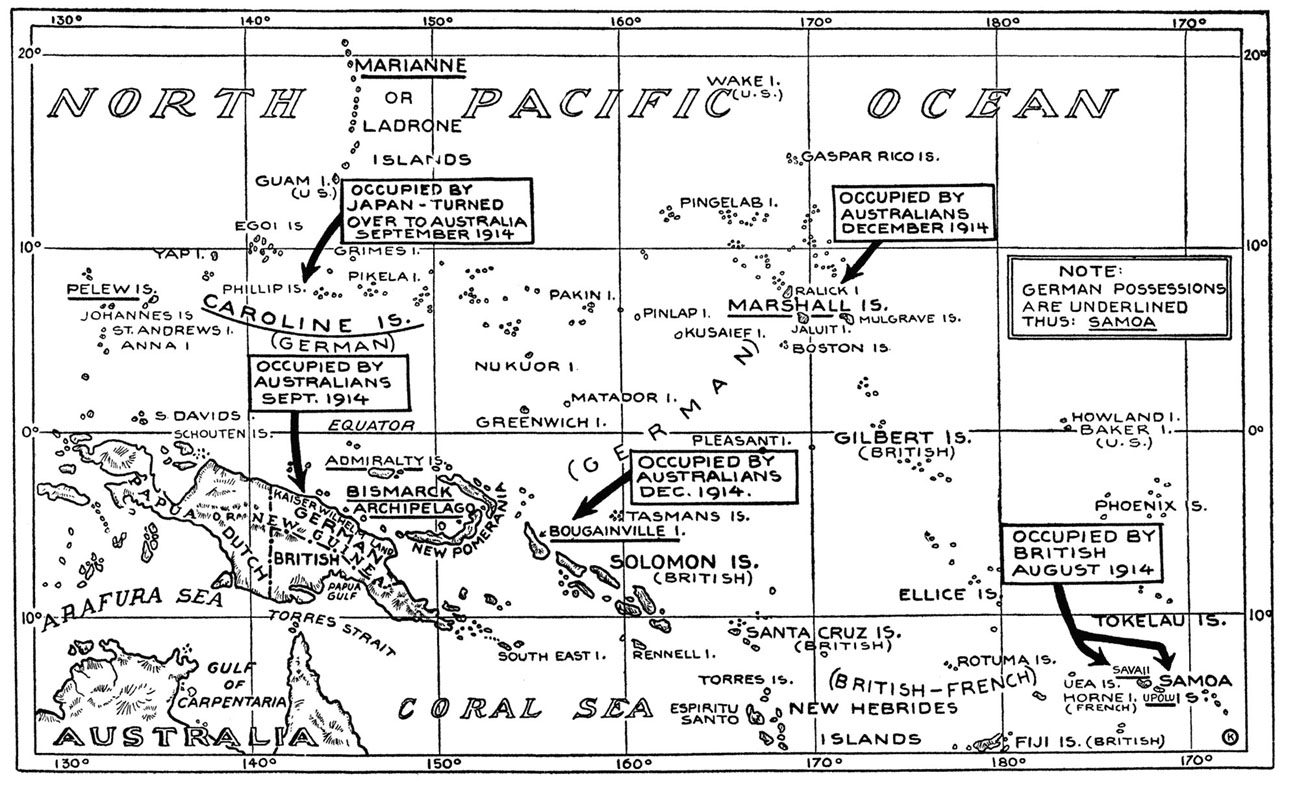
The Asian and African holdings of the German Empire were also divided among the victors. Some of Germany’s Asian lands had been relinquished early in the war, such as Samoa, which New Zealand formally took over after the war. Australia took German New Guinea and Nauru. The Japanese Empire gained German-held islands north of the equator, such as the Marshall Islands and the Caroline Islands (Figure 12.15).
英語のヒント
ドイツ帝国がアジアとアフリカに持っていた領土も、戦勝国の間で分割された。ドイツのアジアの領土の一部は戦争初期にすでに失われていた。たとえばサモアは、戦後ニュージーランドが正式に引き継いだ。オーストラリアはドイツ領ニューギニアとナウルを獲得した。日本帝国は、マーシャル諸島やカロリン諸島など、赤道以北のドイツ領の島々を獲得した(図12.15)。
German Colonies in Asia.アジアのドイツ植民地。
(credit: “German Pacific Colonies 1915 Map” by Project Gutenberg/Wikimedia Commons, Public Domain) · Public Domain
Figure 12.15 Most of Germany’s Asian colonies were occupied by the Allied nations early in the war. This 1915 map reflects those changes and foreshadows the way the Allied powers continued to control these regions after the war. (credit: “German Pacific Colonies 1915 Map” by Project Gutenberg/Wikimedia Commons, Public Domain)
図12.15 アジアにあったドイツ植民地の大半は、戦争初期に連合国に占領された。この1915年の地図は、それらの変化を反映し、戦後も連合国がこれらの地域を支配し続ける姿を先取りしている。(出典:「German Pacific Colonies 1915 Map」、プロジェクト・グーテンベルク/Wikimedia Commons、パブリックドメイン)
In Africa, Germany had held Kamerun (including modern Cameroon as well as areas of Chad, Gabon, Nigeria, and the Congo), German East Africa (Burundi, Rwanda, Tanzania), Togoland (Togo and part of Ghana), and German Southwest Africa (present-day Namibia). These became mandates after the war. Both Britain and France gained land in Togo and Cameroon, South Africa took Southwest Africa, and the Belgians received land in Burundi and Rwanda. No one consulted the African peoples in making these divisions, and in fact the borders cut through ethnic groups, leaving some groups divided between two governments. Self-determination of nations was clearly not at work in Africa, and increasingly louder voices questioned whether Europe had any real moral authority over African colonies.
英語のヒント
アフリカでドイツが保有していたのは、カメルーン、ドイツ領東アフリカ、トーゴラント、ドイツ領南西アフリカだった。カメルーンには現在のカメルーンに加え、チャド、ガボン、ナイジェリア、コンゴの一部が含まれていた。ドイツ領東アフリカは現在のブルンジ、ルワンダ、タンザニア、トーゴラントはトーゴとガーナの一部、ドイツ領南西アフリカは現在のナミビアに当たる。これらの地域は、戦後、委任統治領となった。イギリスとフランスはいずれもトーゴとカメルーンの土地を獲得し、南アフリカは南西アフリカを、ベルギーはブルンジとルワンダの土地を得た。この分割にあたって、アフリカの人々に相談する者はいなかった。実際、国境線は民族集団を横切り、一部の集団は二つの政府の間に分断された。民族自決がアフリカで機能していないことは明らかであり、ヨーロッパがアフリカの植民地に対して本当に道徳的な権威を持つのかを問う声が、ますます大きくなった。