第12章戦間期The Interwar Period
12.1 Recovering from World War I12.1 第一次世界大戦からの復興
Learning Objectives学習の目標
By the end of this section, you will be able to:
この節を学び終えると、次のことができるようになる。
Describe World War I’s immediate aftermath
第一次世界大戦直後の状況を説明する
List the provisions of the Treaty of Versailles
ヴェルサイユ条約の規定を挙げる
Describe how economic issues in Germany helped lead to the rise of the National Socialists
ドイツの経済問題が国家社会主義者の台頭につながった経緯を説明する
Analyze World War I’s effects on the economies of Europe, the United States, East Asia, and Latin America
第一次世界大戦がヨーロッパ、アメリカ合衆国、東アジア、ラテンアメリカの経済に及ぼした影響を分析する
Describe international efforts to prevent future global wars
将来の世界規模の戦争を防ぐための国際的な取り組みを説明する
Two major and competing forces took shape following World War I. One was disillusionment as the sheer horror of the war was finally understood. The other was the tantalizing idea that society had learned from the war and could build a better tomorrow, freed from the senselessness of war, through new institutions such as the League of Nations. Or, in the case of Russia, a new society would be based on more equitable principles. The reality turned out to be far from the ideal.
英語のヒント
第一次世界大戦の後、互いに競合する二つの大きな動きが形を取った。一つは、戦争のすさまじい恐ろしさをようやく理解したことによる幻滅だった。もう一つは、社会は戦争から学んだのであり、国際連盟のような新しい機関を通じて、戦争という無意味な行為から解き放たれた、よりよい明日を築けるはずだという、心を引きつける考えだった。ロシアの場合には、より公平な原則に基づいて新しい社会を築こうとした。しかし現実は、理想からはるかに遠いものとなった。
The Aftermath戦争の直後
As World War I ended in 1918, the world moved to cope with the destruction it had wrought. Military casualties stood between nine and ten million, civilian deaths at approximately ten million, and the number of wounded above twenty-one million. Veterans had both physical and emotional wounds; some needed physical therapy, prosthetics, or vocational training for their postwar lives. The civilian toll meant families had lost not only sons, brothers, husbands, and fathers but daughters, sisters, wives, and mothers. The war also brought into question the notions of superiority that had permeated Western civilization. People wondered whether the West was declining and could no longer consider itself a moral leader in the world.
英語のヒント
1918年に第一次世界大戦が終わると、世界は戦争がもたらした破壊への対処を始めた。軍人の人的損失は900万~1000万人、民間人の死者は約1000万人、負傷者は2100万人以上に上った。復員兵は身体にも心にも傷を負っていた。戦後の生活を送るため、理学療法や義肢、職業訓練が必要な人もいた。民間人の犠牲も大きかったため、家族は息子、兄弟、夫、父親だけでなく、娘、姉妹、妻、母親をも失っていた。戦争はまた、西洋文明に浸透していた優越意識にも疑問を投げかけた。人々は、西洋は衰退しつつあり、もはや自らを世界の道徳的指導者とはみなせないのではないかと考えるようになった。
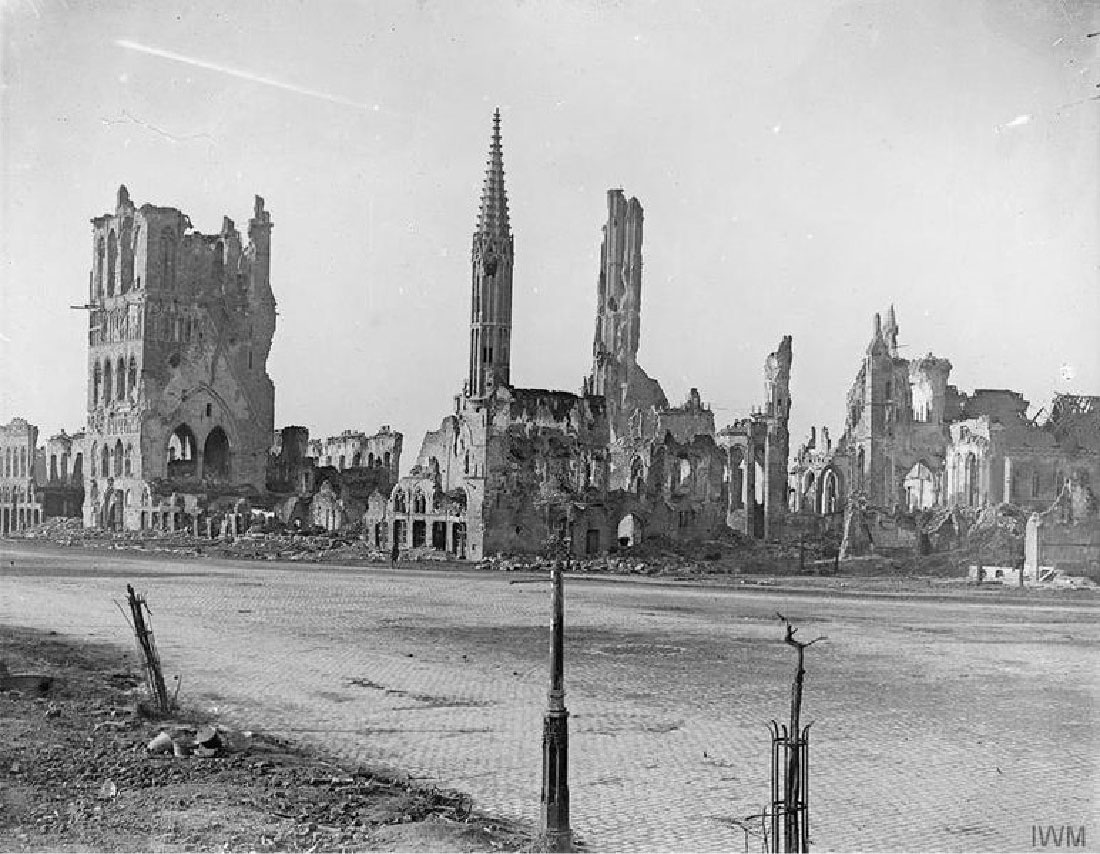
In Belgium and eastern France, the physical destruction was immense. Thousands of acres, often of prime farmland, were barren after years of artillery bombardment. Towns such as Ypres in Belgium had been shelled so heavily that many buildings had collapsed (Figure 12.3). People had to filter back to the farmlands and cities they had fled and begin to rebuild their lives. Some towns, such as Thiepval, France, had been so thoroughly destroyed that they were never rebuilt.
英語のヒント
ベルギーとフランス東部では、物理的な破壊が甚大だった。数千エーカーもの土地は、その多くが良質な農地だったにもかかわらず、長年の砲撃によって荒れ地となっていた。ベルギーのイープルなどの町は激しい砲撃を受け、多くの建物が倒壊した(図12.3)。人々は、かつて逃げ出した農地や都市へと少しずつ戻り、暮らしを再建し始めなければならなかった。フランスのティエプヴァルなど、徹底的に破壊されて再建されなかった町もあった。
Damage of War.戦争の被害
(credit: “Destruction on the Western Front, 1914-1918” by Ministry of Information First World War Official Collection/Wikimedia Commons, Public Domain) · Public Domain
Figure 12.3 The city of Ypres, Belgium, suffered great damage in World War I, as this 1916 photo of its ruined square shows. (credit: “Destruction on the Western Front, 1914-1918” by Ministry of Information First World War Official Collection/Wikimedia Commons, Public Domain)
図12.3 この1916年の写真に写る、廃墟と化した広場が示すように、ベルギーのイープル市は第一次世界大戦で大きな被害を受けた。(出典:Ministry of Information First World War Official Collection/Wikimedia Commons「Destruction on the Western Front, 1914-1918」、パブリックドメイン)
In the defeated countries of Germany and Austria-Hungary, economies were in free fall. Millions of men returned home to find stubborn economic instability and labor markets in transition, with factories ill-equipped to return to peacetime production. For men from Europe’s colonies, it took even longer to return home because European troops were demobilized first. Even the victorious nations faced economic problems. Britain and France had borrowed billions to finance the war and had sizable debts to repay, many to the United States. Industries across the world had to reconvert their machinery and processes to begin producing consumer items again, causing continued unemployment.
英語のヒント
敗戦国のドイツとオーストリア=ハンガリーでは、経済が急速に崩れ落ちていた。何百万人もの男性が帰還して直面したのは、容易に解消しない経済の不安定さと、変化の途上にある労働市場だった。工場には、平時の生産へ戻るための準備が十分に整っていなかった。ヨーロッパ諸国の植民地から来た兵士たちは、ヨーロッパ人部隊が先に復員したため、帰郷までにさらに長い時間がかかった。戦勝国でさえ経済問題に直面した。イギリスとフランスは戦費を賄うために数十億もの資金を借り入れており、多額の債務を返済しなければならなかった。その多くはアメリカ合衆国への借金だった。世界各地の産業は、消費財の生産を再開するために機械設備と生産工程を再び転換しなければならず、その間も失業が続いた。
The world was still dealing with the flu pandemic of 1918–1920, closing schools and theaters and canceling public activities. People were encouraged to wear masks and limit their movement until the crisis had passed. The flu eventually infected about one-third of the world’s population, killing tens of millions, especially younger people. By early 1920, it had stopped spreading, however, and people were able to return to their pre-pandemic lives.
英語のヒント
世界はなお、1918~1920年のインフルエンザの大流行に対処していた。学校や劇場を閉鎖し、公の催しを中止した。人々には、危機が去るまでマスクを着け、移動を控えるよう呼びかけた。インフルエンザには最終的に世界人口のおよそ3分の1が感染し、とりわけ若い人々を中心に数千万人が死亡した。しかし1920年の初めまでには感染拡大が止まり、人々は流行以前の暮らしに戻れるようになった。
Political change was in the winds. The takeover of Russia in 1917 by a small but determined Bolshevik force sent shockwaves through many nations as they began to fear similar uprisings within their own borders. In the United States, a “Red Scare” was unfolding in 1919. Fear of immigrants who might be communists or socialists was expressed in the growth of nativism—the idea that the nation should be reserved for native-born people of northern European ancestry. A number of mail bombs sent to politicians, businessmen, and newspaper editors heightened public fears of anarchy, and Attorney General A. Mitchell Palmer began authorizing what were later called the Palmer Raids, targeting newspaper presses, immigrant groups, and Russian worker unions, often without proper search warrants. Supposed “radical aliens” were arrested; some were held for months without being charged, and some were deported to Russia. The Palmer Raids demonstrated the power of the government to ignore individual rights. The American Civil Liberties Union was formed in 1920 to provide legal assistance to those targeted by the raids. As the months passed with no clear threat of a communist takeover, the public increasingly viewed Palmer’s actions with suspicion, and his political career ended.
英語のヒント
政治にも変化の兆しがあった。1917年、少数ながら決意の固いボリシェヴィキ勢力がロシアの権力を掌握すると、各国は自国でも同様の蜂起が起きるのではないかと恐れ、強い衝撃を受けた。アメリカ合衆国では1919年、「赤狩り」の恐怖が広がっていた。移民のなかに共産主義者や社会主義者がいるかもしれないという恐れは、排外主義の高まりとなって現れた。ここでいう排外主義とは、北ヨーロッパ系の祖先をもつ自国生まれの人々のために国を確保すべきだ、という考えである。政治家、実業家、新聞編集者に郵送された一連の爆弾は、無政府状態への恐怖を高めた。司法長官A・ミッチェル・パーマーは、後に「パーマー・レイド」と呼ばれる一斉捜査を認可し始めた。捜査は新聞印刷所、移民団体、ロシア人労働者の組合を標的とし、適正な捜索令状なしに行われることも多かった。「急進的な外国人」と決めつけられた人々が逮捕された。起訴されないまま何か月も拘束された人もいれば、ロシアへ追放された人もいた。パーマー・レイドは、政府が個人の権利を無視し得る力をもつことを示した。1920年には、捜査の標的となった人々に法的援助を提供するため、アメリカ自由人権協会が設立された。共産主義者による政権奪取の明確な脅威がないまま月日が過ぎると、人々はパーマーの行動をますます疑いの目で見るようになり、彼の政治家としての経歴は終わりを迎えた。
The Treaty of Versaillesヴェルサイユ条約
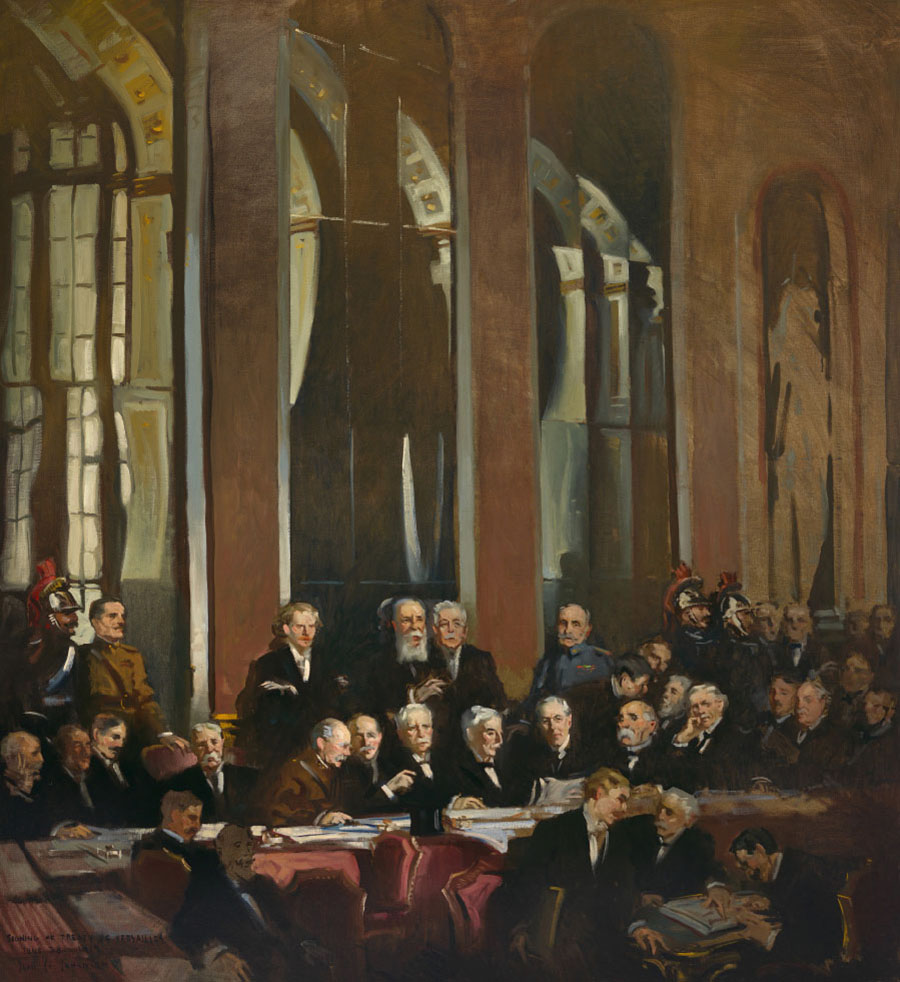
In January 1919, the leaders of the major Allied powers (except Russia) met outside Paris at Versailles to negotiate the treaty formally ending the war (Figure 12.4). Committees were assigned to resolve the many issues concerning not only Europe but also the Middle East, Africa, and Asia. The conference lasted about a year. In its finished form, the Treaty of Versailles was actually a series of treaties, a “[Quotation omitted for rights reasons.]”
英語のヒント
1919年1月、ロシアを除く主要連合国の指導者たちは、戦争を正式に終結させる条約を交渉するため、パリ郊外のヴェルサイユに集まった(図12.4)。ヨーロッパだけでなく、中東、アフリカ、アジアに関わる多くの問題を解決するため、各委員会に任務が割り当てられた。会議は約1年間続いた。完成したヴェルサイユ条約は、実際には一連の条約から成り、次のように表現されている。「〔権利の関係で割愛〕」
Treaty of Versailles.ヴェルサイユ条約
(credit: “Signing of the Treaty of Versailles, 1919” by National Portrait Gallery/Smithsonian Institution; transfer from the Smithsonian American Art Museum; gift of an anonymous donor, 1926, CC0) · CC0
Figure 12.4 This large 1919 painting by John Christen Johansen is called Signing of the Treaty of Versailles, 1919. U.S. president Woodrow Wilson is shown seated near the center of the group, holding some papers in his hand. (credit: “Signing of the Treaty of Versailles, 1919” by National Portrait Gallery/Smithsonian Institution; transfer from the Smithsonian American Art Museum; gift of an anonymous donor, 1926, CC0)
図12.4 ジョン・クリステン・ヨハンセンが1919年に描いたこの大きな絵は、『ヴェルサイユ条約の調印、1919年』と題されている。集団の中央近くに座り、手に書類を持つ人物が、アメリカ大統領ウッドロウ・ウィルソンである。(出典:National Portrait Gallery/Smithsonian Institution「Signing of the Treaty of Versailles, 1919」。スミソニアン・アメリカ美術館から移管、匿名の寄贈者による寄贈、1926年。CC0)
President Woodrow Wilson arrived in Paris in 1919 to grand parades and a hero’s welcome. In January 1918, he had already published a plan he hoped would be the basis of the treaty—the Fourteen Points—embodying his wish to prevent future war by solving issues he believed had led to the recent conflict. Among these points were the rights of neutral nations, freedom of the seas, and the need to break up the empires that had caused the war and create new sovereign states in Europe. Wilson’s last point proposed a League of Nations where member nations could come together for mutual security and work out problems without resorting to war.
英語のヒント
ウッドロウ・ウィルソン大統領が1919年にパリへ到着すると、盛大なパレードと英雄を迎えるような歓迎を受けた。彼はすでに1918年1月、「十四か条の平和原則」という構想を発表していた。条約の土台になることを期待したこの構想には、先の戦争につながったと彼が考える問題を解決することで、将来の戦争を防ぎたいという願いが込められていた。そこでは、中立国の権利、海洋の自由、戦争を引き起こした帝国を解体してヨーロッパに新たな主権国家をつくる必要性などが掲げられた。最後の原則でウィルソンは、加盟国が互いの安全のために集まり、戦争に訴えることなく問題を解決できる国際連盟を提案した。
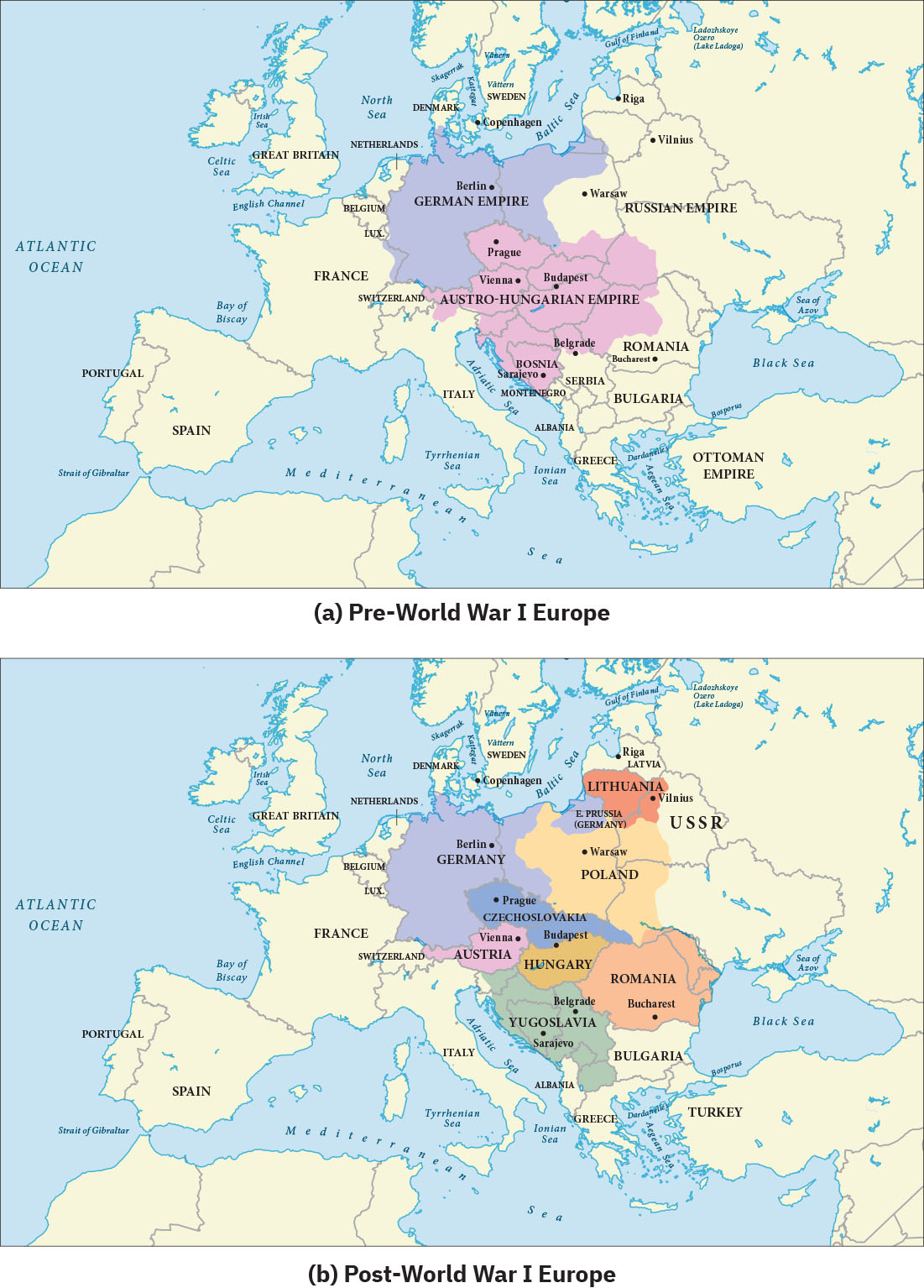
Wilson also strongly advocated self-determination, the idea that each ethnic group should have its own government. The treaty ushered in a major redrawing of Europe, and new countries flooded onto the map. Their borders were drawn by diplomats in Paris, however, and did not always reflect where people of different nationalities lived. Nor could they. In an already diverse empire such as Austria-Hungary, people of different backgrounds lived side by side, so it was no easy feat to draw a border. In some cases, the treaty grouped people in ways that may not have made sense to them. For example, the new country of Czechoslovakia was predominantly composed of Czechs and Slovaks, who did not see themselves as having similar nationalities.
英語のヒント
ウィルソンは民族自決も強く主張した。各民族集団が自らの政府を持つべきだという考えである。条約によってヨーロッパの地図は大きく描き変えられ、新しい国々が地図に次々と現れた。しかし国境を引いたのはパリにいる外交官たちであり、さまざまな民族の人々がどこに暮らしているかを、必ずしも反映していなかった。そもそも、完全に反映させることはできなかった。オーストリア=ハンガリーのようにすでに多様な帝国では、異なる背景をもつ人々が隣り合って暮らしていたため、国境を引くのは容易な仕事ではなかった。条約は、人々自身には納得しがたい方法で集団を一つにまとめることもあった。たとえば新国家チェコスロヴァキアは、主にチェコ人とスロヴァキア人から成っていたが、両者は自分たちを似通った民族だとはみなしていなかった。
Poland resurfaced after having been partitioned out of existence in the late 1700s. A new Polish nation was carved from territory on the German Empire’s eastern side and land Russia had relinquished under the 1918 Treaty of Brest-Litovsk ending its involvement in the war. The German-speaking country of Austria became an independent nation, as did Hungary. The area of the Balkans, the site of so much uncertainty and nationalism prior to the war, received a particularly unfavorable decision regarding self-determination. The Serbs, Croats, Bosnians, Montenegrins, and other Slavic groups there viewed themselves as separate nationalities, yet all were assembled in a single country, to be called Yugoslavia or “land of the Southern Slavs.” Yugoslavia was simply a diplomatic creation, and it did not survive the century (Figure 12.5).
英語のヒント
ポーランドは、18世紀末の分割によって国として消滅していたが、再び姿を現した。新しいポーランド国家は、ドイツ帝国東部の領土と、ロシアが1918年のブレスト=リトフスク条約で手放した土地からつくられた。この条約によって、ロシアは戦争への関与を終えていた。ドイツ語を話すオーストリアは独立国家となり、ハンガリーも同様だった。戦前に大きな不安定さと民族主義を抱えていたバルカン地域では、民族自決にとってとりわけ不利な決定が下された。セルビア人、クロアティア人、ボスニア人、モンテネグロ人、その他のスラヴ系集団は、それぞれ別個の民族だと自認していた。それにもかかわらず、一つの国にまとめられた。その国は、ユーゴスラヴィア、すなわち「南スラヴ人の国」と呼ばれることになる。ユーゴスラヴィアは外交によってつくられた国家であり、その世紀を生き延びることはできなかった(図12.5)。
Redrawing Europe.ヨーロッパの国境の引き直し
(attribution: Copyright Rice University, OpenStax, under CC BY 4.0 license) · CC BY 4.0
Figure 12.5 These maps show Europe (a) before and (b) after World War I. Notice the postwar proliferation of new countries created by the Treaty of Versailles. (attribution: Copyright Rice University, OpenStax, under CC BY 4.0 license)
図12.5 この地図は、第一次世界大戦(a)前と(b)後のヨーロッパを示す。戦後、ヴェルサイユ条約によって多数の新しい国が生まれたことに注目しよう。(帰属表示:著作権者 Rice University、OpenStax。CC BY 4.0)
Other provisions of the treaty were designed to weaken Germany. Great Britain and France were intent on punishing Germany for backing Austria-Hungary in 1914 and enlarging the conflict by invading Belgium and France. They did not want Germany to simply be blamed for the war; they wanted Germany to literally pay for it, so they began a painstaking financial accounting. Every destroyed house or building was assigned a monetary value. Every lost military and civilian life was assessed an amount based on what that person’s future earnings might have been. These reparations totaled over $30 billion in 1919 dollars. (For context, a loaf of bread cost about 9 cents at the time.) Wilson hoped to persuade the other Allied leaders to abandon this course but was unable to, and the treaty reflected their goal of revenge.
英語のヒント
条約のほかの規定は、ドイツを弱体化させるためのものだった。イギリスとフランスは、ドイツが1914年にオーストリア=ハンガリーを支援し、ベルギーとフランスへの侵攻によって紛争を拡大したことを罰しようと強く決意していた。単に戦争の責任をドイツに負わせるだけでは足りなかった。文字どおり戦争の代償を支払わせようと、綿密な金銭上の算定を始めた。破壊された家屋や建物には、一つひとつ金額が付けられた。失われた軍人と民間人の生命にも、その人が将来得たはずの収入に基づいて金額が算定された。こうした賠償金は、1919年のドル換算で総額300億ドルを超えた。参考までに、当時のパン1斤の値段は約9セントだった。ウィルソンは、ほかの連合国指導者を説得してこの方針をやめさせようとしたが、できなかった。その結果、条約には彼らの復讐の意図が反映された。
One of the clearest punishments the treaty inflicted on Germany was restrictions on its military capacity. The German Army was limited to 100,000 troops, the draft was ended, and the number of ships, planes, tanks, and submarines was similarly curtailed. The Allied powers hoped that limiting the might of the German Army would limit its aggressiveness. The method of enforcing these limits was not resolved in Paris, however, and it arose as a real issue in the 1930s.
英語のヒント
条約がドイツに科した最も明確な懲罰の一つが、軍事力の制限だった。ドイツ陸軍の兵員は10万人に制限され、徴兵制は廃止された。艦船、航空機、戦車、潜水艦の数も同様に削減された。連合国は、ドイツ陸軍の力を制限すれば、その侵略性も抑えられると期待した。しかしパリでは、こうした制限をどう実施させるかという問題が解決されず、1930年代には現実の重大問題となった。
Germany was also shrunk, losing 13 percent of the territory it had held in Europe before the war. The Saar region was to be administered by the League of Nations. The Rhineland in the west (the Rhine River Valley) became a demilitarized zone. Germany also lost western territory to both France (Alsace-Lorraine, previously seized by Germany) and Belgium. In the east, German lands and the port of Danzig (now Gdańsk) were given to Poland. Other lands went to Lithuania and the new country of Czechoslovakia. As a result, Germany lost about one-tenth of its population, approximately 6.5 million people. It also had to give up its colonies in Asia and Africa.
英語のヒント
ドイツの領土も縮小され、戦前にヨーロッパで保有していた領土の13パーセントを失った。ザール地方は国際連盟の管理下に置かれることになり、西部のラインラント、すなわちライン川流域は非武装地帯となった。西方では、かつてドイツが奪ったアルザス=ロレーヌをフランスに返還し、ベルギーにも領土を譲った。東方では、ドイツの土地とダンツィヒ港、現在のグダニスクがポーランドに与えられた。ほかの領土はリトアニアと新国家チェコスロヴァキアに渡った。その結果、ドイツは人口の約10分の1、およそ650万人を失った。さらに、アジアとアフリカの植民地も手放さなければならなかった。
One provision of the treaty related directly to Japan and China. Japan had occupied China’s Shandong Province, a former German concession, including the port of Qingdao (Tsingtao), and continued to hold it after the war. Without consulting the millions of Chinese people living there at the time, the treaty makers allowed Japan to retain this territory, which it did until 1922.
英語のヒント
条約の一つの規定は、日本と中国に直接関係していた。日本は、青島〈チンタオ〉港を含む中国の山東省にあった旧ドイツ租借地を占領し、戦後も保持していた。条約を作成した人々は、当時そこに暮らしていた何百万人もの中国人に意見を聞かず、日本がこの領土を保持することを認めた。日本は1922年までこれを保持した。
The racism of the era was apparent in what was not included in the treaty. Japan had requested a clause affirming the equality of all nations regardless of race. This proviso would have set the stage for more open migration and fairer treatment of immigrants (such as Japanese immigrants to the United States). Several powers supported its inclusion, but Australia (which allowed no non-White immigration) and then the United States stated their opposition. Wilson claimed a unanimous vote was necessary to include it, though this was not true for any other clause. In the end, the racial equality clause was absent from the final version of the treaty. As another example, when France and Britain tallied the destruction of the war, they did not include African lives lost in the fighting in Africa. The cost of the devastation there was borne solely by Africans.
英語のヒント
この時代の人種差別は、条約に何が盛り込まれなかったかにも現れていた。日本は、人種にかかわらずすべての国の平等を確認する条項を求めた。この条項が採用されれば、移住の制限を緩め、アメリカ合衆国への日本人移民などをより公平に扱うための土台となったはずだった。いくつかの国は条項の採用を支持したが、非白人の移民を認めていなかったオーストラリアが反対し、その後アメリカ合衆国も反対を表明した。ウィルソンは、採用には全会一致が必要だと主張したが、ほかのどの条項にもそのような条件は課されていなかった。結局、人種平等条項は最終的な条約に入らなかった。別の例として、フランスとイギリスは戦争被害を集計する際、アフリカでの戦闘によって失われたアフリカ人の生命を含めなかった。そこで生じた荒廃の代償は、アフリカ人だけが負担した。
It was clear that a significant period of adjustment must follow the treaty’s signing as the peoples of the new regions and their fledgling governments established themselves. There was also disappointment. For instance, in 1915, Italy had been promised territory in Dalmatia in return for joining the Allied cause but was forced to relinquish it due to Wilson’s opposition. This prompted anger in Italy and some anti-American rallies. France was annoyed that it had received only part of Germany’s African colonies of Cameroon and Togo while the rest went to Britain. Japan, besides being angered at the rejection of the racial equality clause, was disappointed that it had not been given all of Germany’s colonial holdings in Asia and the Pacific. It received only some, while others went to New Zealand and Australia. Internal ethnic issues had not been fully solved by the treaty (such as in the creation of Czechoslovakia) and could easily resurface given the chance.
英語のヒント
新しく生まれた地域の人々と発足したばかりの政府が基盤を築くなかで、条約調印後には相当の調整期間が必要になることは明らかだった。失望も生じた。たとえばイタリアは1915年、連合国側で参戦する見返りにダルマティアの領土を約束されていたが、ウィルソンの反対によって、それを断念させられた。これがイタリアで怒りを引き起こし、反米集会も開かれた。フランスは、ドイツのアフリカ植民地だったカメルーンとトーゴの一部しか受け取れず、残りがイギリスに渡ったことに不満を抱いた。日本も、人種平等条項の否決に怒っただけでなく、ドイツがアジアと太平洋に持っていた植民地をすべて得られなかったことに失望した。日本が受け取ったのは一部で、ほかはニュージーランドとオーストラリアに渡った。チェコスロヴァキアの建国に見られるように、国内の民族問題は条約によって完全には解決しておらず、機会があれば容易に再燃し得た。
The “war guilt” clause of the treaty, blaming Germany for the war, caused many problems for that country over the next decades. Its diplomats felt dishonored by being forced to agree to it, and the harsh monetary reparations left Germany unstable for several years. The government’s decision to print more money to pay these debts caused hyperinflation and made its politicians look incompetent. It was easy for rumors of conspiracy to take hold, particularly among war veterans. The “stab-in-the-back” theory, for example, claimed that German democratic politicians had betrayed the military with the 1918 cease-fire agreement. (In truth, the German military had reached its breaking point in 1918 and was not in a position to continue the war, especially given the continuous arrival of fresh U.S. troops.)
英語のヒント
戦争の責任をドイツに負わせる条約の「戦争責任」条項は、その後数十年にわたってドイツに多くの問題を生んだ。外交官たちは同意を強制されたことを屈辱と感じ、厳しい金銭賠償はドイツを何年も不安定な状態に置いた。債務を支払うために通貨を増刷するという政府の決定は、ハイパーインフレを引き起こし、政治家たちを無能に見せた。とりわけ従軍経験者の間では、陰謀のうわさが根付きやすかった。たとえば「背後からの一突き」という説は、ドイツの民主主義の政治家が1918年の休戦協定によって軍を裏切ったと主張した。しかし実際には、ドイツ軍は1918年にすでに限界に達しており、新たなアメリカ軍部隊が絶えず到着していたこともあって、戦争を続けられる状態ではなかった。
The U.S. Senate’s biggest worry about the Treaty of Versailles was that if the United States joined the League of Nations, its troops could be sent anywhere in the world, drawing the nation into foreign disputes that the Senate, then dominated by the Republican Party, wanted to avoid. Senators feared the treaty would thus cost them their constitutional power to declare war. They also objected to Britain and France’s desire to control the League. For these reasons, the United States did not approve the treaty and did not join the League of Nations. The organization's ability to mediate and resolve international disputes was weakened by the lack of U.S. participation.
英語のヒント
ヴェルサイユ条約に対するアメリカ上院の最大の懸念は、国際連盟に加盟すると、アメリカ軍が世界のどこへでも派遣され得ることだった。それによって、当時共和党が優勢だった上院が避けたいと考える、外国の紛争にアメリカが巻き込まれかねなかった。上院議員たちは、その結果、憲法が自分たちに与えている宣戦布告の権限を条約によって失うのではないかと恐れた。国際連盟を主導しようとするイギリスとフランスの意向にも反対した。こうした理由から、アメリカ合衆国は条約を承認せず、国際連盟にも加盟しなかった。アメリカが参加しなかったことによって、国際紛争を仲介し、解決する国際連盟の能力は弱まった。