第3章微分
3.9 Derivatives of Exponential and Logarithmic Functions3.9 指数関数と対数関数の微分
Learning Objectives学習目標
- Find the derivative of exponential functions.指数関数の導関数を求める。
- Find the derivative of logarithmic functions.対数関数の導関数を求める。
- Use logarithmic differentiation to determine the derivative of a function.対数微分法を使って関数の導関数を求める。
So far, we have learned how to differentiate a variety of functions, including trigonometric, inverse, and implicit functions. In this section, we explore derivatives of exponential and logarithmic functions. As we discussed in Introduction to Functions and Graphs, exponential functions play an important role in modeling population growth and the decay of radioactive materials. Logarithmic functions can help rescale large quantities and are particularly helpful for rewriting complicated expressions.
英語のヒント
これまでに、三角関数・逆関数・陰関数など、さまざまな関数の微分法を学んだ。この節では、指数関数と対数関数の導関数を調べる。「関数とグラフ入門」で学んだように、指数関数は人口の増加や放射性物質の減衰のモデル化で重要な役割を果たす。対数関数は、大きな量の尺度を変えたり、複雑な式を書き換えたりするのに役立つ。
Derivative of the Exponential Function指数関数の導関数
Just as when we found the derivatives of other functions, we can find the derivatives of exponential and logarithmic functions using formulas. As we develop these formulas, we need to make certain basic assumptions. The proofs that these assumptions hold are beyond the scope of this course.
英語のヒント
ほかの関数と同じように、指数関数と対数関数も公式を使って微分できる。その公式を導くにあたり、いくつかの基本的な仮定を置く必要がある。これらの仮定が成り立つことの証明は、この科目の範囲を超える。
First of all, we begin with the assumption that the function is defined for every real number and is continuous. In previous courses, the values of exponential functions for all rational numbers were defined—beginning with the definition of where is a positive integer—as the product of multiplied by itself times. Later, we defined for a positive integer and for positive integers and These definitions leave open the question of the value of where is an arbitrary real number. By assuming the continuity of we may interpret as where the values of as we take the limit are rational. For example, we may view as the number satisfying
英語のヒント
まず、関数がすべての実数で定義され、連続であると仮定する。以前の学習では、を正の整数として、をを回掛けた積と定義するところから始め、有理数の指数に対する値を定めた。その後、正の整数に対してを定義し、正の整数、に対してを定義した。これだけでは、が任意の実数の場合のの値は、まだ決まらない。の連続性を仮定すれば、をと解釈できる。この極限では、を有理数の範囲で近づける。例えば、を次の関係を満たす数と考えられる。
As we see in the following table,
次の表から、とわかる。
64 |
77.8802710486 |
||
73.5166947198 |
77.8810268071 |
||
77.7084726013 |
77.9242251944 |
||
77.8162741237 |
78.7932424541 |
||
77.8702309526 |
84.4485062895 |
||
77.8799471543 |
256 |
We also assume that for the value of the derivative exists. In this section, we show that by making this one additional assumption, it is possible to prove that the function is differentiable everywhere.
英語のヒント
また、について、微分係数が存在すると仮定する。この仮定を1つ加えるだけで、関数がいたるところ微分可能であると証明できることを、この節で示す。
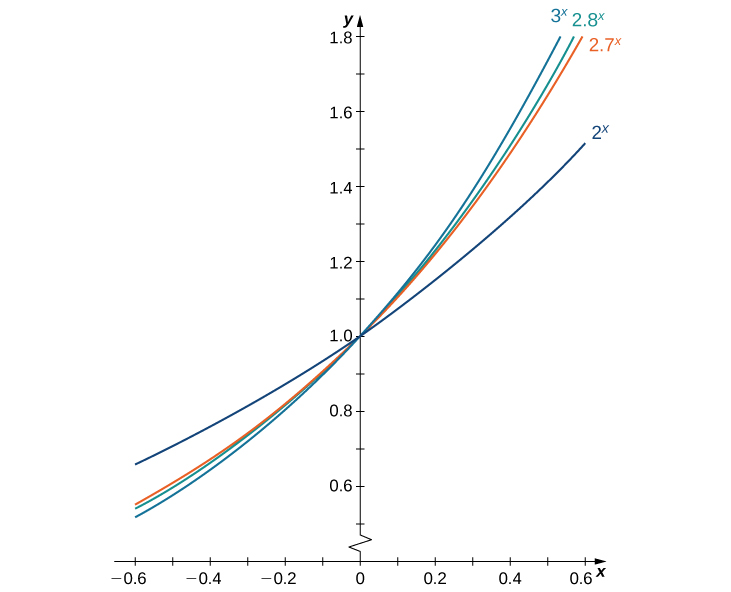
We make one final assumption: that there is a unique value of for which We define to be this unique value, as we did in Introduction to Functions and Graphs. Figure 3.33 provides graphs of the functions and A visual estimate of the slopes of the tangent lines to these functions at 0 provides evidence that the value of e lies somewhere between 2.7 and 2.8. The function is called the natural exponential function. Its inverse, is called the natural logarithmic function.
英語のヒント
OpenStax, Rice University; Calculus Volume 1. · CC BY-NC-SA 4.0
Figure 3.33図 3.33
The graph of is between and
のグラフは、との間にある。
For a better estimate of we may construct a table of estimates of for functions of the form Before doing this, recall that
をより正確に推定するため、という形の関数について、の推定値を表にまとめる。その前に、次の近似を思い出そう。
for values of very close to zero. For our estimates, we choose and to obtain the estimate
これはが0に十分近いときの近似である。ここではとを選び、次のように見積もる。
See the following table.
次の表を見よう。
The evidence from the table suggests that
表の値から、と推測できる。
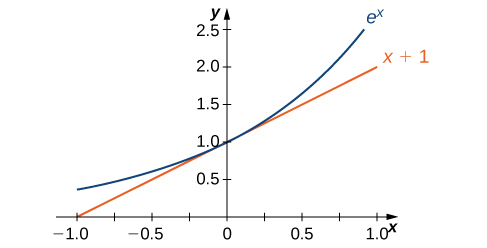
The graph of together with the line are shown in Figure 3.34. This line is tangent to the graph of at
図3.34に、と直線を示す。この直線は、におけるの接線である。
OpenStax, Rice University; Calculus Volume 1. · CC BY-NC-SA 4.0
Figure 3.34図 3.34
The tangent line to at has slope 1.
におけるの接線の傾きは1である。
Now that we have laid out our basic assumptions, we begin our investigation by exploring the derivative of Recall that we have assumed that exists. By applying the limit definition to the derivative we conclude that
英語のヒント
基本的な仮定を明示したので、の導関数を調べよう。の存在を仮定していることを思い出す。極限による導関数の定義から、次が成り立つ。
Turning to we obtain the following.
次にを考えると、次のようになる。
We see that on the basis of the assumption that is differentiable at is not only differentiable everywhere, but its derivative is
が0で微分可能という仮定から、はいたるところ微分可能であるだけでなく、導関数が次式で与えられるとわかる。
For Thus, we have (The value of for an arbitrary function of the form will be derived later.)
自然指数関数ではである。したがって、となる。一般のについてのの値は、このあとで導く。
Example 3.74例題 3.74
Derivative of an Exponential Function指数関数の導関数を求める
Find the derivative of
の導関数を求めなさい。
Solution解き方
Using the derivative formula and the chain rule,
微分公式と連鎖律を使うと、
Example 3.75例題 3.75
Combining Differentiation Rules微分の法則を組み合わせる
Find the derivative of
の導関数を求めなさい。
Solution解き方
Use the derivative of the natural exponential function, the quotient rule, and the chain rule.
自然指数関数の微分公式、商の微分法、連鎖律を使う。
Example 3.76例題 3.76
Applying the Natural Exponential Function自然指数関数の応用
A colony of mosquitoes has an initial population of 1000. After days, the population is given by Show that the ratio of the rate of change of the population, to the population, is constant.
ある蚊の集団の最初の個体数は1000匹である。日後の個体数は、で与えられる。個体数の変化率と個体数の比が一定であることを示しなさい。
Solution解き方
First find By using the chain rule, we have Thus, the ratio of the rate of change of the population to the population is given by
まずを求める。連鎖律よりである。よって、個体数の変化率と個体数の比は、
The ratio of the rate of change of the population to the population is the constant 0.3.
個体数の変化率と個体数の比は、一定値0.3である。