The Quotient Rule 商の微分法 Having developed and practiced the product rule, we now consider differentiating quotients of functions. As we see in the following theorem, the derivative of the quotient is not the quotient of the derivatives; rather, it is the derivative of the function in the numerator times the function in the denominator minus the derivative of the function in the denominator times the function in the numerator, all divided by the square of the function in the denominator. In order to better grasp why we cannot simply take the quotient of the derivatives, keep in mind that
英語のヒント 積の微分法を導いて練習したので、次は関数の商を微分しよう。次の定理で見るように、商の導関数は、導関数どうしの商にはならない。 正しくは、「分子の関数の導関数×分母の関数」から「分母の関数の導関数×分子の関数」を引き、全体を分母の関数の2乗で割る。単に導関数どうしを割るだけではいけない理由を理解するため、次のことを思い出そう。
d d x ( x 2 ) = 2 x , not d d x ( x 3 ) d d x ( x ) = 3 x 2 1 = 3 x 2 .
d d x ( x 2 ) = 2 x , でない d d x ( x 3 ) d d x ( x ) = 3 x 2 1 = 3 x 2
The proof of the quotient rule is very similar to the proof of the product rule, so it is omitted here. Instead, we apply this new rule for finding derivatives in the next example.
商の微分法の証明は、積の微分法の証明とよく似ているので、ここでは省略する。次の例題で、この新しい微分法を使ってみよう。
Example 3.25 例題 3.25
Applying the Quotient Rule 商の微分法を使う Use the quotient rule to find the derivative of k ( x ) = 5 x 2 4 x + 3 .
商の微分法を使って、k ( x ) = 5 x 2 4 x + 3
Solution 解き方
Let f ( x ) = 5 x 2 g ( x ) = 4 x + 3 . f ′ ( x ) = 10 x g ′ ( x ) = 4 .
f ( x ) = 5 x 2 g ( x ) = 4 x + 3 f ′ ( x ) = 10 x g ′ ( x ) = 4
k ′ ( x ) = f ′ ( x ) g ( x ) − g ′ ( x ) f ( x ) ( g ( x ) ) 2 = 10 x ( 4 x + 3 ) − 4 ( 5 x 2 ) ( 4 x + 3 ) 2 .
k ′ ( x ) = f ′ ( x ) g ( x ) − g ′ ( x ) f ( x ) ( g ( x ) ) 2 = 10 x ( 4 x + 3 ) − 4 ( 5 x 2 ) ( 4 x + 3 ) 2
Simplifying, we obtain
整理すると、
k ′ ( x ) = 20 x 2 + 30 x ( 4 x + 3 ) 2 .
k ′ ( x ) = 20 x 2 + 30 x ( 4 x + 3 ) 2
Checkpoint 3.17 確認問題 3.17
Find the derivative of h ( x ) = 3 x + 1 4 x − 3 .
h ( x ) = 3 x + 1 4 x − 3
Solution 解き方
k ′ ( x ) = − 13 ( 4 x − 3 ) 2 .
k ′ ( x ) = − 13 ( 4 x − 3 ) 2
It is now possible to use the quotient rule to extend the power rule to find derivatives of functions of the form x k k
商の微分法を使えば、k x k
Proof 証明 If k n = − k , n is a positive integer with k = − n . n , x − n = 1 x n , f ( x ) = 1 g ( x ) = x n . f ′ ( x ) = 0 g ′ ( x ) = n x n − 1 .
k n = − k k = − n n , x − n = 1 x n f ( x ) = 1 g ( x ) = x n f ′ ( x ) = 0 g ′ ( x ) = n x n − 1
d d x ( x − n ) = 0 ( x n ) − 1 ( n x n − 1 ) ( x n ) 2 .
d d x ( x − n ) = 0 ( x n ) − 1 ( n x n − 1 ) ( x n ) 2
Simplifying, we see that
整理すると、
d d x ( x − n ) = − n x n − 1 x 2 n = − n x ( n − 1 ) − 2 n = − n x − n − 1 .
d d x ( x − n ) = − n x n − 1 x 2 n = − n x ( n − 1 ) − 2 n = − n x − n − 1
Finally, observe that since k = − n ,
最後にk = − n
d d x ( x k ) = k x k − 1 .
d d x ( x k ) = k x k − 1
Example 3.26 例題 3.26
Using the Extended Power Rule 拡張したべき関数の微分法を使う Find d d x ( x −4 ) .
d d x ( x −4 )
Solution 解き方
By applying the extended power rule with k = −4 ,
k = −4
d d x ( x −4 ) = −4 x −4 − 1 = −4 x −5 .
d d x ( x −4 ) = −4 x −4 − 1 = −4 x −5
Example 3.27 例題 3.27
Using the Extended Power Rule and the Constant Multiple Rule 拡張したべき関数の微分法と定数倍の微分法 Use the extended power rule and the constant multiple rule to find the derivative of f ( x ) = 6 x 2 .
拡張したべき関数の微分法と定数倍の微分法を使って、f ( x ) = 6 x 2
Solution 解き方
It may seem tempting to use the quotient rule to find this derivative, and it would certainly not be incorrect to do so. However, it is far easier to differentiate this function by first rewriting it as f ( x ) = 6 x −2 .
商の微分法を使いたくなるかもしれないし、それでも間違いではない。しかし、まずf ( x ) = 6 x −2
f ′ ( x ) = d d x ( 6 x 2 ) = d d x ( 6 x −2 ) Rewrite 6 x 2 as 6 x −2 . = 6 d d x ( x −2 ) Apply the constant multiple rule. = 6 ( −2 x −3 ) Use the extended power rule to differentiate x −2 . = −12 x −3 Simplify.
f ′ ( x ) = d d x ( 6 x 2 ) = d d x ( 6 x −2 ) 6/x²を6x⁻²に書き換える。 = 6 d d x ( x −2 ) 定数倍の微分法を用いる。 = 6 ( −2 x −3 ) 拡張したべき関数の微分法を用いる式: x −2 . = −12 x −3 整理する。
Checkpoint 3.18 確認問題 3.18
Find the derivative of g ( x ) = 1 x 7
拡張したべき関数の微分法を使い、g ( x ) = 1 x 7
Combining Differentiation Rules 微分の法則を組み合わせる As we have seen throughout the examples in this section, it seldom happens that we are called on to apply just one differentiation rule to find the derivative of a given function. At this point, by combining the differentiation rules, we may find the derivatives of any polynomial or rational function. Later on we will encounter more complex combinations of differentiation rules. A good rule of thumb to use when applying several rules is to apply the rules in reverse of the order in which we would evaluate the function.
英語のヒント この節の例題で見てきたように、与えられた関数の導関数を求めるのに、微分の法則を1つしか使わないことはめったにない。ここまでに学んだ法則を組み合わせれば、どの多項式関数や有理関数でも導関数を求められる。 この先では、さらに複雑な法則の組み合わせも扱う。複数の法則を使うときの有効な目安は、関数の値を計算するときとは逆の順序で法則を適用することである。
Example 3.28 例題 3.28
Combining Differentiation Rules 微分の法則を組み合わせる For k ( x ) = 3 h ( x ) + x 2 g ( x ) , k ′ ( x ) .
k ( x ) = 3 h ( x ) + x 2 g ( x ) k ′ ( x )
Solution 解き方
Finding this derivative requires the sum rule, the constant multiple rule, and the product rule.
この導関数を求めるには、和・定数倍・積の微分法が必要である。
k ′ ( x ) = d d x ( 3 h ( x ) + x 2 g ( x ) ) = d d x ( 3 h ( x ) ) + d d x ( x 2 g ( x ) ) Apply the sum rule. = 3 d d x ( h ( x ) ) + ( d d x ( x 2 ) g ( x ) + d d x ( g ( x ) ) x 2 ) Apply the constant multiple rule to differentiate 3 h ( x ) and the product rule to differentiate x 2 g ( x ) . = 3 h ' ( x ) + 2 x g ( x ) + x 2 g ' ( x )
k ′ ( x ) = d d x ( 3 h ( x ) + x 2 g ( x ) ) = d d x ( 3 h ( x ) ) + d d x ( x 2 g ( x ) ) 和の微分法を用いる。 = 3 d d x ( h ( x ) ) + ( d d x ( x 2 ) g ( x ) + d d x ( g ( x ) ) x 2 ) 3h(x)に定数倍の微分法、 x²g(x)に積の微分法を使う。 = 3 h ' ( x ) + 2 x g ( x ) + x 2 g ' ( x )
Example 3.29 例題 3.29
Extending the Product Rule 積の微分法を拡張する For k ( x ) = f ( x ) g ( x ) h ( x ) , k ′ ( x ) f ( x ) , g ( x ) , h ( x ) ,
k ( x ) = f ( x ) g ( x ) h ( x ) k ′ ( x ) f ( x ) , g ( x ) , h ( x )
Solution 解き方
We can think of the function k ( x ) f ( x ) g ( x ) h ( x ) . k ( x ) = ( f ( x ) g ( x ) ) · h ( x ) .
関数k ( x ) f ( x ) g ( x ) h ( x ) k ( x ) = ( f ( x ) g ( x ) ) · h ( x )
k ′ ( x ) = d d x ( f ( x ) g ( x ) ) · h ( x ) + d d x ( h ( x ) ) · ( f ( x ) g ( x ) ) Apply the product rule to the product of f ( x ) g ( x ) and h ( x ) . = ( f ′ ( x ) g ( x ) + g ′ ( x ) f ( x ) ) h ( x ) + h ′ ( x ) f ( x ) g ( x ) Apply the product rule to f ( x ) g ( x ) . = f ′ ( x ) g ( x ) h ( x ) + f ( x ) g ′ ( x ) h ( x ) + f ( x ) g ( x ) h ′ ( x ). Simplify.
k ′ ( x ) = d d x ( f ( x ) g ( x ) ) · h ( x ) + d d x ( h ( x ) ) · ( f ( x ) g ( x ) ) f(x)g(x)とh(x)の積に、 積の微分法を使う。 = ( f ′ ( x ) g ( x ) + g ′ ( x ) f ( x ) ) h ( x ) + h ′ ( x ) f ( x ) g ( x ) 積の微分法を用いる式: f ( x ) g ( x ) . = f ′ ( x ) g ( x ) h ( x ) + f ( x ) g ′ ( x ) h ( x ) + f ( x ) g ( x ) h ′ ( x ). 整理する。
Example 3.30 例題 3.30
Combining the Quotient Rule and the Product Rule 商の微分法と積の微分法を組み合わせる For h ( x ) = 2 x 3 k ( x ) 3 x + 2 , h ′ ( x ) .
h ( x ) = 2 x 3 k ( x ) 3 x + 2 h ′ ( x )
Solution 解き方
This procedure is typical for finding the derivative of a rational function.
これは、有理関数の導関数を求めるときの典型的な手順である。
h ' ( x ) = d d x ( 2 x 3 k ( x ) ) · ( 3 x + 2 ) − d d x ( 3 x + 2 ) · ( 2 x 3 k ( x ) ) ( 3 x + 2 ) 2 Apply the quotient rule. = ( 6 x 2 k ( x ) + k ' ( x ) · 2 x 3 ) ( 3 x + 2 ) − 3 ( 2 x 3 k ( x ) ) ( 3 x + 2 ) 2 Apply the product rule to find d d x ( 2 x 3 k ( x ) ) . Use d d x ( 3 x + 2 ) = 3 . = −6 x 3 k ( x ) + 18 x 3 k ( x ) + 12 x 2 k ( x ) + 6 x 4 k ' ( x ) + 4 x 3 k ' ( x ) ( 3 x + 2 ) 2 Simplify. = 12 k x x 3 + x 2 + 2 k ' x 3 x 4 + 2 x 3 3 x + 2 2
h ' ( x ) = d d x ( 2 x 3 k ( x ) ) · ( 3 x + 2 ) − d d x ( 3 x + 2 ) · ( 2 x 3 k ( x ) ) ( 3 x + 2 ) 2 商の微分法を用いる。 = ( 6 x 2 k ( x ) + k ' ( x ) · 2 x 3 ) ( 3 x + 2 ) − 3 ( 2 x 3 k ( x ) ) ( 3 x + 2 ) 2 積の微分法で求めるもの: d d x ( 2 x 3 k ( x ) ) . 用いる関係: d d x ( 3 x + 2 ) = 3 . = −6 x 3 k ( x ) + 18 x 3 k ( x ) + 12 x 2 k ( x ) + 6 x 4 k ' ( x ) + 4 x 3 k ' ( x ) ( 3 x + 2 ) 2 整理する。 = 12 k x x 3 + x 2 + 2 k ' x 3 x 4 + 2 x 3 3 x + 2 2
Checkpoint 3.19 確認問題 3.19
Find d d x ( 3 f ( x ) − 2 g ( x ) ) .
d d x ( 3 f ( x ) − 2 g ( x ) )
Solution 解き方
3 f ′ ( x ) − 2 g ′ ( x ) .
3 f ′ ( x ) − 2 g ′ ( x )
Example 3.31 例題 3.31
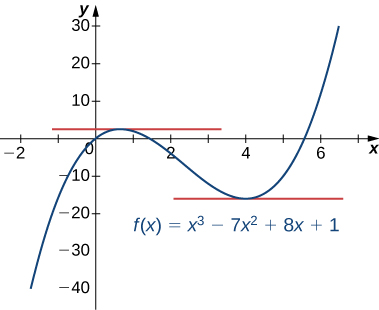
Determining Where a Function Has a Horizontal Tangent 接線が水平になる点を求める Determine the values of x f ( x ) = x 3 − 7 x 2 + 8 x + 1
f ( x ) = x 3 − 7 x 2 + 8 x + 1 x
Solution 解き方
To find the values of x f ( x ) f ′ ( x ) = 0 .
f ( x ) x f ′ ( x ) = 0
f ′ ( x ) = 3 x 2 − 14 x + 8 = ( 3 x − 2 ) ( x − 4 ) ,
f ′ ( x ) = 3 x 2 − 14 x + 8 = ( 3 x − 2 ) ( x − 4 )
we must solve ( 3 x − 2 ) ( x − 4 ) = 0 . x = 2 3 x = 4
したがって( 3 x − 2 ) ( x − 4 ) = 0 x = 2 3 x = 4
Figure 3.19 図 3.19
This function has horizontal tangent lines at x = 2/3 and x = 4.
この関数は、x=2/3とx=4で水平な接線を持つ。
Example 3.32 例題 3.32
Finding a Velocity 速度を求める The position of an object on a coordinate axis at time t s ( t ) = t t 2 + 1 .
時刻t s ( t ) = t t 2 + 1
Solution 解き方
Since the initial velocity is v ( 0 ) = s ′ ( 0 ) , s ′ ( t )
初速度はv ( 0 ) = s ′ ( 0 ) s ′ ( t )
s ′ ( t ) = 1 ( t 2 + 1 ) − 2 t ( t ) ( t 2 + 1 ) 2 = 1 − t 2 ( t 2 + 1 ) 2 .
s ′ ( t ) = 1 ( t 2 + 1 ) − 2 t ( t ) ( t 2 + 1 ) 2 = 1 − t 2 ( t 2 + 1 ) 2
After evaluating, we see that v ( 0 ) = 1 .
値を代入して計算すると、v ( 0 ) = 1
Checkpoint 3.20 確認問題 3.20
Find the values of x f ( x ) = 4 x 2 − 3 x + 2 y = 2 x + 3 .
f ( x ) = 4 x 2 − 3 x + 2 y = 2 x + 3 x
Project 探究課題
Formula One Grandstands F1の観客席 Formula One car races can be very exciting to watch and attract a lot of spectators. Formula One track designers have to ensure sufficient grandstand space is available around the track to accommodate these viewers. However, car racing can be dangerous, and safety considerations are paramount. The grandstands must be placed where spectators will not be in danger should a driver lose control of a car (
Figure 3.20 ).
英語のヒント F1レースは観戦する楽しみが大きく、多くの観客を集める。コースの設計者は、観客を収容できる十分な広さのスタンドを、コースの周囲に確保しなければならない。 しかし、カーレースには危険もあり、安全への配慮が最優先となる。ドライバーが車の制御を失った場合にも、観客が危険にさらされない場所にスタンドを設ける必要がある(図3.20 )。
Figure 3.20 図 3.20
The grandstand next to a straightaway of the Circuit de Barcelona-Catalunya race track, located where the spectators are not in danger.
バルセロナ・カタルーニャ・サーキットの直線区間に隣接する観客席。観客が危険にさらされない位置に設けられている。
Safety is especially a concern on turns. If a driver does not slow down enough before entering the turn, the car may slide off the racetrack. Normally, this just results in a wider turn, which slows the driver down. But if the driver loses control completely, the car may fly off the track entirely, on a path tangent to the curve of the racetrack.
英語のヒント 特にカーブでは安全が問題となる。カーブに入る前に十分に減速しなければ、車はコースの外へ滑り出すことがある。通常は、旋回半径が大きくなり、車が減速するだけで済む。しかし、完全に制御を失えば、コースの曲線に接する方向へ進み、そのままコース外へ飛び出すおそれがある。
Suppose you are designing a new Formula One track. One section of the track can be modeled by the function
f ( x ) = x 3 + 3 x 2 + x (
Figure 3.21 ). The current plan calls for grandstands to be built along the first straightaway and around a portion of the first curve. The plans call for the front corner of the grandstand to be located at the point
( −1.9 , 2.8 ) . We want to determine whether this location puts the spectators in danger if a driver loses control of the car.
英語のヒント 新しいF1コースを設計するとしよう。コースのある部分は、関数f ( x ) = x 3 + 3 x 2 + x 図3.21 )。現在の計画では、最初の直線区間に沿い、最初のカーブの一部を囲むように観客席を設ける。観客席の手前の角は、点( −1.9 , 2.8 ) ドライバーが車の制御を失った場合、この配置で観客が危険にさらされないかを調べたい。
Figure 3.21 図 3.21
(a) One section of the racetrack can be modeled by the function f ( x ) = x 3 + 3 x 2 + x . ( −1.9 , 2.8 ) .
(a)コースの一部は、関数f ( x ) = x 3 + 3 x 2 + x ( −1.9 , 2.8 )
Physicists have determined that drivers are most likely to lose control of their cars as they are coming into a turn, at the point where the slope of the tangent line is 1. Find the ( x , y )
物理学者によれば、カーブへの進入時、接線の傾きが1になる点で、ドライバーは最も制御を失いやすいという。カーブ付近にあるその点の( x , y )
Find the equation of the tangent line to the curve at this point.
その点における曲線の接線の方程式を求めなさい。
To determine whether the spectators are in danger in this scenario, find the x -coordinate of the point where the tangent line crosses the line y = 2.8 .
この状況で観客が危険にさらされるかを調べるため、接線と直線y = 2.8
What if a driver loses control earlier than the physicists project? Suppose a driver loses control at the point ( −2.5 , 0.625 ) .
物理学者の予測より手前で制御を失ったらどうなるだろう。点( −2.5 , 0.625 )
If a driver loses control as described in part 4, are the spectators safe?
問4のように制御を失った場合、観客は安全か。
Should you proceed with the current design for the grandstand, or should the grandstands be moved?
現在の観客席の設計で進めてよいか。それとも、観客席を移動すべきか。