第3章微分
The Sum, Difference, and Constant Multiple Rules和・差・定数倍の微分法
We find our next differentiation rules by looking at derivatives of sums, differences, and constant multiples of functions. Just as when we work with functions, there are rules that make it easier to find derivatives of functions that we add, subtract, or multiply by a constant. These rules are summarized in the following theorem.
次は、関数の和・差・定数倍の導関数を調べ、微分の法則を導く。関数そのものの計算と同じように、関数を足したり、引いたり、定数倍したりしたときの導関数を、簡単に求めるための法則がある。これらを次の定理にまとめる。
Proof証明
We provide only the proof of the sum rule here. The rest follow in a similar manner.
ここでは、和の微分法だけを証明する。残りも同様に示せる。
For differentiable functions and we set Using the limit definition of the derivative we have
微分可能な関数とについて、とおく。極限を用いた導関数の定義より、
By substituting and we obtain
とを代入すると、
Rearranging and regrouping the terms, we have
項を並べ替え、まとめ直すと、
We now apply the sum law for limits and the definition of the derivative to obtain
ここで、極限の和の法則と導関数の定義を使うと、
□
□
Example 3.20例題 3.20
Applying the Constant Multiple Rule定数倍の微分法を使う
Find the derivative of and compare it to the derivative of
の導関数を求め、の導関数と比べなさい。
Solution解き方
We use the power rule directly:
べき関数の微分法を直接使う。
Since has derivative we see that the derivative of is 3 times the derivative of This relationship is illustrated in Figure 3.18.
の導関数はなので、の導関数はの導関数の3倍である。この関係を図3.18に示す。
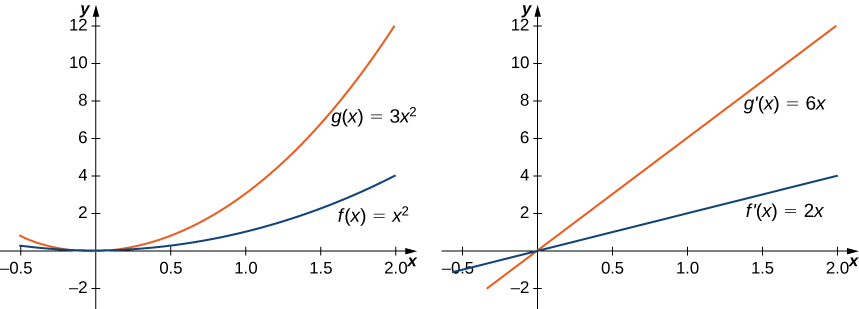
OpenStax, Rice University; Calculus Volume 1. · CC BY-NC-SA 4.0
Figure 3.18図 3.18
The derivative of is 3 times the derivative of
の導関数は、の導関数の3倍である。
Example 3.21例題 3.21
Applying Basic Derivative Rules基本的な微分法を使う
Find the derivative of
の導関数を求めなさい。
Solution解き方
We begin by applying the rule for differentiating the sum of two functions, followed by the rules for differentiating constant multiples of functions and the rule for differentiating powers. To better understand the sequence in which the differentiation rules are applied, we use Leibniz notation throughout the solution:
英語のヒント
まず2つの関数の和の微分法を使い、そのあと定数倍の微分法、べき関数の微分法を使う。どの順序で法則を適用しているのかがわかるよう、解答全体をライプニッツの記法で示す。
Example 3.22例題 3.22
Finding the Equation of a Tangent Line接線の方程式を求める
Find the equation of the line tangent to the graph of at
におけるのグラフの接線の方程式を求めなさい。
Solution解き方
To find the equation of the tangent line, we need a point and a slope. To find the point, compute
接線の方程式を求めるには、通る点と傾きが必要になる。まず、通る点を求めるために、次を計算する。
This gives us the point Since the slope of the tangent line at 1 is we must first find Using the definition of a derivative, we have
したがって、接線は点を通る。x=1における接線の傾きはなので、まずを求める必要がある。導関数の定義を使うと、
so the slope of the tangent line is Using the point-slope formula, we see that the equation of the tangent line is
接線の傾きはとなる。点と傾きから直線の方程式を表すと、
Putting the equation of the line in slope-intercept form, we obtain
これを、傾きと切片で表す形に直すと、
The Product Rule積の微分法
Now that we have examined the basic rules, we can begin looking at some of the more advanced rules. The first one examines the derivative of the product of two functions. Although it might be tempting to assume that the derivative of the product is the product of the derivatives, similar to the sum and difference rules, the product rule does not follow this pattern. To see why we cannot use this pattern, consider the function whose derivative is and not
英語のヒント
基本的な法則を調べたので、さらに進んだ法則を見ていこう。最初は、2つの関数の積の導関数を扱う。和や差の微分法にならって、「積の導関数も、導関数どうしの積だろう」と考えたくなるかもしれない。しかし、積の微分法はそうならない。なぜ同じようにはできないのか、関数で考えよう。この導関数はであり、ではない。
Proof証明
We begin by assuming that and are differentiable functions. At a key point in this proof we need to use the fact that, since is differentiable, it is also continuous. In particular, we use the fact that since is continuous,
英語のヒント
まずとを微分可能な関数とする。この証明の重要な箇所では、が微分可能なら連続でもあるという事実を使う。具体的には、の連続性より、となることを使う。
By applying the limit definition of the derivative to we obtain
に、極限による導関数の定義を適用すると、
By adding and subtracting in the numerator, we have
分子にを足し、同じものを引くと、
After breaking apart this quotient and applying the sum law for limits, the derivative becomes
この商を分け、極限の和の法則を使うと、導関数は次のようになる。
Rearranging, we obtain
並べ替えると、
By using the continuity of the definition of the derivatives of and and applying the limit laws, we arrive at the product rule,
の連続性、との導関数の定義、および極限の法則を使うと、積の微分法が得られる。
□
□
Example 3.23例題 3.23
Applying the Product Rule to Functions at a Pointある点における積の微分法の利用
For use the product rule to find if and
とする。およびのとき、積の微分法を使ってを求めなさい。
Solution解き方
Since and hence
であるから、
Example 3.24例題 3.24
Applying the Product Rule to Binomials二項式の積を微分する
For find by applying the product rule. Check the result by first finding the product and then differentiating.
とする。積の微分法でを求めなさい。また、先に積を展開してから微分し、結果を確かめなさい。
Solution解き方
If we set and then and Thus,
、とおくと、、である。したがって、
Simplifying, we have
整理すると、
To check, we see that and, consequently,
確かめるために展開するとであり、したがってとなる。