第3章微分
3.8 Implicit Differentiation3.8 陰関数の微分
Learning Objectives学習目標
- Find the derivative of a complicated function by using implicit differentiation.陰関数の微分を使い、複雑な関数の導関数を求める。
- Use implicit differentiation to determine the equation of a tangent line.陰関数の微分を使い、接線の方程式を求める。
We have already studied how to find equations of tangent lines to functions and the rate of change of a function at a specific point. In all these cases we had the explicit equation for the function and differentiated these functions explicitly. Suppose instead that we want to determine the equation of a tangent line to an arbitrary curve or the rate of change of an arbitrary curve at a point. In this section, we solve these problems by finding the derivatives of functions that define implicitly in terms of
英語のヒント
これまでに、関数のグラフの接線の方程式や、ある点での変化率を求める方法を学んだ。いずれも、関数が陽に表された式を使って微分していた。では、一般の曲線の接線の方程式や、ある点での変化率を求めたい場合はどうだろう。この節では、をによって陰に定める関係式から導関数を求め、これらの問題を解く。
Implicit Differentiation陰関数の微分
In most discussions of math, if the dependent variable is a function of the independent variable we express y in terms of If this is the case, we say that is an explicit function of For example, when we write the equation we are defining y explicitly in terms of On the other hand, if the relationship between the function and the variable is expressed by an equation where is not expressed entirely in terms of we say that the equation defines y implicitly in terms of For example, the equation defines the function implicitly.
英語のヒント
数学では普通、従属変数が独立変数の関数なら、yをの式で表す。この場合、はの陽関数であるという。例えば、と書けば、yをによって陽に定めている。一方、関数と変数の関係を、がだけの式になっていない方程式で表したとき、その方程式はyをによって陰に定めているという。例えば、方程式は、関数を陰に定める。
Implicit differentiation allows us to find slopes of tangents to curves that are clearly not functions (they fail the vertical line test). We are using the idea that portions of are functions that satisfy the given equation, but that is not actually a function of
陰関数の微分法では、全体としては関数のグラフではない曲線、つまり垂直線テストを満たさない曲線の接線の傾きも求められる。全体はの関数ではなくても、の一部分は、与えられた方程式を満たす関数として扱える、という考え方を使う。
In general, an equation defines a function implicitly if the function satisfies that equation. An equation may define many different functions implicitly. For example, the functions
一般に、ある関数が方程式を満たすなら、その方程式はその関数を陰に定めているという。1つの方程式が、多くの異なる関数を陰に定めることもある。例えば、次の関数と、
and which are illustrated in Figure 3.30, are just three of the many functions defined implicitly by the equation
およびは、方程式が陰に定める多くの関数のうち、3つの例にすぎない。これらを図3.30に示す。
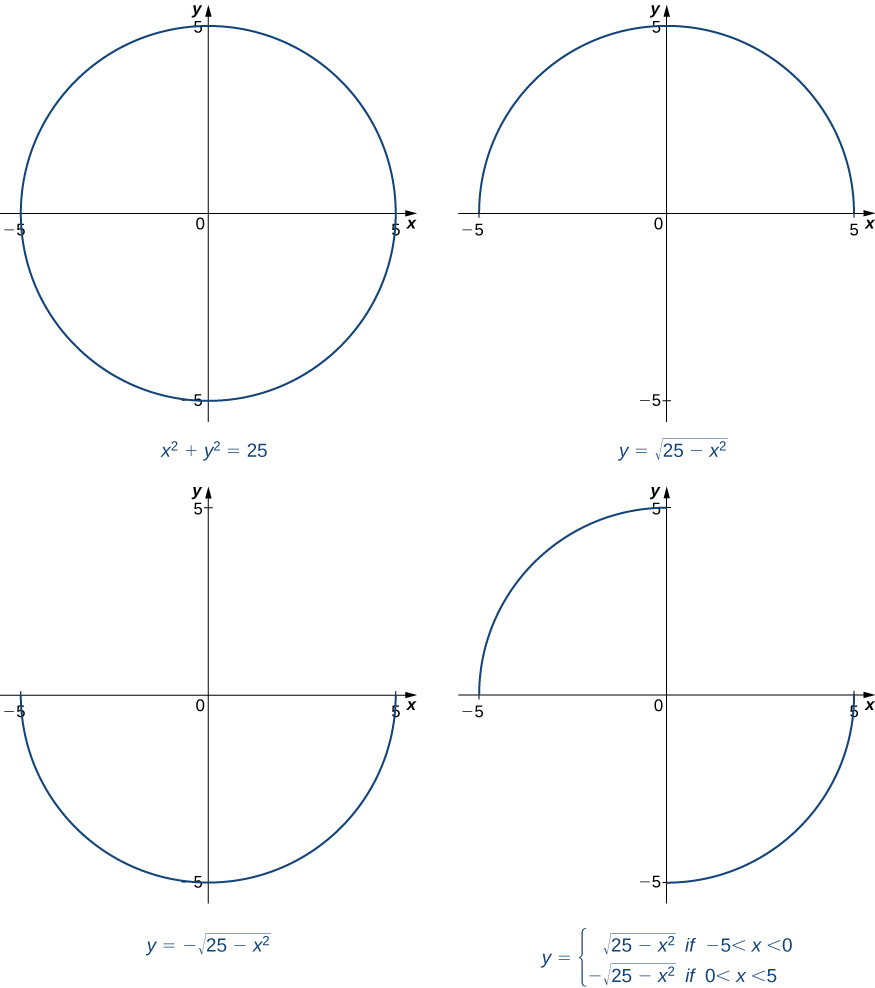
OpenStax, Rice University; Calculus Volume 1. · CC BY-NC-SA 4.0
Figure 3.30図 3.30
The equation defines many functions implicitly.
方程式は、多くの関数を陰に定める。
If we want to find the slope of the line tangent to the graph of at the point we could evaluate the derivative of the function at On the other hand, if we want the slope of the tangent line at the point we could use the derivative of However, it is not always easy to solve for a function defined implicitly by an equation. Fortunately, the technique of implicit differentiation allows us to find the derivative of an implicitly defined function without ever solving for the function explicitly. The process of finding using implicit differentiation is described in the following problem-solving strategy.
英語のヒント
のグラフ上の点で接線の傾きを求めるなら、関数の導関数をで計算すればよい。一方、点での接線の傾きには、の導関数を使える。しかし、方程式で陰に定められた関数を、いつも簡単に解き出せるとは限らない。幸い、陰関数の微分法を使えば、関数を陽に表すことなく導関数を求められる。次に、陰関数の微分でを求める手順を示す。
Example 3.68例題 3.68
Using Implicit Differentiation陰関数の微分を使う
Assuming that is defined implicitly by the equation find
が方程式で陰に定められているとして、を求めなさい。
Solution解き方
Follow the steps in the problem-solving strategy.
上の問題解決の手順に従う。
Example 3.69例題 3.69
Using Implicit Differentiation and the Product Rule陰関数の微分と積の微分法を使う
Assuming that is defined implicitly by the equation find
が方程式で陰に定められているとして、を求めなさい。
Solution解き方
Example 3.70例題 3.70
Using Implicit Differentiation to Find a Second Derivative陰関数の微分で2階導関数を求める
Find if
のとき、を求めなさい。
Solution解き方
In Example 3.68, we showed that We can take the derivative of both sides of this equation to find
例題3.68で、を示した。この等式の両辺を微分すれば、を求められる。
At this point we have found an expression for If we choose, we can simplify the expression further by recalling that and making this substitution in the numerator to obtain
これでの式が求まった。必要なら、を分子に代入してさらに簡単にできる。その結果はである。