第3章微分
3.5 Derivatives of Trigonometric Functions3.5 三角関数の微分
Learning Objectives学習目標
- Find the derivatives of the sine and cosine function.正弦関数と余弦関数の導関数を求める。
- Find the derivatives of the standard trigonometric functions.基本的な三角関数の導関数を求める。
- Calculate the higher-order derivatives of the sine and cosine.正弦関数と余弦関数の高階導関数を計算する。
One of the most important types of motion in physics is simple harmonic motion, which is associated with such systems as an object with mass oscillating on a spring. Simple harmonic motion can be described by using either sine or cosine functions. In this section we expand our knowledge of derivative formulas to include derivatives of these and other trigonometric functions. We begin with the derivatives of the sine and cosine functions and then use them to obtain formulas for the derivatives of the remaining four trigonometric functions. Being able to calculate the derivatives of the sine and cosine functions will enable us to find the velocity and acceleration of simple harmonic motion.
英語のヒント
物理学で重要な運動の1つに、単振動がある。ばねにつながれた物体が振動するような系に見られる運動である。単振動は、正弦関数または余弦関数で記述できる。この節では、微分公式の知識を広げ、これらを含む三角関数の導関数を学ぶ。まず正弦・余弦の導関数を求め、それらを使って残る4つの三角関数の微分公式を導く。正弦・余弦を微分できれば、単振動の速度と加速度を求められる。
Derivatives of the Sine and Cosine Functions正弦関数と余弦関数の導関数
We begin our exploration of the derivative for the sine function by using the formula to make a reasonable guess at its derivative. Recall that for a function
正弦関数の導関数を調べるにあたり、まず公式を使って妥当な予想を立てよう。関数について、次の式を思い出す。
Consequently, for values of very close to 0, We see that by using
したがって、が0に十分近ければ、と近似できる。とすると、
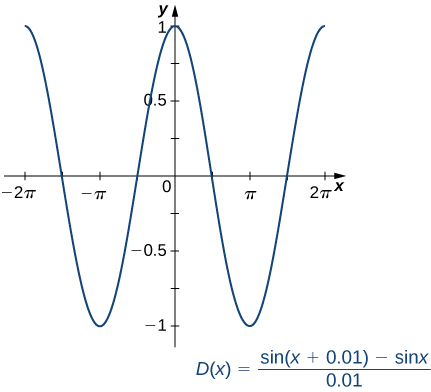
By setting and using a graphing utility, we can get a graph of an approximation to the derivative of (Figure 3.25).
とおき、グラフ作成ツールを使えば、の導関数を近似するグラフを描ける(図3.25)。
OpenStax, Rice University; Calculus Volume 1. · CC BY-NC-SA 4.0
Figure 3.25図 3.25
The graph of the function looks a lot like a cosine curve.
関数のグラフは、余弦曲線によく似ている。
Upon inspection, the graph of appears to be very close to the graph of the cosine function. Indeed, we will show that
のグラフをよく見ると、余弦関数のグラフに非常に近い。実際、次のことを示す。
If we were to follow the same steps to approximate the derivative of the cosine function, we would find that
同じ手順で余弦関数の導関数を近似すると、次の結果が得られる。
Proof証明
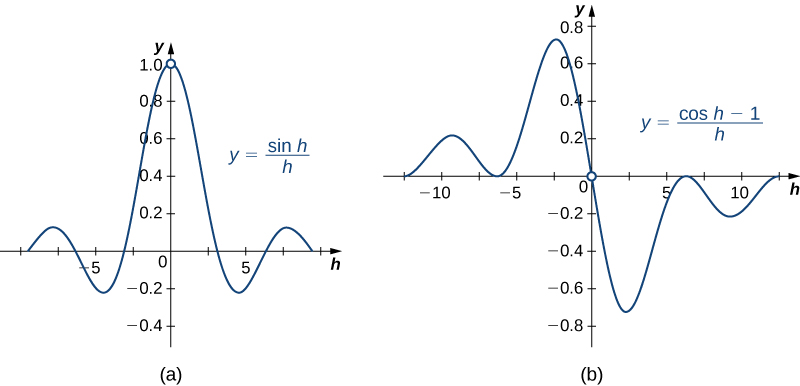
Because the proofs for and use similar techniques, we provide only the proof for Before beginning, recall two important trigonometric limits we learned in Introduction to Limits:
との証明は似た方法を使うので、ここではだけを証明する。始める前に、「極限入門」で学んだ次の重要な三角関数の極限を思い出そう。
The graphs of and are shown in Figure 3.26.
とのグラフを、図3.26に示す。
OpenStax, Rice University; Calculus Volume 1. · CC BY-NC-SA 4.0
Figure 3.26図 3.26
These graphs show two important limits needed to establish the derivative formulas for the sine and cosine functions.
正弦・余弦の微分公式を導くために必要な、2つの重要な極限を示すグラフ。
We also recall the following trigonometric identity for the sine of the sum of two angles:
また、2つの角の和の正弦について、次の加法定理も思い出そう。
Now that we have gathered all the necessary equations and identities, we proceed with the proof.
必要な式と恒等式がそろったので、証明を進める。
□
□
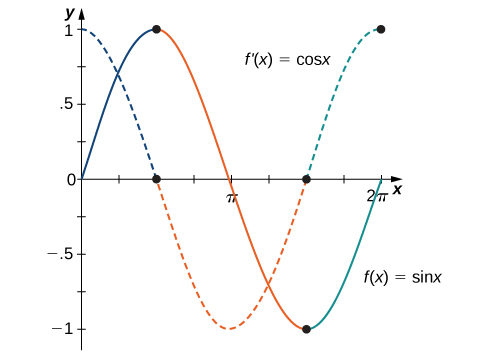
Figure 3.27 shows the relationship between the graph of and its derivative Notice that at the points where has a horizontal tangent, its derivative takes on the value zero. We also see that where is increasing, and where is decreasing,
図3.27は、とその導関数のグラフの関係を示す。の接線が水平になる点では、導関数が0になることに注目しよう。また、が増加するところでは、が減少するところではとなる。
OpenStax, Rice University; Calculus Volume 1. · CC BY-NC-SA 4.0
Figure 3.27図 3.27
Where has a maximum or a minimum, that is, where has a horizontal tangent. These points are noted with dots on the graphs.
が極大または極小となるところではである。すなわち、の接線が水平になるところでとなる。対応する点をグラフ上の点印で示している。
Example 3.39例題 3.39
Differentiating a Function Containing sin xsin xを含む関数を微分する
Find the derivative of
の導関数を求めなさい。
Solution解き方
Using the product rule, we have
積の微分法を使うと、
After simplifying, we obtain
整理すると、
Example 3.40例題 3.40
Finding the Derivative of a Function Containing cos xcos xを含む関数の導関数を求める
Find the derivative of
の導関数を求めなさい。
Solution解き方
By applying the quotient rule, we have
商の微分法を使うと、
Simplifying, we obtain
整理すると、
Example 3.41例題 3.41
An Application to Velocity速度への応用
A particle moves along a coordinate axis in such a way that its position at time is given by for At what times is the particle at rest?
座標軸上を動く質点の、時刻における位置を、でと表す。質点が静止する時刻を求めなさい。
Solution解き方
To determine when the particle is at rest, set Begin by finding We obtain
静止する時刻を求めるには、とおく。まずを求めると、
so we must solve
したがって、次の方程式を解けばよい。
The solutions to this equation are and Thus the particle is at rest at times and
この方程式の解はとである。よって、質点は時刻とに静止する。