第3章微分
3.7 Derivatives of Inverse Functions3.7 逆関数の微分
Learning Objectives学習目標
- Calculate the derivative of an inverse function.逆関数の導関数を計算する。
- Recognize the derivatives of the standard inverse trigonometric functions.基本的な逆三角関数の導関数を理解する。
In this section we explore the relationship between the derivative of a function and the derivative of its inverse. For functions whose derivatives we already know, we can use this relationship to find derivatives of inverses without having to use the limit definition of the derivative. In particular, we will apply the formula for derivatives of inverse functions to trigonometric functions. This formula may also be used to extend the power rule to rational exponents.
英語のヒント
この節では、関数の導関数と、その逆関数の導関数との関係を調べる。元の関数の導関数がわかっていれば、この関係を使うことで、極限による定義に戻らずに逆関数を微分できる。特に、逆関数の微分公式を三角関数に適用する。また、この公式を使い、べき関数の微分法を有理数の指数へ拡張する。
The Derivative of an Inverse Function逆関数の導関数
We begin by considering a function and its inverse. If is both invertible and differentiable, it seems reasonable that the inverse of is also differentiable. Figure 3.28 shows the relationship between a function and its inverse Look at the point on the graph of having a tangent line with a slope of This point corresponds to a point on the graph of having a tangent line with a slope of Thus, if is differentiable at then it must be the case that
英語のヒント
まず、関数とその逆関数を考える。が逆関数を持ち、かつ微分可能なら、の逆関数も微分できそうに思える。図3.28は、関数と逆関数の関係を示している。のグラフ上の点に注目する。この点の接線の傾きはである。対応するのグラフ上の点では、接線の傾きはとなる。したがって、がで微分可能であれば、次の関係が成り立たなければならない。
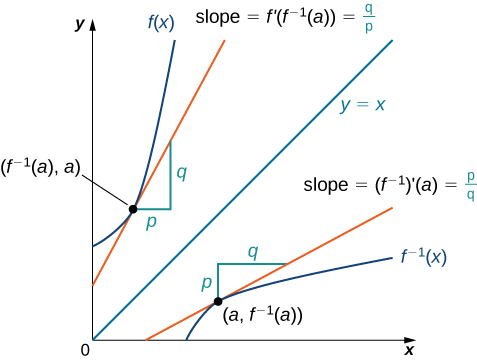
OpenStax, Rice University; Calculus Volume 1. · CC BY-NC-SA 4.0
Figure 3.28図 3.28
The tangent lines of a function and its inverse are related; so, too, are the derivatives of these functions.
関数と逆関数の接線には関係があり、それぞれの導関数にも関係がある。
We may also derive the formula for the derivative of the inverse by first recalling that Then by differentiating both sides of this equation (using the chain rule on the right), we obtain
逆関数の微分公式は、を使っても導ける。両辺を微分し、右辺に連鎖律を使うと、
Solving for we obtain
について解くと、
We summarize this result in the following theorem.
この結果を次の定理にまとめる。
Example 3.60例題 3.60
Applying the Inverse Function Theorem逆関数定理を使う
Use the inverse function theorem to find the derivative of Compare the resulting derivative to that obtained by differentiating the function directly.
逆関数定理を使って、の導関数を求めなさい。その関数を直接微分した結果と比較しなさい。
Solution解き方
The inverse of is Since begin by finding Thus,
の逆関数はである。なので、まずを求める。
Finally,
最後に、
We can verify that this is the correct derivative by applying the quotient rule to to obtain
に商の微分法を使えば、この導関数が正しいことを確認できる。
Example 3.61例題 3.61
Applying the Inverse Function Theorem逆関数定理を使う
Use the inverse function theorem to find the derivative of
逆関数定理を使って、の導関数を求めなさい。
Solution解き方
The function is the inverse of the function Since begin by finding Thus,
関数は、関数の逆関数である。なので、まずを求める。
Finally,
最後に、
From the previous example, we see that we can use the inverse function theorem to extend the power rule to exponents of the form where is a positive integer. This extension will ultimately allow us to differentiate where is any rational number.
英語のヒント
前の例題から、逆関数定理を使えば、を正の整数とするの形の指数にも、べき関数の微分法を拡張できるとわかる。この拡張によって、最終的にはを任意の有理数とするも微分できるようになる。
Proof証明
The function is the inverse of the function Since begin by finding Thus,
関数は、関数の逆関数である。なので、まずを求める。
Finally,
最後に、
To differentiate we must rewrite it as and apply the chain rule. Thus,
を微分するには、と書き直して連鎖律を使う。したがって、
□
□
Example 3.62例題 3.62
Applying the Power Rule to a Rational Power有理数乗にべき関数の微分法を使う
Find the equation of the line tangent to the graph of at
におけるのグラフの接線の方程式を求めなさい。
Solution解き方
First find and evaluate it at Since
まずを求め、での値を計算する。
the slope of the tangent line to the graph at is
したがって、での接線の傾きはである。
Substituting into the original function, we obtain Thus, the tangent line passes through the point Substituting into the point-slope formula for a line, we obtain the tangent line
元の関数にを代入すると、となる。接線は点を通る。点と傾きによる直線の公式に代入し、次の接線を得る。