第3章微分
Derivatives and Continuity微分可能性と連続性
Now that we can graph a derivative, let’s examine the behavior of the graphs. First, we consider the relationship between differentiability and continuity. We will see that if a function is differentiable at a point, it must be continuous there; however, a function that is continuous at a point need not be differentiable at that point. In fact, a function may be continuous at a point and fail to be differentiable at the point for one of several reasons.
英語のヒント
導関数のグラフを描けるようになったので、その振る舞いを調べよう。まず、微分可能性と連続性の関係を考える。ある点で微分可能な関数は、必ずその点で連続である。しかし、ある点で連続な関数が、その点で微分可能とは限らない。実際、関数がある点で連続でも、いくつかの理由により、その点で微分できないことがある。
Proof証明
If is differentiable at then exists and
がで微分可能なら、が存在し、
We want to show that is continuous at by showing that Thus,
を示すことで、がで連続であることを証明したい。そこで、
Therefore, since is defined and we conclude that is continuous at
が定義され、であることが示されたので、はで連続だと結論できる。
□
□
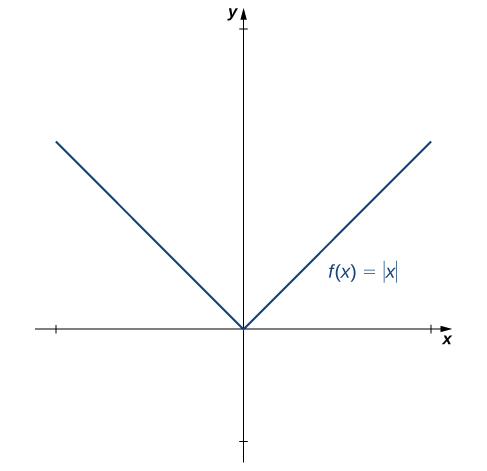
We have just proven that differentiability implies continuity, but now we consider whether continuity implies differentiability. To determine an answer to this question, we examine the function This function is continuous everywhere; however, is undefined. This observation leads us to believe that continuity does not imply differentiability. Let’s explore further. For
微分可能ならば連続であることを証明した。次は、連続ならば微分可能といえるかを考えよう。この問いに答えるため、関数を調べる。この関数はいたるところで連続だが、は定義されない。この例から、連続だからといって微分可能とは限らないと考えられる。さらに確かめよう。について、
This limit does not exist because
この極限は存在しない。なぜなら、
See Figure 3.14.
図3.14を参照しよう。
OpenStax, Rice University; Calculus Volume 1. · CC BY-NC-SA 4.0
Figure 3.14図 3.14
The function is continuous at but is not differentiable at
関数はで連続だが、で微分可能ではない。
Let’s consider some additional situations in which a continuous function fails to be differentiable. Consider the function
連続な関数が微分できない、別の状況も考えよう。関数を取り上げる。
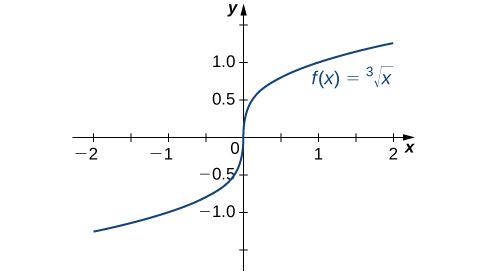
Thus does not exist. A quick look at the graph of clarifies the situation. The function has a vertical tangent line at (Figure 3.15).
したがって、は存在しない。のグラフを見れば、状況は明らかになる。この関数はで鉛直な接線をもつ(図3.15)。
OpenStax, Rice University; Calculus Volume 1. · CC BY-NC-SA 4.0
Figure 3.15図 3.15
The function has a vertical tangent at It is continuous at but is not differentiable at
関数はで鉛直な接線をもつ。で連続だが、で微分可能ではない。
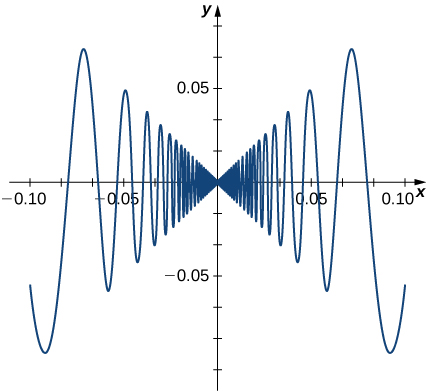
The function also has a derivative that exhibits interesting behavior at We see that
関数についても、で微分係数を調べると興味深い振る舞いが見られる。次の式が得られる。
This limit does not exist, essentially because the slopes of the secant lines continuously change direction as they approach zero (Figure 3.16).
この極限は存在しない。大まかにいえば、0に近づくにつれて割線の傾きが絶えず正負に変わり続けるためである(図3.16)。
OpenStax, Rice University; Calculus Volume 1. · CC BY-NC-SA 4.0
Figure 3.16図 3.16
The function is not differentiable at
関数はで微分可能ではない。
In summary:
以上をまとめる。
- We observe that if a function is not continuous, it cannot be differentiable, since every differentiable function must be continuous. However, if a function is continuous, it may still fail to be differentiable.微分可能な関数は必ず連続なので、連続でない関数は微分可能ではない。しかし、連続な関数でも微分できないことがある。
- We saw that failed to be differentiable at because the limit of the slopes of the tangent lines on the left and right were not the same. Visually, this resulted in a sharp corner on the graph of the function at From this we conclude that in order to be differentiable at a point, a function must be “smooth” at that point.がで微分できないのは、左右の接線の傾きの極限が一致しないためだった。グラフでは、に鋭い角ができていた。このことから、ある点で微分可能であるためには、関数のグラフはそこで「滑らか」でなければならない。
- As we saw in the example of a function fails to be differentiable at a point where there is a vertical tangent line.の例で見たように、鉛直な接線をもつ点では関数は微分できない。
- As we saw with a function may fail to be differentiable at a point in more complicated ways as well.で見たように、もっと複雑な理由で、ある点において微分できないこともある。
Example 3.14例題 3.14
A Piecewise Function that is Continuous and Differentiable連続かつ微分可能な区分的に定義された関数
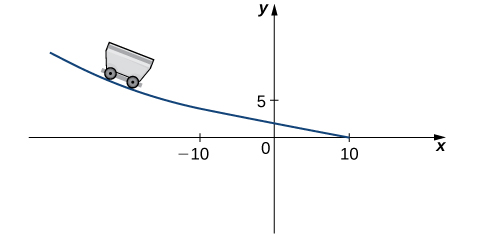
A toy company wants to design a track for a toy car that starts out along a parabolic curve and then converts to a straight line (Figure 3.17). The function that describes the track is to have the form where and are in inches. For the car to move smoothly along the track, the function must be both continuous and differentiable at Find values of and that make both continuous and differentiable.
英語のヒント
ある玩具会社は、おもちゃの車が最初は放物線状の部分を走り、その後、直線部分へ移るコースを設計したい(図3.17)。コースを表す関数はの形とし、との単位をインチとする。車が滑らかに走るには、はで連続かつ微分可能でなければならない。を連続かつ微分可能にするとの値を求めなさい。
OpenStax, Rice University; Calculus Volume 1. · CC BY-NC-SA 4.0
Figure 3.17図 3.17
For the car to move smoothly along the track, the function must be both continuous and differentiable.
車がコースを滑らかに走るには、関数は連続かつ微分可能でなければならない。
Solution解き方
For the function to be continuous at Thus, since
関数が連続であるための条件はである。ここで、
and we must have Equivalently, we have
であり、だから、でなければならない。同値な形でとなる。
For the function to be differentiable at
関数がで微分可能であるためには、
must exist. Since is defined using different rules on the right and the left, we must evaluate this limit from the right and the left and then set them equal to each other:
が存在しなければならない。は左右で異なる式により定義されているため、この極限を右側と左側から求め、両者を等しくする必要がある。
We also have
また、次の式も得られる。
This gives us Thus and
これらからとなる。よって、、である。