第3章微分
The Derivative of a Function at a Point一点における関数の微分係数
The type of limit we compute in order to find the slope of the line tangent to a function at a point occurs in many applications across many disciplines. These applications include velocity and acceleration in physics, marginal profit functions in business, and growth rates in biology. This limit occurs so frequently that we give this value a special name: the derivative. The process of finding a derivative is called differentiation.
英語のヒント
ある点における関数の接線の傾きを求めるために計算した極限は、多くの分野のさまざまな応用で現れる。たとえば、物理学の速度と加速度、ビジネスの限界利益関数、生物学の成長率などである。この極限は非常によく現れるので、その値に「微分係数」という特別な名前を付ける。微分係数や導関数を求める操作を「微分」という。
Example 3.4例題 3.4
Estimating a Derivative微分係数を推定する
For use a table to estimate using Equation 3.5.
について、表を作り、式3.5を使ってを推定しなさい。
Solution解き方
Create a table using values of just below and just above
として、をわずかに下回る値と、をわずかに上回る値を使って表を作る。
After examining the table, we see that a good estimate is
表を調べると、がよい推定値だと分かる。
Example 3.5例題 3.5
Finding a Derivative微分係数を求める
For find by using Equation 3.5.
について、式3.5を使ってを求めなさい。
Solution解き方
Substitute the given function and value directly into the equation.
与えられた関数と値を、そのまま式に代入する。
Example 3.6例題 3.6
Revisiting the Derivative微分係数を別の定義から求める
For find by using Equation 3.6.
について、式3.6を使ってを求めなさい。
Solution解き方
Using this equation, we can substitute two values of the function into the equation, and we should get the same value as in Example 3.5.
この式には関数の二つの値を代入でき、例題3.5と同じ値が得られるはずである。
The results are the same whether we use Equation 3.5 or Equation 3.6.
Velocities and Rates of Change速度と変化率
Now that we can evaluate a derivative, we can use it in velocity applications. Recall that if is the position of an object moving along a coordinate axis, the average velocity of the object over a time interval if or if is given by the difference quotient
微分係数を求められるようになったので、速度の問題に応用しよう。が座標軸に沿って動く物体の位置を表すとき、時間区間(の場合)、または(の場合)における物体の平均速度は、次の差商で与えられる。
As the values of approach the values of approach the value we call the instantaneous velocity at That is, instantaneous velocity at denoted is given by
の値がに近づくと、の値は、における瞬間速度と呼ばれる値に近づく。すなわち、における瞬間速度をと書くと、次のように与えられる。
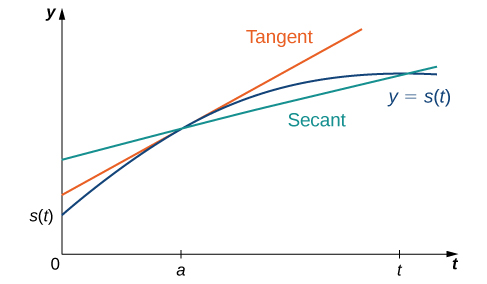
To better understand the relationship between average velocity and instantaneous velocity, see Figure 3.8. In this figure, the slope of the tangent line (shown in red) is the instantaneous velocity of the object at time whose position at time is given by the function The slope of the secant line (shown in green) is the average velocity of the object over the time interval
平均速度と瞬間速度の関係をよりよく理解するため、図3.8を見よう。時刻における位置が関数で与えられる物体について、この図の赤い接線の傾きは、時刻の瞬間速度を表す。緑の割線の傾きは、時間区間における物体の平均速度である。
OpenStax, Rice University; Calculus Volume 1. · CC BY-NC-SA 4.0
Figure 3.8図 3.8
The slope of the secant line is the average velocity over the interval The slope of the tangent line is the instantaneous velocity.
割線の傾きは、区間における平均速度である。接線の傾きは瞬間速度である。
We can use Equation 3.5 to calculate the instantaneous velocity, or we can estimate the velocity of a moving object by using a table of values. We can then confirm the estimate by using Equation 3.7.
Example 3.7例題 3.7
Estimating Velocity速度を推定する
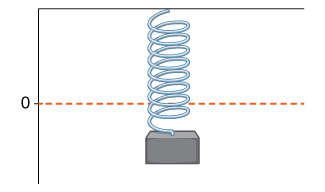
A lead weight on a spring is oscillating up and down. Its position at time with respect to a fixed horizontal line is given by (Figure 3.9). Use a table of values to estimate Check the estimate by using Equation 3.5.
英語のヒント
OpenStax, Rice University; Calculus Volume 1. · CC BY-NC-SA 4.0
Figure 3.9図 3.9
A lead weight suspended from a spring in vertical oscillatory motion.
ばねにつり下げた鉛のおもりが、鉛直方向に振動している。
Solution解き方
We can estimate the instantaneous velocity at by computing a table of average velocities using values of approaching as shown in Table 3.1.
表3.1のように、をに近づける値を使って平均速度の表を作れば、における瞬間速度を推定できる。
From the table we see that the average velocity over the time interval is the average velocity over the time interval is and so forth. Using this table of values, it appears that a good estimate is
英語のヒント
表から、時間区間の平均速度は、時間区間の平均速度は、というように読み取れる。この表の値を見ると、がよい推定値だと考えられる。
By using Equation 3.5, we can see that
式3.5を使うと、次のことが分かる。
Thus, in fact,
したがって、実際にである。
As we have seen throughout this section, the slope of a tangent line to a function and instantaneous velocity are related concepts. Each is calculated by computing a derivative and each measures the instantaneous rate of change of a function, or the rate of change of a function at any point along the function.
この節を通して見たように、関数の接線の傾きと瞬間速度は、互いに関連する概念である。どちらも微分係数を計算して求められ、関数の瞬間の変化率、すなわち関数上のある点における変化率を測るものである。
Example 3.8例題 3.8
Chapter Opener: Estimating Rate of Change of Velocity章の導入問題:速度の変化率を推定する
Image omitted because its reuse rights could not be verified.権利の確認ができないため画像を割愛。
Figure 3.10図 3.10
(credit: modification of work by Codex41, Flickr)
(出典:Codex41/Flickrの作品を改変)
Reaching a top speed of mph, the Hennessey Venom GT is one of the fastest cars in the world. In tests it went from to mph in seconds, from mph in seconds, from mph in seconds, and from mph in seconds. Use this data to draw a conclusion about the rate of change of velocity (that is, its acceleration) as it approaches mph. Does the rate at which the car is accelerating appear to be increasing, decreasing, or constant?
最高時速マイルに達するヘネシー・ヴェノムGTは、世界最速級の自動車である。試験走行では、時速マイルからマイルまで秒、時速マイルまで秒、時速マイルまで秒、時速マイルまで秒で加速した。このデータを使い、時速マイルに近づくにつれて速度の変化率、すなわち加速度がどうなるか考えなさい。車が加速する割合は、増加・減少・一定のどれに見えるだろうか。
Solution解き方
First observe that mph = ft/s, mph ft/s, mph ft/s, and mph ft/s. We can summarize the information in a table.
まず、 mph = ft/s、 mph ft/s、 mph ft/s、 mph ft/sであることを確認する。この情報を表にまとめよう。
Now compute the average acceleration of the car in feet per second per second on intervals of the form as approaches as shown in the following table.
次の表のように、をに近づけながら、という形の時間区間で車の平均加速度を計算する。単位は、1秒当たりの速度変化をフィート毎秒で表すft/s²とする。
The rate at which the car is accelerating is decreasing as its velocity approaches mph ft/s).
速度が時速マイル、すなわち ft/s)に近づくにつれて、車の加速度は小さくなっている。
Example 3.9例題 3.9
Rate of Change of Temperature温度の変化率
A homeowner sets the thermostat so that the temperature in the house begins to drop from at p.m., reaches a low of during the night, and rises back to by a.m. the next morning. Suppose that the temperature in the house is given by for where is the number of hours past p.m. Find the instantaneous rate of change of the temperature at midnight.
英語のヒント
ある家の住人は、午後時に室温がから下がり始め、夜の間に最低となり、翌朝の午前時までにへ戻るよう、温度調節器を設定した。室温はの範囲でにより与えられるとする。ここでは午後時からの経過時間を時間単位で表す。真夜中における温度の瞬間変化率を求めなさい。
Solution解き方
Since midnight is hours past p.m., we want to compute Refer to Equation 3.5.
真夜中は午後時から時間後なので、求めたいのはである。式3.5を参照する。
The instantaneous rate of change of the temperature at midnight is per hour.
真夜中における温度の瞬間変化率は、1時間当たりである。
Example 3.10例題 3.10
Rate of Change of Profit利益の変化率
A toy company can sell electronic gaming systems at a price of dollars per gaming system. The cost of manufacturing systems is given by dollars. Find the rate of change of profit when games are produced. Should the toy company increase or decrease production?
英語のヒント
ある玩具会社は、電子ゲーム機1台の価格をドルにすると、台販売できる。台の製造費はドルである。台を生産するときの利益の変化率を求めなさい。この会社は生産を増やすべきか、減らすべきか。
Solution解き方
The profit earned by producing gaming systems is where is the revenue obtained from the sale of games. Since the company can sell games at per game,
ゲーム機台を生産して得られる利益はである。ここでは、ゲーム機台の販売によって得られる売上高である。1台当たりドルの価格で台販売できるので、
Consequently,
したがって、
Therefore, evaluating the rate of change of profit gives
よって、利益の変化率を計算すると、
Since the rate of change of profit and the company should increase production.
利益の変化率がで、利益自体もなので、この会社は生産を増やすべきである。