第3章微分
Derivatives of Inverse Trigonometric Functions逆三角関数の導関数
We now turn our attention to finding derivatives of inverse trigonometric functions. These derivatives will prove invaluable in the study of integration later in this text. The derivatives of inverse trigonometric functions are quite surprising in that their derivatives are actually algebraic functions. Previously, derivatives of algebraic functions have proven to be algebraic functions and derivatives of trigonometric functions have been shown to be trigonometric functions. Here, for the first time, we see that the derivative of a function need not be of the same type as the original function.
英語のヒント
次は逆三角関数の導関数を求めよう。これらは、この先の積分の学習で非常に役立つ。逆三角関数を微分すると、実は代数関数になる。これは少し意外な結果である。これまでは、代数関数の導関数は代数関数であり、三角関数の導関数は三角関数だった。ここで初めて、導関数が元の関数と同じ種類とは限らないことがわかる。
Example 3.63例題 3.63
Derivative of the Inverse Sine Function逆正弦関数の導関数
Use the inverse function theorem to find the derivative of
逆関数定理を使って、の導関数を求めなさい。
Solution解き方
Since for in the interval is the inverse of begin by finding Since
を区間に制限したとき、f(x)=sin xはの逆関数である。そこで、まずを求める。
we see that
よって、
Example 3.64例題 3.64
Applying the Chain Rule to the Inverse Sine Function逆正弦関数に連鎖律を使う
Apply the chain rule to the formula derived in Example 3.61 to find the derivative of and use this result to find the derivative of
例題3.61で導いた公式に連鎖律を適用し、の導関数を求めなさい。その結果を使って、の導関数を求めなさい。
Solution解き方
Applying the chain rule to we have
に連鎖律を使うと、
Now let so Substituting into the previous result, we obtain
ここでとおくと、となる。先ほどの結果に代入すると、
The derivatives of the remaining inverse trigonometric functions may also be found by using the inverse function theorem. These formulas are provided in the following theorem.
残る逆三角関数の導関数も、逆関数定理で求められる。次の定理に公式をまとめる。
Example 3.65例題 3.65
Applying Differentiation Formulas to an Inverse Tangent Function逆正接関数に微分公式を使う
Find the derivative of
の導関数を求めなさい。
Solution解き方
Let so Substituting into Equation 3.24, we obtain
とおくと、である。式3.24に代入すると、
Simplifying, we have
整理すると、
Example 3.66例題 3.66
Applying Differentiation Formulas to an Inverse Sine Function逆正弦関数に微分公式を使う
Find the derivative of
の導関数を求めなさい。
Solution解き方
By applying the product rule, we have
積の微分法を使うと、
Example 3.67例題 3.67
Applying the Inverse Tangent Function逆正接関数の応用
The position of a particle at time is given by for Find the velocity of the particle at time
質点の時刻における位置を、の範囲でと表す。時刻での質点の速度を求めなさい。
Solution解き方
Begin by differentiating in order to find Thus,
を求めるため、まずを微分する。
Simplifying, we have
整理すると、
Thus,
したがって、である。
Key Concepts重要な概念
- The inverse function theorem allows us to compute derivatives of inverse functions without using the limit definition of the derivative.逆関数定理を使うと、極限による導関数の定義を使わずに逆関数の導関数を求められる。
- We can use the inverse function theorem to develop differentiation formulas for the inverse trigonometric functions.逆関数定理を使って、逆三角関数の微分公式を導ける。
Key Equations重要な式
Inverse function theorem 逆関数定理 |
whenever and is differentiable. が微分可能でのとき、。 |
Power rule with rational exponents 有理数乗の微分法 |
|
Derivative of inverse sine function 逆正弦関数の導関数 |
|
Derivative of inverse cosine function 逆余弦関数の導関数 |
|
Derivative of inverse tangent function 逆正接関数の導関数 |
|
Derivative of inverse cotangent function 逆余接関数の導関数 |
|
Derivative of inverse secant function 逆正割関数の導関数 |
|
Derivative of inverse cosecant function 逆余割関数の導関数 |
Exercises 260–263練習問題 260–263
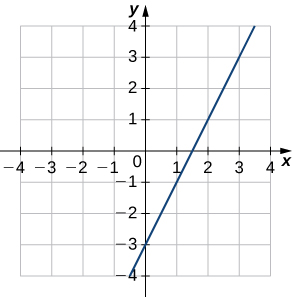
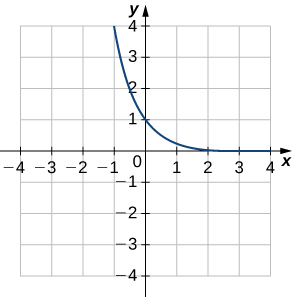
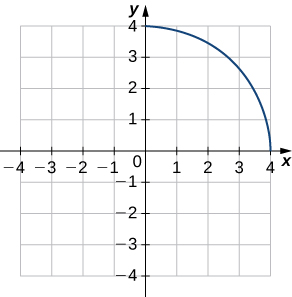
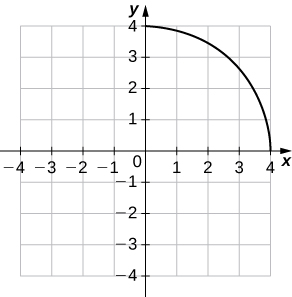
For the following exercises, use the graph of to
次の問題では、のグラフを使って以下に答えなさい。
- sketch the graph of andのグラフの概形を描く。
- use part a. to estimate(a)を使って、を推定する。
Exercise 260問題 260
OpenStax, Rice University; Calculus Volume 1. · CC BY-NC-SA 4.0
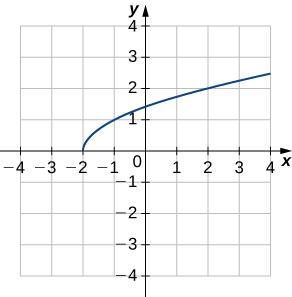
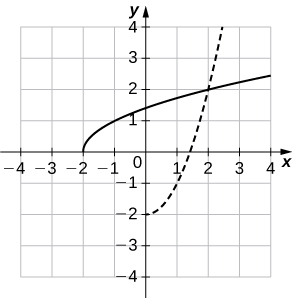
Exercise 262問題 262
OpenStax, Rice University; Calculus Volume 1. · CC BY-NC-SA 4.0
Exercises 264–267練習問題 264–267
For the following exercises, use the functions to find
次の問題では、関数を使って以下を求めなさい。
- at andにおける。
- Then use part b. to find at次に(b)を使い、におけるを求める。
Exercise 264問題 264
Exercise 265問題 265
Solution解き方
a. 6, b. c.
a. 6, b. c.
Exercise 266問題 266
Exercise 267問題 267
Solution解き方
a. b. c.
a. b. c.
Exercises 268–273練習問題 268–273
For each of the following functions, find
次の各関数について、を求めなさい。
Exercise 268問題 268
Exercise 269問題 269
Solution解き方
Exercise 270問題 270
Exercise 271問題 271
Solution解き方
Exercise 272問題 272
Exercise 273問題 273
Solution解き方
Exercises 274–278練習問題 274–278
For each of the given functions
与えられた各関数について、以下に答えなさい。
- find the slope of the tangent line to its inverse function at the indicated point and指定された点での、逆関数の接線の傾きを求める。
- find the equation of the tangent line to the graph of at the indicated point.指定された点における、のグラフの接線の方程式を求める。
Exercise 274問題 274
Exercise 275問題 275
Solution解き方
a. b.
a. b.
Exercise 276問題 276
Exercise 277問題 277
Solution解き方
a. b.
a. b.
Exercise 278問題 278
Exercises 279–288練習問題 279–288
For the following exercises, find for the given function.
次の問題では、与えられた関数のを求めなさい。
Exercise 279問題 279
Solution解き方
Exercise 280問題 280
Exercise 281問題 281
Solution解き方
Exercise 282問題 282
Exercise 283問題 283
Solution解き方
Exercise 284問題 284
Exercise 285問題 285
Solution解き方
Exercise 286問題 286
Exercise 287問題 287
Solution解き方
Exercise 288問題 288
Exercises 289–299練習問題 289–299
For the following exercises, use the given values to find
次の問題では、与えられた値を使ってを求めなさい。
Exercise 289問題 289
Solution解き方
Exercise 290問題 290
Exercise 291問題 291
Solution解き方
Exercise 292問題 292
Exercise 293問題 293
Solution解き方
Exercise 294問題 294
Exercise 295問題 295
[T] The position of a moving hockey puck after seconds is where is in meters.
[T] 動いているホッケーのパックの秒後の位置は、である。の単位はメートルとする。
- Find the velocity of the hockey puck at any time任意の時刻におけるパックの速度を求めなさい。
- Find the acceleration of the puck at any time任意の時刻におけるパックの加速度を求めなさい。
- Evaluate a. and b. for and seconds.および秒について、(a)と(b)の値を求めなさい。
- What conclusion can be drawn from the results in c.?(c)の結果から何がわかるか。
Solution解き方
a. b. c. d. The hockey puck is decelerating/slowing down at 2, 4, and 6 seconds.
英語のヒント
a. b. c. d. 2秒、4秒、6秒では、いずれもパックの速さが小さくなっている。
Exercise 296問題 296
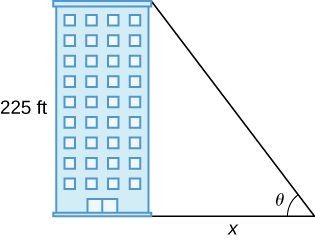
[T] A building that is 225 feet tall casts a shadow of various lengths as the day goes by. An angle of elevation is formed by lines from the top and bottom of the building to the tip of the shadow, as seen in the following figure. Find the rate of change of the angle of elevation when feet.
英語のヒント
[T] 高さ225フィートの建物が作る影の長さは、1日の間で変化する。図のように、影の先端と建物の上端・下端を結ぶ線が、仰角を作る。フィートのとき、影の長さに対する仰角の変化率を求めなさい。
OpenStax, Rice University; Calculus Volume 1. · CC BY-NC-SA 4.0
Exercise 297問題 297
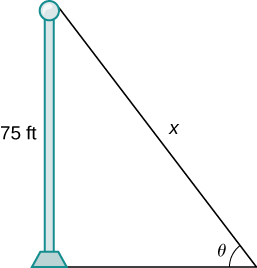
[T] A pole stands 75 feet tall. An angle is formed when wires of various lengths of feet are attached from the ground to the top of the pole, as shown in the following figure. Find the rate of change of the angle when a wire of length 90 feet is attached.
[T] 高さ75フィートの柱がある。図のように、長さフィートのワイヤーを地面から柱の頂点へ張ると、地面との間に角ができる。長さ90フィートのワイヤーを張ったとき、ワイヤーの長さに対する角の変化率を求めなさい。
OpenStax, Rice University; Calculus Volume 1. · CC BY-NC-SA 4.0
Solution解き方
radians per foot
1フィート当たりラジアン。
Exercise 298問題 298
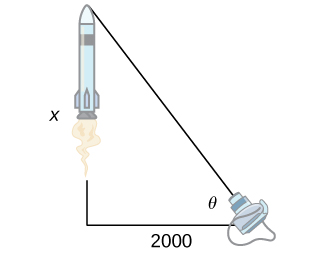
[T] A television camera at ground level is 2000 feet away from the launching pad of a space rocket that is set to take off vertically, as seen in the following figure. The angle of elevation of the camera can be found by where is the height of the rocket. Find the rate of change of the angle of elevation after launch when the camera and the rocket are 5000 feet apart.
[T] 鉛直に打ち上げる宇宙ロケットの発射台から2000フィート離れた地上に、テレビカメラを置く。カメラの仰角はで表され、はロケットの高さである。打ち上げ後、カメラとロケットの距離が5000フィートとなるとき、高さに対する仰角の変化率を求めなさい。
OpenStax, Rice University; Calculus Volume 1. · CC BY-NC-SA 4.0
Exercise 299問題 299
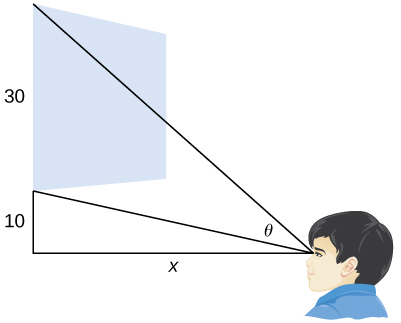
[T] A local movie theater with a 30-foot-high screen that is 10 feet above a person’s eye level when seated has a viewing angle (in radians) given by
[T] ある映画館のスクリーンは高さ30フィートで、下端は座った人の目の位置より10フィート高い。画面全体を見込む角(ラジアン)は、で与えられる。
where is the distance in feet away from the movie screen that the person is sitting, as shown in the following figure.
ここでは、図のように、座った人からスクリーンまでの水平距離をフィート単位で表したものである。
OpenStax, Rice University; Calculus Volume 1. · CC BY-NC-SA 4.0
- Findを求めなさい。
- Evaluate for and 20.および20におけるを求めなさい。
- Interpret the results in b..(b)の結果を解釈しなさい。
- Evaluate for and 40および40におけるを求めなさい。
- Interpret the results in d. At what distance should the person sit to maximize his or her viewing angle?(d)の結果を解釈しなさい。画面を見込む角を最大にするには、どの距離に座ればよいか。
Solution解き方
a. b. c. As a person moves farther away from the screen, the viewing angle is increasing, which implies that as he or she moves farther away, his or her screen vision is widening. d. e. As the person moves beyond 20 feet from the screen, the viewing angle is decreasing. The optimal distance the person should stand for maximizing the viewing angle is 20 feet.
a. b. c. この範囲では、スクリーンから離れるほど見込む角が大きくなり、視野の中で画面が占める角度が広がる。d. e. スクリーンから20フィートを超えて離れると、見込む角は小さくなる。この角を最大にする最適な距離は20フィートである。