Derivative of the Logarithmic Function 対数関数の導関数 Now that we have the derivative of the natural exponential function, we can use implicit differentiation to find the derivative of its inverse, the natural logarithmic function.
自然指数関数の導関数がわかったので、陰関数の微分を使い、その逆関数である自然対数関数の導関数を求められる。
Theorem 3.15 定理 3.15
The Derivative of the Natural Logarithmic Function 自然対数関数の導関数 If x > 0 y = ln x ,
x > 0 y = ln x
More generally, let g ( x ) x g ( x ) > 0 , h ( x ) = ln ( g ( x ) )
より一般に、g ( x ) g ( x ) > 0 x h ( x ) = ln ( g ( x ) )
h ′ ( x ) = 1 g ( x ) g ′ ( x ) .
h ′ ( x ) = 1 g ( x ) g ′ ( x )
(3.31)
Proof 証明 If x > 0 y = ln x , e y = x .
x > 0 y = ln x e y = x
Solving for d y d x
d y d x
Finally, we substitute x = e y
最後にx = e y
We may also derive this result by applying the inverse function theorem, as follows. Since y = g ( x ) = ln x f ( x ) = e x ,
この結果は、逆関数定理からも導ける。y = g ( x ) = ln x f ( x ) = e x
d y d x = 1 f ′ ( g ( x ) ) = 1 e ln x = 1 x .
d y d x = 1 f ′ ( g ( x ) ) = 1 e ln x = 1 x
Using this result and applying the chain rule to h ( x ) = ln ( g ( x ) )
この結果を使い、h ( x ) = ln ( g ( x ) )
h ′ ( x ) = 1 g ( x ) g ′ ( x ) .
h ′ ( x ) = 1 g ( x ) g ′ ( x )
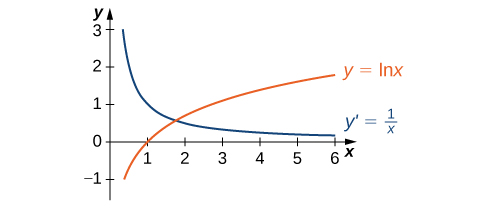
The graph of
y = ln x and its derivative
d y d x = 1 x are shown in
Figure 3.35 .
図3.35 に、y = ln x d y d x = 1 x
Figure 3.35 図 3.35
The function y = ln x ( 0 , + ∞ ) . y ′ = 1 x ( 0 , + ∞ ) .
関数: y = ln x ( 0 , + ∞ ) y ′ = 1 x ( 0 , + ∞ )
Example 3.77 例題 3.77
Taking a Derivative of a Natural Logarithm 自然対数を微分する Find the derivative of f ( x ) = ln ( x 3 + 3 x − 4 ) .
f ( x ) = ln ( x 3 + 3 x − 4 )
Solution 解き方
f ′ ( x ) = 1 x 3 + 3 x − 4 · ( 3 x 2 + 3 ) Use g ( x ) = x 3 + 3 x − 4 in h ′ ( x ) = 1 g ( x ) g ′ ( x ) . = 3 x 2 + 3 x 3 + 3 x − 4 Rewrite.
f ′ ( x ) = 1 x 3 + 3 x − 4 · ( 3 x 2 + 3 ) 用いる関係: g ( x ) = x 3 + 3 x − 4 in h ′ ( x ) = 1 g ( x ) g ′ ( x ) . = 3 x 2 + 3 x 3 + 3 x − 4 書き換える。
Example 3.78 例題 3.78
Using Properties of Logarithms in a Derivative 微分に対数の性質を使う Find the derivative of f ( x ) = ln ( x 2 sin x 2 x + 1 ) .
f ( x ) = ln ( x 2 sin x 2 x + 1 )
Solution 解き方
At first glance, taking this derivative appears rather complicated. However, by using the properties of logarithms prior to finding the derivative, we can make the problem much simpler.
英語のヒント 一見すると、この微分はかなり複雑に見える。しかし、微分する前に対数の性質を使えば、問題をずっと簡単にできる。
f ( x ) = ln ( x 2 sin x 2 x + 1 ) = 2 ln x + ln ( sin x ) − ln ( 2 x + 1 ) Apply properties of logarithms. f ′ ( x ) = 2 x + cot x − 2 2 x + 1 Apply sum rule and h ′ ( x ) = 1 g ( x ) g ′ ( x ) .
f ( x ) = ln ( x 2 sin x 2 x + 1 ) = 2 ln x + ln ( sin x ) − ln ( 2 x + 1 ) 対数の性質を用いる。 f ′ ( x ) = 2 x + cot x − 2 2 x + 1 和の微分法と h′(x)=g′(x)/g(x)を使う。
Checkpoint 3.52 確認問題 3.52
Differentiate: f ( x ) = ln ( 3 x + 2 ) 5 .
f ( x ) = ln ( 3 x + 2 ) 5
Now that we can differentiate the natural logarithmic function, we can use this result to find the derivatives of y = l o g b x y = b x b > 0 , b ≠ 1 .
自然対数関数を微分できるようになったので、その結果を使い、b > 0 , b ≠ 1 y = l o g b x y = b x
Theorem 3.16 定理 3.16
Derivatives of General Exponential and Logarithmic Functions 一般の指数関数と対数関数の導関数 Let b > 0 , b ≠ 1 , g ( x )
b > 0 , b ≠ 1 g ( x )
If, y = log b x ,
y = log b x
h ( x ) = log b ( g ( x ) ) , x for which g ( x ) > 0 ,
より一般に、h ( x ) = log b ( g ( x ) ) g ( x ) > 0
h ′ ( x ) = g ′ ( x ) g ( x ) ln b .
h ′ ( x ) = g ′ ( x ) g ( x ) ln b
(3.33)
h ( x ) = b g ( x ) ,
より一般に、h ( x ) = b g ( x )
h ′ ( x ) = b g ( x ) g ′ ( x ) ln b .
h ′ ( x ) = b g ( x ) g ′ ( x ) ln b
(3.35)
Proof 証明 If y = log b x , b y = x . ln ( b y ) = ln x . y ln b = ln x . y , y = ln x ln b . ln b
y = log b x b y = x ln ( b y ) = ln x y ln b = ln x y y = ln x ln b ln b
If y = b x , ln y = x ln b . ln b 1 y d y d x = ln b . d y d x y = b x ,
y = b x ln y = x ln b ln b 1 y d y d x = ln b d y d x y = b x
d y d x = y ln b = b x ln b .
d y d x = y ln b = b x ln b
The more general derivative (
Equation 3.35 ) follows from the chain rule.
より一般的な導関数の公式である式3.35 は、連鎖律から得られる。
Example 3.79 例題 3.79
Applying Derivative Formulas 微分公式を使う Find the derivative of h ( x ) = 3 x 3 x + 2 .
h ( x ) = 3 x 3 x + 2
Solution 解き方
h ′ ( x ) = 3 x ln 3 ( 3 x + 2 ) − 3 x ln 3 ( 3 x ) ( 3 x + 2 ) 2 Apply the quotient rule. = 2 · 3 x ln 3 ( 3 x + 2 ) 2 Simplify.
h ′ ( x ) = 3 x ln 3 ( 3 x + 2 ) − 3 x ln 3 ( 3 x ) ( 3 x + 2 ) 2 商の微分法を用いる。 = 2 · 3 x ln 3 ( 3 x + 2 ) 2 整理する。
Example 3.80 例題 3.80
Finding the Slope of a Tangent Line 接線の傾きを求める Find the slope of the line tangent to the graph of y = log 2 ( 3 x + 1 ) x = 1 .
x = 1 y = log 2 ( 3 x + 1 )
Solution 解き方
To find the slope, we must evaluate
d y d x at
x = 1 . Using
Equation 3.33 , we see that
傾きを求めるには、x = 1 d y d x 式3.33 より、
d y d x = 3 ( 3 x + 1 ) ln 2 .
d y d x = 3 ( 3 x + 1 ) ln 2
By evaluating the derivative at x = 1 ,
x = 1
d y d x | x = 1 = 3 4 ln 2 = 3 ln 16 .
d y d x | x = 1 = 3 4 ln 2 = 3 ln 16
Checkpoint 3.53 確認問題 3.53
Find the slope for the line tangent to y = 3 x x = 2 .
x = 2 y = 3 x
Logarithmic Differentiation 対数微分法 At this point, we can take derivatives of functions of the form y = ( g ( x ) ) n n , y = b g ( x ) , b > 0 b ≠ 1 . y = x x y = x π . logarithmic differentiation , which allows us to differentiate any function of the form h ( x ) = g ( x ) f ( x ) . y = x 2 x + 1 e x sin 3 x .
英語のヒント ここまでで、ある種のn y = ( g ( x ) ) n b > 0 b ≠ 1 y = b g ( x ) しかし、y = x x y = x π h ( x ) = g ( x ) f ( x ) また、この方法は、y = x 2 x + 1 e x sin 3 x
Using Logarithmic Differentiation 対数微分法の手順
To differentiate y = h ( x ) ln y = ln ( h ( x ) ) .
対数微分法でy = h ( x ) ln y = ln ( h ( x ) )
Use properties of logarithms to expand ln ( h ( x ) )
対数の性質を使い、ln ( h ( x ) )
Differentiate both sides of the equation. On the left we will have 1 y d y d x .
等式の両辺を微分する。左辺は1 y d y d x
Multiply both sides of the equation by y d y d x .
両辺にy d y d x
Replace y h ( x ) .
y h ( x )
Example 3.81 例題 3.81
Using Logarithmic Differentiation 対数微分法を使う Find the derivative of y = ( 2 x 4 + 1 ) tan x .
y = ( 2 x 4 + 1 ) tan x
Solution 解き方
Use logarithmic differentiation to find this derivative.
この導関数は対数微分法で求める。
ln y = ln ( 2 x 4 + 1 ) tan x Step 1. Take the natural logarithm of both sides. ln y = tan x ln ( 2 x 4 + 1 ) Step 2. Expand using properties of logarithms. 1 y d y d x = sec 2 x ln ( 2 x 4 + 1 ) + 8 x 3 2 x 4 + 1 · tan x Step 3. Differentiate both sides. Use the product rule on the right. d y d x = y · ( sec 2 x ln ( 2 x 4 + 1 ) + 8 x 3 2 x 4 + 1 · tan x ) Step 4. Multiply by y on both sides. d y d x = ( 2 x 4 + 1 ) tan x ( sec 2 x ln ( 2 x 4 + 1 ) + 8 x 3 2 x 4 + 1 · tan x ) Step 5. Substitute y = ( 2 x 4 + 1 ) tan x .
ln y = ln ( 2 x 4 + 1 ) tan x 手順1:両辺の自然対数をとる。 ln y = tan x ln ( 2 x 4 + 1 ) 手順2:対数の性質を用いて展開する。 1 y d y d x = sec 2 x ln ( 2 x 4 + 1 ) + 8 x 3 2 x 4 + 1 · tan x 手順3:両辺を微分する。 右辺には積の微分法を用いる。 d y d x = y · ( sec 2 x ln ( 2 x 4 + 1 ) + 8 x 3 2 x 4 + 1 · tan x ) 手順4:掛ける因子: y (両辺に掛ける)。 d y d x = ( 2 x 4 + 1 ) tan x ( sec 2 x ln ( 2 x 4 + 1 ) + 8 x 3 2 x 4 + 1 · tan x ) 手順5:代入する式: y = ( 2 x 4 + 1 ) tan x .
Example 3.82 例題 3.82
Using Logarithmic Differentiation 対数微分法を使う Find the derivative of y = x 2 x + 1 e x sin 3 x .
y = x 2 x + 1 e x sin 3 x
Solution 解き方
This problem really makes use of the properties of logarithms and the differentiation rules given in this chapter.
この問題では、対数の性質と、この章で学んだ微分の法則が大いに役立つ。
ln y = ln x 2 x + 1 e x sin 3 x Step 1. Take the natural logarithm of both sides. ln y = ln x + 1 2 ln ( 2 x + 1 ) − x ln e − 3 ln sin x Step 2. Expand using properties of logarithms. 1 y d y d x = 1 x + 1 2 x + 1 − 1 − 3 cos x sin x Step 3. Differentiate both sides. d y d x = y ( 1 x + 1 2 x + 1 − 1 − 3 cot x ) Step 4. Multiply by y on both sides. d y d x = x 2 x + 1 e x sin 3 x ( 1 x + 1 2 x + 1 − 1 − 3 cot x ) Step 5. Substitute y = x 2 x + 1 e x sin 3 x .
ln y = ln x 2 x + 1 e x sin 3 x 手順1:両辺の自然対数をとる。 ln y = ln x + 1 2 ln ( 2 x + 1 ) − x ln e − 3 ln sin x 手順2:対数の性質を用いて展開する。 1 y d y d x = 1 x + 1 2 x + 1 − 1 − 3 cos x sin x 手順3:両辺を微分する。 d y d x = y ( 1 x + 1 2 x + 1 − 1 − 3 cot x ) 手順4:掛ける因子: y (両辺に掛ける)。 d y d x = x 2 x + 1 e x sin 3 x ( 1 x + 1 2 x + 1 − 1 − 3 cot x ) 手順5:代入する式: y = x 2 x + 1 e x sin 3 x .
Example 3.83 例題 3.83
Extending the Power Rule べき関数の微分法を拡張する Find the derivative of y = x r r
r y = x r
Solution 解き方
The process is the same as in
Example 3.82 , though with fewer complications.
ln y = ln x r Step 1. Take the natural logarithm of both sides. ln y = r ln x Step 2. Expand using properties of logarithms. 1 y d y d x = r 1 x Step 3. Differentiate both sides. d y d x = y r x Step 4. Multiply by y on both sides. d y d x = x r r x Step 5. Substitute y = x r . d y d x = r x r − 1 Simplify.
ln y = ln x r 手順1:両辺の自然対数をとる。 ln y = r ln x 手順2:対数の性質を用いて展開する。 1 y d y d x = r 1 x 手順3:両辺を微分する。 d y d x = y r x 手順4:掛ける因子: y (両辺に掛ける)。 d y d x = x r r x 手順5:代入する式: y = x r . d y d x = r x r − 1 整理する。
Checkpoint 3.54 確認問題 3.54
Use logarithmic differentiation to find the derivative of y = x x .
対数微分法を使い、y = x x
Solution 解き方
d y d x = x x ( 1 + ln x )
d y d x = x x ( 1 + ln x )
Checkpoint 3.55 確認問題 3.55
Find the derivative of y = ( tan x ) π .
y = ( tan x ) π
Solution 解き方
y ′ = π ( tan x ) π − 1 sec 2 x
y ′ = π ( tan x ) π − 1 sec 2 x