第9章工業化時代の拡張Expansion in the Industrial Age
9.4 Exploitation and Resistance9.4 搾取と抵抗
Learning Objectives学習の目標
By the end of this section, you will be able to:
この節を学び終えると、次のことができるようになる。
Describe the imperial powers’ treatment of their colonies
帝国列強による植民地の扱いを説明する
Explain how colonized people were harmed by imperialism
植民地化された人々が帝国主義によってどのような害を受けたかを説明する
Explain how colonized people resisted control by the imperial powers
植民地化された人々が帝国列強の支配にどのように抵抗したかを説明する
The primary motivation of the imperial powers in acquiring colonies was economic, and in the name of profit they frequently brutalized and exploited native populations. Even when they believed their intentions were benevolent and would improve the lives of Africans, Asians, and Pacific Islanders, their means were often cruel. As colonial powers stripped wealth from the lands they exploited, often causing significant environmental damage and destroying countless lives, the residents did not peacefully accept the loss of their independence.
英語のヒント
帝国列強が植民地を獲得する主な動機は経済的なものであり、利益の名のもとに、先住の人々をしばしば残虐に扱い、搾取した。自分たちの意図は善意に基づき、アフリカ・アジア・太平洋諸島の人々の暮らしを改善すると信じているときでさえ、その手段はしばしば残酷だった。植民地支配国が、搾取する土地から富を奪い、深刻な環境破壊をもたらし、数えきれない命を壊す中、住民は独立を失うことを平穏に受け入れたわけではなかった。
Brutality and Exploitation残虐行為と搾取
While all the great powers were capable of brutality and people were exploited in all the colonies, King Leopold II’s subjects in the Congo Free State suffered in ways that have become infamous. Despite his claims that his interest in Africa lay solely in a desire to improve people’s lives, in reality, Leopold was a cruel master. The Congo Free State was considered his personal possession and thus immune from intervention by the Belgian government. Leopold extracted wealth from it by leasing portions to private companies and individuals. Without adopting even a veneer of benevolence, these intermediaries brutalized the peoples of the Congo from the moment they arrived.
英語のヒント
すべての大国に残虐行為を行う能力があり、どの植民地でも人々は搾取されたが、コンゴ自由国におけるレオポルド2世の臣民は、後に悪名を残すような苦しみを受けた。アフリカへの関心は人々の暮らしを改善したいという願いだけから生じたと彼は主張したが、実際のレオポルドは残酷な主人だった。コンゴ自由国は彼の私有財産とみなされ、そのためベルギー政府の介入を受けなかった。レオポルドは一部の地域を民間企業や個人に貸すことで、そこから富を引き出した。これらの仲介者は、慈善のうわべさえ装わず、到着した瞬間からコンゴの人々を残虐に扱った。
Disembarking from steamboats that brought them up the Congo River, Europeans seized Africans and forced them to carry their numerous possessions inland. At times, several hundred would be conscripted to carry a boat’s cargo, marching single-file with iron collars around their necks, attached to chains to ensure they did not run away.
英語のヒント
コンゴ川をさかのぼってきた蒸気船から降りると、ヨーロッパ人はアフリカ人を捕らえ、自分たちの大量の荷物を内陸へ運ぶよう強制した。一隻分の積荷を運ぶため数百人が徴発されることもあり、逃げられないよう鎖につながれた鉄の首輪をはめられ、一列で歩かされた。
Europeans used Africans in the Congo Free State for all forms of labor, but primarily to gather ivory and harvest rubber from wild rubber tree vines. The amount of rubber they were required to collect each day was so large that, instead of tapping the rubber-bearing vines and letting the liquid flow into pails, they chopped through the vines and allowed the liquid latex to cover their bodies. At the end of the day, the hardened rubber had to be scraped from their skin. For this work, they received low pay if any, often only the food they were given.
英語のヒント
コンゴ自由国でヨーロッパ人はアフリカ人をあらゆる労働に使ったが、主な仕事は象牙集めと、野生のゴム植物のつるからゴムを採ることだった。毎日集めるよう命じられたゴムの量があまりに多かったため、つるに切れ目を入れ、液をバケツへ流す方法を取れず、つるを切断して、流れ出るラテックスを自分の体に浴びた。一日の終わりには、固まったゴムを皮膚からこそげ落とさなければならなかった。この労働への報酬は、あったとしてもわずかで、しばしば支給される食べ物だけだった。
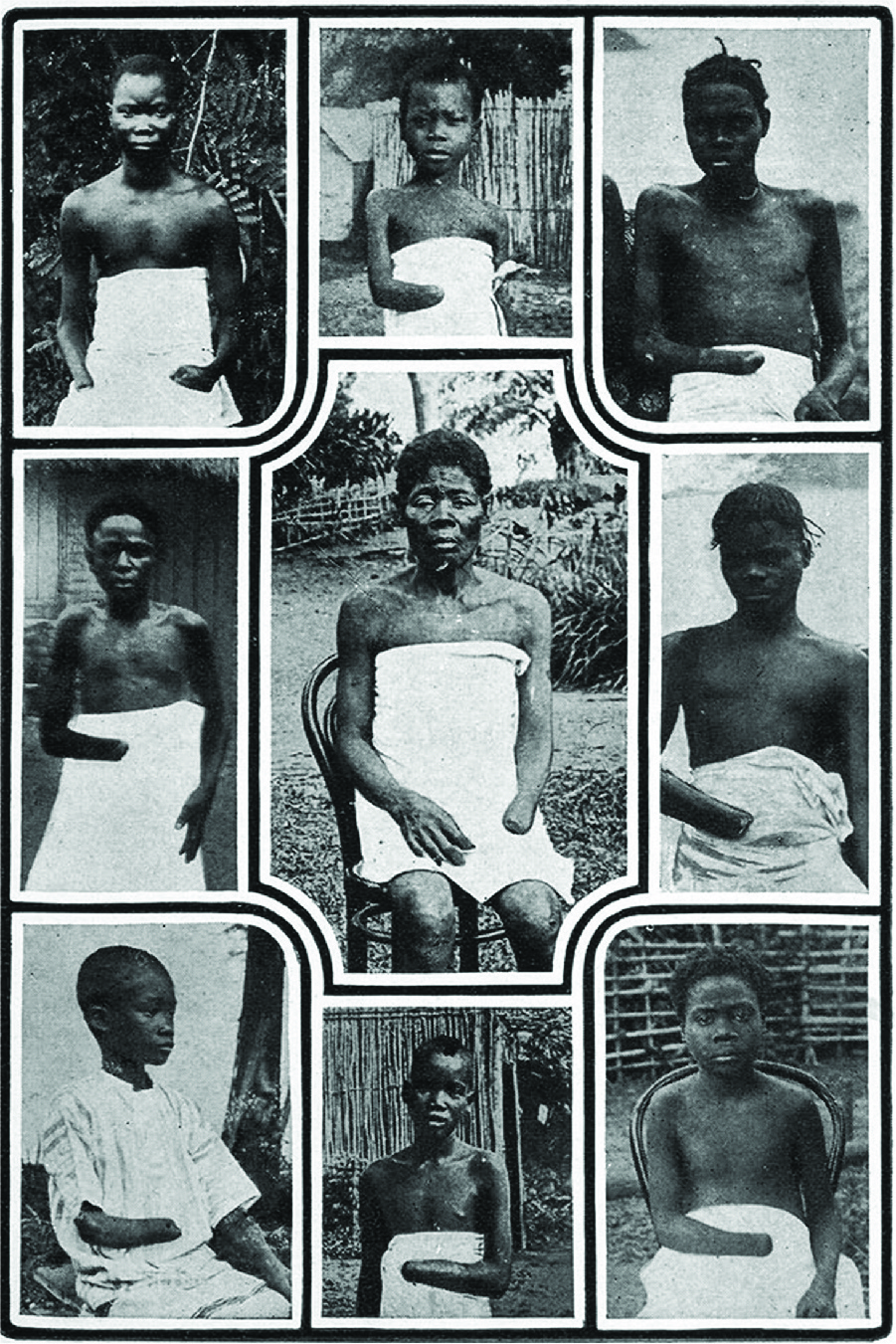
Entire villages could be emptied of men forced into service, their wives and children held hostage to ensure their compliance. The ill and injured were left to die, and those who were uncooperative or slow were whipped, sometimes to unconsciousness or even death. Discipline was maintained by the Force Publique, an Indigenous army commanded by European officers. This army killed those who resisted forced labor or tried to run away and then cut a hand from each victim to maintain a tally of the dead. If the quota set by officers was not met, hands were chopped from the living to make up the number. People who failed to gather enough rubber could also lose their hands (Figure 9.27).
英語のヒント
村の男たちが一人残らず強制労働へ連れ出されることもあり、従わせるため妻や子供が人質にされた。病人や負傷者は死ぬに任され、非協力的な者や仕事の遅い者は鞭打たれ、意識を失い、ときには死に至った。規律を維持したのは、ヨーロッパ人将校が指揮する現地人の軍隊、公安軍だった。この軍は、強制労働に抵抗した者や逃げようとした者を殺し、死者を数えるため犠牲者の片手を切り落とした。将校が定めた割当数に達しなければ、生きている者から手を切り取り、数を合わせた。十分なゴムを集められなかった人々も、手を失うことがあった(図9.27)。
Colonial Discipline in the Congo Free State.コンゴ自由国の植民地的統制。
(credit: “Mutilated Congolese children and adults” by Alice Seeley Harris/Wikimedia Commons, Public Domain) · Public Domain
Figure 9.27 These photos from about 1900 to 1905 show civilian children and adults mutilated by Free State authorities acting for Belgian king Leopold II. (credit: “Mutilated Congolese children and adults” by Alice Seeley Harris/Wikimedia Commons, Public Domain)
図9.27 1900~1905年ごろのこれらの写真は、ベルギー国王レオポルド2世のために行動した自由国当局によって、身体を切断された民間人の子供と大人を示す。(クレジット:「Mutilated Congolese children and adults」、アリス・シーリー・ハリス/Wikimedia Commons、パブリックドメイン)
In 1899, Joseph Conrad published his novella Heart of Darkness, based on what he had seen in the Congo Free State. The book elicited cries for intervention among the British, and following a British official’s detailed report, the Congo Reform Association (CRA) was founded. Many prominent British and American thinkers were members, and they pressured governments to end the suffering of the Congolese people. In 1908, the Belgian Parliament took the Congo from Leopold II, renamed it the Belgian Congo, and assumed authority over it.
英語のヒント
1899年、ジョゼフ・コンラッドはコンゴ自由国で見たものに基づいて、中編小説『闇の奥』を発表した。この本はイギリスで介入を求める声を引き起こし、イギリス官僚の詳細な報告に続いて、コンゴ改革協会(CRA)が設立された。イギリスとアメリカの著名な思想家が多数加入し、コンゴの人々の苦しみを終わらせるよう各国政府に圧力をかけた。1908年、ベルギー議会はレオポルド2世からコンゴを取り上げ、ベルギー領コンゴと改称して、その統治権を引き受けた。
Although the Congo Free State became notorious for the brutal treatment its people suffered, it differed from most other colonies largely in degree, not in kind. Forced laborers toiled in Egypt to build portions of the Suez Canal. In Portugal’s African colonies, people were made to grow rice and cotton and sell it to government agents at prices the government set. Where Europeans ruled through local leaders, such as in France’s West African colonies, forced labor might be disguised as a form of traditional communal labor ordered by a village head or chief.
英語のヒント
コンゴ自由国は住民への残虐な扱いで悪名を得たが、他のほとんどの植民地との違いは、主に程度の差であって種類の差ではなかった。エジプトでは強制労働者がスエズ運河の一部の建設に苦役した。ポルトガルのアフリカ植民地では、人々は米や綿花を育て、政府が定めた価格で政府の代理人に売ることを強制された。フランスの西アフリカ植民地のように、ヨーロッパ人が現地の指導者を通じて支配する場所では、強制労働が、村長や首長の命じる伝統的な共同労働という形で偽装されることもあった。
Imperialism harmed the people of Africa, Asia, and the Pacific Islands in other ways as well. European and U.S. visitors in the late nineteenth century often brought infectious diseases. The introduction of measles to Fiji in 1875 resulted in the death of approximately one-quarter of the population. Modern methods of travel further spread disease. Railroads built to move goods and raw materials in India helped spark outbreaks of cholera, smallpox, and bubonic plague. The demand of textile producers for cotton resulted in the digging of irrigation canals in places like Egypt, which provided ideal breeding environments for malaria-bearing mosquitoes.
英語のヒント
帝国主義は別の形でも、アフリカ・アジア・太平洋諸島の人々に害を及ぼした。19世紀後半に訪れたヨーロッパ人やアメリカ人は、しばしば感染症を持ち込んだ。1875年にフィジーへ麻疹が持ち込まれた結果、人口の約4分の1が死亡した。近代的な移動手段は、さらに病気を拡散した。インドで商品や原材料を運ぶために敷かれた鉄道は、コレラ・天然痘・腺ペストの流行を引き起こす一因となった。織物業者の綿花需要によって、エジプトなどでは灌漑用水路が掘られ、マラリアを媒介する蚊に理想的な繁殖環境を与えた。
Colonizers also brought the cattle disease rinderpest with them wherever they went. Rinderpest came to the Philippines from the United States, for example, swiftly killing the draft animals of Filipino farmers and making it harder for them to grow adequate amounts of food. Once the domestic cattle had died, the mosquitoes turned to biting humans and sickening them with malaria. The introduction of rinderpest-infected cattle to the Horn of Africa by Italians afflicted herds throughout the eastern and southern part of the continent. With herds diminished, thornbush shrubs flourished, providing a perfect home for the tsetse flies that carried sleeping sickness.
英語のヒント
植民者は行く先々に牛の病気である牛疫も持ち込んだ。たとえばフィリピンにはアメリカから牛疫が入り、フィリピン農民の荷役動物を急速に死なせ、十分な食料の栽培を一層難しくした。家畜の牛が死ぬと、蚊は人間を刺すようになり、マラリアを発症させた。イタリア人が牛疫に感染した牛をアフリカの角へ持ち込むと、大陸の東部・南部全体の牛の群れが被害を受けた。群れが減ると、とげのある低木が繁茂し、睡眠病を運ぶツェツェバエに絶好のすみかを与えた。
Farmers often devoted so much land to cash crops that they were unable to raise enough food to feed themselves. People who mined ore or gathered ivory or rubber for Europeans also did not have time to grow crops to feed themselves. Thus people became dependent on food sold by European and American overseers that was often highly processed and lacked nutrients, such as white flour and white rice, leading many to suffer from dietary deficiency diseases.
英語のヒント
農民は土地のあまりに多くを換金作物に割いたため、自分たちを養うだけの食料を栽培できないことがよくあった。ヨーロッパ人のために鉱石を掘り、象牙やゴムを集める人々にも、自分の食べ物を育てる時間はなかった。そのため人々は、ヨーロッパ人やアメリカ人の監督者が売る食料に依存するようになった。それは白い小麦粉や白米のように、加工度が高く栄養素の乏しいことが多く、多くの人が栄養欠乏症に苦しんだ。
Exploitation also occurred in other ways. In the United States, “Wild West” shows hired Native Americans to re-enact battle scenes for crowds of paying White customers. Carnival barkers often placed Native Americans, Inuit, and Filipino Islanders on display for others to look at. The 1904 St. Louis World’s Fair featured Filipino tribespeople living in recreations of their native villages. Such “human zoos” of tribal peoples from Africa, Asia, the Arctic, and the Pacific were not uncommon in European cities and in other world’s fairs.
英語のヒント
搾取は別の形でも行われた。アメリカでは「ワイルド・ウエスト」の見世物が先住民を雇い、料金を払う白人観客の前で戦闘場面を再現させた。見世物の呼び込み人は、アメリカ先住民・イヌイット・フィリピン諸島の住民を、人々が眺める展示物にすることがよくあった。1904年のセントルイス万国博覧会では、再現された故郷の村で暮らすフィリピンの部族の人々が展示された。アフリカ・アジア・北極圏・太平洋の部族の人々を展示するこのような「人間動物園」は、ヨーロッパの都市や他の万国博覧会でも珍しくなかった。
Given the harm colonization caused, it is worth asking why native peoples ever cooperated with foreign imperialists. Of course, some did so for fear of the consequences of refusing. Some, however, worked with the imperial powers to gain advantages for themselves and their families. For those who learned to speak the language of the imperial power and acquired a certain level of education, jobs were available at the lower levels of government bureaucracies. People could also serve as soldiers and police, a benefit for members of minority tribal groups that had been dominated by more powerful ones. Others could secure jobs as interpreters or guides, and wealthier ones might enter into business with the imperial power, as did some Indians, Chinese, and Vietnamese. Imperial powers like Britain and France often provided education for the children of those who assisted them, preparing them for a possible job in the colonial bureaucracy and even a university education in London or Paris. Finally, many converts to Christianity were sincere in their beliefs and may have felt they had more in common with European fellow Christians than with non-Christian peers.
英語のヒント
植民地化がもたらした害を考えると、なぜ先住の人々が外国の帝国主義者に協力したのかは、問う価値がある。拒否した場合の結果を恐れて協力した人々がいたのは当然である。しかし、自分や家族の利益を得るために帝国列強と働いた人々もいた。帝国の言語を話せるようになり、一定の教育を受ければ、政府官僚機構の下級職に就くことができた。兵士や警察官にもなれ、それは強力な部族に支配されてきた少数部族の人々にとって利点だった。通訳や案内人の仕事を得る者もいれば、インド人・中国人・ベトナム人の一部のように、裕福な者は帝国側との商売に入ることもできた。イギリスやフランスなどの帝国列強は、協力者の子供に教育を与えることが多く、将来の植民地官僚としての仕事に備えさせ、ロンドンやパリでの大学教育への道も開いた。最後に、多くのキリスト教改宗者は信仰に真剣であり、非キリスト教徒の同胞より、ヨーロッパの同じキリスト教徒との方が共通点が多いと感じたかもしれない。