第9章工業化時代の拡張Expansion in the Industrial Age
The Civilizing Mission文明化の使命
On the heels of the soldiers who first opened countries in Africa, Asia, and the Pacific to agents of businesses came others seeking to bring what industrializing countries thought was valuable. Many from the United States and Europe considered it the duty of citizens from the industrialized—or as they phrased it, the “civilized”—world to bring the benefits of western culture to the conquered. According to social Darwinism, a theory then popular in Europe and the United States, some groups of people become stronger and more powerful because they are naturally superior. In this view, those of European ancestry could impose their will on others because they were innately “better” and their societies more advanced. Jules Ferry, the prime minister of France in the early 1880s, stressed that such domination was not only the duty of “superior” peoples but also their right. The “benefits” brought to the colonized typically consisted of religion, education, western clothing, and “character-building” sports like soccer. The British also introduced cricket to colonies in Africa and Asia, and baseball came to the Caribbean from the United States. The introduction of these sports was thought to teach people supposedly western values like fair play, teamwork, and competitiveness. The French called this aspect of imperialism “the civilizing mission.” Colonizers also typically erected an infrastructure in the lands they controlled, building roads and railroads and establishing secure water systems and telegraph lines.
英語のヒント
アフリカ・アジア・太平洋の国々を最初に企業の代理人に開放した兵士たちに続いて、工業化する国々が価値あるものと考えたものを持ち込もうとする人々がやって来た。アメリカやヨーロッパの多くの人々は、工業化した世界、彼らの言い方では「文明化した」世界の市民には、征服された人々に西洋文化の恩恵をもたらす義務があると考えた。当時ヨーロッパとアメリカで流行していた社会ダーウィニズムという理論によれば、ある集団がより強く力を持つのは、生まれつき優れているからだった。この見方では、ヨーロッパ系の人々は、生来「より優れ」、その社会もより進歩しているため、他者に自分たちの意思を押しつけることができるとされた。1880年代初めのフランス首相ジュール・フェリーは、このような支配は「優等」な民族の義務であるだけでなく権利でもあると強調した。植民地化された人々に与える「恩恵」は、通常、宗教・教育・西洋の服装、そしてサッカーのような「人格を鍛える」スポーツからなっていた。イギリスはアフリカやアジアの植民地にクリケットも導入し、野球はアメリカからカリブ海地域へ伝わった。こうした競技の導入は、公正なプレー、チームワーク、競争心といった、西洋的とされた価値観を教えるものと考えられた。フランス人は帝国主義のこの側面を「文明化の使命」と呼んだ。植民者は一般に、支配地に道路・鉄道を建設し、安定した給水設備や電信線を設けるなど、社会基盤も整備した。
As the thinking went, people had been conquered not to deprive them of their wealth but to introduce them to the benefits of civilization through the generosity of the industrialized country. This view no doubt served many as merely a cover for baser motives. Others, however, truly believed that African, Asian, and Pacific Islander societies were being improved by the adoption of the hallmarks of western civilization, such as Christianity, monogamous marriage, and fashions that covered the entire body. This was the attitude taken by English writer Rudyard Kipling in his pro-imperialist poem “The White Man’s Burden.” In the first stanza of the poem, written in 1899 in response to the U.S. acquisition of the Philippines, Kipling expresses his belief that it was the White conquerors who suffered at the expense of the conquered people of color, who are portrayed as uncivilized and in need of guidance by people of a biologically and culturally superior race:
英語のヒント
その理屈では、人々を征服したのは富を奪うためではなく、工業国の寛大さによって文明の恩恵を知らせるためだった。この見方が、多くの人にとって、もっと卑しい動機を隠すだけの口実だったことは疑いない。しかし、キリスト教、一夫一婦制の結婚、全身を覆う服装など、西洋文明の特徴を取り入れることで、アフリカ・アジア・太平洋諸島の社会が改善されると本当に信じていた人々もいた。イギリスの作家ラドヤード・キプリングが帝国主義を支持する詩「白人の重荷」で取ったのは、この態度だった。アメリカによるフィリピン獲得に応じて1899年に書かれたこの詩の第1連で、キプリングは、有色人種の被征服者のために苦しむのは白人の征服者の側だという信念を表す。有色人種は文明化されておらず、生物学的・文化的に優れた人種による指導を必要とする人々として描かれている。
Take up the White Man's burden—
Send forth the best ye breed—
Go, bind your sons to exile
To serve your captives’ need;
To wait, in heavy harness,
On fluttered folk and wild—
Your new-caught sullen peoples,
Half devil and half child.英語のヒント
白人の重荷を担え——お前たちが育てた最良の者を送り出せ——行け、息子たちを異郷の務めに縛りつけよお前たちが捕らえた者の求めに仕えるために。重い馬具を負い、仕えるのだ動揺し、荒々しい民に——新たに捕らえた、不機嫌な民に、半ば悪魔で、半ば子供である民に。
As Kipling’s reference to the “half devil” nature of people of color suggests, missionaries played a prominent role in the civilizing mission. They were often the chief means by which the “gifts” of civilization were brought to people. All the imperial powers except Japan sent missionaries to their new colonies. Roman Catholic clergy had already been converting people in European colonies for hundreds of years. Now Protestant clergy and avid lay volunteers established churches and schools to convert the peoples of Africa, Asia, and the Pacific to Christianity and teach them the language of the conquering nation. They also took in orphaned or abandoned children and attempted to assimilate them to the home country’s culture.
英語のヒント
キプリングが有色人種の性質を「半ば悪魔」と述べたことからもうかがえるように、宣教師は文明化の使命において大きな役割を果たした。宣教師はしばしば、人々に文明の「贈り物」をもたらす主な担い手となった。日本を除くすべての帝国列強が、新たな植民地へ宣教師を送った。ローマ・カトリックの聖職者は、すでに何百年もの間、ヨーロッパの植民地で改宗を進めていた。今度はプロテスタントの聖職者と熱心な一般信徒の志願者が、アフリカ・アジア・太平洋の人々をキリスト教に改宗させ、征服国の言語を教えるため、教会や学校を設けた。孤児や捨てられた子供も引き取り、本国の文化に同化させようとした。
Although some missionary activities, like the building of hospitals, may have benefited the Indigenous inhabitants, most others were undoubtedly harmful. Shocked by the practice of polygamy, missionaries often demanded that men with multiple wives choose one and divorce the others, who then had to return to their families in shame or, if they had no family, live without means of support. In China, missionaries’ insistence that Christian converts abandon the practice of ancestor veneration often caused the new Christians to be rejected by their families.
英語のヒント
病院の建設のように、宣教師の活動の一部は先住の住民に恩恵をもたらしたかもしれないが、他のほとんどの活動は間違いなく有害だった。一夫多妻の慣習に衝撃を受けた宣教師は、複数の妻を持つ男性に一人だけを選んで他の妻とは離婚するよう、しばしば要求した。離婚された妻たちは、恥を負って実家へ戻るか、家族がいなければ生活を支える手段なしに暮らさなければならなくなった。中国では、キリスト教への改宗者に祖先崇拝の慣習を捨てるよう宣教師が強く求めた結果、新たなキリスト教徒が家族から拒絶されることがよくあった。
Many aspects of the “civilizing mission,” whether carried out by missionaries or government functionaries, were believed to benefit the conquering nation and its citizens as much as to help the “savage” inhabitants of foreign lands. Telegraph lines enabled communications, and water systems protected city dwellers from diseases like typhoid and cholera. Literate Indigenous people trained in European values and customs were employed in colonial bureaucracies and police forces. Although such changes may have eventually benefitted the people of the colonized country, they also changed the nature of societies, for example by eliminating traditional jobs, and it was always the case that the colonizing nations benefited the most. Instead of connecting population centers as European railroads did, for instance, railroad lines in places like Africa led only from the interior to the coast, the better to move to waiting ships the raw materials destined for European and U.S. factories.
英語のヒント
宣教師が行う場合も政府の役人が行う場合も、「文明化の使命」の多くの側面は、外国の「未開」な住民を助けるのと同じくらい、征服国とその国民にも利益をもたらすと考えられていた。電信線は通信を可能にし、給水設備は都市住民を腸チフスやコレラなどの病気から守った。ヨーロッパの価値観や慣習を教え込まれた、読み書きのできる先住民は、植民地の官僚機構や警察に雇われた。こうした変化は、最終的には植民地化された国の人々に利益を与えたかもしれないが、伝統的な仕事をなくすなど、社会の性質も変えた。そして常に、最大の利益を得たのは植民地を支配する国だった。たとえば、ヨーロッパの鉄道のように人口の集中する場所を結ぶのではなく、アフリカなどの鉄道は内陸から海岸へ向かうだけだった。ヨーロッパやアメリカの工場向けの原材料を、待機している船へより効率よく運ぶためである。
The Means of Imperialism帝国主義の手段
Before either the economic or the cultural goals of the imperialists could be achieved, the desired regions had first to be conquered. One of the first hurdles was the physical difficulty of penetrating the interiors of Africa and Asia. Sub-Saharan Africa was a hot and humid home to microbes unknown to Europeans that sickened both them and their draft animals. Malaria laid low many Europeans who attempted to explore the continent’s interior.
英語のヒント
帝国主義者の経済的目標も文化的目標も、実現する前に、まず目当ての地域を征服しなければならなかった。初期の障害の一つは、アフリカやアジアの内陸へ入り込む物理的な難しさだった。サハラ以南のアフリカは高温多湿で、ヨーロッパ人には未知の微生物が生息し、人も荷役動物も病気にした。大陸内部の探検を試みた多くのヨーロッパ人が、マラリアに倒れた。
Malaria was also a significant problem in Britain’s colony of India. It was exacerbated by schemes to dig irrigation canals and clear land for railroads, creating more areas for water to collect in breeding grounds for the mosquitoes that carried the disease. Quinine, which comes from the bark of the cinchona tree, had been used to treat malaria for years, and in the 1840s the British discovered that taking it before exposure could prevent people from ever contracting the disease. Cinchona trees grew only in the Andes, however, and there were not enough to meet the European demand. Attempts to plant cinchona trees elsewhere often failed, but by the 1870s the Dutch were successfully growing them in their colony of Indonesia and producing additional quinine, a development that assisted Europeans in their exploitation of the African interior.
英語のヒント
マラリアは、イギリスの植民地インドでも深刻な問題だった。灌漑用水路を掘り、鉄道のために土地を切り開く計画によって、水がたまる場所、すなわち病気を媒介する蚊の繁殖場所が増え、問題は悪化した。キナの木の樹皮から採れるキニーネは長年マラリア治療に使われていたが、1840年代、イギリス人は、感染にさらされる前に服用すれば発病自体を防げることを発見した。しかし、キナの木はアンデスにしか育たず、ヨーロッパの需要を満たすほどの量はなかった。他地域へ植える試みはしばしば失敗したが、1870年代までにオランダ人は植民地インドネシアでの栽培とキニーネの増産に成功した。この進展が、ヨーロッパ人によるアフリカ内陸部の搾取を助けた。
Besides disease, difficult terrain and dense brush also made European exploratory and military missions difficult. Following rivers inland was the easiest means of travel. However, most rivers were too shallow for sailing ships, so exploration beyond the coast depended on the development of steamboats. In the 1810s, American explorers began to use steamboats to venture into the interior of North America, exploring the upper reaches of the Mississippi River in 1825, for example, and the British sent steamboats up the Irrawaddy River to conquer Burma (also currently known as Myanmar).
英語のヒント
病気に加え、険しい地形や密生したやぶも、ヨーロッパ人の探検や軍事行動を難しくした。川をたどって内陸へ進むのが、最も容易な移動方法だった。しかし、たいていの川は帆船には浅すぎたため、海岸の先を探検するには蒸気船の発達が必要だった。1810年代、アメリカの探検家は北米の内陸に踏み込むため蒸気船を使い始め、たとえば1825年にはミシシッピ川上流域を探検した。また、イギリスはビルマ(現在はミャンマーとも呼ばれる)を征服するため、イラワジ川をさかのぼる蒸気船を送った。
Steamboats were also of great use in Africa. The interior of the continent is a high plateau from which rivers pour down and rush to the seacoast. All have waterfalls, making it impossible for large sailing ships to follow them for their full length. By the second half of the nineteenth century, however, Europeans were regularly plying African waters in steamships much improved over the earliest ones. Besides sturdy iron hulls, the boats had propellers instead of the paddle wheels the original boats had and steel boilers that were less likely to burst than iron ones. When the boats reached a waterfall, they were disassembled, carried around the falls by African porters, and reassembled to continue down the river (Figure 9.15).
英語のヒント
アフリカでも蒸気船は大いに役立った。大陸の内陸は高原で、そこから川が流れ落ち、海岸へ向けて激しく流れる。どの川にも滝があり、大型の帆船が全長をたどることは不可能だった。しかし19世紀後半までには、ヨーロッパ人は初期のものから大幅に改良された蒸気船で、アフリカの水路を日常的に航行していた。船には頑丈な鉄製の船体に加え、初期の船の外輪に代わるプロペラ、そして鉄製より破裂しにくい鋼製ボイラーが備わっていた。滝に着くと船を解体し、アフリカ人の運搬人が滝を迂回して運び、組み立て直して川を先へ進んだ(図9.15)。
Steamboats for Exploration.探検のための蒸気船。
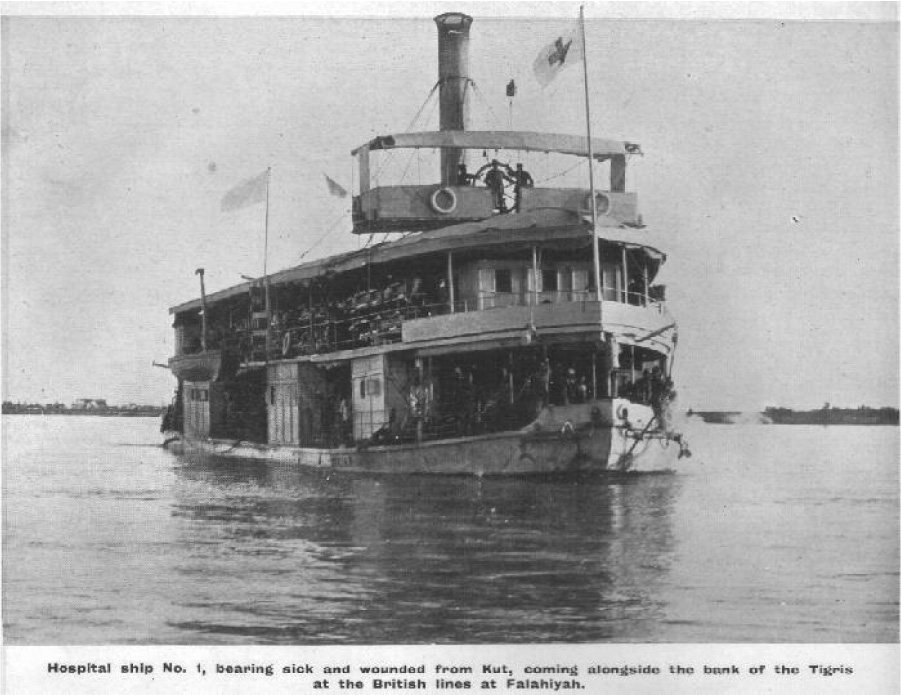
(credit: “British hospital ship on the Tigris river carrying wounded in 1916” by E. E. Jones/Wikimedia Commons, Public Domain) · Public Domain
Figure 9.15 Steamships carried people and supplies up the rivers of Africa and Asia, opening these continents to explorers, missionaries, and soldiers. The hospital ship in this early photograph traveled the Tigris River in Iraq. (credit: “British hospital ship on the Tigris river carrying wounded in 1916” by E. E. Jones/Wikimedia Commons, Public Domain)
図9.15 蒸気船はアフリカとアジアの川をさかのぼって人員や物資を運び、これらの大陸を探検家・宣教師・兵士に開いた。この古い写真の病院船は、イラクのチグリス川を航行した。(クレジット:「British hospital ship on the Tigris river carrying wounded in 1916」、E. E. Jones/Wikimedia Commons、パブリックドメイン)
Steamships carried not only soldiers, explorers, and traders into the interiors of continents but also guns. Weapons had improved rapidly in the industrialized world in the nineteenth century, and guns were another type of technology that gave Europeans a significant advantage. European and U.S. soldiers were armed with breech-loading, repeating rifles and handguns that could be loaded quickly and fired with greater accuracy. Smokeless powder increased the velocity of bullets—and thus the severity of gunshot wounds—and bullets had been rendered more lethal. Dum dum bullets (named for Dumdum, the arsenal town in India where they were first used) were flat or hollow bullets that expanded upon impact, increasing the size of the holes they made. Machine guns were also used extensively in colonial warfare. The Gatling gun from the United States could fire three thousand bullets per minute. Another U.S. invention, the Maxim gun, was a single-barreled weapon (unlike the Gatling gun) that could fire eleven bullets per second.
英語のヒント
蒸気船が大陸の内陸へ運んだのは、兵士・探検家・商人だけでなく銃もだった。19世紀の工業化した世界では兵器が急速に改良され、銃はヨーロッパ人に大きな優位を与えるもう一つの技術となった。ヨーロッパとアメリカの兵士は、素早く装填でき、より高い命中精度で発射できる、後装式の連発小銃や拳銃で武装していた。無煙火薬は弾丸の速度を上げ、その結果、銃創を重くした。また、弾丸そのものの致死性も高められた。ダムダム弾(最初に使われたインドの兵器廠の町ダムダムにちなむ名)は、先端が平ら、または空洞になった弾丸で、命中時に広がり、開ける穴を大きくした。植民地戦争では機関銃も広く使われた。アメリカのガトリング砲は1分間に3000発を発射できた。もう一つのアメリカの発明であるマキシム機関銃は、ガトリング砲とは異なる単銃身の兵器で、毎秒11発を発射できた。
Such weapons could be produced in large numbers only in industrialized nations. Thus the only way the people of Asia, Africa, and the Pacific could acquire guns was to purchase them, and they were inordinately expensive. A native of the Sudan who wanted to purchase a European- or U.S.-made rifle at the end of the nineteenth century would have to pay at least five camels or, if a European were willing to make the trade, thirty-six enslaved people. Firearms were less common in Central and South Africa, and people fought with swords and spears into the nineteenth century.
英語のヒント
こうした兵器を大量に生産できるのは、工業国だけだった。そのためアジア・アフリカ・太平洋の人々が銃を手に入れる唯一の方法は購入することだったが、銃は途方もなく高価だった。19世紀末、ヨーロッパ製やアメリカ製の小銃を買おうとするスーダンの住民は、少なくともラクダ5頭、あるいはヨーロッパ人がその取引に応じるなら奴隷にされた人々36人を支払う必要があった。アフリカ中部や南部では火器はさらに少なく、人々は19世紀に入っても剣と槍で戦っていた。