第9章工業化時代の拡張Expansion in the Industrial Age
Obstacles to Industrialization産業化の障害
As the United States and European nations industrialized, African, Latin American, and Asian nations, with the exception of Japan, did not. This left them at an economic, technological, and military disadvantage compared to the countries of the industrialized world. Historians disagree about the reasons for this Great Divergence. Some point to the fact that these nations lacked natural resources, such as abundant coal, that European nations possessed. Many note that establishing colonies in the Americas and Asia helped nations like Britain and France acquire capital, resources, and markets that assisted their industrial development. Thus Africa, Asia, and Latin America became parties to unequal treaties forced on them by Europeans bearing deadlier weapons.
英語のヒント
米国とヨーロッパ諸国が工業化する一方、日本を除くアフリカ、ラテンアメリカ、アジアの国々は工業化しなかった。その結果、工業世界の国々に比べ、経済・技術・軍事面で不利な立場に置かれた。この「大分岐」の理由について、歴史家の見解は一致していない。これらの国々には、ヨーロッパ諸国にあった豊富な石炭などの天然資源がなかったという事実を指摘する人もいる。多くの歴史家は、アメリカ大陸とアジアに植民地を設けたことが、英仏などによる資本・資源・市場の獲得を助け、産業発展を支えたと指摘する。こうしてアフリカ、アジア、ラテンアメリカは、より殺傷力の高い兵器をもつヨーロッパ人に押し付けられた不平等条約の当事者となった。
A contrasting argument is that countries such as Egypt and the Latin American nations realized their strengths lay in producing raw materials for the industrializing nations. Factors such as history, geography, climate, and the nature of their labor forces better suited them to producing agricultural goods or other types of raw materials than to pursuing widespread industrialization. In each nation, a unique set of circumstances influenced the path taken.
英語のヒント
これと異なる議論は、エジプトやラテンアメリカ諸国などが、自分たちの強みは工業化する国々へ原料を供給することにあると認識していた、というものだ。歴史、地理、気候、労働力の性質などの条件により、これらの国々は広範な産業化を追求するより、農産物やその他の原料を生産するのに適していた。それぞれの国で固有の事情の組み合わせが、選ばれた道に影響した。
Indiaインド
India’s industrial endeavors were greatly affected by its relationship with Britain, which had begun trading in India in the 1600s. The Seven Years’ War and the subsequent Treaty of Paris, signed in 1763, effectively brought French power in India to an end, paving the way for Britain’s eventual control of the subcontinent. At this time, India possessed characteristics that seemed to make it an ideal candidate for industrialization. It had large merchant and artisan classes, which produced beautiful textiles highly valued in sixteenth- and seventeenth-century England. India was, in fact, the largest exporter of cotton cloth in the world by the middle of the eighteenth century. It was also wealthy, and the country’s Mughal rulers had maintained ports, roads, and bridges that helped manufacturers and merchants bring goods to market.
英語のヒント
インドの産業上の取り組みは、17世紀にインドとの貿易を始めた英国との関係に大きく左右された。七年戦争と、その後1763年に調印されたパリ条約は、インドにおけるフランスの勢力を事実上終わらせ、最終的な英国の亜大陸支配への道を開いた。当時、インドには産業化に理想的と思われる特徴があった。商人と職人の層が厚く、16、17世紀のイングランドで高く評価される美しい織物を生産していた。実際、18世紀半ばには世界最大の綿布輸出国だった。インドは豊かでもあり、ムガル帝国の支配者は、生産者や商人が品物を市場へ運ぶのを助ける港、道路、橋を維持していた。
Britain, however, had no intention of allowing its colony to become its economic rival. Like all colonies, India was meant to enrich Britain, not compete with it. Thus began a process often referred to as deindustrialization, a reduction in a nation’s or region’s industrial activity. In the early eighteenth century, even before Britain had forced the French from India, the British Parliament passed the Calico Acts, prohibiting the importation of finished cotton textiles that could compete with the products of English weavers. India thus lost an important market for its goods and a source of revenue. Many weavers lost their jobs, reducing the number of workshops that could be mechanized later in the century. The destruction of the Indian textile industry only accelerated once British textile production became mechanized. Inexpensive mass-produced British cloth flooded Indian markets, underpricing local weavers and driving them out of business.
英語のヒント
しかし英国には、植民地が自国の経済上の競争相手になるのを認めるつもりはなかった。すべての植民地と同じく、インドは英国を富ませるためのものであり、競争するためのものではなかった。こうして、国や地域の産業活動の縮小を意味する「脱工業化」と一般に呼ばれる過程が始まった。18世紀初頭、英国がインドからフランスを排除する前から、英国議会はキャラコ法を可決し、イングランドの織り手の製品と競合し得る綿織物の完成品の輸入を禁じた。その結果、インドは重要な販売市場と収入源を失った。多くの織り手が職を失い、世紀後半に機械化できる工房の数が減った。英国の織物生産が機械化されると、インド繊維産業の破壊はさらに加速した。安価な英国の大量生産綿布がインド市場にあふれ、地元の織り手より安く売られて、彼らを廃業へ追いやった。
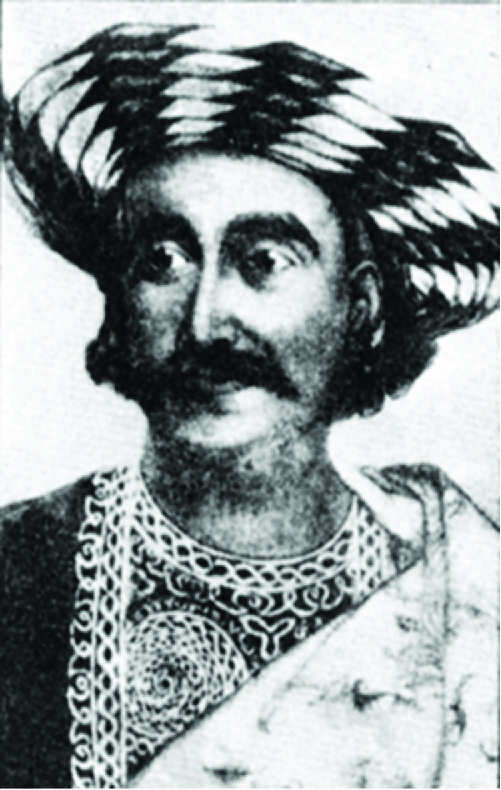
India’s economy was not completely destroyed by the British presence, however, and Indian entrepreneurs invested in industrial development. For example, Dwarkanath Tagore, a member of a wealthy Hindu family, founded a bank and purchased hand-manufacturing operations (Figure 9.10). Eager to work with the British, he pooled his money with that of British investors to open India’s first coal mine in 1834 and to build sugar refineries and textile factories. Other Indians also invested in such ventures, especially cloth production. Indeed, at the time Britain entered the Second Industrial Revolution, Indian textile factories were successfully competing with British ones selling cloth in China.
英語のヒント
それでも、英国の存在によってインド経済が完全に破壊されたわけではなく、インドの起業家は産業発展に投資した。例えば、裕福なヒンドゥー教徒の家の出身であるドワルカナート・タゴールは、銀行を設立し、手工業の事業所を買い取った(図9.10)。英国人との協働に熱心で、自分の資金と英国投資家の資金を合わせて、1834年にインド初の炭鉱を開き、製糖所と繊維工場を建てた。他のインド人も、特に布の生産などの事業へ投資した。実際、英国が第2次産業革命に入った時点では、インドの繊維工場は、中国で綿布を売る英国の工場と十分に競争していた。
Dwarkanath Tagore.ドワルカナート・タゴール
(credit: “Dwarkanath Tagore” by Unknown/Wikimedia Commons, Public Domain) · Public Domain
Figure 9.10 Indian industrialist Dwarkanath Tagore invested in coal mines and textile factories. He was also a partner in a company that traded opium to China. (credit: “Dwarkanath Tagore” by Unknown/Wikimedia Commons, Public Domain)
図9.10 インドの実業家ドワルカナート・タゴールは、炭鉱と繊維工場へ投資した。中国へのアヘン貿易を行う会社の共同経営者でもあった。(出典:「Dwarkanath Tagore」/Unknown/Wikimedia Commons、Public Domain)
Ultimately, though, Indian textiles could not compete with British products on price. One part of the Indian economy that Britain did encourage was cash-crop agriculture. Small farmers unable to pay British taxes were evicted from their lands, which were combined with others and transformed into cotton plantations. The loss of food-producing land in the late eighteenth century led to devastating famines that killed some thirty million people. Thus India was transformed from a manufacturing nation into an export economy, producing primarily raw materials such as cotton but also tea and sugar for use by the British and opium for the British to sell in China.
英語のヒント
しかし結局、インドの織物は価格で英国製品に対抗できなかった。英国が奨励したインド経済の分野の一つは、換金作物農業だった。英国の税を払えない小農は土地を追われ、その土地は他の土地とまとめられ、綿花プランテーションに変えられた。18世紀後半に食料生産地が失われたことで壊滅的な飢饉が起き、およそ3,000万人が死亡した。こうしてインドは製造業の国から輸出経済へと変えられ、主に綿花などの原料に加え、英国向けの茶と砂糖、英国が中国で売るアヘンを生産するようになった。
Egyptエジプト
A similar process of deindustrialization took place in Egypt, but there British influence was only one of the reasons. In 1805, Muhammad Ali, an Albanian army commander in the service of the Ottoman Empire, gained control of Egypt with the assistance of Egyptian political and religious leaders and replaced the viceroy who had governed on behalf of the Ottoman sultan Selim III. In 1811, Muhammad Ali won Egypt’s effective (although not formal) independence from the Ottoman Empire by defeating the Mamluks, the ruling dynasty of formerly enslaved soldiers who had guarded the country for the Ottomans. To reinforce his authority, he adopted the title khedive of Egypt, a designation above a viceroy and only one step below the reigning sultan.
英語のヒント
同様の脱工業化はエジプトでも起きたが、そこでは英国の影響は理由の一つにすぎなかった。1805年、オスマン帝国に仕えるアルバニア人の軍司令官ムハンマド・アリーが、エジプトの政治・宗教指導者の助けを受けて支配権を握り、スルタン・セリム3世に代わって統治していた総督を追放した。1811年、ムハンマド・アリーは、オスマン帝国のためにエジプトを守ってきた元奴隷兵の支配王朝、マムルークを破り、正式ではないものの実質的な独立を勝ち取った。自らの権威を強めるため、総督より上で、在位中のスルタンのすぐ下に位置する、エジプトのヘディーヴという称号を用いた。
As Egypt’s new ruler, Muhammad Ali set out to modernize it. He encouraged the peasantry to grow cotton during the winter months, when they were not growing food crops, and sold the cotton to Britain. He used the profits to modernize Egypt’s army, purchase ships for a modern navy, build irrigation systems to grow more cotton, and establish a weapons foundry. He reformed Egypt’s educational system, built a military college, and founded a medical college for women. He built paper mills, sugar refineries, and textile factories using imported European machinery and technicians. Under Muhammad Ali’s rule, Egyptian landowners prospered. Peasants, however, resented both the forced labor system employed in many construction projects and conscription into the army. Many ran away or deliberately crippled themselves to avoid them.
英語のヒント
新たな支配者として、ムハンマド・アリーはエジプトの近代化に取りかかった。食料作物を育てていない冬季に綿花を栽培するよう農民に奨励し、その綿花を英国へ売った。利益を使い、陸軍を近代化し、近代的海軍の船を購入し、綿花増産のため灌漑設備を建設し、兵器鋳造所を設けた。教育制度を改革し、陸軍学校と女性のための医学校を設立した。ヨーロッパの機械と技術者を輸入して、製紙工場、製糖所、繊維工場も建設した。彼の統治下で地主は繁栄した。農民は、多くの建設事業で使われた強制労働制度と軍への徴兵の両方に反感を抱いた。多くは逃亡し、それらを避けるため意図的に自らの身体を損なう者もいた。
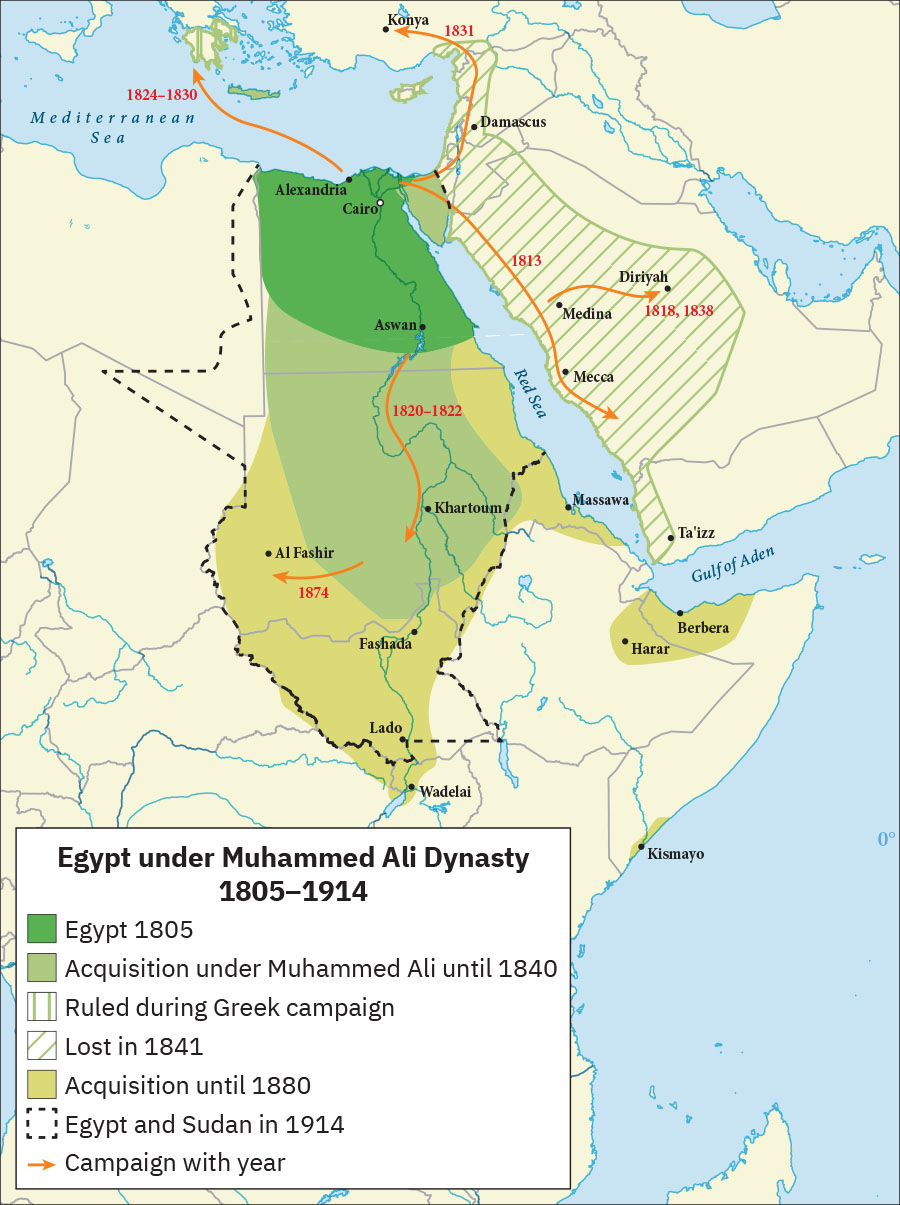
Muhammad Ali also used his army to expand his domains. He seized the western part of the Arabian Peninsula and most of Sudan as well as Crete and Syria (Figure 9.11). Alarmed by his military success, the Ottoman sultan called upon the European powers for assistance. Faced with a blockade of the Nile by the British and Austrians, Muhammad Ali was forced at the Convention of London in 1840 to reduce his army, dissolve his navy, and give up all the territory he had claimed except Egypt and Sudan. In exchange he won the right to establish hereditary rule for his family in Egypt.
英語のヒント
ムハンマド・アリーは軍を用いて領土も広げた。アラビア半島西部、スーダンの大部分、クレタ島、シリアを占領した(図9.11)。軍事的成功に危機感を抱いたオスマン帝国のスルタンは、ヨーロッパ列強に援助を求めた。英国とオーストリアによるナイル川封鎖に直面したムハンマド・アリーは、1840年のロンドン協定で、陸軍の縮小、海軍の解散、エジプトとスーダンを除く獲得領土の放棄を強いられた。引き換えに、エジプトで一族の世襲統治を確立する権利を得た。
Egypt Under the Rule of Muhammad Ali’s Family.ムハンマド・アリー家統治下のエジプト
(credit: modification of work “Map of Egypt under Muhammad Ali Dynasty in English” by Don-kun, Eric Gaba/Wikimedia Commons, CC BY 3.0) · CC BY 3.0
Figure 9.11 Under the rule of Muhammad Ali’s family, Egypt temporarily extended its power into the Sudan and what are now Saudi Arabia and Syria. (credit: modification of work “Map of Egypt under Muhammad Ali Dynasty in English” by Don-kun, Eric Gaba/Wikimedia Commons, CC BY 3.0)
図9.11 ムハンマド・アリー家の統治下で、エジプトは一時的に、スーダンおよび現在のサウジアラビアとシリアへ勢力を伸ばした。(出典:Don-kun、Eric Gabaによる「Map of Egypt under Muhammad Ali Dynasty in English」を改変/Wikimedia Commons、CC BY 3.0)
The European powers also interfered with Muhammad Ali’s efforts to industrialize. In the 1838 Treaty of Balta Liman with Britain, the Ottoman Empire agreed to abolish monopolies and reduce import taxes on British- and French-made goods, making them cheaper than those produced in Egypt. Lacking coal to power steam engines, Egypt’s factories also could not rapidly produce enough goods to satisfy Egyptian demand. Although Egypt’s manufacturing sector faltered, agriculture boomed, with ready buyers for its sugar and cotton. Needing tax revenues to pay for its military and for foreign imports, the government promoted the growing of cash crops for sale to Europe, and Egypt found itself locked into the role of an export economy.
英語のヒント
ヨーロッパ列強は、ムハンマド・アリーによる産業化の努力にも干渉した。オスマン帝国は1838年に英国と結んだバルタ・リマン条約で、独占を廃止し、英仏製品の輸入税を下げることに同意した。そのため、輸入品はエジプト製品より安くなった。蒸気機関を動かす石炭がなかったエジプトの工場は、国内需要を満たす十分な品物を素早く生産することもできなかった。製造業部門は振るわなかったが、砂糖と綿花にはすぐに買い手がつき、農業は好況を呈した。軍事費と外国からの輸入代金を賄う税収が必要な政府は、ヨーロッパで売る換金作物の栽培を奨励した。こうしてエジプトは、輸出経済という役割に固定されていることに気づいた。