第9章工業化時代の拡張Expansion in the Industrial Age
Asiaアジア
Despite Britain’s expansion into Africa, India remained its most important overseas territory. India had been a possession of the British East India Company, which directly ruled approximately half of India. In 1857, however, Muslim and Hindu soldiers in the company’s employ, known as sepoys, rose in revolt. In 1858, following the British army’s suppression of the revolt, Parliament disbanded the British East India Company and took control of the territory it had ruled. Local rulers whose authority the East India Company acknowledged and who had remained loyal were left in nominal control of their kingdoms, but in reality, they became subservient to Britain. Queen Victoria was officially proclaimed empress of India in 1876, and the last Mughal emperor, who had not been active in the revolt, was sent into exile. This transfer of power began the period of direct British rule called the British Raj.
英語のヒント
イギリスがアフリカへ進出しても、インドは引き続き最も重要な海外領土だった。インドはイギリス東インド会社の所有地であり、会社はその約半分を直接統治していた。しかし1857年、会社に雇われ、セポイと呼ばれていたムスリムとヒンドゥー教徒の兵士が反乱を起こした。イギリス軍がこれを鎮圧した後、1858年に議会は東インド会社を解散させ、同社が統治していた領土を支配下に置いた。会社に権威を認められ、忠誠を保っていた現地の支配者には、名目上は自分の王国の統治が残されたが、実際にはイギリスに従属した。1876年、ヴィクトリア女王は正式にインド女帝と宣言され、反乱に積極的に参加していなかった最後のムガル皇帝は追放された。この権力の移行によって、イギリス領インド帝国、すなわちブリティッシュ・ラージと呼ばれる、イギリスの直接統治の時代が始まった。
India supplied Britain’s lifeblood, without which it likely could not have maintained the wealth and power that enabled it to assume supremacy over the rest of the world for most of the nineteenth century. Refusing to impose high tariffs as many industrialized nations did, England was flooded with foreign-made goods that dominated the market. Having converted its economy largely to manufacturing by the mid-nineteenth century, England also depended on trade with other countries for its food supply. As a result, it maintained a negative balance of trade with most of the world; that is, it purchased more from other nations than they purchased from it. This imbalance threatened Britain with economic ruin.
英語のヒント
インドはイギリスの命を支えていた。インドがなければ、19世紀の大半にわたり世界の他地域に君臨することを可能にした富と力を、イギリスは維持できなかっただろう。他の多くの工業国のような高関税を課すことを拒んだイングランドには、外国製品が流入し、市場を支配した。19世紀半ばまでに経済の大部分を製造業へ転換していたイングランドは、食料供給も外国との貿易に依存していた。その結果、世界の大半の地域との間で貿易赤字を抱えた。つまり、他国がイングランドから買う額より、イングランドが他国から買う額の方が多かった。この不均衡は、イギリスに経済的破綻の危機をもたらした。
India saved Britain from this fate, though at great cost to the Indian people. To reduce Britain’s trade imbalances, Indian farmers were forced to grow cash crops such as cotton and tea to maintain British factories and households. High excise taxes were imposed on Indian textiles, making English fabrics cheaper for Indian consumers to buy than those made in their own country. British officials imposed high taxes on the Indian people to pay the British soldiers and officials stationed in India. The tax revenue also went to purchase rails, locomotives, and wire from Britain for railroads and telegraph lines in India. Built primarily to transport British manufactured goods into the interior for sale and Indian cash crops to the coast for transport to the British Isles, the new infrastructure benefited the colonizers far more than the colonized.
英語のヒント
インドはイギリスをこの運命から救ったが、インドの人々は大きな犠牲を払った。イギリスの貿易不均衡を減らすため、インドの農民は、イギリスの工場や家庭を支える綿花・茶などの換金作物の栽培を強いられた。インドの織物には高い物品税がかけられ、インドの消費者にとっては、自国製品よりイギリスの織物の方が安く買えるようになった。イギリスの官僚は、インド駐留のイギリス兵と官僚の給与を支払うため、インドの人々に重税を課した。税収は、インドの鉄道や電信線のため、イギリスからレール・機関車・電線を購入することにも使われた。新しい社会基盤は主として、イギリス製品を内陸へ運んで売り、インドの換金作物をイギリス諸島へ送るため海岸へ運ぶ目的で造られ、植民地化された側より、支配する側にはるかに大きな利益を与えた。
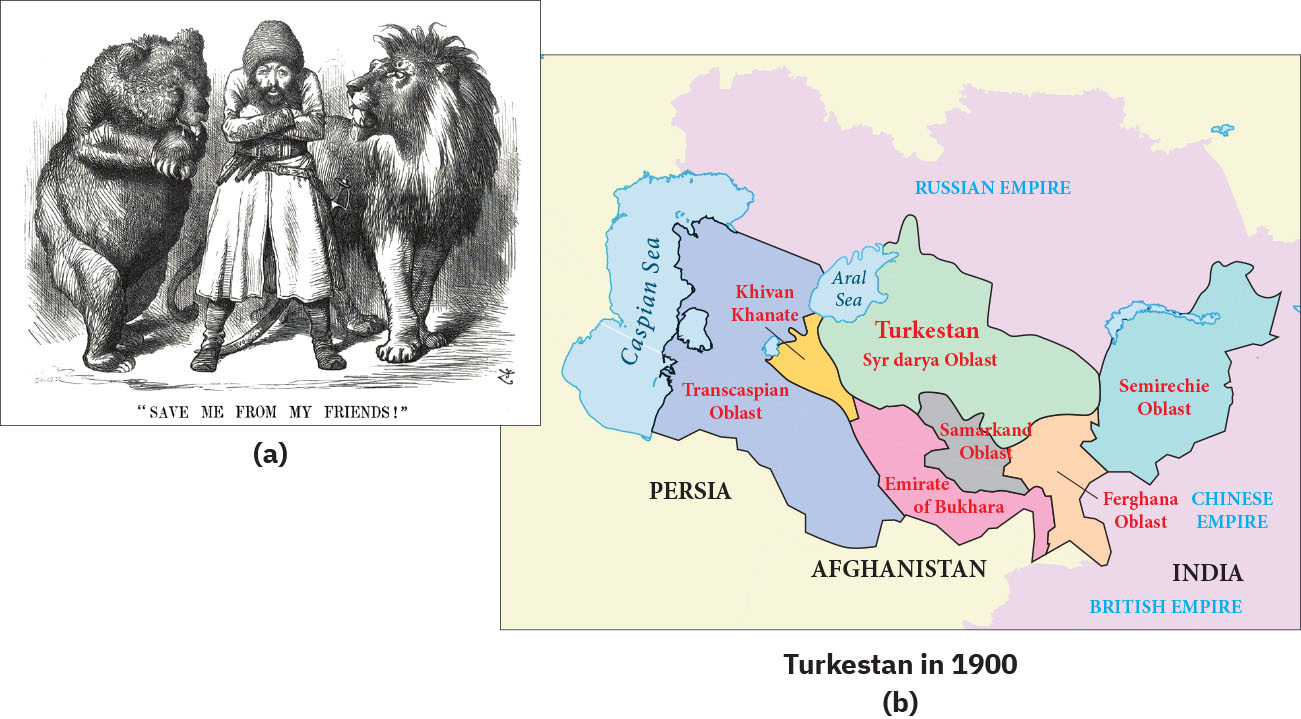
British attempts to gain control over regions of Asia beyond India and Hong Kong were often frustrated by Russia, which also sought to expand its influence there. The ongoing struggle between the two was called The Great Game. From the 1850s through the 1870s, Russia gained control of kingdoms occupied by Turkic-speaking peoples in central Asia and incorporated them into its empire as a region called Turkestan (Figure 9.22). Russia argued that its actions were necessary to “civilize” the region’s inhabitants and protect important trade routes. Britain feared Russia would try to absorb India as well. To protect its prized possession, Britain sought to use the Emirate of Afghanistan as a buffer zone. When its diplomats were refused admission to Afghanistan in 1878, the British army invaded. Britain emerged victorious, gaining the right to act as a go-between for Afghanistan and Russia. When Russia gained control of much of what is now Turkmenistan in 1881, the two European nations jointly established the boundary line between an independent Afghanistan and Russian territory, ending a serious conflict between the two powers.
英語のヒント
イギリスがインドと香港の外のアジア地域を支配しようとすると、同じく影響力の拡大を求めるロシアによって、しばしば阻まれた。両国の継続的な争いは「グレート・ゲーム」と呼ばれた。1850年代から1870年代にかけて、ロシアは中央アジアのテュルク語系の人々が住む王国を支配し、トルキスタンという地域として帝国に組み込んだ(図9.22)。ロシアは、地域住民を「文明化」し、重要な交易路を保護するために必要な行動だと主張した。イギリスは、ロシアがインドをも取り込もうとするのではないかと恐れた。大切な領土を守るため、イギリスはアフガニスタン首長国を緩衝地帯として使おうとした。1878年、外交使節がアフガニスタンへの入国を拒まれると、イギリス軍は侵攻した。勝利したイギリスは、アフガニスタンとロシアの仲介者となる権利を得た。1881年にロシアが現在のトルクメニスタンの大部分を支配すると、両欧州大国は独立国アフガニスタンとロシア領の境界を共同で定め、深刻な対立を終わらせた。
The Great Game.グレート・ゲーム。
(credit a: modification of work “Great Game cartoon from 1878” by Punch/Wikimedia Commons, Public Domain; attribution b: Copyright Rice University, OpenStax, under CC BY 4.0 license) · Public Domain + CC BY 4.0
Figure 9.22 (a) This 1878 cartoon shows the Afghan Emir Sher Ali Khan poised between the competitors Russia and Britain. (b) In the middle of the nineteenth century, Russia added the region it called Turkestan to its empire by conquering Turkic-speaking kingdoms in central Asia. (credit a: modification of work “Great Game cartoon from 1878” by Punch/Wikimedia Commons, Public Domain; attribution b: Copyright Rice University, OpenStax, under CC BY 4.0 license)
図9.22 (a)1878年のこの風刺画は、競い合うロシアとイギリスの間に立つ、アフガニスタンの首長シェール・アリー・ハーンを示す。(b)19世紀半ば、ロシアは中央アジアのテュルク語系の王国を征服し、トルキスタンと呼ぶ地域を帝国に加えた。(クレジットa:「Great Game cartoon from 1878」を改変、『Punch』/Wikimedia Commons、パブリックドメイン。出典b:著作権 Rice University、OpenStax、CC BY 4.0ライセンス)
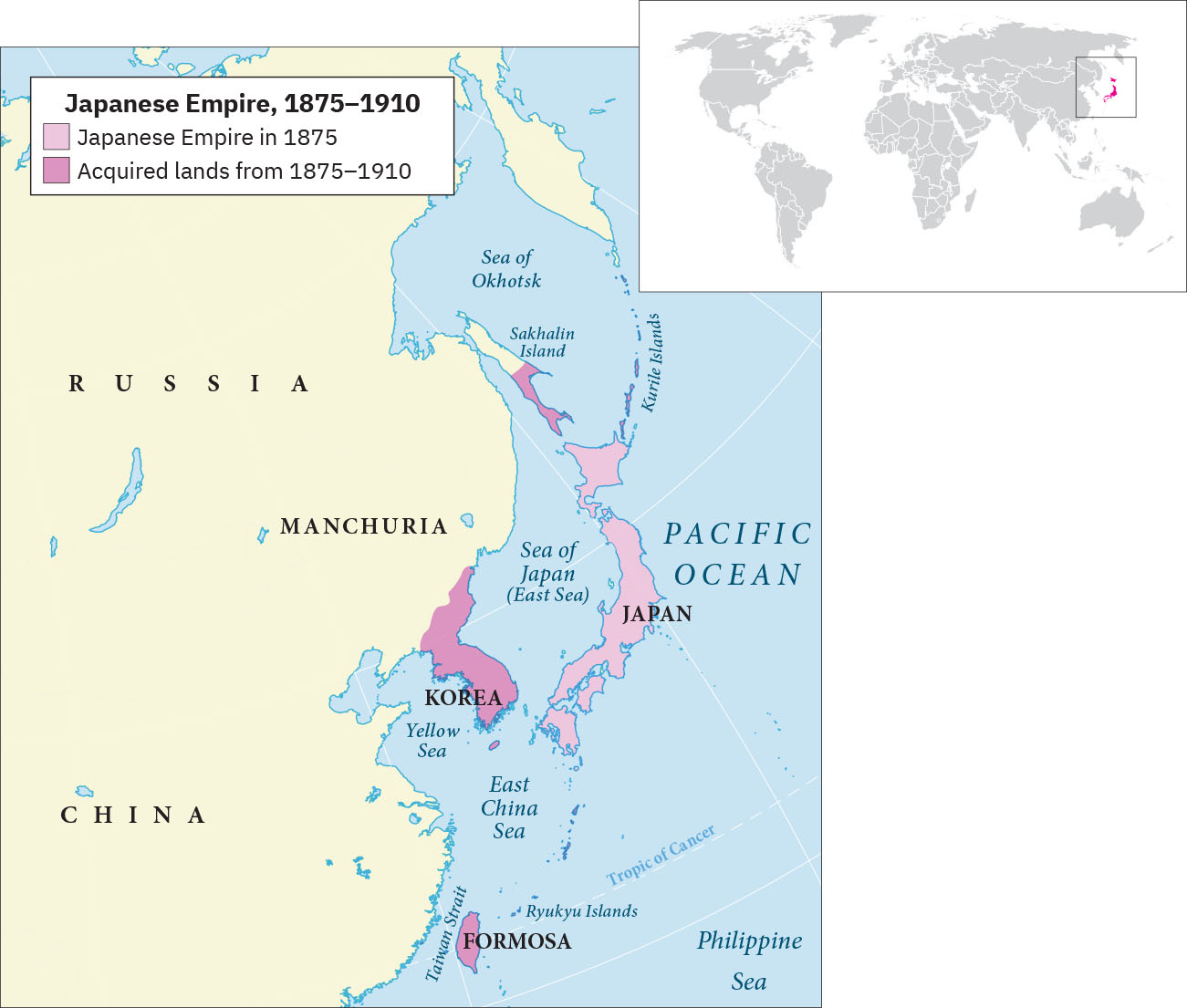
Russia also desired to expand control over the far eastern end of its empire, on the Pacific coast. Here, however, it found itself in conflict with a new imperial power—Japan. Lacking many of the raw materials necessary for industrialization, Japan, like other industrialized nations, began to seek them abroad. It first took control of the Ryukyu Islands and also claimed the Kurile Islands and Sakhalin Island (Figure 9.23). Russia, however, also laid claim to these territories, and for a while the two nations shared Sakhalin Island. In 1875, Japan relinquished its claims to the island in exchange for complete control over the Kurile Islands.
英語のヒント
ロシアは、帝国の極東端にあたる太平洋沿岸でも支配を拡大しようとした。しかし、ここでは新たな帝国主義大国、日本との対立が生じた。工業化に必要な原材料の多くを欠く日本は、他の工業国と同様、海外でそれを求め始めた。まず琉球諸島を支配し、千島列島と樺太の領有も主張した(図9.23)。しかしロシアもこれらの領土を要求し、一時期、両国は樺太を共同で領有した。1875年、日本は千島列島の完全な支配と引き換えに、樺太への領有権の主張を放棄した。
Japan’s Empire.日本の帝国。
(attribution Japanese Empire map: Copyright Rice University, OpenStax, under CC BY 4.0 license; credit world map: modification of work “Japan Seychelles Locator” by “Bobamnertiopsis”/Wikimedia Commons, Public Domain) · CC BY 4.0 + Public Domain
Figure 9.23 Unlike many European nations, Japan sought colonies closer to home, including the Ryukyu, Kurile, and Sakhalin Islands. (attribution Japanese Empire map: Copyright Rice University, OpenStax, under CC BY 4.0 license; credit world map: modification of work “Japan Seychelles Locator” by “Bobamnertiopsis”/Wikimedia Commons, Public Domain)
図9.23 多くのヨーロッパ諸国とは異なり、日本は琉球・千島・樺太など、本国に近い植民地を求めた。(日本帝国地図の出典:著作権 Rice University、OpenStax、CC BY 4.0ライセンス。世界地図のクレジット:「Japan Seychelles Locator」を改変、作者「Bobamnertiopsis」/Wikimedia Commons、パブリックドメイン)
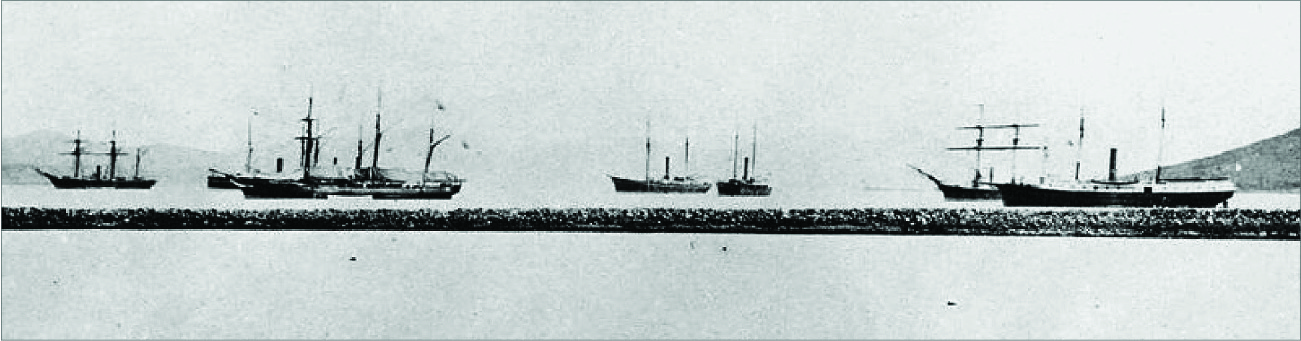
Japan’s most desired prize was Korea, then a largely isolated tributary state of China. Japan traded with Korea but in a limited way. In 1873, however, Korea’s King Gojong began to consider opening the nation to the outside world. Anxious to gain an advantage, in 1876 Japan sent a gunboat to force Korea to sign the Japan-Korea Treaty of Amity (Ganghwa Treaty) before it could make commercial treaties with other nations. Among other provisions, the treaty allowed the Japanese to establish trading ports in addition to the one to which they already had access. It also let Japanese merchants live and work in Korea while subject only to Japanese law. In addition, Korea was declared to no longer be a tributary state of China (Figure 9.24).
英語のヒント
日本が最も欲しがったのは、当時はおおむね外部から孤立し、中国の朝貢国だった朝鮮だった。日本は朝鮮と貿易していたが、その規模は限られていた。しかし1873年、朝鮮国王の高宗は対外開放を検討し始めた。優位を得ることを急いだ日本は、朝鮮が他国と通商条約を結ぶ前に、1876年に砲艦を送り、日朝修好条規(江華島条約)の締結を強いた。この条約はさまざまな条項の中で、すでに利用できた港に加え、日本人が通商港を設けることを認めた。日本の商人は朝鮮に住んで仕事をしながら、日本法にだけ従えばよいことにもなった。さらに、朝鮮はもはや中国の朝貢国ではないと宣言された(図9.24)。
Opening Korea to Trade.朝鮮の通商開放。
(credit: modification of work “Kanfado Kantai” by Unknown/Wikimedia Commons, Public Domain) · Public Domain
Figure 9.24 Ships from the Japanese navy sail to Ganghwa Island, Korea, in this photograph made in 1876. Soon, Japan controlled all of Korea. (credit: modification of work “Kanfado Kantai” by Unknown/Wikimedia Commons, Public Domain)
図9.24 1876年に撮影されたこの写真では、日本海軍の船が朝鮮の江華島へ向かっている。やがて日本は朝鮮全土を支配した。(クレジット:「Kanfado Kantai」を改変、作者不詳/Wikimedia Commons、パブリックドメイン)
China did not wish to relinquish its control so easily, and a series of uprisings and mutinies in Korea in the 1880s gave it the opportunity to reassert its authority. In 1885, however, both Japan and China agreed to withdraw military forces from the peninsula in 1885. Although this temporarily prevented armed conflict between Japan and China, hostilities between the two soon commenced. In 1894, the pro-Japanese Korean leader Kim Ok-Kyun was murdered in Shanghai, and an outraged Japan awaited an opportunity to confront the Chinese. That same year, the Donghak Rebellion swept Korea as disgruntled peasants demanded social reforms, giving China an excuse to dispatch a military force to Korea in violation of its agreement with Japan. Japan in turn sent troops to confront the Chinese, and the First Sino-Japanese War began.
英語のヒント
中国は簡単に支配を手放そうとはせず、1880年代に朝鮮で起きた一連の蜂起や軍の反乱は、その権威を再主張する機会となった。しかし1885年、日本と中国はともに半島からの軍の撤退に合意した。これによって両国の武力衝突は一時的に防がれたが、間もなく戦闘が始まった。1894年、親日的な朝鮮の指導者、金玉均が上海で殺害され、憤激した日本は中国と対決する機会をうかがった。同年、不満を持つ農民が社会改革を要求して東学農民運動が朝鮮全土に広がり、中国は、日本との協定に違反して朝鮮に軍を派遣する口実を得た。これに対して日本も中国軍と対峙するため出兵し、日清戦争が始まった。
Although China had the larger military force by far, Japan’s navy was much more modern and defeated the Chinese handily. Humiliated, China signed the Treaty of Shimonoseki in 1895, which recognized Korea’s independence and conceded to Japan territory on the Liaodong Peninsula in Manchuria as well as Taiwan and the Penghu Islands. Japan had now acquired an empire. Japan quickly realized, however, that it would have to defend its gains from its old rival Russia. In 1896, Koreans, angered by the assassination of their pro-Chinese queen by Japanese agents, overthrew the pro-Japanese government then in power. As Japanese influence waned, Russian influence grew, and Russia soon acquired mineral and timber rights in the northern Korean peninsula.
英語のヒント
中国の兵力ははるかに大きかったが、日本海軍はずっと近代的で、中国軍を難なく破った。屈辱を受けた中国は1895年に下関条約を結び、朝鮮の独立を認め、満州の遼東半島の領土、台湾、澎湖諸島を日本に割譲した。日本は今や帝国を獲得した。しかし、その獲得物を古くからの競争相手ロシアから守る必要があることに、すぐ気づいた。1896年、日本人の手先による親中国派の王妃の暗殺に怒った朝鮮人は、当時の親日政権を打倒した。日本の影響力が弱まるとロシアの影響力が強まり、ロシアは間もなく朝鮮半島北部の鉱物・木材の権益を得た。
Russia also began to encroach upon Japanese territory in Manchuria. Russia’s one Pacific port, Vladivostok, was often frozen over. Seeking a harbor that was ice-free year-round, Russia leased land from China on the Liaodong Peninsula in 1897 and built a new port, Port Arthur. A wary Japan offered Russia free rein on the Liaodong Peninsula in exchange for Japan’s retaining control over Korea. When Russia refused to compromise, Japan attacked the Russian fleet at Port Arthur in the winter of 1904, beginning the Russo-Japanese War. Once again, Japan emerged victorious over a much larger nation. The Treaty of Portsmouth, signed in September 1905, acknowledged Japan’s right to Korea and awarded Japan control of southern Manchuria. Japan formally annexed Korea in 1910.
英語のヒント
ロシアは満州の日本領にも侵入し始めた。ロシアの太平洋側の唯一の港、ウラジヴォストクは、しばしば凍結した。通年で氷に閉ざされない港を求め、ロシアは1897年に遼東半島の土地を中国から租借し、新しい港、旅順港を築いた。警戒した日本は、朝鮮への支配を維持する代わりに、遼東半島ではロシアの自由な行動を認めると提案した。ロシアが妥協を拒むと、日本は1904年冬に旅順のロシア艦隊を攻撃し、日露戦争が始まった。再び日本は、はるかに大きな国に勝利した。1905年9月に結ばれたポーツマス条約は、日本の朝鮮に対する権利を承認し、南満州の支配を日本に与えた。日本は1910年に朝鮮を正式に併合した。
As Japan, Russia, and Britain competed for control of Asia, France largely refrained. Its principal interest on the continent of Asia was Indochina (now Vietnam, Laos, and Cambodia). In 1858, the emperor of Vietnam ordered French missionaries in the country to leave. In response, Napoleon III sent gunboats to protect the missionaries and their Christian converts and forced the emperor to grant France control over three southern provinces. When the Vietnamese ruler proved unwilling to abide by the terms, troops returned in 1862, forcing him to concede yet more territory. By 1887, France had established protectorates over the remaining provinces of Vietnam and over Cambodia, a vassal state of the emperor of Siam (now Thailand). Laos, also Siamese territory, became part of French Indochina after a brief military conflict between Siam and France in 1893.
英語のヒント
日本・ロシア・イギリスがアジアの支配を争う間、フランスはおおむね参加を控えた。アジア大陸における主な関心は、インドシナ(現在のベトナム・ラオス・カンボジア)だった。1858年、ベトナム皇帝は国内のフランス人宣教師に退去を命じた。これに対しナポレオン3世は、宣教師とキリスト教に改宗した人々を保護するため砲艦を送り、南部3省の支配をフランスに与えるよう皇帝に強いた。ベトナムの支配者が条件に従う意思を示さなかったため、1862年にフランス軍が戻り、さらに領土を譲渡させた。1887年までにフランスは、ベトナムの残る諸省と、シャム(現在のタイ)王の属国だったカンボジアを保護国とした。同じくシャム領だったラオスも、1893年のシャムとフランスの短い軍事衝突の後、フランス領インドシナの一部となった。
China could do little as Asia was devoured. By the second half of the nineteenth century, China was a shadow of its former self. Defeat in the Opium Wars of 1839 and 1856 had weakened it, and the peace treaties concluding the Second Opium War had forced it to open additional ports and allow British, French, Russian, and U.S. citizens to travel freely and enjoy the right of extraterritoriality, meaning that while in China they were subject only to the laws of their own countries. China was also forced to allow the practice of Christianity.
英語のヒント
アジアがむさぼり取られる中、中国にできることはほとんどなかった。19世紀後半までに、中国にはかつての面影しか残っていなかった。1839年と1856年に始まったアヘン戦争での敗北によって弱体化し、第二次アヘン戦争を終結させた講和条約で、さらに港を開き、イギリス・フランス・ロシア・アメリカの国民が自由に旅行し、治外法権を享受することを認めさせられた。治外法権とは、中国にいても自国の法律にだけ従うということである。中国は、キリスト教の信仰を認めることも強いられた。
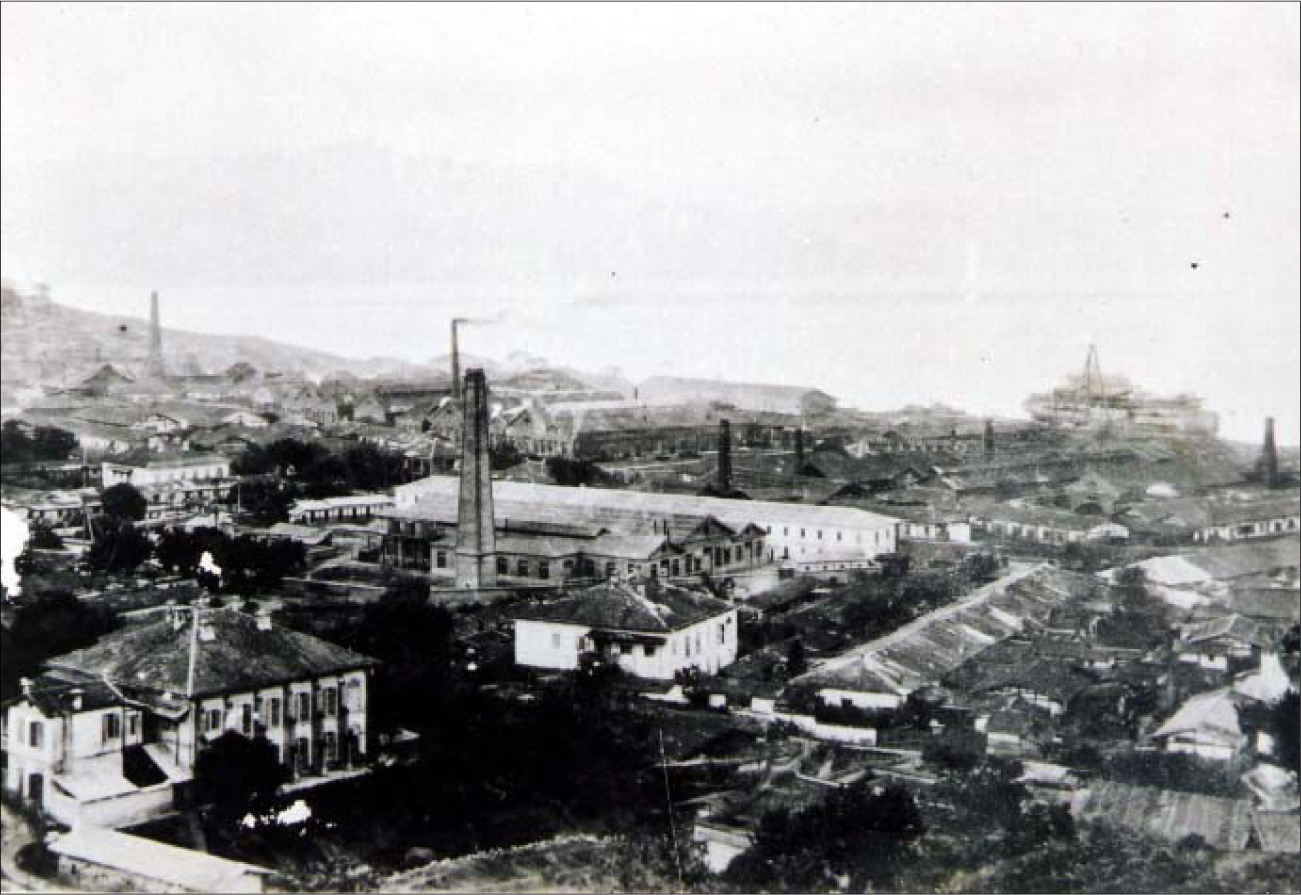
Alarmed by their nation’s inability to defend itself against foreign threats, many Chinese in the 1860s began to call for reform. Among them was Feng Guifen, a scholar and government official who advocated the adoption of western military technology and the study of western science. Military leaders such as Zeng Guofan and Li Hongzhang also supported these reforms. The reformist Self-Strengthening Movement was championed by Prince Gong, who had negotiated with the British and French invaders in 1860. Arsenals to build and house modern weapons and shipyards to construct modern warships were established (Figure 9.25). Efforts were made to build railroad and telegraph lines and to open iron and coal mines. Although they still clung to traditional Confucian values, the leaders of the movement also advocated educational reform with a new emphasis on mathematics, science, and foreign languages (so foreign books could be translated) instead of the Confucian classics. They regarded the Self-Strengthening Movement as a way of saving the Qing dynasty, not undermining it.
英語のヒント
外国の脅威から自国を守れないことに危機感を抱き、1860年代、多くの中国人が改革を求め始めた。その一人、学者で官僚の馮桂芬は、西洋の軍事技術の採用と西洋科学の研究を主張した。曽国藩や李鴻章のような軍事指導者も改革を支持した。改革派の洋務運動を推進したのは、1860年に英仏の侵略軍と交渉した恭親王だった。近代兵器を製造・保管する兵器廠と、近代的な軍艦を造る造船所が設けられた(図9.25)。鉄道や電信線の建設、鉄鉱山や炭鉱の開発も進められた。運動の指導者は伝統的な儒教の価値観に固執しつつも、儒教の経典に代えて、数学・科学・外国語(外国の書物を翻訳するため)を新たに重視する教育改革も唱えた。彼らは洋務運動を、清朝を弱めるのではなく救う手段とみなした。
Fuzhou Arsenal.福州船政局。
(credit: “Foochow arsenal in Mawei” by Unknown/Wikimedia Commons, Public Domain) · Public Domain
Figure 9.25 The Fuzhou Arsenal in Mawei was built as part of China’s Self-Strengthening Movement. This photograph was taken in about 1880. (credit: “Foochow arsenal in Mawei” by Unknown/Wikimedia Commons, Public Domain)
図9.25 馬尾の福州船政局は、中国の洋務運動の一環として建設された。この写真は1880年ごろに撮影された。(クレジット:「Foochow arsenal in Mawei」、作者不詳/Wikimedia Commons、パブリックドメイン)
Efforts to modernize did not go unopposed. Government officials steeped in Confucian learning regarded the new emphasis on science and technology as a threat to their power. Many Chinese were also reluctant to allow foreigners to invest in or own railways or factories. The Self-Strengthening Movement received a serious blow in 1895 with China’s defeat by Japan in the First Sino-Japanese War. Critics of the movement questioned why China was trying to change when the changes did not bring the military power reformers had promised.
英語のヒント
近代化の取り組みに反対がなかったわけではない。儒学に深く浸った官僚たちは、科学技術を新たに重視する動きを、自分たちの権力への脅威とみなした。外国人が鉄道や工場に投資したり所有したりすることを認めたがらない中国人も多かった。1895年、日清戦争で中国が日本に敗れると、洋務運動は深刻な打撃を受けた。運動の批判者は、改革者が約束した軍事力を変革がもたらさないのなら、なぜ中国は変わろうとするのかと問いただした。
Following China’s defeat in 1895, European nations and the United States pushed for even more advantages. France gained control over the provinces of Guizhou, Guangxi, and Yunnan. Britain extended its influence along the Yangtze River Valley. Germany was given control of the Yellow River Valley to the north as well as the Shandong Peninsula and Jiaozhou Bay. Soon nearly all the industrialized nations had been granted concessions, enclaves within port cities such as Tianjin and Shanghai, where they exercised the rights of extraterritoriality.
英語のヒント
1895年の中国の敗北後、ヨーロッパ諸国とアメリカは、さらに多くの利権を求めた。フランスは貴州・広西・雲南の各省を支配した。イギリスは長江流域で影響力を広げた。ドイツには、山東半島と膠州湾に加え、北の黄河流域の支配が与えられた。間もなくほぼすべての工業国に租界が認められた。租界は天津や上海などの港湾都市内にある飛び地で、各国はそこで治外法権を行使した。
In 1900, several of these nations signed a treaty with the Chinese government at the urging of John Hay, the U.S. secretary of state. The treaty established an Open Door policy in which China agreed to trade with all countries on the same terms. In this way, none of the industrialized powers could gain an advantage over the others. In exchange, they promised not to annex any of China’s territory.
英語のヒント
1900年、アメリカ国務長官ジョン・ヘイの働きかけで、これらの国々の一部が中国政府と条約を結んだ。条約は門戸開放政策を定め、中国はすべての国と同じ条件で貿易することに同意した。これにより、工業列強のいずれも他国より有利な立場を得られなくなった。その代わりに各国は、中国の領土を一切併合しないと約束した。