第9章工業化時代の拡張Expansion in the Industrial Age
Belgiumベルギー
Belgium was one of the smallest industrialized nations, and its legislators did not believe it had the money or force to acquire and maintain colonial possessions. However, Belgium’s second king, the constitutional monarch Leopold II, dreamed of establishing an empire in the Congo Basin of Central Africa and was not to be dissuaded. The region was relatively unexplored by Europeans and rich in resources like ivory and rubber, and no other European powers claimed it. In 1876, Leopold established the International African Association. Its goal, he claimed, was to “civilize” the natives of Africa and dispense humanitarian aid.
英語のヒント
ベルギーは工業国の中でも特に小さく、議員たちは、植民地を獲得し維持する資金や軍事力が自国にあるとは考えていなかった。しかし、ベルギー第2代国王で立憲君主のレオポルド2世は、中央アフリカのコンゴ盆地に帝国を築くことを夢見ており、思いとどまろうとしなかった。この地域はヨーロッパ人による探検があまり進んでおらず、象牙やゴムなどの資源に恵まれ、他のヨーロッパ列強も領有を主張していなかった。1876年、レオポルドは国際アフリカ協会を設立した。その目的はアフリカの先住民を「文明化」し、人道援助を与えることだと、彼は主張した。
Leopold’s noble-sounding statements were lies, however. Although Britain and France were leery of his interest in the Congo, at the Berlin Conference in 1884 he promised he would impose no tariffs on the colony’s imports and had in mind only the benefit of the Congolese natives. Control of the Congo thus was given to him. He named it the Congo Free State and ruled it entirely as his own private colony; it did not belong to the nation of Belgium. Although Leopold kept his promise to make it a free-trade zone, Europeans there were free to exploit and abuse African laborers in the pursuit of profit.
英語のヒント
しかし、レオポルドの高潔に聞こえる発言は嘘だった。イギリスとフランスは彼のコンゴへの関心を警戒したが、1884年のベルリン会議で彼は、植民地への輸入に関税を課さず、コンゴの先住民の利益しか考えていないと約束した。こうしてコンゴの支配は彼に与えられた。彼はそれをコンゴ自由国と名づけ、全面的に自分の私有植民地として統治した。それはベルギーという国家に属していたのではない。レオポルドは自由貿易地域にするという約束を守ったが、そこにいるヨーロッパ人は、利益を追求するためアフリカ人労働者を自由に搾取し虐待できた。
Germanyドイツ
Germany came late to the scramble for colonies, delayed by a number of factors. Until 1871, it consisted of a variety of German-speaking states and kingdoms in northern and central Europe, none wealthy or powerful enough to establish colonies. Once unified as a country in 1871, it still did not possess the ocean-going navy needed to trade with and defend colonies, and its first chancellor, Otto von Bismarck, in office from 1871 until 1890, initially had no interest in an overseas empire.
英語のヒント
ドイツはさまざまな要因で遅れ、植民地争奪への参加も遅かった。1871年までは北欧・中欧の多様なドイツ語圏の国々や王国からなり、植民地を築くほど裕福で強力な国はなかった。1871年に一国として統一された後も、植民地との交易やその防衛に必要な外洋海軍を持たず、1871~1890年に在職した初代宰相オットー・フォン・ビスマルクも、当初は海外帝国に関心がなかった。
Bismarck originally believed empire building was a foolish venture that cost more than it returned. But by the 1880s he had changed his mind, perhaps influenced by German merchants who sought trade and investment opportunities overseas, or by public clamor to increase German prestige through the claiming of colonies. In Africa, Germany staked its claim to regions scattered across the continent that had not already been colonized by France and England, from Togoland (today Togo and part of Ghana) and German Cameroon (now parts of Cameroon, Chad, the Central African Republic, and Gabon) in the west to German South-West Africa (now Namibia) and German East Africa (today Rwanda, Burundi, and parts of Tanzania).
英語のヒント
ビスマルクはもともと、帝国建設は収益以上に費用がかかる愚かな事業だと考えていた。しかし1880年代までには考えを変えた。海外の貿易・投資機会を求めるドイツ商人や、植民地を獲得してドイツの威信を高めよという国民の強い要求の影響を受けたのかもしれない。アフリカでドイツは、まだフランスやイギリスが植民地にしていない、大陸各地に散在する地域の領有を主張した。西部のトーゴラント(現在のトーゴとガーナの一部)とドイツ領カメルーン(現在のカメルーン・チャド・中央アフリカ共和国・ガボンの一部)から、ドイツ領南西アフリカ(現在のナミビア)、ドイツ領東アフリカ(現在のルワンダ・ブルンジとタンザニアの一部)までが含まれた。
Italyイタリア
Italy was the last European power to establish colonies in Africa. In 1884, an Italian shipping company bought Assab Bay, a port city on the Red Sea, from a local sultan. In 1886, Italy took control of the Egyptian Red Sea port of Massawa at Britain’s urging to prevent France from acquiring more territory in the region.
英語のヒント
イタリアは、アフリカに植民地を築いた最後のヨーロッパ列強だった。1884年、イタリアの海運会社は紅海の港町アッサブ湾を現地のスルタンから買い取った。1886年には、フランスがこの地域でさらに領土を得るのを防ぐため、イギリスの勧めで、エジプトの紅海沿いの港マッサワを支配した。
In 1889, Italy claimed Eritrea as a colony. It also signed the Treaty of Wuchale with Menelik II, who became emperor of Ethiopia that same year. In the Italian-language version of the treaty, Menelik was promised military and financial aid in exchange for control over Eritrea and its foreign affairs. In the Ethiopian-language version, the emperor had the choice of accepting or rejecting Italian control. When, in 1895, Italy insisted on enforcing the terms of the Italian-language treaty, war began.
英語のヒント
1889年、イタリアはエリトリアを植民地として領有すると主張した。同じ年にエチオピア皇帝となったメネリク2世とは、ウッチャリ条約も結んだ。イタリア語版の条約では、エリトリアとその外交の支配権と引き換えに、メネリクへの軍事・財政援助が約束された。エチオピア語版では、皇帝はイタリアの支配を受け入れるか拒むかを選べた。1895年、イタリアがイタリア語版の条項の履行を要求すると、戦争が始まった。
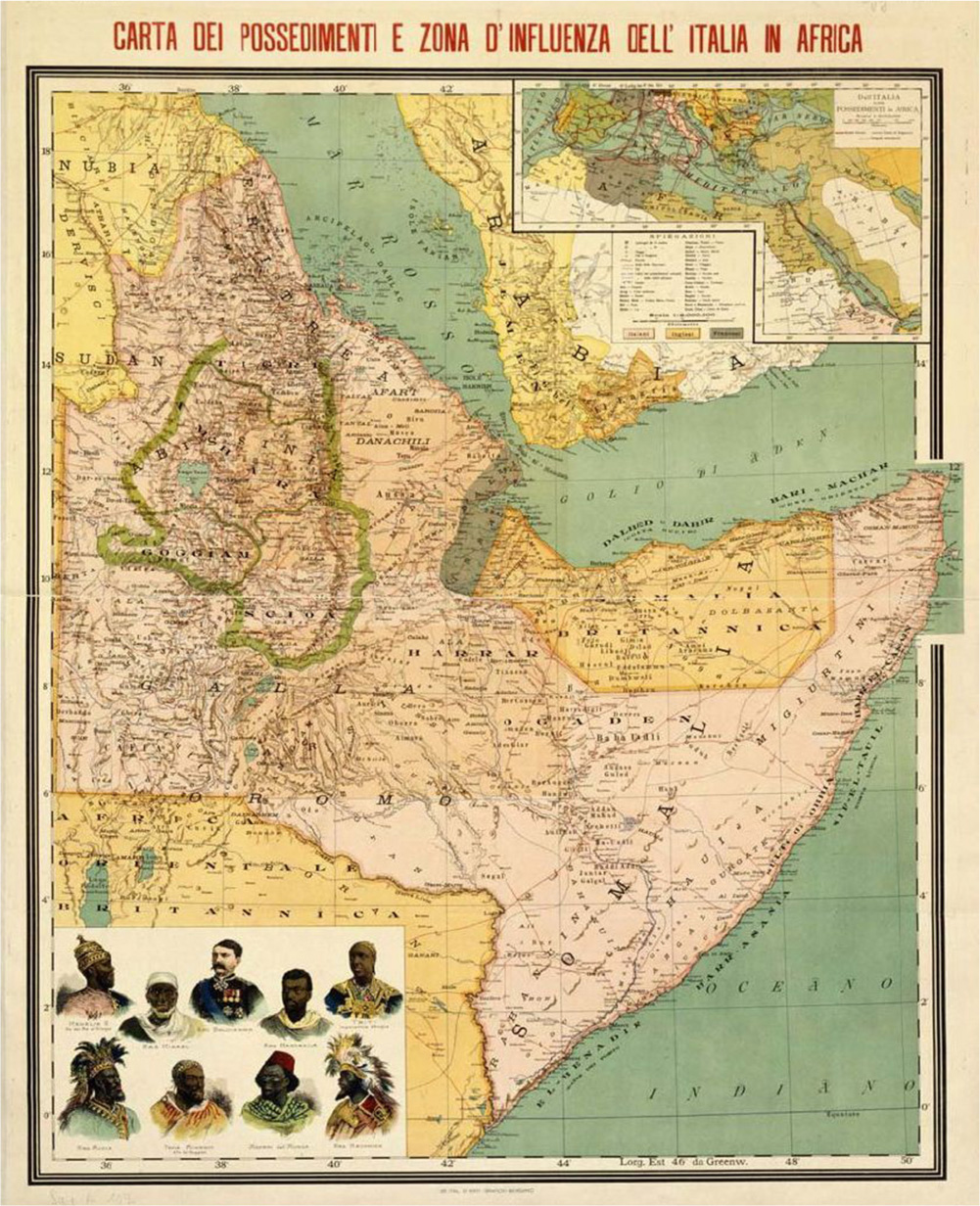
The conflict ended ignominiously for Italy at the 1896 Battle of Adwa, when its troops encountered a much larger Ethiopian force. Six thousand Italians were killed, three thousand were captured, and others fled the battlefield, leaving eleven thousand rifles that the Ethiopians seized. As night fell, Ethiopian peasants fell upon stragglers in the retreat and killed them. Riots broke out in Rome and Naples at the news, and Italians demanded the return of all soldiers and tried to block the troop trains. Adwa largely marked the end of Italy’s expansion in Africa. Menelik II allowed Italy to retain control of Eritrea, but the treaty ending the war reaffirmed Ethiopia’s independence (Figure 9.19).
英語のヒント
1896年のアドワの戦いで、イタリア軍ははるかに大きなエチオピア軍と遭遇し、この紛争はイタリアにとって不名誉な結末を迎えた。イタリア人6000人が戦死し、3000人が捕虜となり、他の兵士は戦場から逃走した。残された小銃1万1000丁は、エチオピア軍が奪った。日が暮れると、エチオピアの農民が退却中に遅れた兵士たちを襲って殺した。この知らせを受けてローマとナポリでは暴動が起き、イタリア人は全兵士の帰還を求め、兵員輸送列車を止めようとした。アドワは、イタリアのアフリカ拡張がほぼ終わったことを示した。メネリク2世はイタリアにエリトリアの支配を維持させたが、講和条約はエチオピアの独立を再確認した(図9.19)。
Italy’s Claims in Africa.イタリアのアフリカ領有権主張。
(credit: “Possessions italiennes en Afrique-1896” by Bibliothèque nationale de France/Wikimedia Commons, Public Domain) · Public Domain
Figure 9.19 Italy grasped the parts of Africa that lay unclaimed by other European powers. This 1896 map of the Horn of Africa shows Italy’s possessions of Italian Eritrea and Italian Somaliland. (credit: “Possessions italiennes en Afrique-1896” by Bibliothèque nationale de France/Wikimedia Commons, Public Domain)
図9.19 イタリアは、他のヨーロッパ列強が領有を主張していないアフリカの地域をつかみ取った。アフリカの角を描く1896年のこの地図は、イタリアの領土であるイタリア領エリトリアとイタリア領ソマリランドを示す。(クレジット:「Possessions italiennes en Afrique-1896」、フランス国立図書館/Wikimedia Commons、パブリックドメイン)
European Powers in Conflict対立するヨーロッパ列強
Although Italy’s expansion in Africa was halted, the other great powers continued to extend their influence, sometimes through their private citizens. Entering South Africa’s diamond trade as a young man, for example, Cecil Rhodes of Britain established a company called De Beers in 1888 that soon monopolized the diamond market. In 1890, Rhodes became prime minister of the Cape Colony.
英語のヒント
イタリアのアフリカ拡張は止まったが、他の大国は、自国の私人を通じることも含め、影響力を広げ続けた。たとえば、若くして南アフリカのダイヤモンド取引に入ったイギリスのセシル・ローズは、1888年にデビアスという会社を設立し、間もなくダイヤモンド市場を独占した。1890年、ローズはケープ植民地の首相となった。
It was Rhodes’s goal to expand the British Empire in South Africa. In 1889, the British government gave him a charter that enabled a company he had formed, the British South Africa Company, to sign treaties with local rulers, gain mineral concessions from them, and essentially rule their lands. Rhodes and his agents thus extended British influence northward from the Limpopo River in South Africa across the Zambezi River to Central Africa, calling the land Rhodesia (now Zambia and Zimbabwe) in 1895.
英語のヒント
ローズの目標は、南アフリカのイギリス帝国を拡大することだった。1889年、イギリス政府は、彼が設立したイギリス南アフリカ会社に特許状を与えた。これにより会社は現地の支配者と条約を結び、鉱業権を得て、事実上その土地を統治できるようになった。ローズとその代理人は、こうして南アフリカのリンポポ川からザンベジ川を越え、中央アフリカへ向けてイギリスの影響力を北に広げ、1895年にその土地をローデシア(現在のザンビアとジンバブエ)と呼んだ。
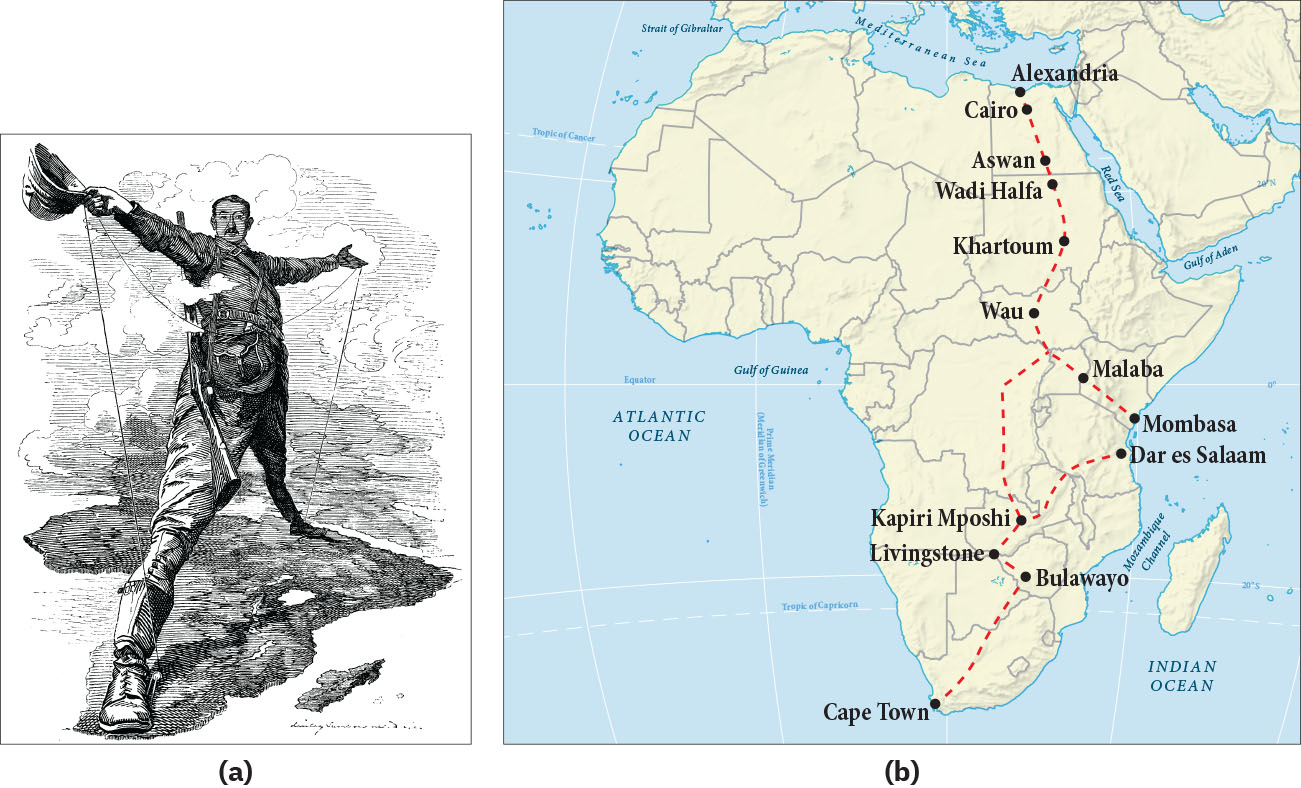
Rhodes’s motives were not only to gain personal wealth and power but also to expand the British presence in Africa and provide room for Anglo-Saxons, whom he considered a superior race, to grow in number. Rhodes was a racist with no respect for Africans. To strengthen British control over Central Africa, where Germany, Belgium, and Portugal also claimed land, he proposed a “Cape to Cairo” railway connecting Britain’s East African colonies (Figure 9.20). This link, he believed, would make it easier to govern the British Empire in Africa and attract more settlers, and the British government agreed.
英語のヒント
ローズの動機は、個人的な富と権力を得ることだけでなく、アフリカでのイギリスの存在を拡大し、彼が優れた人種と考えるアングロサクソン人が数を増やす空間を与えることにもあった。ローズはアフリカ人に敬意を払わない人種差別主義者だった。ドイツ・ベルギー・ポルトガルも領有を主張する中央アフリカでイギリスの支配を強めるため、彼は、イギリスの東アフリカ植民地をつなぐ「ケープからカイロへ」の鉄道を提案した(図9.20)。この連絡路によって、アフリカのイギリス帝国を統治しやすくなり、より多くの入植者を引きつけられると彼は考え、イギリス政府も同意した。
Cecil Rhodes.セシル・ローズ。
(credit a: modification of work “The Rhodes Colossus” by Punch/Wikimedia Commons, Public Domain; attribution b: Copyright Rice University, OpenStax, under CC BY 4.0 license) · Public Domain + CC BY 4.0
Figure 9.20 In his caricature of Cecil Rhodes (a), which appeared in the British humor magazine Punch in 1892, artist Edward Linley Sambourne shows him bestriding Africa. Rhodes proposed a railroad connecting Britain’s Cape Colony to Egypt in the 1890s (b). Some lines were not completed until the twentieth century, and some were never built. (credit a: modification of work “The Rhodes Colossus” by Punch/Wikimedia Commons, Public Domain; attribution b: Copyright Rice University, OpenStax, under CC BY 4.0 license)
図9.20 1892年にイギリスの風刺誌『Punch』に掲載されたセシル・ローズの風刺画(a)で、画家エドワード・リンリー・サンボーンは、彼がアフリカをまたぐ姿を描いた。ローズは1890年代、イギリスのケープ植民地とエジプトをつなぐ鉄道を提案した(b)。20世紀まで完成しなかった区間も、建設されなかった区間もある。(クレジットa:「The Rhodes Colossus」を改変、『Punch』/Wikimedia Commons、パブリックドメイン。出典b:著作権 Rice University、OpenStax、CC BY 4.0ライセンス)
Several hurdles stood in the way, however. First, in 1891 Germany had established the colony of German East Africa (today’s Burundi, Tanzania, and Rwanda), effectively blocking the proposed railway’s path. In addition, Portugal objected that it controlled the land between its colonies of Angola and Mozambique, encompassing much of what Rhodes claimed as part of Rhodesia. Britain rejected Portugal’s claims, but another obstacle was that Britain did not control Sudan; the Mahdist army did.
英語のヒント
しかし、いくつもの障害が立ちはだかった。まず、1891年にドイツはドイツ領東アフリカ(現在のブルンジ・タンザニア・ルワンダ)を設置し、計画された鉄道の経路を事実上遮った。さらにポルトガルは、アンゴラとモザンビークの両植民地の間の土地を自国が支配していると異議を唱えた。その範囲には、ローズがローデシアの一部と主張する地域の多くが含まれた。イギリスはポルトガルの主張を退けたが、もう一つの障害は、スーダンを支配しているのがイギリスではなくマフディー派の軍隊だったことだった。
n 1896, fearing that Sudan might be seized by a competing foreign power, Britain appointed Sir Herbert Kitchener to reclaim it. There was also concern that the Mahdist ruler, Abdullah Ibn-Muhammed Al-Khalifa, might ally with Menelik II to drive Europeans out. That same year, France also dispatched expeditions from both French Somaliland (Djibouti) in East Africa and Senegal in the west to gain control of Sudan. France hoped to lay claim to Sudan in order to build an east-west railway linking its colony of French Somaliland with its West and Central African possessions.
英語のヒント
1896年、競合する外国勢力にスーダンを奪われることを恐れたイギリスは、その奪還をハーバート・キッチナー卿に命じた。マフディー派の支配者アブドゥッラーヒ・イブン=ムハンマド・アル=ハリーファが、ヨーロッパ人を追い出すためメネリク2世と同盟を結ぶかもしれないという懸念もあった。同じ年、フランスもスーダンを支配するため、東アフリカのフランス領ソマリランド(ジブチ)と西部のセネガルの両方から遠征隊を派遣した。フランスは、フランス領ソマリランドを西・中央アフリカの領土と結ぶ東西鉄道を建設するため、スーダンの領有を主張しようとした。
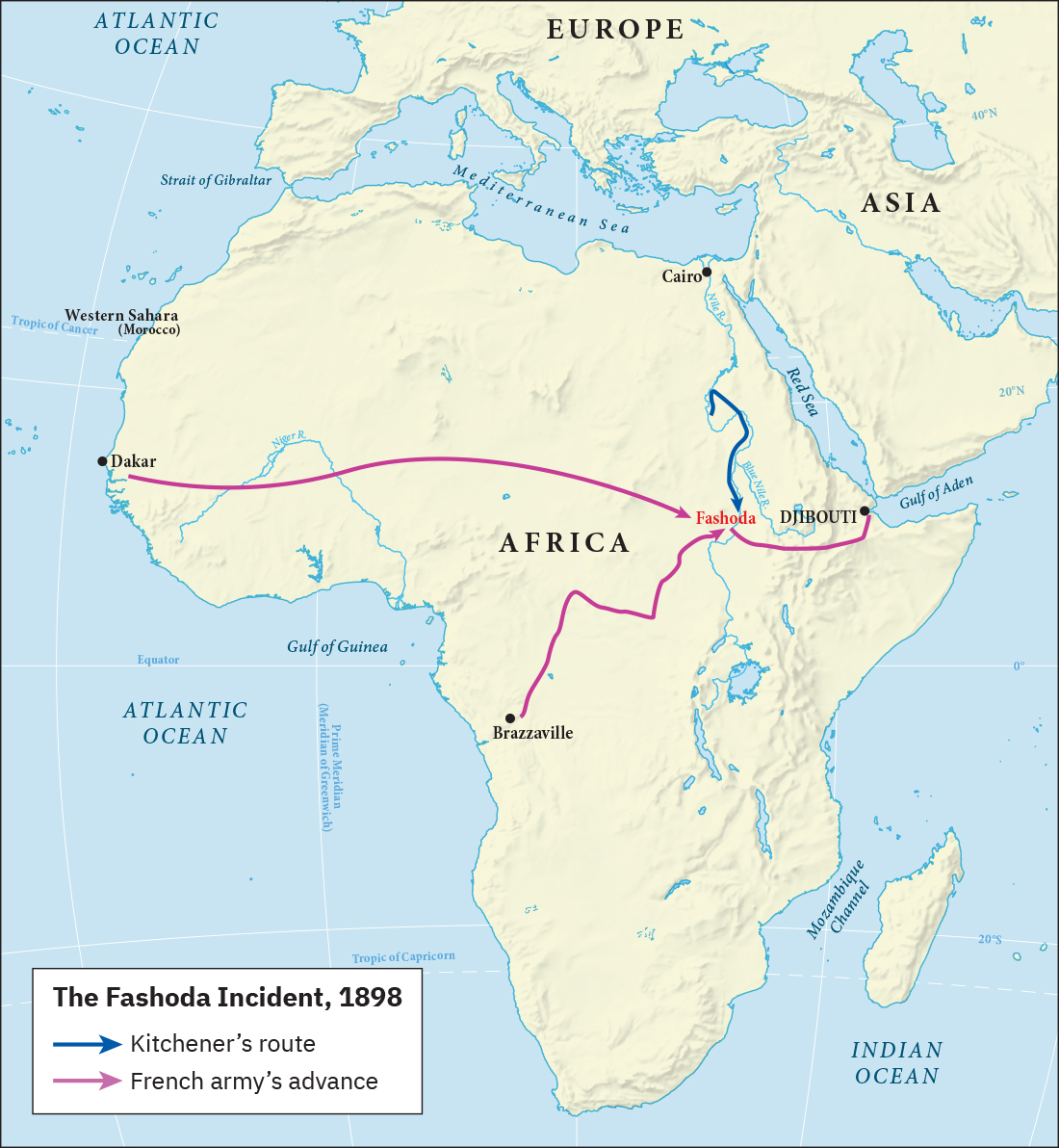
As the French marched steadily across the Sahara, Kitchener, with an Egyptian and Sudanese army, moved south along the Nile, establishing railroad lines and reclaiming towns from Mahdist control as he went. Finally, in September 1898, Kitchener and his forces, augmented by British troops, met the Mahdist ruler Al-Khalifa at Omdurman and defeated him. Before he could reclaim the rest of Sudan, however, Kitchener was dispatched to the town of Fashoda, where the proposed British and French railroad lines crossed (Figure 9.21). The French had arrived from Senegal some months earlier and claimed the town. As the two armies waited through September and October for instructions from their governments, civilians in both countries loudly proclaimed their nation to be in the right. The British Royal Navy prepared for war. The Fashoda Incident, as it is called, ended when France withdrew its claims, realizing it was outgunned, and the two nations agreed upon a boundary line between their spheres in Africa.
英語のヒント
フランス軍が着々とサハラを横断する一方、キッチナーはエジプト人とスーダン人の軍を率いてナイル川沿いに南下し、進む先々で鉄道を敷き、マフディー派から町を奪還した。ついに1898年9月、イギリス兵の増援を受けたキッチナー軍は、オムドゥルマンでマフディー派の支配者アル=ハリーファと戦い、これを破った。しかし、スーダンの残りを奪還する前に、キッチナーは英仏両国が計画した鉄道路線の交差する町ファショダへ派遣された(図9.21)。フランス軍は数か月前にセネガルから到着し、すでに町の領有を主張していた。9月から10月にかけて両軍が本国政府の指示を待つ間、両国の民間人は自国こそ正しいと声高に主張した。イギリス海軍は戦争に備えた。ファショダ事件と呼ばれるこの事件は、軍事力で劣ると悟ったフランスが主張を撤回し、両国がアフリカにおける勢力範囲の境界線に合意したことで終結した。
The Fashoda Incident.ファショダ事件。
(attribution: Copyright Rice University, OpenStax, under CC BY 4.0 license) · CC BY 4.0
Figure 9.21 France and Britain both sought to build railroad lines connecting their African colonies. They nearly went to war when their military forces encountered one another at Fashoda, where the proposed lines were to cross. (attribution: Copyright Rice University, OpenStax, under CC BY 4.0 license)
図9.21 フランスとイギリスはどちらも、自国のアフリカ植民地を結ぶ鉄道の建設を求めた。計画路線の交点であるファショダで両国の軍が出会ったとき、両国は戦争寸前に至った。(出典:著作権 Rice University、OpenStax、CC BY 4.0ライセンス)
Britain’s final effort to exert control over territory in Africa was the Boer War. Tensions between the British Cape Colony and the Boer republics of the Orange Free State and the Transvaal Republic had increased. In 1877, following Britain’s announcement that it was annexing the Transvaal Republic, fighting broke out between British and Boer forces in the First Boer War. The British were soundly defeated and forced to recognize the independence of the South African Republic (the new name of the Transvaal Republic).
英語のヒント
アフリカの領土を支配しようとするイギリスの最後の取り組みは、ボーア戦争だった。イギリス領ケープ植民地と、ボーア人の共和国であるオレンジ自由国およびトランスヴァール共和国の間では、緊張が高まっていた。1877年、イギリスがトランスヴァール共和国の併合を宣言した後、第一次ボーア戦争で英軍とボーア軍の戦闘が始まった。イギリス軍は大敗し、南アフリカ共和国という新しい名になったトランスヴァール共和国の独立を認めざるをえなくなった。
In 1900, following an abortive British raid into the South African Republic, the Boers laid siege to British Cape Colony settlements. In response to Boer guerrilla tactics, the British adopted a scorched-earth policy, destroying Boer homes, farms, and livestock to deny them food and shelter. Boer women and children were forced into concentration camps, where nearly thirty thousand died from disease or starvation. The war ended in 1902, and the Cape Colony annexed the South African Republic and the Orange Free State. In 1910, the two former Boer republics, the Cape Colony, and the British-controlled Natal Colony came together to form the Union of South Africa.
英語のヒント
1900年、イギリスによる南アフリカ共和国への襲撃が失敗した後、ボーア人はイギリス領ケープ植民地の入植地を包囲した。ボーア人のゲリラ戦術に対し、イギリス軍は焦土作戦を採用し、食料と住まいを奪うため、ボーア人の家・農場・家畜を破壊した。ボーア人の女性と子供は強制収容所に入れられ、そこで約3万人が病気や飢えで死んだ。戦争は1902年に終結し、ケープ植民地は南アフリカ共和国とオレンジ自由国を併合した。1910年、かつてのボーア人の二共和国、ケープ植民地、イギリス支配下のナタール植民地が合併し、南アフリカ連邦が成立した。