第9章工業化時代の拡張Expansion in the Industrial Age
9.1 The Second Industrial Revolution9.1 第2次産業革命
Learning Objectives学習の目標
By the end of this section, you will be able to:
この節を学び終えると、次のことができるようになる。
Describe the technological innovations of the Second Industrial Revolution
第2次産業革命における技術革新を説明する。
Describe the spread of industrialization beyond western and central Europe and the United States
西・中央ヨーロッパと米国の外へ産業化が広まった過程を説明する。
Explain the obstacles to industrialization facing countries in Asia, North Africa, and Latin America in the nineteenth century
19世紀のアジア、北アフリカ、ラテンアメリカ諸国が産業化に際して直面した障害を説明する。
Great Britain was the first nation to enter the Industrial Revolution, beginning to mechanize the production of goods in the eighteenth century. It was followed by the United States, France, Belgium, and, in the first half of the nineteenth century, by Germany. These nations harnessed the power first of water and then of steam and began the mass production of goods such as textiles, iron, and steel. Perhaps most significantly, they also manufactured machines that produced parts for other machines, such as spinning jennies and flying shuttles. Developments in transportation and communications technology, especially the locomotive, steamboat, and telegraph, transformed the way their citizens lived, traveled, and worked.
英語のヒント
産業革命に最初に入った国は英国であり、18世紀に物品生産の機械化を始めた。米国、フランス、ベルギーが続き、19世紀前半にはドイツも加わった。これらの国々は初めに水力、次いで蒸気の力を利用し、織物、鉄、鋼などを大量生産するようになった。おそらく最も重要なのは、ジェニー紡績機や飛び杼など、ほかの機械の部品を作る機械も製造したことである。輸送・通信技術、とりわけ機関車、蒸気船、電信の発達は、人々の暮らし方、移動の仕方、働き方を変えた。
Between the middle of the nineteenth century and the beginning of the twentieth, these nations embarked on a new phase of industrialization. European and U.S. industry was transformed again by new sources of power, technological innovations, new forms of transportation, and growing communications networks. This process is often called the Second Industrial Revolution. At the same time, industrialization began outside the United States and western and central Europe, especially in Russia and Japan.
英語のヒント
19世紀半ばから20世紀初頭にかけて、これらの国々は産業化の新段階に踏み出した。ヨーロッパと米国の産業は、新たな動力源、技術革新、新しい交通手段、拡大する通信網によって再び変貌した。この過程は一般に第2次産業革命と呼ばれる。同じ頃、米国および西・中央ヨーロッパの外、とりわけロシアと日本でも産業化が始まった。
The Expansion and Transformation of Technology技術の拡大と変容
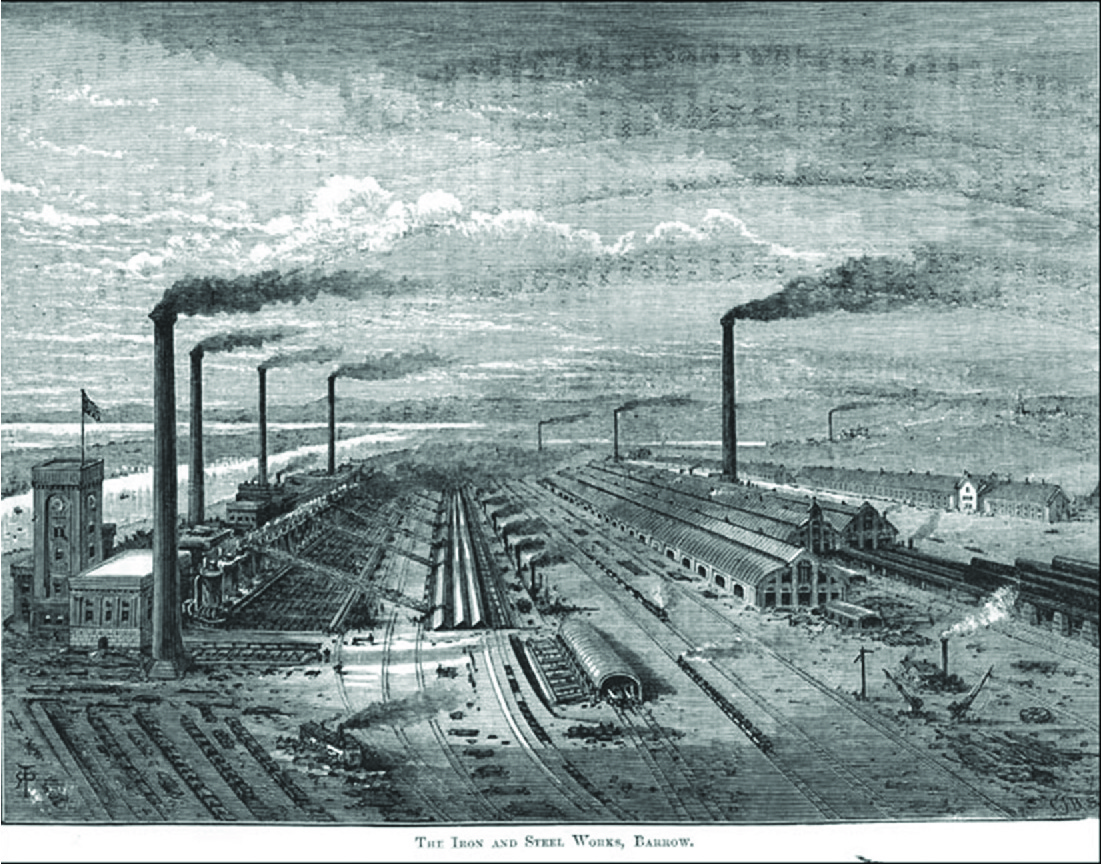
Many developments of the Second Industrial Revolution built on or improved earlier technology. Mass production of steel, for example, had begun with the development of the Bessemer process in the 1850s. This innovation removed impurities from molten pig iron, producing stronger steel better suited to building rail lines and machines. Later engineers further improved the process. The open-hearth Siemens-Martin process, first developed in Germany in the 1860s, was slower than the Bessemer process, but it produced higher-quality steel that was less brittle. By the beginning of the twentieth century, the Siemens-Martin process had become the most common way of manufacturing steel. The mass production of steel made possible the great engineering feats of the Second Industrial Revolution, such as the first skyscrapers and the expansion of railroads (Figure 9.4).
英語のヒント
第2次産業革命の多くの発展は、それ以前の技術を土台にしたり、改良したりしたものだった。例えば、鋼の大量生産は1850年代のベッセマー法の開発によって始まった。この技術は溶けた銑鉄から不純物を取り除き、線路や機械の製造に適した、より強い鋼を作り出した。その後、技師たちは製法をさらに改良した。1860年代にドイツで最初に開発されたジーメンス=マルタン平炉法は、ベッセマー法より時間がかかったが、もろさの少ない高品質の鋼を生産できた。20世紀初頭には、ジーメンス=マルタン法が最も一般的な製鋼法となっていた。鋼の大量生産により、最初期の高層建築や鉄道網の拡張など、第2次産業革命の大規模な工学的成果が可能になった(図9.4)。
A British Steelworks.英国の製鉄所
(credit: “Steelworks at Barrow-in-Furness, 1877” by Unknown/University of Strathclyde project/Wikimedia Commons, Public Domain) · Public Domain
Figure 9.4 The Second Industrial Revolution was built on steel. Shown here in a British image made before 1877, the Barrow Hematite Steelworks in Lancashire, England, was then the world’s largest producer of steel. (credit: “Steelworks at Barrow-in-Furness, 1877” by Unknown/University of Strathclyde project/Wikimedia Commons, Public Domain)
図9.4 第2次産業革命は鋼を土台としていた。1877年以前に制作されたこの英国の図に描かれているのは、イングランドのランカシャーにあったバロー・ヘマタイト製鋼所で、当時は世界最大の鋼の生産者だった。(出典:「Steelworks at Barrow-in-Furness, 1877」/Unknown/University of Strathclyde project/Wikimedia Commons、Public Domain)
Improvements in steel manufacturing enabled other innovations. As rust-resistant steel became less expensive, more could be used to manufacture rail lines, making them heavier, stronger, and able to support heavier locomotives pulling heavier loads. Railroads expanded across the United States and Europe, carrying more freight and passengers.
英語のヒント
製鋼技術の改良は、ほかの革新も可能にした。さびに強い鋼が安価になるにつれ、線路の製造により多く使えるようになり、線路は重く頑丈になって、より大きな荷を引く重い機関車を支えられるようになった。鉄道は米国とヨーロッパ全域に延び、より多くの貨物と乗客を運んだ。
Other inventions also made railroads more efficient. The air brake, invented by George Westinghouse in 1869, sent compressed air through a line to enable the train’s engineer to apply brakes from the locomotive. Before this, trains had been braked by workers who jumped from one moving car to the next and applied the brakes manually. The method was obviously very dangerous, and if a train car broke free, there was no way of stopping it. Because trains could now be stopped more safely, they could also travel at higher speeds.
英語のヒント
ほかの発明も鉄道の効率を高めた。1869年にジョージ・ウェスティングハウスが発明した空気ブレーキは、管を通じて圧縮空気を送り、運転士が機関車からブレーキをかけられるようにした。それまでは、作業員が走行中の車両から次の車両へ飛び移り、手動でブレーキをかけて列車を止めていた。この方法は明らかに危険で、車両が連結から外れれば止める手段がなかった。列車をより安全に停止できるようになったため、より高速で走らせることも可能になった。
By the end of the nineteenth century, railroads had become a common way of transporting people and products over land across distances long and short. Two new modes of transportation vied with railroads for popularity. The first modern bicycle, the safety bicycle, was developed by John Kemp Starley of England in 1885 and sported two wheels of equal size, unlike earlier bicycles with oversized front wheels that required riders to perch far above the ground. The safety bicycle could be ridden by anyone, including women and children. Developments in rubber-production technology also improved the bicycle. The process of vulcanizing rubber, discovered by American inventor Charles Goodyear in 1839, made it stronger and better able hold its shape under extremes of temperature. (Non-vulcanized rubber melts in the heat and shatters in the cold.) In 1887, Scottish-born inventor John Boyd Dunlop made a pressurized air-filled pneumatic tire from vulcanized rubber, just in time for use by bicycle and automobile manufacturers. Although pneumatic tires had been invented earlier, Dunlop’s was the first practical tire to be mass produced, and he patented his invention in 1888. By the 1890s, bicycling had become popular in Europe and the United States, and tens of thousands of people rode daily.
英語のヒント
19世紀末までに鉄道は、長距離にも短距離にも、人や製品を陸上輸送する一般的な手段となっていた。そこへ二つの新しい交通手段が現れ、鉄道と人気を競った。最初の近代的自転車である安全型自転車は、1885年にイングランドのジョン・ケンプ・スターレーが開発した。それ以前の自転車は前輪が非常に大きく、乗り手は地面から遠く離れた高所に座らなければならなかったが、安全型は同じ大きさの二つの車輪を備えていた。女性や子どもを含め、誰もが乗ることができた。ゴム製造技術の発達も自転車を改良した。米国の発明家チャールズ・グッドイヤーが1839年に発見したゴムの加硫処理は、ゴムを強くし、極端な高温・低温でも形を保ちやすくした。(加硫していないゴムは暑さで溶け、寒さで砕ける。)1887年、スコットランド生まれの発明家ジョン・ボイド・ダンロップが、加硫ゴムに圧縮空気を入れた空気入りタイヤを製作した。自転車・自動車メーカーが使うのにちょうどよい時期だった。空気入りタイヤ自体は以前にも発明されていたが、ダンロップのものは大量生産された最初の実用タイヤであり、彼は1888年に特許を取得した。1890年代には欧米で自転車が普及し、毎日何万人もの人々が乗るようになった。
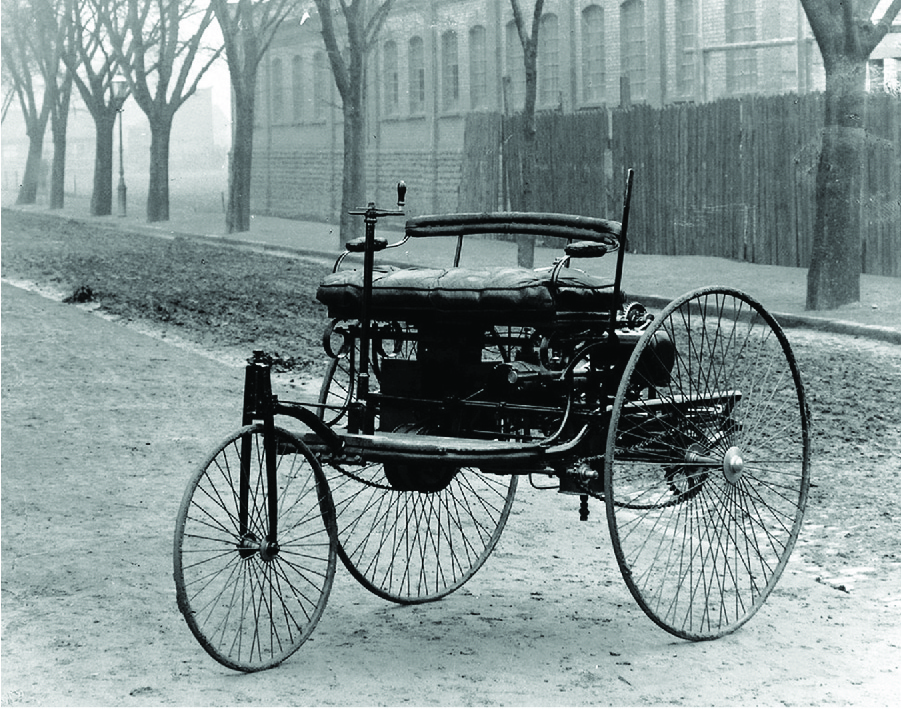
Eventually eclipsing both the train and the bicycle in popularity in the United States and western and central Europe was the gasoline-fueled automobile, patented by the German Karl Benz in 1886 and marketed beginning in 1888 (Figure 9.5). Within a few decades, the automobile had transformed the world as few other inventions have. Cities and suburbs could expand beyond the reach of rail lines, leading city and national governments to raise taxes to pay for new roads. New businesses that sold and repaired cars replaced blacksmiths and stables. City traffic grew noisier and more dangerous, and autos added their exhaust to the emissions of factory smokestacks. The automobile industry also increased the demand for rubber and petroleum, which most industrialized nations needed to import. Even though the United States was initially able to satisfy its petroleum demands with domestic oil, it had to look elsewhere for rubber.
英語のヒント
やがて米国と西・中央ヨーロッパで、鉄道と自転車の両方を人気で上回ったのがガソリン自動車だった。ドイツ人カール・ベンツが1886年に特許を取得し、1888年から販売した(図9.5)。数十年のうちに、自動車はほかの発明にはほとんど例のないほど世界を変えた。都市や郊外は鉄道沿線の外へ広がることが可能となり、都市・国家の政府は新しい道路の建設費を賄うため増税した。車を販売・修理する新たな業種が鍛冶屋や厩に取って代わった。市街地の交通はより騒々しく危険になり、工場の煙突から出る排出物に自動車の排気も加わった。自動車産業はゴムと石油の需要も増大させたが、工業国の大半はそれらを輸入する必要があった。米国でさえ、当初は石油需要を国産油で満たせたものの、ゴムは国外に求めなければならなかった。
The First Automobile.最初の自動車
(credit: “1885 Benz” by Alonso de Mendoza/Wikimedia Commons, Public Domain) · Public Domain
Figure 9.5 This 1885 photo shows the Benz Patent-Motorwagen, the first automobile sold to consumers. It was a few more decades before automobiles came to resemble the cars we drive today. (credit: “1885 Benz” by Alonso de Mendoza/Wikimedia Commons, Public Domain)
図9.5 この1885年の写真に写るベンツ・パテント・モトールヴァーゲンは、消費者向けに販売された最初の自動車である。自動車が現在私たちの運転する車に似た姿になるのは、さらに数十年後だった。(出典:Alonso de Mendozaによる「1885 Benz」/Wikimedia Commons、Public Domain)
The automobile’s arrival depended on another crucial invention—the internal combustion engine. This engine generates power by burning fuel, often some form of petroleum, in the presence of oxygen in a chamber, to produce a gas whose high pressure exerts force on another component such as a piston, rotor, or turbine blade, causing it to move. Internal combustion engines powered automobiles as well as machinery in small workshops, offering an alternative where steam engines, which were large, could not easily fit.
英語のヒント
自動車の登場は、もう一つの重要な発明である内燃機関に支えられていた。内燃機関は、燃焼室内で酸素の存在下に燃料(多くの場合は何らかの石油)を燃やして、高圧の気体を生み出す。この気体がピストン、回転子、タービン翼などの別の部品に力を加え、動かすことで動力を発生させる。内燃機関は自動車だけでなく小規模な作業場の機械も動かし、大型の蒸気機関を収めにくい場所での代替手段となった。
Internal combustion did not become the sole source of energy that powered the Second Industrial Revolution, however. It did not completely replace steam or the horse. Indeed, the steam turbine, invented by Sir Charles Parsons in 1884, provided efficient power for river- and ocean-going vessels. Steam was also used to generate electricity, one of the great developments of the Second Industrial Revolution. Burning coal turned water to steam that moved the blades of turbines, which generated electric current. Parsons’s steam turbine served this purpose in Britain and the United States. Water power also generated electricity; in 1882, the first world’s hydroelectric plant opened in Appleton, Wisconsin. Wind turbines also generated electricity, and in 1911 Italy built a plant to produce electricity from geothermal power. By the end of the century, electricity was the dominant force powering the factories of industrialized nations.
英語のヒント
もっとも、内燃機関が第2次産業革命を動かす唯一のエネルギー源になったわけではなく、蒸気や馬を完全に置き換えることもなかった。実際、1884年にサー・チャールズ・パーソンズが発明した蒸気タービンは、川や海を航行する船舶に効率のよい動力を提供した。蒸気は、この時代の大きな進歩の一つである発電にも使われた。石炭を燃やして水を蒸気に変え、その蒸気でタービン翼を動かして電流を発生させた。英国と米国ではパーソンズの蒸気タービンがこの役割を担った。水力による発電も行われ、1882年にはウィスコンシン州アップルトンに世界初の水力発電所が開業した。風車も発電に使われ、1911年にはイタリアが地熱発電所を建設した。世紀末までには、電気が工業国の工場を動かす主要な力になっていた。
Electricity ran machines in factories and lit streets, workplaces, and homes following the invention of the incandescent light bulb, by Joseph Swan in Britain in 1878 and Thomas Edison in the United States in 1879. The incandescent bulb’s bright light replaced the dim and often odorous illumination of oil and gas lamps that brought the risk of fire and, in the case of gas, of suffocation and explosions. Electric lighting made it possible for factories to operate far into the night.
英語のヒント
英国のジョゼフ・スワンが1878年に、米国のトマス・エジソンが1879年に白熱電球を発明すると、電気は工場の機械を動かすだけでなく、街路、職場、家庭を照らすようになった。白熱電球の明るい光は、薄暗くしばしば臭いもあった石油灯やガス灯に取って代わった。これらの灯火には火災の危険があり、ガス灯の場合は窒息や爆発の危険もあった。電灯によって、工場は夜遅くまで操業できるようになった。
Communications technology improved when the first transatlantic telegraph line between Great Britain and North America was completed in 1858, and by the end of the century all the world’s continents were connected except Antarctica. The telephone, patented by American inventor Alexander Graham Bell in 1876, spread throughout Europe and North America during the same time, greatly easing business communications. In 1901, the Italian engineer Guglielmo Marconi successfully transmitted a wireless signal across the Atlantic Ocean from Wales to Newfoundland, Canada. He then founded broadcasting stations in Europe and North America and used them to send communications to ships at sea. In the 1920s, once the vacuum tube and the triode had been developed, commercial radio that broadcast news, music, and radio plays became available as well.
英語のヒント
1858年に英国と北米を結ぶ最初の大西洋横断電信線が完成すると、通信技術は向上した。世紀末までには南極を除く世界の全大陸が結ばれた。同じ時期、米国の発明家アレグザンダー・グラハム・ベルが1876年に特許を取得した電話が欧米全域に広がり、商取引上の連絡を大いに容易にした。1901年、イタリアの技師グリエルモ・マルコーニは、ウェールズからカナダのニューファンドランドへ、大西洋を越えて無線信号を送ることに成功した。その後、欧米に送信局を設け、海上の船舶への通信に使った。1920年代には真空管と三極管が開発され、ニュース、音楽、ラジオ劇を放送する商業ラジオも利用できるようになった。
Other discoveries transformed the factory and the home. Chemical experimentation produced synthetic aniline dyes yielding textile colors more intense and vibrant than those from plant dyes, transforming fashions. Along with combine harvesters, mechanical seeders, and horse-drawn machines that reaped, gathered, and winnowed grain in one operation, chemical fertilizers enabled farmers to grow ever-larger crops. Another invention, barbed wire, helped cattle ranchers protect their herds. Refrigerated rail cars were perfected in the 1870s by engineers working for U.S. meat packer Gustavus Swift. The meat and other foods being produced in increasing quantities could now be shipped great distances without spoiling.
英語のヒント
ほかの発見も工場と家庭を変えた。化学実験から合成アニリン染料が生まれ、植物染料より濃く鮮やかな色で布を染められるようになり、流行も変わった。コンバイン収穫機、機械式播種機、刈り取り・取り込み・風選を一度に行う馬引きの機械とともに、化学肥料は農家がますます多くの作物を育てることを可能にした。有刺鉄線も新たな発明であり、牧場主が牛の群れを守るのに役立った。米国の食肉業者グスタヴス・スウィフトのもとで働く技師たちが、1870年代に冷蔵貨車を実用化した。増え続ける肉やほかの食料は、腐らせずに遠方へ輸送できるようになった。
Other inventions made office workers more productive. Typewriters and adding machines were common by the 1880s, and New York jeweler Willard Legrand Bundy patented the time clock in 1888. Upon arriving at or leaving work, employees inserted a card in the machine, which stamped it with the exact time and led to the expression “punching the clock.”
英語のヒント
ほかの発明は事務職の生産性を高めた。1880年代にはタイプライターと加算機が広く使われ、ニューヨークの宝石商ウィラード・ルグラン・バンディが1888年にタイムレコーダーの特許を取得した。従業員は出勤時と退勤時にカードを機械へ差し込み、機械が正確な時刻を打刻した。ここから「タイムカードを押す」という表現が生まれた。
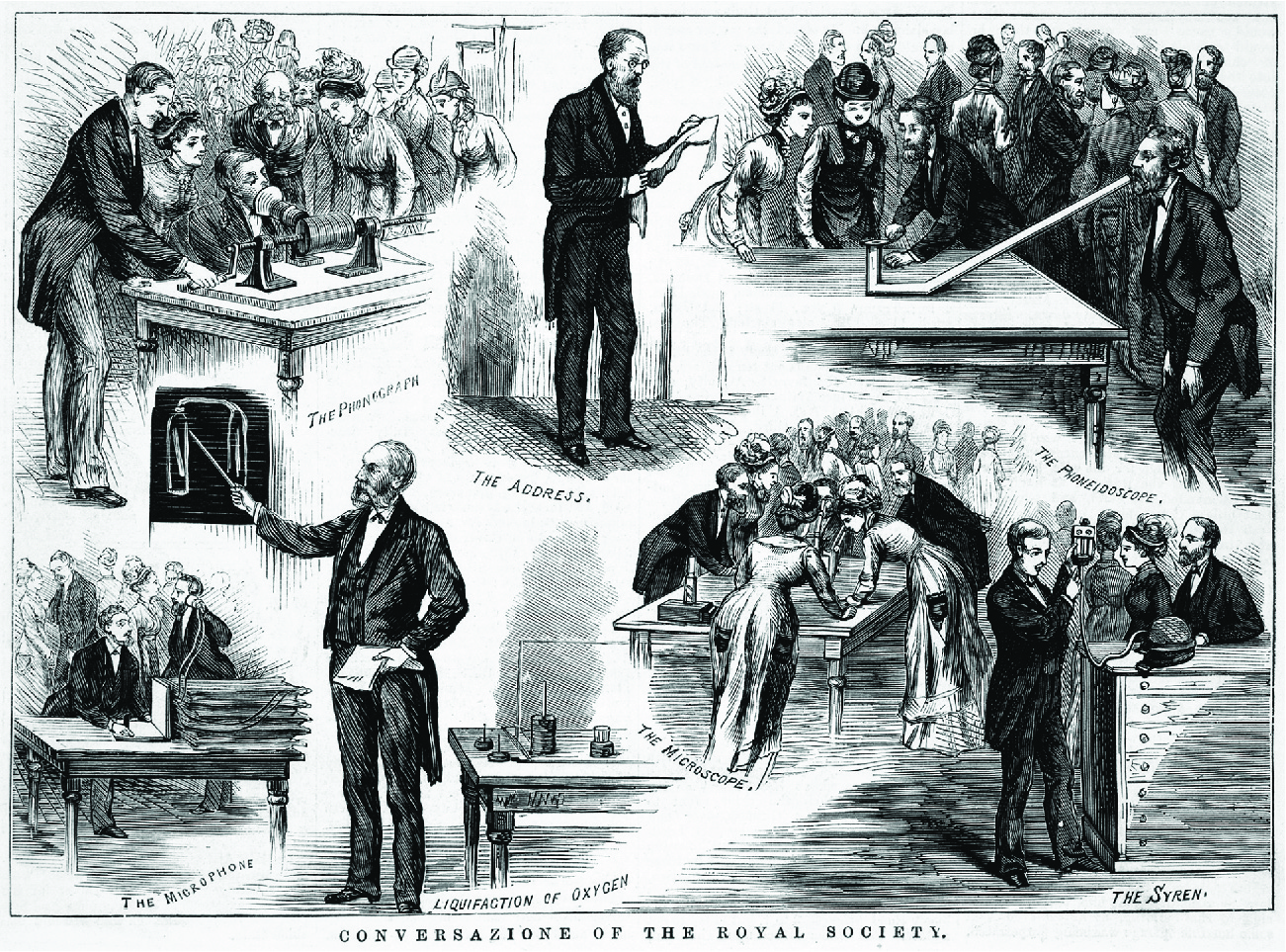
New technology also changed leisure activities. In 1877, Edison patented the phonograph, a machine that could record sound by tracing soundwaves with a stylus on a rotating disc or cylinder and then play it back. Although it had business applications, the phonograph was soon used for entertainment. Phonograph recordings were often combined with the projection of still photographic images to create audiovisual presentations, the forerunners of motion pictures (Figure 9.6).
英語のヒント
新技術は余暇の過ごし方も変えた。1877年、エジソンは蓄音機の特許を取得した。これは回転する円盤や円筒に針で音波を刻んで音を記録し、再生する装置だった。業務上の用途もあったが、蓄音機はまもなく娯楽に使われた。蓄音機の録音はしばしば静止写真の投影と組み合わされ、映画の先駆けとなる視聴覚的な発表を生み出した(図9.6)。
The First Phonograph.最初の蓄音機
(credit: “Conversatione of the Royal Society of Victoria” by State Library of Victoria/Wikimedia Commons, Public Domain) · Public Domain
Figure 9.6 Only a year after Thomas Edison patented the phonograph, residents of Melbourne, Australia, flocked to see a demonstration of the new machine, as this wood engraving from an 1878 newspaper shows. (credit: “Conversatione of the Royal Society of Victoria” by State Library of Victoria/Wikimedia Commons, Public Domain)
図9.6 この1878年の新聞の木版画が示すように、トマス・エジソンによる蓄音機の特許取得からわずか1年後、オーストラリアのメルボルンの住民は新しい機械の実演を見るために押しかけた。(出典:「Conversatione of the Royal Society of Victoria」/State Library of Victoria/Wikimedia Commons、Public Domain)
Photographic technology advanced in the first half of the nineteenth century, enabling people to permanently record images with a camera. In the late nineteenth century, a number of people began taking multiple photographs of objects or people in motion and replaying them quickly to give the impression of movement. A patent for a machine to do this was filed by English inventor Wordsworth Donisthorpe in 1876, and a variety of photographers and inventors tried to perfect the process in the following years. The most famous experiment was made in 1878 by English photographer Eadweard Muybridge, who photographed running horses and replayed the images on a machine he called the Zoopraxiscope. Following the invention of photographic film by New York native George Eastman in 1884, light-sensitive cameras captured images on strips of paper coated with gelatin. In 1887, French inventor Louis Le Prince patented a motion-picture camera that relied on photographic film and used it to record the first movie still in existence: a scene, only a few seconds long, of people walking in a garden in England. The age of cinema had been born, but it was some time before recorded sound and moving images were synchronized.
英語のヒント
19世紀前半に写真技術が進歩し、人々はカメラで画像を永続的に記録できるようになった。19世紀後半には、動く物体や人物の写真を何枚も撮り、素早く再生して動いているように見せる試みが始まった。そのための装置の特許を1876年に出願したのは、イングランドの発明家ワーズワース・ドニスソープであり、その後、多くの写真家や発明家が方式の改良を試みた。最も有名なのは1878年にイングランドの写真家エドワード・マイブリッジが行った実験で、疾走する馬を撮影し、ゾープラクシスコープと名付けた装置で画像を再生した。1884年にニューヨーク出身のジョージ・イーストマンが写真フィルムを発明すると、光に感応するカメラはゼラチンを塗った帯状の紙に画像を記録した。1887年、フランスの発明家ルイ・ル・プランスは写真フィルムを使う映画カメラの特許を取得し、現在も残る最初の映画を撮影した。イングランドの庭を人々が歩く、わずか数秒の場面だった。映画の時代は生まれたが、録音と動く映像が同期されるまでには、なお時間がかかった。