第9章工業化時代の拡張Expansion in the Industrial Age
Industrial Frontiers産業化の新しい地域
Until the mid-nineteenth century, industrialization had taken place only in Britain, the United States, France, Germany, and Belgium. By the middle of the century, other countries like Canada, Italy, and Russia had also begun to industrialize.
英語のヒント
19世紀半ばまで、産業化が起きていたのは英国、米国、フランス、ドイツ、ベルギーだけだった。世紀半ばには、カナダ、イタリア、ロシアなどでも産業化が始まっていた。
Canadaカナダ
Industrialization in Canada, then under British rule, began in the 1850s in the population centers of Toronto and Montreal. As in the United States and Britain, early factories produced textiles and metal goods. Brewing and the milling of flour were also industrialized. In the second half of the nineteenth century, Canadian entrepreneurs began the mass production of steel, established meat-packing companies, and invested in the extraction of natural resources such as timber, coal, and oil.
英語のヒント
当時英国の支配下にあったカナダでは、1850年代、人口の集中するトロントとモントリオールで産業化が始まった。米英と同じく、初期の工場は織物と金属製品を生産した。ビール醸造と製粉も工業化された。19世紀後半には、カナダの起業家が鋼の大量生産を始め、食肉加工会社を設立し、木材、石炭、石油などの天然資源の採取に投資した。
In 1867, to facilitate national defense and build a transcontinental railroad, the British Parliament passed the British North American Act, joining its colonies of Nova Scotia, New Brunswick, and the Province of Canada (which included Ontario and Quebec) in the Dominion of Canada. The Dominion had the right to govern itself, but it remained within the British Empire with Queen Victoria as its head of state.
英語のヒント
1867年、英国議会は国防を容易にし、大陸横断鉄道を建設するために英領北アメリカ法を可決した。これにより、ノヴァスコシア、ニューブランズウィック、カナダ植民地(オンタリオとケベックを含む)がカナダ自治領にまとめられた。自治領には自治権があったが、ヴィクトリア女王を国家元首とし、引き続き大英帝国の一部だった。
Two years later, the Dominion purchased the territory of Rupert’s Land from the Hudson’s Bay Company for the railroad. Rupert’s Land was inhabited largely by Métis, people of mixed First Nations and French ancestry who were largely French-speaking and Roman Catholic. Fearing the loss of their land and culture under the Dominion’s English-speaking Protestant majority, many Métis united under the leadership of Louis Riel to oppose the Canadian government’s attempts to survey Rupert’s Land. Riel formed a provisional government to negotiate with Canada, demanding protection for Métis rights, especially the right to establish French-language schools for children. After a brief outbreak of violence, Canada’s Parliament granted the Métis 200,000 hectares of land, incorporated into the Dominion as the new province of Manitoba in 1870 (Figure 9.7).
英語のヒント
その2年後、自治領は鉄道のために、ハドソン湾会社からルパート・ランドの領土を購入した。ルパート・ランドの住民の多くは、先住民ファースト・ネーションズとフランス人を祖先にもつメティで、大半はフランス語を話すローマ・カトリック教徒だった。英語を話すプロテスタントが多数を占める自治領のもとで土地と文化を失うことを恐れ、多くのメティはルイ・リエルの指導下に団結し、カナダ政府によるルパート・ランド測量の試みに反対した。リエルはカナダと交渉する暫定政府を組織し、メティの権利、とりわけ子どものためのフランス語学校を設ける権利の保護を求めた。短期間の暴力的な衝突の後、カナダ議会はメティに20万ヘクタールの土地を認め、その土地は1870年、新しいマニトバ州として自治領に組み込まれた(図9.7)。
The Creation of Manitoba.マニトバの成立
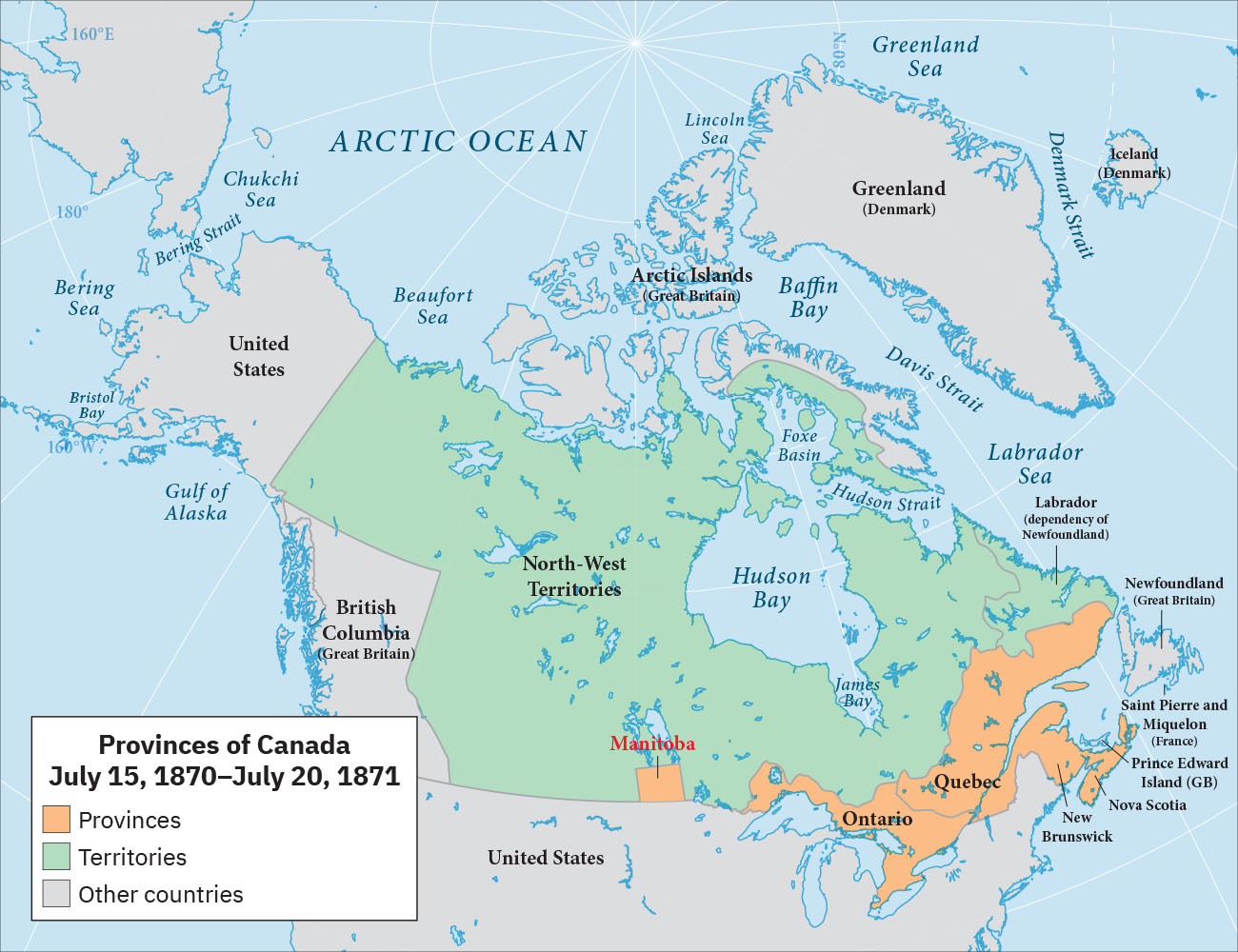
(credit: modification of work “Canada provinces 1870-1871” by “Golbez”/Wikimedia Commons, CC BY 2.5) · CC BY 2.5
Figure 9.7 In 1870, Canada’s parliament created the province of Manitoba as a home for the Métis. (credit: modification of work “Canada provinces 1870-1871” by “Golbez”/Wikimedia Commons, CC BY 2.5)
図9.7 1870年、カナダ議会はメティの居住地としてマニトバ州を設けた。(出典:「Golbez」による「Canada provinces 1870-1871」を改変/Wikimedia Commons、CC BY 2.5)
The Dominion of Canada reached the Pacific in 1871, when British Columbia agreed to join it if a railroad connecting eastern and western Canada were built within ten years. The Canadian Pacific Railroad, constructed largely by European and Chinese immigrants, was completed in 1885. It enabled the settling of the prairie provinces in the middle of the country and aided Canada’s industrialization.
英語のヒント
カナダ自治領は1871年に太平洋へ達した。カナダ東西をつなぐ鉄道を10年以内に建設するという条件で、ブリティッシュコロンビアが加入に同意したためである。主にヨーロッパと中国からの移民が建設したカナダ太平洋鉄道は1885年に完成した。この鉄道は、国土中央部のプレーリー諸州への入植を可能にし、カナダの産業化を助けた。
Industrialization was also assisted by the National Policy, begun in 1878 under Prime Minister John A. Macdonald and lasting until World War II. It imposed taxes on imports, some as high as 20 percent, to shield Canadian industry from competition by U.S. companies. While the policy did help Canadian businesses grow, residents of the west argued that the tariffs generated wealth for industrialized eastern provinces like Quebec and Ontario while maintaining artificially high prices for domestic goods in the prairie provinces.
英語のヒント
産業化は、ジョン・A・マクドナルド首相のもとで1878年に始まり、第2次世界大戦まで続いたナショナル・ポリシー(国民政策)にも支えられた。この政策は米国企業との競争からカナダ産業を守るため、輸入品に課税し、税率が20%に達するものもあった。政策がカナダ企業の成長を助けたのは確かだが、西部の住民は、関税がケベックやオンタリオなど工業化した東部諸州に富をもたらす一方、プレーリー諸州では国産品の価格を人為的に高く保っていると主張した。
Italyイタリア
Italy industrialized after other western and central European nations such as France and Germany. The fragmented political system of the Italian peninsula before its unification as a single nation (which began in 1861) delayed general industrial development. After unification (completed in 1871 with the incorporation of Rome and Veneto), the government was dominated by northern Italians and invested in northern industries. From the 1890s to the 1910s, steelworks, shipyards, rubber plants, and factories producing canned food, machine tools, chemicals, cement, and automobiles were established north of Rome. Agricultural production in northern provinces such as Emilia-Romagna was also modernized and mechanized, freeing peasants from the land to work in the new factories. The Italian government imposed high tariffs on imported goods to protect northern industry.
英語のヒント
イタリアの産業化は、フランスやドイツなど西・中央ヨーロッパの他国より遅かった。一つの国家への統一が1861年に始まるまで、イタリア半島の政治体制は分裂しており、全般的な産業発展が遅れた。ローマとヴェネトの編入で1871年に統一が完了すると、北部出身者が政府を主導し、北部産業へ投資した。1890年代から1910年代にかけて、ローマ以北には製鋼所、造船所、ゴム工場、缶詰食品・工作機械・化学製品・セメント・自動車を生産する工場が設立された。エミリア=ロマーニャなど北部諸州の農業生産も近代化・機械化され、農民は土地を離れて新しい工場で働けるようになった。イタリア政府は北部産業を守るため、輸入品に高関税を課した。
South of Rome, with the exception of Naples, little industrial development took place. Southern Italy and the island of Sicily remained rural and agricultural. As the north grew wealthier and more urbanized, the south grew poorer and more depopulated as peasants left to seek opportunities abroad.
英語のヒント
ローマ以南では、ナポリを除いて産業発展がほとんど起きなかった。イタリア南部とシチリア島は、農村的な農業地域のままだった。北部が豊かになり都市化するにつれ、南部は貧しくなり、農民が国外の機会を求めて去っていくことで人口も減っていった。
Russiaロシア
Russia had begun industrializing in the early nineteenth century, as Russian entrepreneurs imported textile manufacturing equipment from Britain to create cotton cloth. The tsars were eager to use new technology to unite their empire and offered cash incentives to European and American business leaders willing to assist. With their help, Russia established steamship lines, and as early as 1820 steamships were regularly traveling the Volga River, Russia’s main waterway. By 1851, Moscow was joined by rail with St. Petersburg, the nation’s capital and home of the tsar (Figure 9.8).
英語のヒント
ロシアでは19世紀初頭、起業家が綿布を作るため英国から織物製造設備を輸入し、産業化が始まった。皇帝たちは新技術で帝国を結びつけることに熱心で、協力する意思のある欧米の実業家に金銭的な奨励を提示した。その援助によってロシアは蒸気船航路を開設し、1820年にはすでに、主要水路のヴォルガ川を蒸気船が定期運航していた。1851年までにはモスクワが、首都で皇帝の居住地でもあるサンクトペテルブルクと鉄道で結ばれた(図9.8)。
The Russian Railroad.ロシアの鉄道
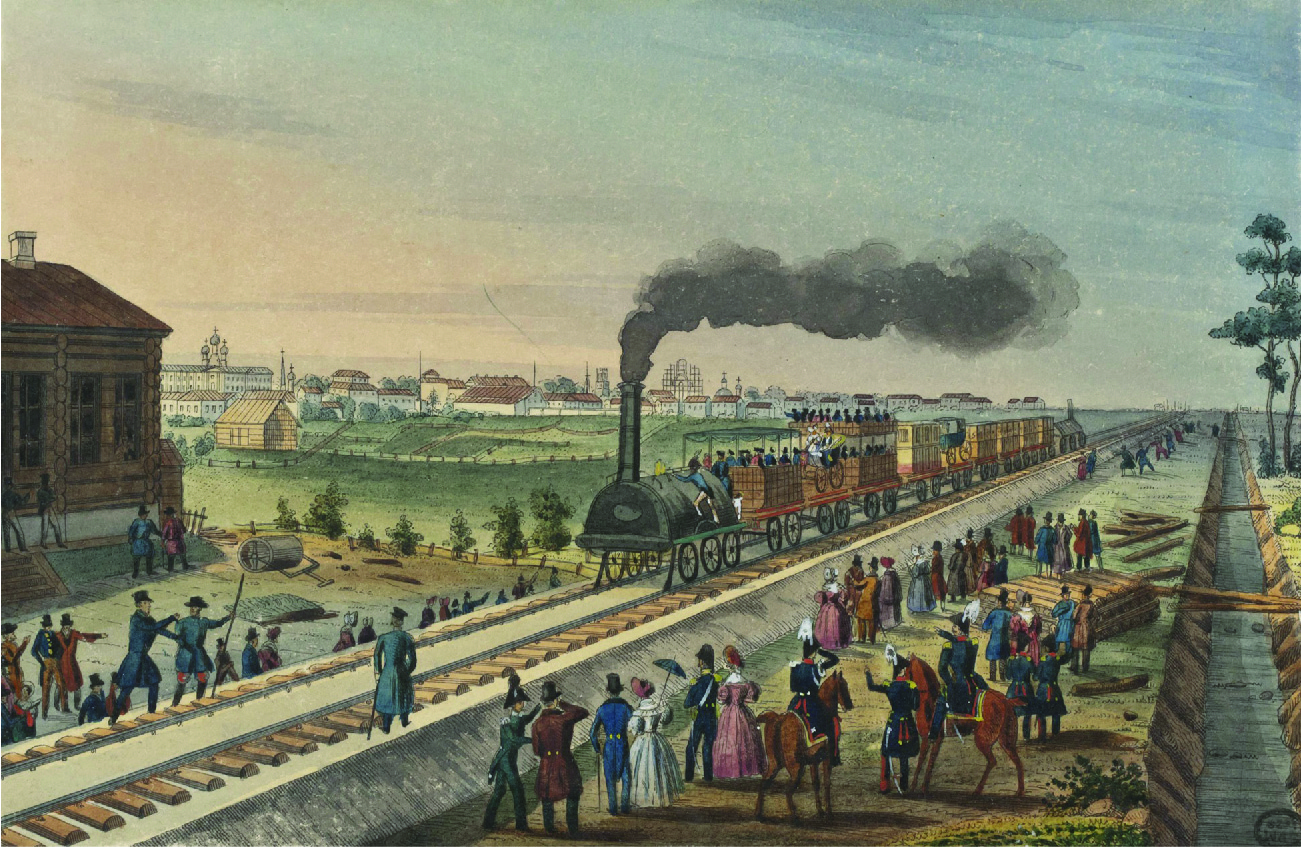
(credit: “Tzarskoselskaya Railway – Watercolour” by State Hermitage/Wikimedia Commons, Public Domain) · Public Domain
Figure 9.8 A lithograph from the 1840s shows the first train arriving in Tsarkoye Selo, a small town outside St. Petersburg, in 1837. One of the residences of the Russian royal family was located there. (credit: “Tzarskoselskaya Railway – Watercolour” by State Hermitage/Wikimedia Commons, Public Domain)
図9.8 1840年代の石版画には、1837年、サンクトペテルブルク郊外の小さな町ツァールスコエ・セローへ最初の列車が到着する様子が描かれている。そこにはロシア皇室の御用邸の一つがあった。(出典:「Tzarskoselskaya Railway – Watercolour」/State Hermitage/Wikimedia Commons、Public Domain)
Nevertheless, Russia remained relatively unindustrialized compared to the United States and much of western and central Europe. This became apparent when Russia lost the Crimean War in 1856, despite having a population larger than that of its opponents Britain and France and despite fighting the war in its own backyard while the enemy traveled more than a thousand miles by sea. Britain’s and France’s steamships provided better transportation than Russia’s few roads and railroads did, and their factories produced more and better weapons.
英語のヒント
それでもロシアは、米国や西・中央ヨーロッパの多くに比べ、工業化の程度が低かった。このことは1856年のクリミア戦争で敗北した際に明らかになった。ロシアは敵の英仏より人口が多く、自国のすぐ近くで戦っており、敵側は海を1,000マイル以上も移動して来たにもかかわらず、敗れたのである。英仏の蒸気船は、わずかしかないロシアの道路や鉄道より優れた輸送手段となり、英仏の工場は、より多く、より優れた兵器を生産した。
Despite its size and the support of its tsars, Russia lacked many advantages for industrializing that other countries possessed. It did not have many artisans, and mechanization of production means little in a country without crafts to be mechanized. So long as peasant families were available to plant and harvest crops, there was no pressing need to mechanize agriculture either. Russia’s population also consisted of many serfs who, unlike American and British farmers, were bound to the land and could not seek opportunities elsewhere such as in factories. Many Russians found it easier to profit by shipping raw materials such as grain, timber, and hemp to the industrializing nations of western Europe than to build a manufacturing sector of their own.
英語のヒント
国土が広く皇帝の支援もあったが、ロシアには、ほかの国が産業化のためにもっていた多くの有利な条件が欠けていた。職人は多くなく、機械化すべき手工業がない国では、生産の機械化には大きな意味がない。農民の家族が作付けと収穫を担えるかぎり、農業機械化の切迫した必要もなかった。人口には農奴も多く、米英の農民と違って土地に縛られ、工場など他所の機会を求めることができなかった。多くのロシア人にとっては、自国の製造業部門を築くより、穀物、木材、麻などの原料を、工業化する西ヨーロッパ諸国へ出荷して利益を得る方が容易だった。
Finally, Russia’s sheer size made industrialization difficult. Its rich natural resources were widely separated and far from the cities in which factories were located. To allow access, thousands of miles of roads and railroad lines needed to be constructed through the dense tracts of uninhabited forests, over raging rivers, and across the frozen tundra that covered much of the country. The United States, which industrialized relatively early, is also large, but not as large as Russia. The workers who laid railroad lines to connect its Atlantic and Pacific coasts worked across easy terrain of largely flat, treeless prairie and plains. In Russia, the few railroad and steamship lines and the few thousand miles of roads constructed before the end of the nineteenth century were not enough to bring natural resources to factories or manufactured goods to the countryside.
英語のヒント
最後に、ロシアの途方もない広さそのものが産業化を難しくした。豊かな天然資源は遠く離れて分布し、工場のある都市からも遠かった。資源へ到達するには、国土の多くを覆う人の住まない密林、激流、凍ったツンドラを越え、何千マイルもの道路や鉄道を建設する必要があった。比較的早く工業化した米国も広いが、ロシアほどではない。米国の大西洋岸と太平洋岸を結ぶ鉄道を敷いた労働者は、おおむね平らで木のないプレーリーや平原という、作業しやすい地形を横断した。ロシアでは、19世紀末までに建設されたわずかな鉄道・蒸気船航路と数千マイルの道路だけでは、天然資源を工場へ、工業製品を農村へ運ぶには不十分だった。
Following its defeat in the Crimean War, Russia increased its efforts to industrialize. In 1861, it abolished serfdom, providing potential workers for factories. In the 1890s, Minister of Finance Sergei Witte successfully lobbied for improvements in Russia’s railway system, which at the end of the Crimean War had had fewer than one thousand miles of track. In 1891, the construction of a rail line across Siberia was begun. By 1900, the country had approximately thirty-six thousand miles of track. Soon it became easier to exploit the interior’s vast reserves of iron, wood, and coal. However, Russia’s late start meant it did not reach the same level of industrialization as western and central Europe and the United States until the twentieth century.
英語のヒント
クリミア戦争での敗北後、ロシアは産業化への取り組みを強めた。1861年には農奴制を廃止し、工場労働者になり得る人々を生み出した。1890年代、財務相セルゲイ・ヴィッテは鉄道網の改善を働きかけ、実現した。クリミア戦争終結時には線路は1,000マイル未満しかなかった。1891年にシベリア横断鉄道の建設が始まり、1900年までに国内の線路は約3万6,000マイルとなった。内陸部に眠る鉄、木材、石炭の膨大な資源を利用しやすくなった。しかし、出発が遅かったため、西・中央ヨーロッパや米国と同じ産業化水準に達したのは20世紀に入ってからだった。
Industrialization conveyed a great advantage. Once a country had begun the process, it was capable of generating even more wealth and building larger, more technologically advanced military forces, which enabled it to gain an advantage over non-industrialized countries. It became nearly impossible for non-industrialized countries to compete with industrialized ones or even to protect themselves from aggression by their industrialized rivals. Japan proved an exception.
英語のヒント
産業化は大きな優位をもたらした。いったんその過程に入った国は、さらに多くの富を生み、より大規模で技術的に進んだ軍隊を築けるようになり、それによって非工業国に対する優位を得られた。非工業国が工業国と競争することはほとんど不可能となり、工業化した競争相手からの侵略を防ぐことさえ難しくなった。日本は例外となった。