第9章工業化時代の拡張Expansion in the Industrial Age
9.3 Colonial Empires9.3 植民地帝国
Learning Objectives学習の目標
By the end of this section, you will be able to:
この節を学び終えると、次のことができるようになる。
Identify the places in which the industrialized nations built empires in the late nineteenth and early twentieth centuries
19世紀後半から20世紀初めに工業国が帝国を築いた地域を明らかにする
Describe how the industrialized nations built their empires
工業国がどのように帝国を築いたかを説明する
Explain where and why the world’s industrialized nations came into conflict while building their empires
世界の工業国が帝国を築く過程で、どこで、なぜ衝突したかを説明する
In the later nineteenth century, the industrialized nations regarded their colonies as necessary sources of wealth and strength. Some, like Britain and France, had already established colonies a century or more before. Now they focused on tightening their control over these and acquiring more. The United States, Germany, and Japan lacked overseas colonies and now sought to acquire them.
英語のヒント
19世紀後半、工業国は植民地を富と力の不可欠な源泉とみなした。イギリスやフランスのように、1世紀以上前から植民地を築いていた国もあった。そうした国々は今や、既存の植民地への支配を強化し、さらに多くの植民地を獲得することに力を注いだ。海外植民地を持っていなかったアメリカ・ドイツ・日本も、その獲得を目指し始めた。
Africaアフリカ
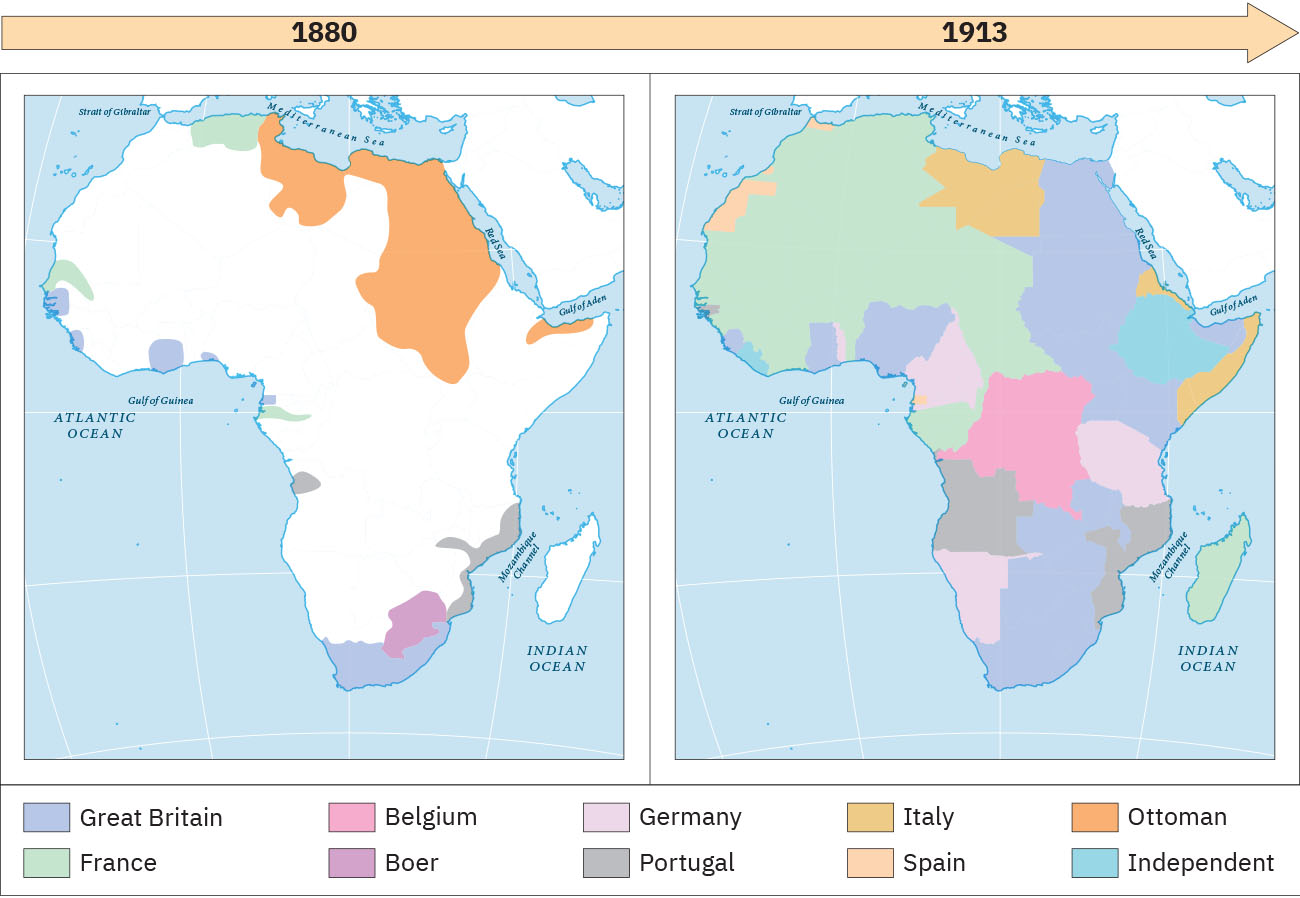
The industrialized nations of Europe saw Africa, with its rich natural resources, as the great prize, and they moved quickly to seize it. At the beginning of the Second Industrial Revolution, Europeans controlled about 10 percent of the African continent. By the end of the century, after the “Scramble for Africa”—the competition among European countries to establish African colonies—they controlled 90 percent, with the largest portions ruled by Britain, France, Belgium, and Germany. Portugal and Spain still claimed colonies acquired in the fourteenth and fifteenth centuries (Figure 9.16).
英語のヒント
ヨーロッパの工業国は、天然資源の豊かなアフリカを大きな獲物とみなし、素早くその奪取に乗り出した。第二次産業革命の初め、ヨーロッパ人の支配下にあったのはアフリカ大陸の約10%だった。アフリカに植民地を築こうとヨーロッパ諸国が競い合った「アフリカ分割」を経て、世紀末までには90%を支配し、最も大きな部分はイギリス・フランス・ベルギー・ドイツが統治した。ポルトガルとスペインは、14~15世紀に獲得した植民地を引き続き領有していた(図9.16)。
Colonial Africa.植民地化されたアフリカ。
(attribution: Copyright Rice University, OpenStax, under CC BY 4.0 license) · CC BY 4.0
Figure 9.16 The 1880 map shows how much territory was controlled by Europeans at the beginning of the Second Industrial Revolution. The 1913 map shows Africa approximately thirty years later. (attribution: Copyright Rice University, OpenStax, under CC BY 4.0 license)
図9.16 1880年の地図は、第二次産業革命の初めにヨーロッパ人がどれだけの領土を支配していたかを示す。1913年の地図は、約30年後のアフリカを示す。(出典:著作権 Rice University、OpenStax、CC BY 4.0ライセンス)
European nations aimed to colonize the continent to get access to raw materials and new markets for their goods, to boost international prestige and national pride, and to achieve military dominance over rivals. The “Scramble for Africa” reached its height during the Berlin Conference of 1884–1885 when, without input from Africans, European nations simply allotted different parts of the continent to one another. Some agreements were formal recognitions of existing colonies and territories, while others recognized new claims. Colonization continued throughout the 1880s–1910s.
英語のヒント
ヨーロッパ諸国は、原材料と自国製品の新しい市場を得ること、国際的威信と国民の誇りを高めること、そして競争国に対する軍事的優位を得ることを目指して、大陸を植民地化しようとした。「アフリカ分割」は1884~1885年のベルリン会議で頂点に達した。この会議でヨーロッパ諸国は、アフリカ人の意見を聞かず、大陸のさまざまな部分を互いに割り当てた。一部の協定は既存の植民地や領土を正式に承認し、他の協定は新たな領有権の主張を認めた。植民地化は1880年代から1910年代まで続いた。
Franceフランス
France had been reluctant to claim colonies in Africa. It controlled the island of Gorée off the coast of Senegal and had a few trading posts in the interior. Beyond expanding into the interior of Senegal in the 1850s, however, it did little until the end of the nineteenth century, when the European powers met at the 1878 Congress of Berlin to decide the fate of the defeated Ottoman Empire’s possessions in North Africa. France received Tunisia.
英語のヒント
フランスはアフリカの植民地獲得に消極的だった。セネガル沖のゴレ島を支配し、内陸にいくつか交易拠点を持っていた。しかし、1850年代にセネガル内陸へ進出した以外は、19世紀末までほとんど行動しなかった。1878年のベルリン会議では、敗北したオスマン帝国の北アフリカ領の運命を決めるためにヨーロッパ列強が集まり、フランスはチュニジアを与えられた。
Tunisia had borrowed heavily from European powers to fund development and modernize its army. When it declared bankruptcy in 1869, Britain, France, and Italy established a commission to manage its finances and ensure repayment. At the Congress of Berlin, Italy hoped to gain Tunisia since a number of its citizens now lived there. Britain, however, did not wish Italy to control both sides of the Strait of Sicily, endangering British access to the eastern Mediterranean, but it did want French support for its claims to the Mediterranean island of Cyprus. Germany wished France to focus on North Africa rather than continental Europe, where Germany hoped to increase its own influence. Thus, France was given Tunisia, and Italy received the city of Tripoli in Libya instead.
英語のヒント
チュニジアは開発資金と軍の近代化のため、ヨーロッパ列強から多額の借款を受けていた。1869年に破産を宣言すると、イギリス・フランス・イタリアは、財政を管理し返済を確保する委員会を設けた。ベルリン会議では、多くの自国民がすでに住んでいたため、イタリアはチュニジアの獲得を望んだ。しかしイギリスは、イタリアがシチリア海峡の両岸を支配して、東地中海へのイギリスの通行を脅かすことを望まなかった。他方、地中海のキプロス島への自国の権利主張には、フランスの支持を求めていた。ドイツは、ヨーロッパ大陸で自国の影響力を拡大したかったため、フランスに大陸より北アフリカへ注意を向けさせようとした。こうしてフランスにはチュニジア、イタリアには代わりにリビアの都市トリポリが与えられた。
Britain and Germany were content to allow France to claim Tunisia, but the Tunisians refused to acknowledge this grant of power. A Tunisian attack on the French colony of Algeria in 1881 gave France an excuse to invade Tunisia and establish a protectorate over it, a form of control that allowed the Tunisian government under Muhammad III as-Sadiq to manage domestic affairs while France oversaw its defense and its relations with other nations.
英語のヒント
イギリスとドイツは、フランスがチュニジアの領有を主張することを容認したが、チュニジア人はこの権限の付与を認めなかった。1881年にチュニジア人がフランス植民地アルジェリアを攻撃すると、フランスはそれを口実にチュニジアへ侵攻し、保護国とした。保護国とは、ムハンマド3世アッ=サーディクのチュニジア政府に内政を任せる一方、フランスが防衛と他国との関係を監督する支配の形だった。
After realizing Belgium desired neighboring regions in Central Africa, France moved speedily to acquire more colonial holdings. As a result, from 1880 to 1900 many parts of West Africa came under French control as the Italian-born French naval officer Pierre Savorgnan de Brazza traveled the region, negotiating with local rulers and signing treaties on behalf of France. Areas that are now nations (or parts of nations) quickly became French possessions: the Côte d’Ivoire, Benin, Niger, Mali, Mauritania, Cameroon, the Central African Republic, the Republic of the Congo, the Democratic Republic of the Congo, Gabon, Burkina Faso, and Chad. Besides providing markets for manufactured goods, these colonies also produced abundant palm oil, used for lubricating industrial machinery. France also took control of French Somaliland (Djibouti) in East Africa and the island of Madagascar off the East African coast.
英語のヒント
中央アフリカの隣接地域をベルギーが欲していると知ると、フランスはさらに植民地を得るため急いで行動した。その結果、1880~1900年、イタリア生まれのフランス海軍士官ピエール・サヴォルニャン・ド・ブラザが各地を旅し、現地の支配者と交渉してフランスを代表する条約を結ぶにつれ、西アフリカの多くの地域がフランスの支配下に入った。現在の国、またはその一部にあたるコートジボワール、ベナン、ニジェール、マリ、モーリタニア、カメルーン、中央アフリカ共和国、コンゴ共和国、コンゴ民主共和国、ガボン、ブルキナファソ、チャドが、相次いでフランス領となった。これらの植民地は工業製品の市場になるだけでなく、工業機械の潤滑に使うパーム油も豊富に生産した。フランスはさらに、東アフリカのフランス領ソマリランド(ジブチ)と、東アフリカ沖のマダガスカル島も支配した。
The French takeover of its African colonies was sometimes peaceful, as when Brazza signed a treaty with the Bateke ruler King Illoh Makoko in today’s Republic of the Congo and Democratic Republic of the Congo. At other times it consisted of brutal conquest. For example, Captain Paul Voulet earned a reputation for cruelty as he marched through French Sudan (modern Niger) on his way to Lake Chad. Voulet’s troops looted villages already under French control and raped and killed their inhabitants.
英語のヒント
フランスによるアフリカの植民地獲得が平和的だった場合もある。ブラザが、現在のコンゴ共和国とコンゴ民主共和国にあたる地域で、バテケ人の支配者イロー・マココ王と条約を結んだときがその例である。しかし、残虐な征服による場合もあった。たとえばポール・ヴーレ大尉は、チャド湖へ向かう途上でフランス領スーダン(現在のニジェール)を行軍し、その残虐さで悪名を得た。ヴーレの軍隊は、すでにフランスの支配下にあった村々を略奪し、住民を強姦し殺害した。
Great Britainイギリス
South Africa was Britain’s first toehold on the continent. In 1806, Britain took formal control over the Dutch Cape Colony, established by Dutch traders in the seventeenth century. South Africa was intended as a settler colony, and as British immigrants arrived, the Dutch who lived there, called Afrikaners or Boers, were forced ever further inland, north and east, in the Great Trek of 1836. They established two independent republics, the Transvaal Republic and the Orange Free State, and left the Cape Colony to the British.
英語のヒント
南アフリカは、イギリスが大陸で得た最初の足がかりだった。1806年、イギリスは、17世紀にオランダ商人が築いたケープ植民地を正式に支配した。南アフリカは入植植民地として構想され、イギリスからの移民が到着すると、そこに住んでいたアフリカーナーまたはボーア人と呼ばれるオランダ系住民は、1836年のグレート・トレックで北と東の内陸へ、ますます遠く押し出された。彼らはトランスヴァール共和国とオレンジ自由国という二つの独立共和国を建て、ケープ植民地をイギリス人に明け渡した。
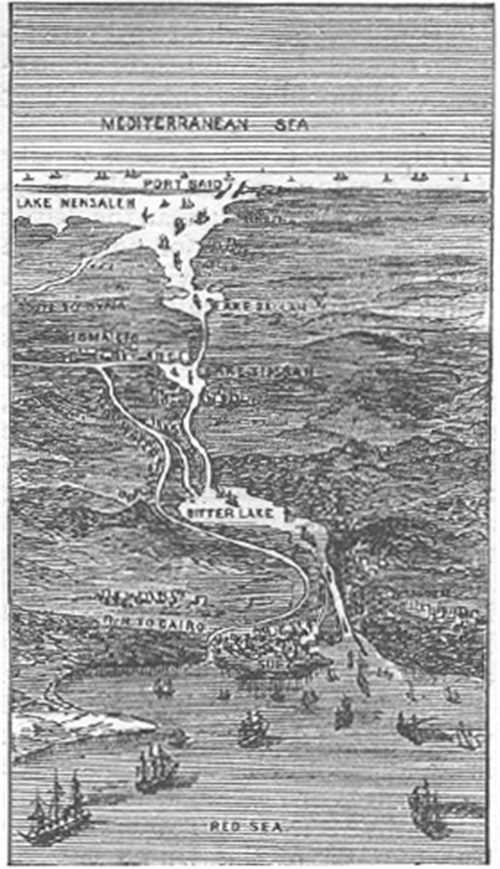
Britain’s second area of interest in Africa was Egypt, an excellent source of cotton for its textile mills. The possibility of building a canal across the Isthmus of Suez, which divided Asia from Africa, had intrigued Europeans since the fifteenth century. Linking the Mediterranean and Red Seas would allow ships to reach the Indian and Pacific Oceans without sailing around the tip of Africa, greatly easing trade with South and East Asia. Now seemed the time to make this dream a reality. In 1854, the French diplomat and business owner Ferdinand de Lesseps approached Sa’id Pasha, the son of Muhammad Ali, who became ruler of Egypt and Sudan in 1854, for permission to build a canal through Egyptian territory. Lesseps received it, and in 1858 he organized a team from seven countries to engineer a canal that ships of any nations could use. Construction began in 1859, and the Suez Canal opened to shipping in 1869 (Figure 9.17).
英語のヒント
アフリカでイギリスが次に関心を向けたのは、自国の紡績工場にとって優れた綿花供給地であるエジプトだった。アジアとアフリカを隔てるスエズ地峡を横切る運河を築く構想は、15世紀以来ヨーロッパ人の関心を引いていた。地中海と紅海を結べば、アフリカの南端を回らずにインド洋や太平洋へ行けるようになり、南アジアや東アジアとの貿易が大幅に容易になる。今こそこの夢を実現するときだと思われた。1854年、フランスの外交官で事業家のフェルディナン・ド・レセップスは、同年にエジプトとスーダンの支配者となったムハンマド・アリーの息子サイード・パシャに、エジプト領内を通る運河の建設許可を求めた。許可を得たレセップスは、どの国の船も使える運河を設計するため、1858年に7か国の技術者からなるチームを組織した。工事は1859年に始まり、1869年にスエズ運河が開通した(図9.17)。
Suez Canal.スエズ運河。
(credit: modification of work “Suez Canal in the year 1881” by Young Persons' Cyclopedia of Persons and Places/Wikimedia Commons, Public Domain) · Public Domain
Figure 9.17 This 1881 illustration from the Young Persons’ Cyclopedia of Persons and Places shows the route of the Suez Canal from Port Said on the Mediterranean Sea to the Red Sea. (credit: modification of work “Suez Canal in the year 1881” by Young Persons' Cyclopedia of Persons and Places/Wikimedia Commons, Public Domain)
図9.17 『Young Persons’ Cyclopedia of Persons and Places』に掲載された1881年のこの挿絵は、地中海のポートサイドから紅海へ至るスエズ運河の経路を示す。(クレジット:「Suez Canal in the year 1881」を改変、『Young Persons’ Cyclopedia of Persons and Places』/Wikimedia Commons、パブリックドメイン)
Britain had initially opposed the canal. It threatened British domination over the main water route to Asia, which passed the British Cape Colony, and it made its prized colony of India more accessible—and more vulnerable. Britain’s attitude changed, however, when Ismail Pasha, who became khedive or viceroy of Egypt and Sudan following the death of his uncle Sa’id Pasha in 1863, found himself deeply in debt to European creditors, which made it possible for European interests to manipulate him. For example, he was forced to establish a dual court system in which accused Europeans were tried by European judges, not Egyptian ones. In 1875, unable to pay his debts, Ismail Pasha sold Egypt’s shares in the Suez Canal to Britain. He was also forced to allow British and French officials to manage Egypt’s financial affairs.
英語のヒント
イギリスは当初、運河に反対した。運河は、イギリス領ケープ植民地を通るアジアへの主要航路に対するイギリスの優位を脅かし、大切な植民地インドへの接近を容易にすると同時に、インドを攻撃にさらしやすくしたからである。しかし、1863年に叔父サイード・パシャが死去した後、エジプトとスーダンのヘディーヴ、すなわち副王となったイスマーイール・パシャが、ヨーロッパの債権者に多額の負債を抱えると、イギリスの態度は変わった。この負債によって、ヨーロッパの利害関係者は彼を操れるようになった。たとえば彼は、訴追されたヨーロッパ人をエジプト人ではなくヨーロッパ人の裁判官が裁く、二重の裁判制度の設置を強いられた。1875年、債務を返済できなくなったイスマーイール・パシャは、エジプトが持つスエズ運河の株式をイギリスに売却した。また、エジプトの財政をイギリスとフランスの官僚に管理させることも強いられた。
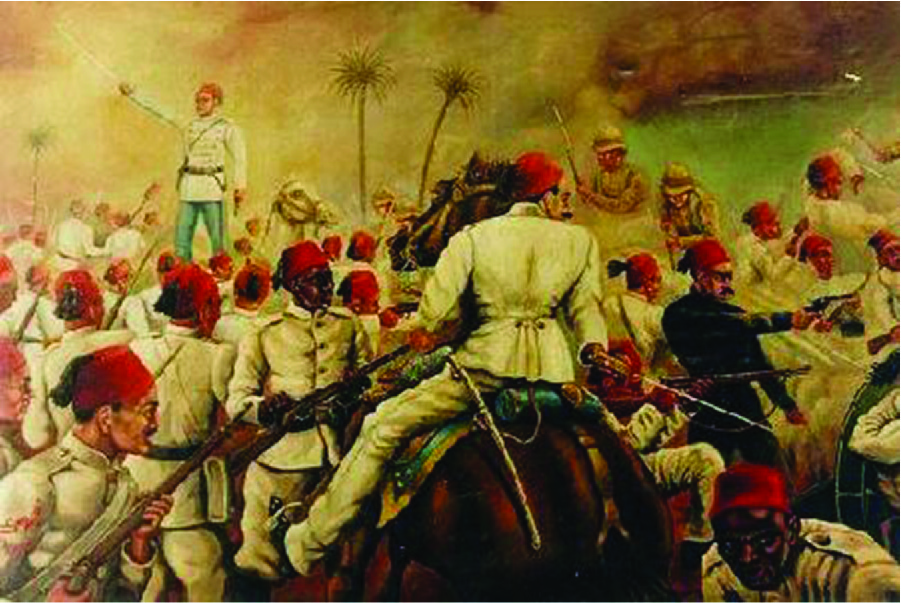
In 1879, an anti-European uprising began in Egypt under the leadership of Colonel Ahmed Urabi. When Ismail Pasha gave in to Urabi’s demands to remove the British and French from governmental positions, Britain and France requested that the Ottoman sultan remove Pasha from power, which the sultan did, replacing him with his more agreeable son, Tawfiq Pasha. Equally unwilling to accept Tawfiq as their ruler, however, Urabi’s forces continued to fight until 1882, when they were defeated by the British (Figure 9.18). With the conclusion of this Anglo-Egyptian War, Britain assumed control of Egypt and Sudan to protect its financial interests in the region, and Urabi was sent into exile.
英語のヒント
1879年、アフマド・オラービー大佐の指導のもとで、反ヨーロッパの蜂起がエジプトで始まった。イスマーイール・パシャが、イギリス人とフランス人を政府の職から排除せよというオラービーの要求に応じると、英仏両国はオスマン帝国のスルタンにパシャの罷免を求めた。スルタンはこれに従い、より従順な息子タウフィーク・パシャに交代させた。しかしオラービーの軍勢は、タウフィークを支配者として受け入れることも同じように拒み、1882年にイギリス軍に敗れるまで戦い続けた(図9.18)。このイギリス・エジプト戦争の終結に伴い、イギリスは地域での財政上の利益を守るためエジプトとスーダンの支配を引き受け、オラービーは国外へ追放された。
The Anglo-Egyptian War.イギリス・エジプト戦争。
(credit: “Anglo-Egyptian War” by The Illustrated London News/Wikimedia Commons, Public Domain) · Public Domain
Figure 9.18 From 1879 to 1882, Egyptian forces, depicted in this 1882 image from The Illustrated London News, fought to rid their country of European domination and unseat rulers who acceded to European demands. (credit: “Anglo-Egyptian War” by The Illustrated London News/Wikimedia Commons, Public Domain)
図9.18 『The Illustrated London News』の1882年のこの絵に描かれたエジプト軍は、1879~1882年、ヨーロッパの支配を国から取り除き、ヨーロッパの要求に従う支配者を退位させるために戦った。(クレジット:「Anglo-Egyptian War」、『The Illustrated London News』/Wikimedia Commons、パブリックドメイン)
As hostilities between Britain and Urabi’s forces were coming to a close, a new threat arose in Sudan, where British control had been weak. In 1881, a religious leader named Muhammad Ahmad called upon the Sudanese to free themselves from Ottoman rule, which meant, in effect, freeing themselves of British-guided Egyptian rule. Muhammad Ahmad began to refer to himself as the Mahdi, a messiah or savior who will appear on earth to revive the practice of “true” Islam and usher in a period of justice that will last for a few years before the end of the world. Muhammad Ahmad proclaimed a religious crusade against the ruler of Egypt and gathered followers. British efforts to maintain control over Sudan failed, and the Mahdi’s followers continued to enforce their control over the region, even after his death in 1885.
英語のヒント
イギリスとオラービー軍の戦闘が終わりに近づくころ、イギリスの支配が弱かったスーダンで新たな脅威が生じた。1881年、ムハンマド・アフマドという宗教指導者が、オスマン帝国の支配から自らを解放するようスーダンの人々に呼びかけた。それは事実上、イギリスが指導するエジプトの支配からの解放を意味した。ムハンマド・アフマドは自らをマフディーと呼び始めた。マフディーとは、「真の」イスラームの実践を復興するために地上に現れ、世界の終末前の数年間続く正義の時代を開く、メシアまたは救世主である。ムハンマド・アフマドはエジプトの支配者に対する宗教的聖戦を宣言し、信奉者を集めた。スーダンの支配を維持しようとするイギリスの試みは失敗し、マフディーの信奉者たちは、1885年の彼の死後もこの地域への支配を守り続けた。