第10章工業化世界の生活と労働Life and Labor in the Industrial World
10.2 Life in the Industrial City10.2 工業都市の生活
Learning Objectives学習の目標
By the end of this section, you will be able to:
この節を読み終えると、次のことができるようになる。
Describe the benefits of living in a city in the Second Industrial Revolution
第二次産業革命期に都市で暮らす利点を説明する
Analyze the problems of city life and their relationship to industrialization
都市生活の問題と、工業化との関係を分析する
Identify cultural and artistic movements of the Second Industrial Revolution
第二次産業革命期の文化・芸術運動を明らかにする
Hand in hand with industrialization went the process of urbanization. Industrial cities grew by leaps and bounds as workers streamed from the countryside and from overseas to find work in factories and other places of employment. City life was challenging, especially for those whose only experience of urban life had been their nearby market town. The rapidity with which growth and change took place often made it difficult to plan for the orderly development of cities. As a result, cities were dirty and overcrowded. However, they did offer exciting opportunities and benefits not available in the countryside.
英語のヒント
工業化と手を携えて都市化が進んだ。労働者が農村や海外から、工場その他の職場で仕事を探そうと流れ込み、工業都市は急激に成長した。都市の生活は、とりわけ近くの市場町しか都市生活を知らない人々にとって厳しかった。成長と変化があまりに速いため、秩序ある都市開発を計画するのはしばしば困難だった。その結果、都市は汚れ、過密になった。しかし、農村では得られない刺激的な機会や利点も確かに提供した。
The Benefits of Life in the Industrial City工業都市で暮らす利点
In the nineteenth century, people came to industrial cities largely to find work. Some were also attracted by the excitement of city life. There were many drawbacks to living in nineteenth-century cities, but there were benefits too.
英語のヒント
19世紀、人々が工業都市へ来た主な理由は仕事探しだった。都市生活の刺激に引かれた人々もいた。19世紀の都市暮らしには多くの欠点があったが、利点もあった。
One of the advantages was the wealth of opportunities for leisure and recreation, some of which could be found only in cities. For instance, for the wealthy elite and the growing middle class—the sales representatives, engineers, accountants, and managers on whom industrialization was so dependent—there were libraries and bookstores. Many libraries were subscription libraries that loaned books only to dues-paying members, but free libraries also existed in communities ranging from large cities such as Boston, New York, London, Paris, Berlin, Moscow, Saint Petersburg, Tokyo, and Kyoto to small towns like Peterborough, New Hampshire. Newspapers abounded; every city published at least one, and some had many more. Theaters staged concerts, plays, ballets, and operas for the wealthy and middle class, but often the working class could observe the action and listen to the music. Even the city of Manaus in the depths of the Brazilian rain forest featured an opera house, built between 1885 and 1892, where rubber barons and the wealthy bankers and merchants who served them could attend operas, plays, and concerts.
英語のヒント
利点の一つは、余暇や娯楽の機会が豊富なことで、その中には都市でしか得られないものもあった。たとえば、裕福なエリートや、工業化が大きく依存した営業担当者・技師・会計士・管理職などの増え続ける中産階級のために、図書館や書店があった。多くは会費を払う会員にだけ本を貸す会員制図書館だったが、ボストン、ニューヨーク、ロンドン、パリ、ベルリン、モスクワ、サンクトペテルブルク、東京、京都などの大都市から、ニューハンプシャー州ピーターバラのような小さな町まで、無料の図書館もあった。新聞は多数あり、どの都市でも少なくとも一紙、多いところではさらに多くが発行された。劇場は富裕層と中産階級のためにコンサート、演劇、バレエ、オペラを上演したが、労働者階級も演技を見たり音楽を聴いたりできることが多かった。ブラジルの熱帯雨林の奥地にあるマナウスにさえ、1885~1892年に建設された歌劇場があり、ゴムの大実業家や彼らに仕える裕福な銀行家・商人が、オペラ、演劇、コンサートを鑑賞できた。
Members of the working class had other options for entertainment. Music halls in Britain, burlesque theaters in the United States, and cabarets in Paris featured young women singing and dancing. More often than not, skirts were kicked in the air, an exciting prospect at a time when women’s dresses covered the tops of their shoes. Dance halls attracted men and women every night. Even after long days in factories and offices, young city dwellers found the energy to dance, and many dances, like the tango, which emerged in the 1880s in the dance halls of Buenos Aires, were developed and popularized by working-class men and women.
英語のヒント
労働者階級には、他の娯楽の選択肢もあった。イギリスのミュージックホール、アメリカのバーレスク劇場、パリのキャバレーでは、若い女性が歌い踊った。たいていはスカートが空中へ蹴り上げられ、女性のドレスが靴の上部まで覆っていた時代には、それは刺激的な見ものだった。ダンスホールは毎晩、男女を引きつけた。工場や事務所で長い一日を過ごしても、都市の若者には踊る力が残っていた。1880年代のブエノスアイレスのダンスホールに現れたタンゴなど、多くの踊りは労働者階級の男女が生み出し、広めた。
By the end of the nineteenth century, cities offered yet more forms of entertainment that even the working class could afford. Arcades contained machines that enabled people to watch short films for a small sum. Early movie theaters appeared in cities at the end of the century, featuring silent films with simple story lines.
英語のヒント
19世紀末までに都市には、労働者階級にも手の届く娯楽がさらに増えた。遊戯場には、小額で短い映画を見られる機械が置かれた。世紀末には初期の映画館が都市に現れ、単純な筋書きの無声映画を上映した。
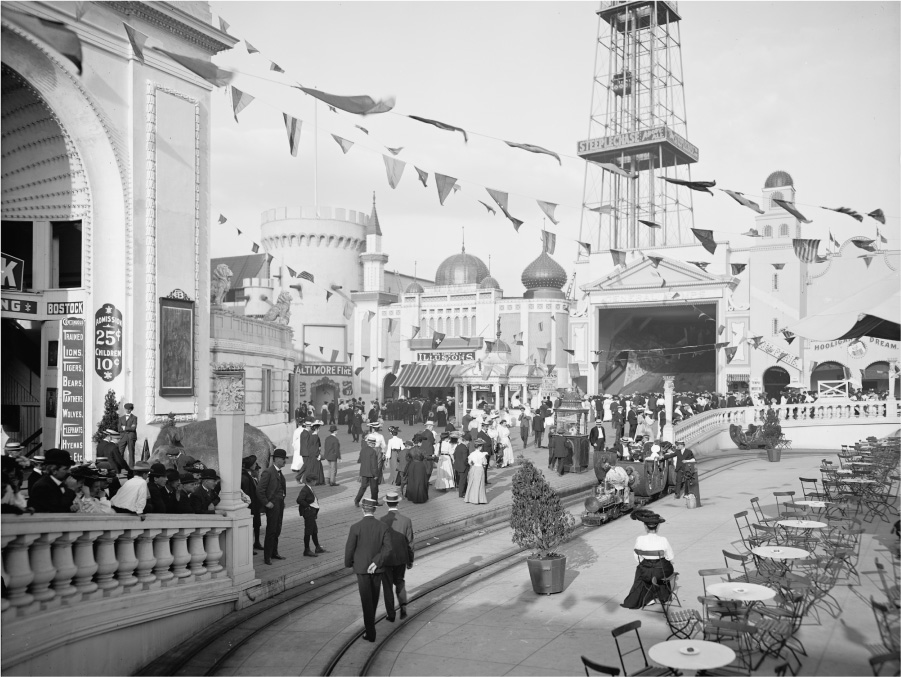
Amusement parks, lavishly decorated with electric lights and steam-powered rides, appeared at the end of streetcar and rail lines. Attractions such as roller coasters, Ferris wheels, and target shooting commonly offered visceral thrills like flying through the air or served as outlets for aggression. For men and women used to boring, repetitive labor and forced to suppress their resentment while on the job, the attraction was obvious. Some parks, like Copenhagen’s Tivoli (Denmark) and Coney Island’s Dreamland (New York), appealed more strongly to families because they were considered more sedate and refined. Dreamland sought to provide a supposedly educational experience by reproducing Swiss landscapes and Venetian canals for visitors (Figure 10.8). It also featured shows with biblical themes that warned of the punishment for sin.
英語のヒント
電灯で華やかに飾られ、蒸気で動く乗り物を備えた遊園地が、路面電車や鉄道の終点に現れた。ジェットコースター、観覧車、射的などの呼び物は、空を飛ぶような身体に直接響く興奮を与えたり、攻撃性を発散する場になったりした。退屈で反復的な労働に慣れ、仕事中は不満を抑え込むことを強いられた男女にとって、その魅力は明らかだった。コペンハーゲンのチボリ公園(デンマーク)や、コニーアイランドのドリームランド(ニューヨーク)のように、より落ち着いて上品だと考えられ、家族連れに特に人気の公園もあった。ドリームランドは、スイスの風景やヴェネツィアの運河を来園者のために再現し、教育的とされる体験を提供しようとした(図10.8)。罪への罰を警告する聖書の主題のショーもあった。
Dreamland.ドリームランド。
(credit: modification of work “Dreamland Park, Coney Island, N.Y.” by Detroit Publishing, Co./Library of Congress) · Public Domain
Figure 10.8 Dreamland was one of three amusement parks on Brooklyn’s Coney Island (New York) in the second half of the nineteenth century. This photograph from 1905 shows the grandiose architecture the park’s builder favored. From one vantage spot, visitors could see architectural styles typical of various European countries. (credit: modification of work “Dreamland Park, Coney Island, N.Y.” by Detroit Publishing, Co./Library of Congress)
図10.8 ドリームランドは、19世紀後半のブルックリンのコニーアイランド(ニューヨーク)にあった三つの遊園地の一つだった。1905年のこの写真は、建設者が好んだ壮大な建築を示す。一つの見晴らしのよい場所から、来園者はヨーロッパ各国を代表する建築様式を眺められた。(クレジット:「Dreamland Park, Coney Island, N.Y.」を改変、Detroit Publishing, Co./アメリカ議会図書館)
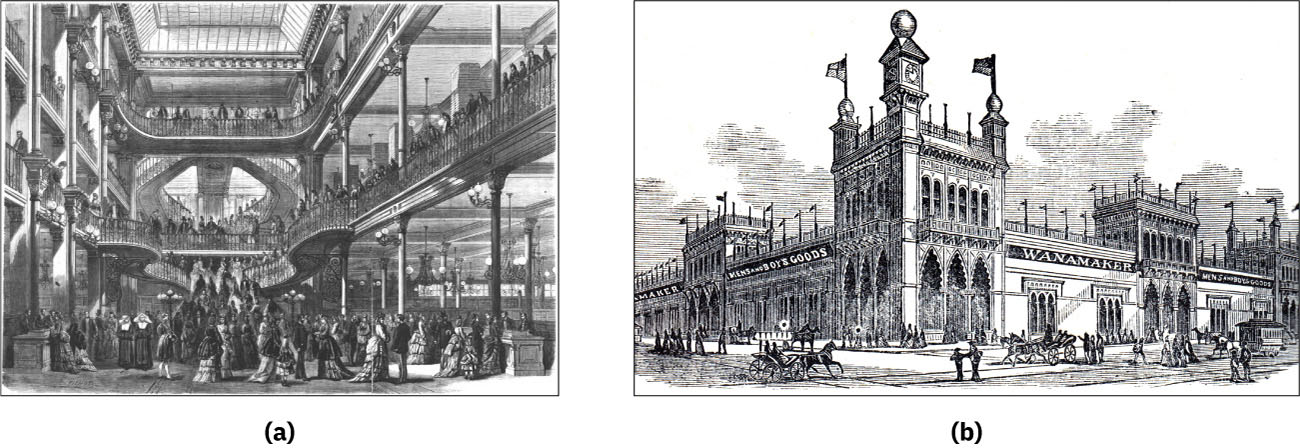
Among the delights of city life was shopping. Public transportation and the mass production of consumer goods aided in the creation of the modern department store, with enticing window displays, a wide variety of goods, and electrical illumination. All the world’s major industrialized cities possessed at least one such grand store. Philadelphia had Wanamaker’s, London boasted Selfridge’s, New York had Stewart’s and Macy’s, and in Paris it was Le Bon Marché (Figure 10.9). Mitsukoshi and Matsuzakaya in Tokyo introduced another innovation to Japanese society, which normally required people to go unshod indoors: Customers could wear their shoes inside the stores.
英語のヒント
都市生活の楽しみには買い物もあった。公共交通機関と消費財の大量生産は、魅力的なショーウィンドー、豊富な品ぞろえ、電気照明を備える近代的な百貨店の誕生を助けた。世界の主要な工業都市は、少なくとも一つはこのような大店舗を持っていた。フィラデルフィアにはワナメーカーズ、ロンドンにはセルフリッジズ、ニューヨークにはスチュワートとメイシーズ、パリにはル・ボン・マルシェがあった(図10.9)。東京の三越と松坂屋は、通常は屋内で靴を脱ぐ日本社会に別の革新を導入した。客が店内でも靴を履いたままでいられるようにしたのである。
The Bon Marché and Wanamaker’s.ボン・マルシェとワナメーカーズ。
(credit a: modification of work “Le Bon Marché” by L’illustration/Wikimedia Commons, Public Domain; credit b: modification of work “John Wanamaker’s Clothing House” by The Illustrated History of the Centennial Exposition/The Cooper Collections of US History”Wikimedia Commons, Public Domain) · Public Domain
Figure 10.9 The Bon Marché department store (a) was a favorite place for Parisians to shop. Management went to great lengths to make customers happy, even maintaining a fleet of horse-drawn conveyances to drive them home. Opening to crowds during the Centennial Exhibition in 1876, Wanamaker’s (b) in Philadelphia was modeled on the European open-air market, like Les Halles in Paris. In 1878, Wanamaker’s become the first department store with electric lighting. (credit a: modification of work “Le Bon Marché” by L’illustration/Wikimedia Commons, Public Domain; credit b: modification of work “John Wanamaker’s Clothing House” by The Illustrated History of the Centennial Exposition/The Cooper Collections of US History”Wikimedia Commons, Public Domain)
図10.9 ボン・マルシェ百貨店(a)は、パリ市民に人気の買い物の場所だった。経営側は客を満足させるため力を尽くし、客を家まで送る馬車の一団まで保有した。1876年のアメリカ独立百周年記念博覧会の期間に大勢の客を迎えて開店した、フィラデルフィアのワナメーカーズ(b)は、パリのレ・アールのようなヨーロッパの露天市場をモデルにした。1878年、ワナメーカーズは電気照明を備えた最初の百貨店となった。(クレジットa:「Le Bon Marché」を改変、『L’illustration』/Wikimedia Commons、パブリックドメイン。クレジットb:「John Wanamaker’s Clothing House」を改変、『The Illustrated History of the Centennial Exposition』/The Cooper Collections of US History/Wikimedia Commons、パブリックドメイン)
Along with housework and childcare, consumption was an important part of the lives of middle-class women during the Second Industrial Revolution. Stores enticed them with tearooms and ladies’ lounges, where they could rest should shopping tire them. Department stores also gave young working-class women opportunities for employment in clean, safe settings. Even those who could not afford to purchase the goods could still delight in looking at them; thus, window shopping was born. The inherent pleasure of the pastime is captured in the French term lecher les vitrines, literally, “licking the window glass.” By acquainting visitors with the latest styles, department stores helped to shape a developing consumer culture.
英語のヒント
第二次産業革命期の中産階級女性の暮らしでは、家事や育児とともに、消費も重要な部分を占めた。店はティールームや女性用休憩室で客を引きつけ、買い物に疲れたときはそこで休めた。百貨店はまた、若い労働者階級の女性に、清潔で安全な環境で働く機会を与えた。品物を買う余裕がない人も眺めて楽しめた。こうしてウィンドーショッピングが生まれた。この楽しみそのものの快さは、フランス語のlecher les vitrines、文字通りには「ショーウィンドーのガラスをなめる」という言葉に表れている。百貨店は訪問者に最新の流行を知らせることで、形成されつつある消費文化を形づくるのを助けた。