第10章工業化世界の生活と労働Life and Labor in the Industrial World
The Family in the Industrial Age工業化時代の家族
As people moved from small farms and country villages to cities and factory towns, their lives changed in ways both small and profound. On farms and in artisans’ workshops, women and children had labored alongside husbands and fathers and contributed to the family’s income. They did not always have similar opportunities in the industrial city.
英語のヒント
人々が小さな農場や農村から都市や工場町へ移ると、暮らしは小さな点でも根本的な点でも変わった。農場や職人の工房では、女性や子供は夫や父と並んで働き、家計に貢献していた。工業都市では、必ずしも同じような機会は得られなかった。
Early in the Industrial Revolution, women and children worked in factories, but by the end of the nineteenth century, this situation had changed. Although increasing mechanization meant that workers needed less physical strength, the presence of women and children in the workplace declined. Because wages were low, adult men still often needed the assistance of wives and children to pay the rent and purchase necessities, but less of this work now took place in factories. It became a point of pride for working-class men to keep their wives at home as the middle class did, even if the women were working. Married women also preferred to stay home when possible; tending to home and children was difficult while also working long hours in factories.
英語のヒント
産業革命の初めには女性や子供も工場で働いたが、19世紀末までに状況は変わった。機械化が進むと労働者に必要な体力は少なくなったが、職場の女性と子供は減少した。賃金が低いため、成人男性は家賃や必需品の購入に妻や子供の助けをなお必要とすることが多かったが、その仕事のうち工場で行う割合は減った。たとえ女性が働いていても、中産階級のように妻を家にいさせることが、労働者階級の男性の誇りとなった。既婚女性も可能なら家にいることを好んだ。工場で長時間働きながら家や子供の世話をするのは難しかったからである。
Indeed, many male laborers blamed women’s willingness to accept low wages for keeping their own pay low, and they sought to push women out of the workplace. In the United States and western Europe, children also had largely ceased working in most factories by the beginning of the twentieth century. Greater mechanization of the workplace eliminated the jobs that children had once been employed to do. Increasingly, too, governments passed laws that attempted to ban child labor. In some cases, this effort was motivated by the desire of upper-middle-class politicians to protect children while failing to understand the extent to which a working-class family might rely on their wages. At other times, politicians worried that children whose days were spent in factories would become physically inadequate soldiers or illiterate and uneducated citizens.
英語のヒント
実際、多くの男性労働者は、女性が低賃金を受け入れるために自分たちの賃金も低く抑えられるのだと非難し、女性を職場から押し出そうとした。アメリカと西ヨーロッパでは、20世紀初めまでに、子供も大半の工場ではほぼ働かなくなった。職場の機械化の進展は、かつて子供が雇われていた仕事をなくした。政府も、児童労働を禁止しようとする法律を次第に多く成立させた。場合によっては、子供を守りたいという上層中産階級の政治家の願いがこの努力を促したが、彼らは労働者の家庭が子供の賃金にどれほど依存するかを理解していなかった。また、工場で一日を過ごす子供は、兵士として身体的に不適格になったり、読み書きのできない無教育な市民になったりすると政治家が心配する場合もあった。
Britain, the first nation to industrialize, led the way in eliminating child labor. The Factory Act of 1819 limited children’s work to twelve hours a day. The Factory Act of 1833 prohibited children younger than nine from working in textile factories, the most common type of factory in Britain at that time. Children under fourteen were restricted to working eight hours a day and were required to receive two hours of schooling each day. Those fourteen and older could work only twelve hours a day. All children were given an hour for lunch.
英語のヒント
最初に工業化したイギリスは、児童労働の廃止でも先頭に立った。1819年工場法は子供の労働を一日12時間に制限した。1833年工場法は、当時のイギリスで最も一般的だった織物工場で、9歳未満の子供が働くことを禁じた。14歳未満の子供の労働は一日8時間に限られ、毎日2時間の学校教育を受けることが義務づけられた。14歳以上は一日12時間まで働けた。すべての子供に昼食時間が1時間与えられた。
In 1839, Prussia’s Child Labor Act banned factory employment for children under nine and limited shifts for factory workers under sixteen to ten hours. Children were also banned from working in factories at night. Such laws were widely evaded, however, by working-class families who needed children’s income and by employers who sought inexpensive labor. Many politicians also opposed such legislation, not only because it interfered with business but also because it deprived men of the right to govern their families.
英語のヒント
1839年、プロイセンの児童労働法は、9歳未満の子供の工場雇用を禁止し、16歳未満の工場労働者の勤務を10時間に制限した。子供が夜に工場で働くことも禁じられた。しかしこうした法律は、子供の収入を必要とする労働者家庭と、安価な労働力を求める雇い主によって、広く回避された。多くの政治家も、そのような法律は事業に干渉するだけでなく、男性が家族を統率する権利を奪うとして反対した。
In the face of such opposition to limits on it, child labor continued until laws requiring compulsory education helped to move children from factories to schoolrooms. By the end of the nineteenth century, new laws in the United States and western and central Europe mandated schooling, largely eliminating formal wage work by children under the age of fourteen. In places like Russia and Japan, where industrialization had begun later, married women and young children continued to work outside the home. In Japan, for example, more than 70 percent of married women from the lowest level of the working class (the hinmin) worked outside the home in 1911, but just ten years later, only 44 percent did.
英語のヒント
児童労働の制限にこのような反対があったため、子供を工場から教室へ移す助けとなる義務教育法ができるまで、児童労働は続いた。19世紀末までに、アメリカと西・中央ヨーロッパの新しい法律は就学を義務づけ、14歳未満の子供の正式な賃金労働をほぼなくした。工業化の開始が遅かったロシアや日本では、既婚女性と幼い子供が引き続き家の外で働いた。たとえば日本では1911年、労働者階級の最下層である貧民の既婚女性の70%以上が家の外で働いたが、わずか10年後には44%になった。
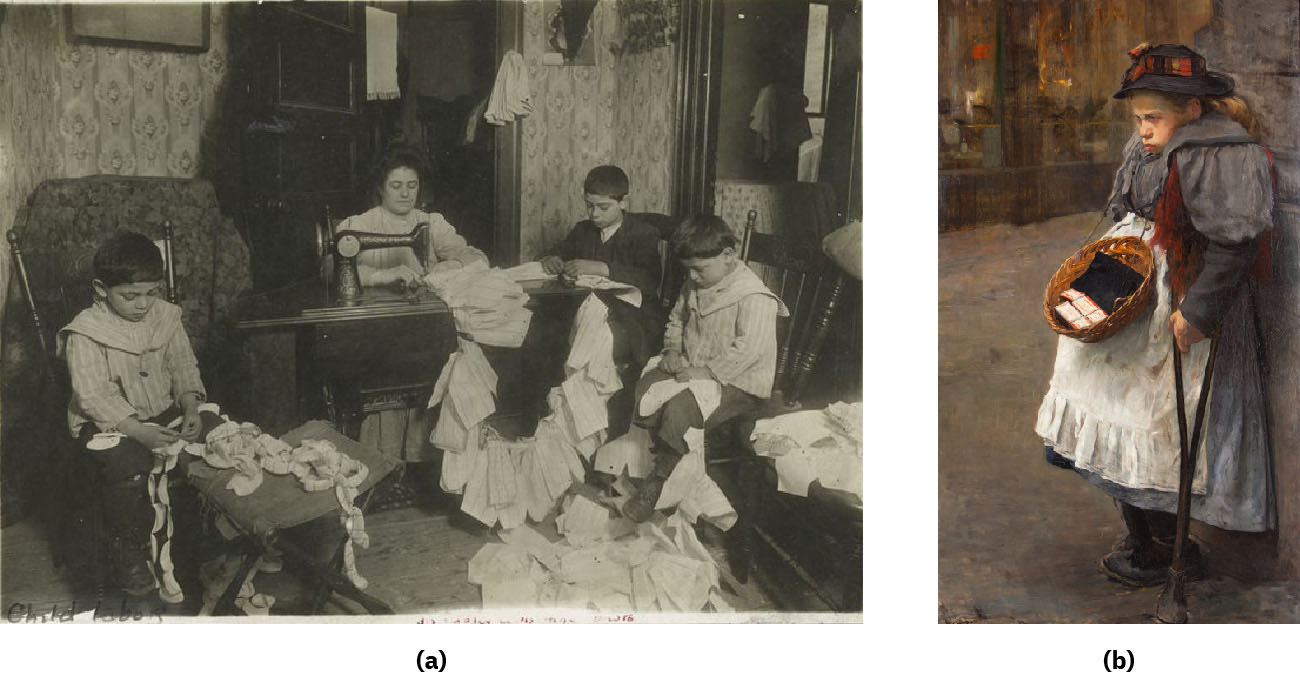
The result of these changes was that by the beginning of the twentieth century in the United States, France, Great Britain, and Germany, working-class wives tended to supplement the family’s income by working at home, not outside it. Unmarried women and those whose husbands were disabled or absent still sought factory work, but married women more commonly earned money in ways that did not require them to leave the home. Some cared for the children of working neighbors and took in laundry. If the family’s living space were large enough, they might take in boarders, who often slept with the children, and the woman of the house would cook and clean for them as well as for her own family. Many women did piecework at home, compensated based on the number of items produced. They collected materials from local businesses and assembled small items like toys, costume jewelry, or artificial flowers. Some stitched together items of clothing. They were often joined by their children, who might also hawk newspapers and peddle wares on the street (Figure 10.7).
英語のヒント
こうした変化の結果、20世紀初めまでにアメリカ・フランス・イギリス・ドイツでは、労働者階級の妻は外ではなく自宅で働き、家計を補う傾向を強めた。未婚女性や、夫に障害がある、または夫が不在の女性はなお工場の仕事を求めたが、既婚女性は家を離れなくてよい方法で稼ぐことが多くなった。働く近隣住民の子供を預かったり、洗濯物を請け負ったりした。住まいが十分広ければ下宿人を置くこともあった。下宿人は子供と同じ部屋で寝ることが多く、主婦は自分の家族だけでなく彼らのためにも料理と掃除をした。多くの女性は、作った品数に応じて報酬を得る出来高払いの内職をした。地元の事業者から材料を受け取り、玩具、模造宝飾品、造花などの小物を組み立てた。衣服を縫い合わせる者もいた。子供も手伝うことが多く、さらに街頭で新聞や商品を売り歩くこともあった(図10.7)。
Child Labor.児童労働。
(credit a: modification of work “Sewing work at home” by The New York Public Library/The New York Public Library Digital Collections, Public Domain; credit b: modification of work “Matchstick girl” by Haags Historisch Museum/Wikimedia Commons, Public Domain) · Public Domain
Figure 10.7 Children contributed to the income of working-class families in many ways. (a) In this photograph, a mother and her children are doing piecework in their nineteenth-century New York City apartment. Perhaps the older boy, sitting at the table with his mother, has just returned from school. (b) In the painting Matchstick Girl from about 1900 by Dutch painter Floris Arntzenius, a girl with a disability sells matches near the entrance to a shopping arcade in The Hague. (credit a: modification of work “Sewing work at home” by The New York Public Library/The New York Public Library Digital Collections, Public Domain; credit b: modification of work “Matchstick girl” by Haags Historisch Museum/Wikimedia Commons, Public Domain)
図10.7 子供たちは多くの方法で労働者家庭の収入に貢献した。(a)この写真では、母親と子供たちが、19世紀のニューヨーク市のアパートで内職をしている。母と同じ卓に座る年長の少年は、学校から帰ったばかりかもしれない。(b)オランダの画家フローリス・アルンツェニウスによる1900年ごろの絵『Matchstick Girl』では、障害のある少女が、ハーグの商店街アーケードの入口近くでマッチを売っている。(クレジットa:「Sewing work at home」を改変、ニューヨーク公共図書館/同デジタルコレクション、パブリックドメイン。クレジットb:「Matchstick girl」を改変、ハーグ歴史博物館/Wikimedia Commons、パブリックドメイン)
Family size was also affected by these changes in the nature of work. In the United States, France, Great Britain, and Germany, by the beginning of the nineteenth century middle-class families had reduced the number of children they had. On the farm, in craft shops, and in early factories, children’s labor was still valuable, so the working classes continued to have large families. By the second half of the century, however, children could no longer earn their keep alongside their parents in the factory and instead had to be fed and clothed during their school years from a smaller pool of money. They then became an expense many working-class families could not afford. The inadequate and overcrowded urban housing available to the industrial working class also made large families undesirable.
英語のヒント
仕事の性質のこうした変化は、家族の大きさにも影響した。アメリカ・フランス・イギリス・ドイツでは、19世紀初めまでに中産階級の家庭は子供の数を減らしていた。農場、職人の店、初期の工場では子供の労働はなお有用だったため、労働者階級は大家族を持ち続けた。しかし世紀後半になると、子供は工場で親と働いて自分の食いぶちを稼ぐことができなくなり、学校に通う間、減った家計の中から食事や衣服を与えなければならなくなった。そのため子供は、多くの労働者家庭にとって負担しきれない支出となった。工業労働者階級が利用できる、不十分で過密な都市住宅も、大家族を望ましくないものにした。
Innovations in birth control at this time enabled working-class parents to limit the number of children they had, just as the middle-class did. Vulcanized rubber made for more comfortable and reliable condoms, as well as cervical caps and early forms of diaphragms called “womb veils.” New printing techniques allowed the mass-production of pamphlets instructing women in how to limit family size. In 1877, the Malthusian League, which advocated the use of contraception, was founded in Great Britain. It was named for Thomas Malthus, who had advocated limiting births in the late eighteenth century in order to prevent the human population from growing beyond the capacity of the land to support it. Although Malthus himself had opposed the use of contraceptive devices, Britons like Charles Bradlaugh and Annie Besant in the 1870s, and Marie Stopes in the early twentieth century, advocated for their use. In the United States, Margaret Sanger, a visiting nurse who cared for working-class women in New York and witnessed the detrimental effects on their health of repeated pregnancies, championed birth control, a term she popularized, as Stopes was doing the same in Britain.
英語のヒント
この時期の避妊技術の革新により、労働者階級の親も中産階級と同様、子供の数を制限できるようになった。加硫ゴムは、より快適で確実なコンドーム、子宮頸管キャップ、「子宮のベール」と呼ばれた初期のペッサリーの製造を可能にした。新しい印刷技術によって、家族規模を抑える方法を女性に教えるパンフレットを大量生産できた。1877年、避妊の利用を提唱するマルサス主義連盟がイギリスで設立された。その名は、18世紀末に、土地が支えられる限度を人間の人口が超えないよう、出生の制限を主張したトマス・マルサスに由来する。マルサス自身は避妊具の使用に反対したが、1870年代のチャールズ・ブラッドローとアニー・ベサント、20世紀初めのマリー・ストープスなどのイギリス人は使用を提唱した。アメリカでは、ニューヨークの労働者階級の女性をケアし、繰り返す妊娠が健康を害する様子を見た訪問看護師マーガレット・サンガーが、自ら普及させた語である「バース・コントロール(産児調節)」を推進した。同じころ、ストープスもイギリスで同様の活動をしていた。
In those parts of Europe where the Catholic Church was powerful and the use of contraceptive devices was frowned upon, women married later in order to avoid early childbearing. Beginning in the 1870s, working-class families began to shrink in size, and by the start of the twentieth century, the average family size for laborers had dropped from four to six children to two to four, only slightly larger than among the middle class. This reduction in family size caused by falling birth rates in industrialized nations is called the demographic transition.
英語のヒント
カトリック教会が強く、避妊具の使用が好ましく思われないヨーロッパの地域では、女性は早い時期の出産を避けるため結婚を遅らせた。1870年代から労働者階級の家族は小さくなり始め、20世紀初めまでに、労働者家庭の平均的な子供の数は4~6人から2~4人へ減り、中産階級をわずかに上回るだけになった。工業国で出生率が下がることによる家族規模のこの縮小を、人口転換という。
The main job of nearly all city children at this time was education. The industrialized world called for skills that could be learned only in school. Achieving middle-class status depended on obtaining a job for which at least a secondary school education was needed, and providing one for their children was an important goal for middle-class parents seeking to maintain their position in the world. By the end of the nineteenth century, some members of the middle class, especially young men, attended college, but education beyond secondary school was reserved largely for the sons of the wealthy.
英語のヒント
この時代、ほぼすべての都市の子供にとって、主な仕事は教育を受けることだった。工業化した世界は、学校でしか学べない技能を要求した。中産階級の地位を得るには、少なくとも中等教育を必要とする仕事を得なければならず、子供にその教育を受けさせることは、自分たちの社会的地位を維持したい中産階級の親にとって重要な目標だった。19世紀末までには中産階級の一部、とりわけ若い男性が大学へ進んだが、中等教育より上の教育は主に富裕層の息子たちに限られていた。
Aspirational members of the working class sought to keep their children in school until they had completed the elementary grades, where they acquired basic literacy and learned arithmetic. Some children also attended a few years of secondary school, where they were introduced to mathematics, history, and perhaps a modern or classical language like Latin. A job that required little beyond a basic education, such as store clerk, cashier, or bookkeeper, could raise a child into the higher levels of the working class. If a daughter were to complete secondary school and become a teacher, she crossed the threshold into the lower ranks of the middle class.
英語のヒント
向上心のある労働者階級の親は、子供が基礎的な読み書きと算数を学ぶ初等課程を終えるまで、学校に通わせようとした。中等学校にも数年間通い、数学、歴史、場合によっては現代語やラテン語のような古典語を学ぶ子供もいた。店員、出納係、簿記係など、基礎教育以上のものをあまり必要としない仕事でも、子供を労働者階級の上層へ引き上げることができた。娘が中等教育を修了して教師になれば、中産階級の下層へ入る境界を越えた。
By the end of the nineteenth century, industrialized societies had created systems of public education that were able to instill basic literacy in a majority of their populations. In Britain, Germany, and the Netherlands, nearly all people were literate by 1910. Ninety percent of adult Japanese men could read. More than 80 percent of the French and Belgian populations could as well. Even in countries that were slower to industrialize, like Italy, by the beginning of the twentieth century, more than half the population could read.
英語のヒント
19世紀末までに、工業化した社会は、人口の大半に基礎的な読み書きを身につけさせる公教育制度を作り上げていた。イギリス・ドイツ・オランダでは、1910年までにほぼ全員が読み書きできた。日本の成人男性の90%は読めた。フランスとベルギーでも人口の80%以上が読めた。イタリアのように工業化が遅れた国でも、20世紀初めまでに人口の半分以上が読めるようになった。