第5章古代のアジアAsia in Ancient Times
5.4 Vedic India to the Fall of the Maurya Empire5.4 ヴェーダ時代のインドからマウリヤ朝帝国の崩壊まで
Learning Objectives学習の目標
By the end of this section, you will be able to:
この節を学ぶと、次のことができるようになる。
Explain the caste system and the way it functioned in Indian society
カースト制度と、それがインド社会でどのように機能したかを説明する。
Identify the main elements of Buddhism
仏教の主な要素を挙げる。
Describe India’s faith traditions: Brahmanism, Buddhism, and Hinduism
インドの信仰の伝統である、バラモン教・仏教・ヒンドゥー教を説明する。
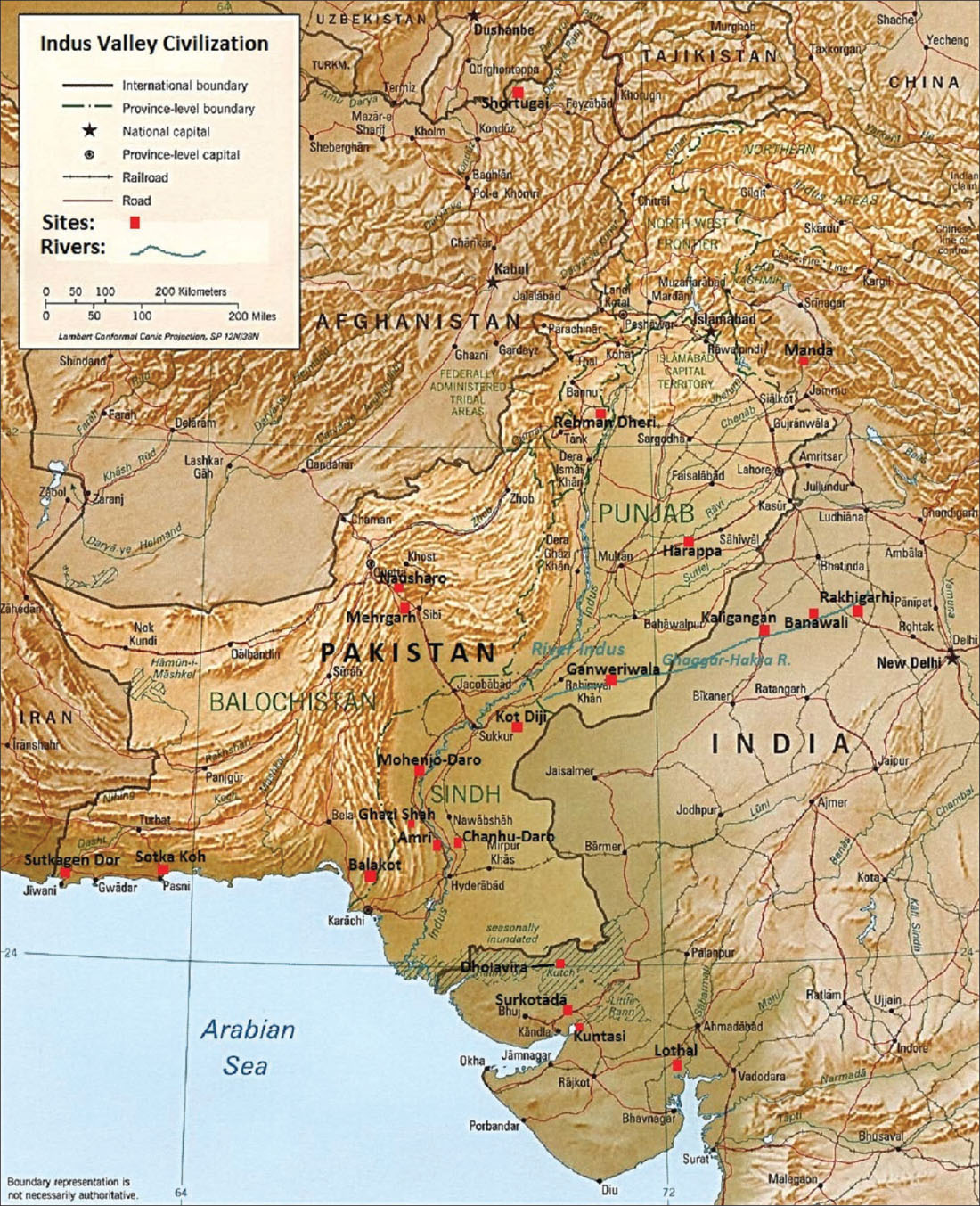
Few areas of the world are as important to our understanding of the emergence of human civilizations as India. Occupying an enormous subcontinent in South Asia, India has three distinct geographic zones: a northern area defined by the Himalayas that forms a natural barrier to the rest of the Asian mainland, the densely populated river valleys of the Indus and Ganges Rivers that lie to the south and northwest of that area, and lastly the tropical south, cut off from those valleys by many mountains and thick forests (Figure 5.20).
英語のヒント
人類文明の出現を理解するうえで、インドほど重要な地域は世界でも少ない。南アジアの巨大な亜大陸を占めるインドには、三つの異なる地理的区域がある。一つはヒマラヤ山脈を特徴とし、アジア本土のほかの地域との自然の障壁をなす北部。次はその南と北西に位置する、人口の密集したインダス川とガンジス川の流域である。そして最後が、多くの山々と深い森林によってこれらの流域から隔てられた、熱帯の南部である(図5.20)。
The Indian Subcontinent.インド亜大陸。
(credit: “The major sites of the Indus Valley Civilization fl 2600–1900 BCE in Pakistan, India and Afghanistan” by US Federal Central Intelligence Agency (CIA)/Wikimedia Commons, Public Domain) · Public Domain
Figure 5.20 This map outlines the major features of the Indian subcontinent, where the Himalayas stand as a northern border with the rest of Asia. (credit: “The major sites of the Indus Valley Civilization fl 2600–1900 BCE in Pakistan, India and Afghanistan” by US Federal Central Intelligence Agency (CIA)/Wikimedia Commons, Public Domain)
図5.20 この地図はインド亜大陸の主要な特徴を示す。北では、ヒマラヤ山脈がアジアのほかの地域との境界をなしている。(出典: “The major sites of the Indus Valley Civilization fl 2600–1900 BCE in Pakistan, India and Afghanistan”/US Federal Central Intelligence Agency (CIA)/Wikimedia Commons, パブリックドメイン)
Early humans traveled into Asia in waves around sixty thousand to eighty thousand years ago, moving from Africa to the Arabian Peninsula into India and beyond, on routes that hugged the coast. Some of the earliest evidence of this migration was found at Jwalapuram, India. Here, hundreds of stone tools dating to 74,000 BCE were discovered that resemble those of roughly the same age found in Africa, Laos, and Australia. But the roots of India’s ancient civilizations lie in the north, amid the archaeological remains of two ancient cities, Harappa and Mohenjo-Daro.
英語のヒント
初期の人類は約6万~8万年前、いくつもの波となってアジアへ移動した。アフリカからアラビア半島を経て、沿岸をたどる道筋でインドへ、さらにその先へ進んだ。この移動の最初期の証拠のいくつかは、インドのジュワラプラムで見つかった。そこでは、アフリカ・ラオス・オーストラリアで発見されたほぼ同時期のものに似た、前7万4000年の石器が数百点発見された。しかしインドの古代文明の根は、北部にある二つの古代都市、ハラッパーとモヘンジョダロの考古学的遺構の中にある。
Harappa and Mohenjo-Daroハラッパーとモヘンジョダロ
Unlike ancient cultures in Mesopotamia (3500–3000 BCE), Egypt (3500–3000 BCE), and China (2200–2000 BCE), the Indus valley civilization shows little evidence of political power concentrated in the hands of hereditary monarchs. Yet its culture and technology spread, in an area running from parts of present-day Afghanistan into Pakistan and western India. There, early human communities capable of agriculture flourished near the fertile plains around the Indus River and other waters fed annually by the region’s monsoons.
英語のヒント
メソポタミア(前3500~前3000年)、エジプト(前3500~前3000年)、中国(前2200~前2000年)の古代文化とは異なり、インダス文明には、政治権力が世襲君主に集中していた証拠がほとんど見られない。それでも文化と技術は、現在のアフガニスタンの一部からパキスタン・インド西部に及ぶ地域へ広がった。そこでは、農耕を行うことのできる初期の共同体が、インダス川と、毎年のモンスーンによって水を供給されるほかの水域の周囲の肥沃な平野で栄えた。
Farmers harvested domesticated crops of peas, dates, and cotton, harnessing the power of draft animals such as the water buffalo. The archaeological record shows few traces of any kind of elaborate monumental architecture, burial mounds, or domination by warriors and kings. Instead, a common culture grew that was defined by urban planning, complete with advanced drainage systems, orderly streets, and distinctive bricks made in ovens. Equipped with those tools, the Indus River valley produced two of the ancient world’s most technologically advanced cities, Harappa and Mohenjo-Daro. Within them, residents developed a highly urban society and rich spiritual life, with altars featuring fire and incense, practices such as ceremonial bathing, and a symbolic vocabulary using elephants and bulls as revered animals. Dedicated artisans made jewelry and fabrics. All these aspects of the Indus valley culture left an imprint on later Indian civilizations.
英語のヒント
農民は、水牛などの役畜の力を利用しながら、栽培化されたエンドウ・ナツメヤシ・綿を収穫した。考古学的記録には、手の込んだ巨大建築や墳墓、戦士や王による支配の痕跡は、ほとんど見られない。代わりに、高度な排水設備、整然とした街路、炉で焼いた特徴的な煉瓦を備える都市計画によって特徴づけられる、共通文化が発展した。こうした技術を備えたインダス川流域は、古代世界で最も技術的に進んだ都市のうちの二つ、ハラッパーとモヘンジョダロを生んだ。住民は高度な都市社会と豊かな宗教生活を発達させ、火と香を用いる祭壇、儀礼的な沐浴、象や牡牛を崇敬される動物として用いる象徴表現を持っていた。専門の職人は装身具や織物を作った。インダス文明のこうした側面はすべて、後のインド文明に痕跡を残した。
How did a civilization with a high degree of labor specialization and the coordination necessary for irrigated agriculture and large urban centers manage such complexity without a powerful centralized state? There is no consensus answer, though the Indus valley civilization may have developed as a series of small republic-like states, dominated by religious specialists such as priests presiding over an intensely hierarchical class system. It does seem likely, however, that the environmental toll the civilization inflicted upon the surrounding areas led to its decline. Over time, irrigation replaced fertile soil with soil having greater quantities of salt, lowering crop yields. The use of wood as a fuel source, such as for making the oven-fired bricks, led to rapid deforestation and even greater soil erosion. It appears that most communities in and around Harappa and Mohenjo-Daro abandoned the sites around 1700 BCE, when they became unable to feed and supply themselves. Before their decline, however, the two cities housed perhaps as many as forty thousand residents each, most of whom lived in comparatively luxurious homes of more than one story that featured indoor plumbing and were laid out in an orderly pattern along grid-like streets. Public buildings such as bathhouses were quite large, as were the protective city walls and citadels.
英語のヒント
高度な分業と、灌漑農業や大都市に必要な調整力を備えた文明が、強力な中央集権国家なしに、これほど複雑な仕組みをどう運営したのだろうか。合意された答えはない。ただし、インダス文明は、厳格な階層制度を取り仕切る祭司など、宗教的な専門家に支配された、共和制に似た小国家の集まりとして発展した可能性がある。しかし文明が周囲の環境へ与えた負担が衰退につながった、という見方には可能性がある。時とともに灌漑は肥沃な土を塩分の多い土に変え、収穫を減らした。煉瓦を炉で焼くなどのために木を燃料として使ったことは、急速な森林破壊と、いっそう大きな土壌流出を招いた。ハラッパーとモヘンジョダロの内外の共同体の大半は、食料や物資を自給できなくなった前1700年ごろ、これらの場所を去ったと考えられる。しかし衰退以前には、両都市にそれぞれ最大4万人ほどの住民がいた可能性がある。その大半は、格子状の街路に沿って整然と配置された、屋内の給排水設備を備える比較的ぜいたくな2階建て以上の家に住んでいた。浴場などの公共建築は、防御用の城壁や城塞と同様、かなり大きかった。
The development of a written script, found on clay seals and pottery at the sites, likely made such feats possible. The written language of the Indus valley civilization featured more than four hundred symbols that functioned as pictures of ideas, words, and numbers. While many of the symbols have yet to be deciphered, one of the primary functions of writing appears to have been commerce because many finished goods were stamped with written seals. Writing used as a means of communication and recordkeeping probably also helped the Indus valley civilization profit from long-distance trade with Mesopotamia and Egypt.
英語のヒント
遺跡の粘土製印章や土器に見られる文字体系の発達が、こうした事業を可能にしたと考えられる。インダス文明の文字には400以上の記号があり、観念・語・数を表す図像として機能した。記号の多くはまだ解読されていないが、完成品の多くに文字を伴う印章が押されているため、文字の主要な機能の一つは商業だったと考えられる。意思疎通と記録の手段として使われた文字は、メソポタミアやエジプトとの遠距離交易からインダス文明が利益を得るうえでも、おそらく役立った。
Merchants from Sumer traveled to the Indus River valley to establish trade in luxury items such as lapis lazuli. In return, it appears that traders and merchants from cities such as Harappa took up residence in cities in Mesopotamia to facilitate exchange. In this way, Mesopotamia exerted a recognizable influence on India’s art and culture. Scholars have identified aspects of Greek naturalist art in sculptures found in Harappa, combined with local preferences for representing human bodies in motion rather than adopting the Greek emphasis on anatomical correctness. Art from these early cities helped usher in artistic styles and motifs that created a continuous tradition ingrained within Indian culture. Stone seals with fantastic beasts and anthropomorphic deities were later associated with Indian traditions such as yoga and Hindu deities.
英語のヒント
シュメールの商人は、ラピスラズリなどの奢侈品の交易を始めるため、インダス川流域へ赴いた。その見返りに、ハラッパーなどの都市の交易者や商人も、交換を容易にするためメソポタミアの都市へ住みついたと考えられる。こうしてメソポタミアは、インドの美術と文化に認識できる影響を及ぼした。学者はハラッパーで見つかった彫刻に、ギリシアの自然主義的美術の特徴を見いだしている。それは、解剖学的な正確さを重んじるギリシアの考えをそのまま採用するのではなく、動きのある人体表現を好む土地の嗜好と組み合わされていた。これら初期都市の美術は、インド文化に深く根づく連続した伝統を作る、芸術様式や文様をもたらすのに役立った。幻想的な獣や人の姿をした神々を刻んだ石印は、後にヨーガのようなインドの伝統や、ヒンドゥー教の神々と結びつけられた。
Significant archaeological evidence suggests that urban women in the Indus valley were influential figures who functioned as specialists in rituals. More figurines were found depicting female than male deities, and women were typically buried with female relatives—their mothers and grandmothers—and not with their husbands. This is not to suggest that all women were equals. The prevalence of contrasting hairstyles and clothing on many surviving figurines indicates that women were differentiated by a great number of class and ethnic markers.
英語のヒント
重要な考古学的証拠は、インダス流域の都市の女性が、儀礼の専門家として働く、影響力のある人物だったことを示唆する。男性の神よりも女性の神を表す小像が多く見つかり、女性は一般に夫とではなく、母や祖母など女性の親族とともに埋葬された。これは、すべての女性が平等だったことを示すものではない。現存する多くの小像に髪型や服装の違いが広く見られることは、多数の階級的・民族的特徴によって、女性が区別されていたことを示している。
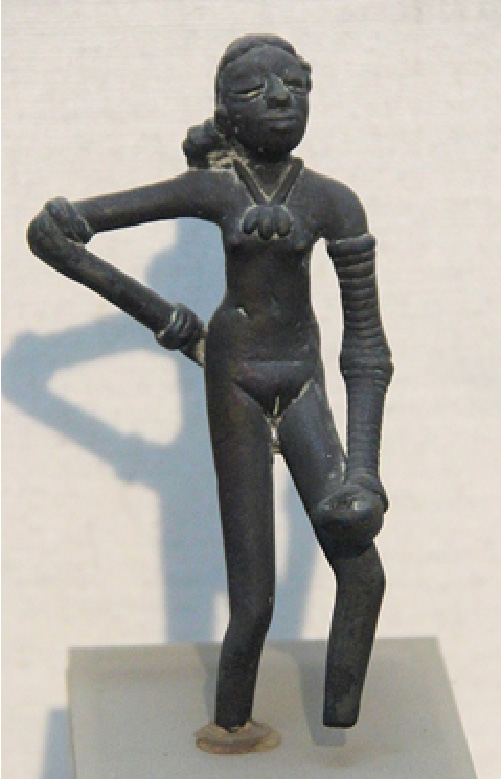
Among the more intriguing clues to the way women fared in the Indus valley is a tiny artifact from Mohenjo-Daro called Dancing Girl, a bronze and copper figurine about 4.5 inches tall and dating from around 2500 BCE (Figure 5.21). Created by a method of casting bronze known as the “lost wax” method, the nude figure appears in a confident and relaxed pose, with her hair gathered in a bun. She may have represented a royal woman, a sacred priestess of a temple, or perhaps a lower-born tribal girl. That scholars can draw such a wide array of plausible conclusions speaks to the fact that the Indus valley likely had a very fluid class structure and a highly complex society.
英語のヒント
インダス流域で女性がどのような境遇にあったかを示す、特に興味深い手がかりの一つが、モヘンジョダロの小さな遺物「踊る少女」である。青銅と銅の小像で、高さは約4.5インチ、前2500年ごろのものとされる(図5.21)。「ロストワックス法」という青銅鋳造法で作られた裸体像は、髪を丸く束ね、自信がありくつろいだ姿勢を取っている。王族の女性、神殿の神聖な女性祭司、あるいは身分の低い部族の少女を表したのかもしれない。学者がこれほど幅広い、もっともらしい結論を引き出せることは、インダス流域に非常に流動的な階級構造と、高度に複雑な社会があった可能性を物語っている。
Dancing Girl.踊り子。
(credit: modification of work “Bronze ‘Dancing Girl,’ Mohenjo-daro, c. 2500 BC” by Gary Todd/Flickr, Public Domain) · Public Domain
Figure 5.21 A bronze and copper figurine from India, the tiny Dancing Girl found at Mohenjo-Daro stands as one of the most enigmatic artifacts from ancient Asia. (credit: modification of work “Bronze ‘Dancing Girl,’ Mohenjo-daro, c. 2500 BC” by Gary Todd/Flickr, Public Domain)
図5.21 インドの青銅と銅の小像で、モヘンジョダロから見つかった小さな《踊り子》は、古代アジアで最も謎めいた遺物の一つである。(出典: 原作品を加工:“Bronze ‘Dancing Girl,’ Mohenjo-daro, c. 2500 BC”/Gary Todd/Flickr, パブリックドメイン)