第5章古代のアジアAsia in Ancient Times
5.1 Ancient China5.1 古代中国
Learning Objectives学習の目標
By the end of this section, you will be able to:
この節を学ぶと、次のことができるようになる。
Discuss the early dynasties of ancient China
古代中国の初期王朝について論じる。
Analyze the impact of the Warring States Period on ancient Chinese politics and culture
戦国時代が古代中国の政治と文化に与えた影響を分析する。
Explain the connections between ancient Chinese philosophy and its political and social context
古代中国の思想と、その政治的・社会的な背景とのつながりを説明する。
Ancient China was not the first area in Asia to practice agriculture and develop cities. But it was home to some of the world’s earliest political dynasties, and it produced written scripts, influential schools of thought and religion, and innovations in architecture and metallurgy, such as the manufacture of bronze and iron agricultural implements, weapons, chariots, and jewelry. A climate of constant regional warfare between small Chinese states imparted to kings and philosophers alike a sense of urgency to build institutions and systems that would bring stability to their realms. Against this background, China’s first empire, the Qin, presided over the creation of some of the ancient world’s greatest historical treasures, including the Terracotta Army and an early form of the Great Wall.
英語のヒント
古代中国は、アジアで最初に農耕を行い都市を発達させた地域ではない。しかし、世界でも最初期の王朝のいくつかが生まれた場所であり、文字体系、影響力のある思想・宗教の学派、建築や冶金の技術革新を生み出した。青銅・鉄の農具や武器、戦車、装身具の製造もその一例である。中国の小国間で絶えず地域的な戦争が起こる状況は、王にも哲学者にも、領域に安定をもたらす制度や仕組みを築くことの切迫した必要性を感じさせた。こうした背景の下、中国最初の帝国である秦は、兵馬俑や初期の万里の長城など、古代世界を代表する歴史的遺産の建設を主導した。
Prehistoric China先史時代の中国
Recent studies of Paleolithic and Neolithic China suggest it was home to several distinct cultural complexes that developed independently of one another and exhibited notable regional variations in agriculture, social organization, language, and religion.
英語のヒント
旧石器時代・新石器時代の中国に関する近年の研究は、互いに独立して発展した複数の異なる文化複合が存在し、農耕・社会組織・言語・宗教に顕著な地域差があったことを示唆している。
Human beings set foot on the Chinese subcontinent more than a million years ago. Evidence indicates the presence there of an archaic member of the human lineage known as Homo erectus, a term meaning “upright man.” One example is the well-known Peking Man, a subspecies of Homo erectus identified by fossil remains found in northern China in 1929. The species Homo sapiens (meaning “wise man” and including all modern humans) appeared later, around 100,000 years ago. These communities of hunter-gatherers followed the mammoth, elk, and moose on which they subsisted into northern China. Later they learned to fish along China’s many rivers and long coastlines and supplemented their food stores by foraging from a rich variety of plants, including many grasses, beans, yams, and roots.
英語のヒント
人類は100万年以上前に中国の亜大陸へ足を踏み入れた。証拠によれば、そこにはホモ・エレクトス、すなわち「直立する人」と呼ばれる人類系統の古い一員がいた。その一例がよく知られる北京原人で、1929年に中国北部で見つかった化石によって同定された、ホモ・エレクトスの亜種である。ホモ・サピエンスという種は、それより後の約10万年前に現れた。この名称は「賢い人」を意味し、現生人類はすべてこの種に含まれる。狩猟採集民の共同体は、食料としていたマンモス、エルク、ヘラジカを追って中国北部へ入った。後には、中国の数多い河川や長い海岸で漁労を行うことを覚え、さまざまな草・豆・ヤムイモ・根など豊富な植物を採集して、蓄える食料を補った。
Archaeological evidence from this stage of China’s prehistory, the Paleolithic period from roughly 100,000 to 10,000 BCE, confirms that these groups developed symbolic language, which enabled them to evolve ideas about abstractions like kinship and an afterlife and thus produce the foundations for a shared culture and society. Their tools, such as those used for grinding plants, were simple and fashioned primarily of stone, but also of bone and wood. Early humans arrived in China from Africa and western Asia in waves separated by hundreds of years, but they were far from uniform. Thus, they eventually produced early societies that spoke a variety of languages, differed in their spiritual beliefs, and developed the capacity for agriculture independently of one another.
英語のヒント
中国の先史時代のこの段階、すなわちおよそ前10万~前1万年の旧石器時代の考古学的証拠は、これらの集団が象徴的な言語を発達させたことを示す。それによって、親族関係や死後の世界といった抽象的な事柄について考え、共通の文化や社会の土台を生み出せるようになった。植物をすりつぶすものなどの道具は単純で、主に石から、また骨や木からも作られた。初期の人類は、数百年ずつの間隔を置くいくつもの波となって、アフリカや西アジアから中国へ到来した。しかし、その人びとは一様ではなかった。そのため、やがてさまざまな言語を話し、宗教的信仰も異なり、互いに独立して農耕を行う力を獲得した初期社会が形成された。
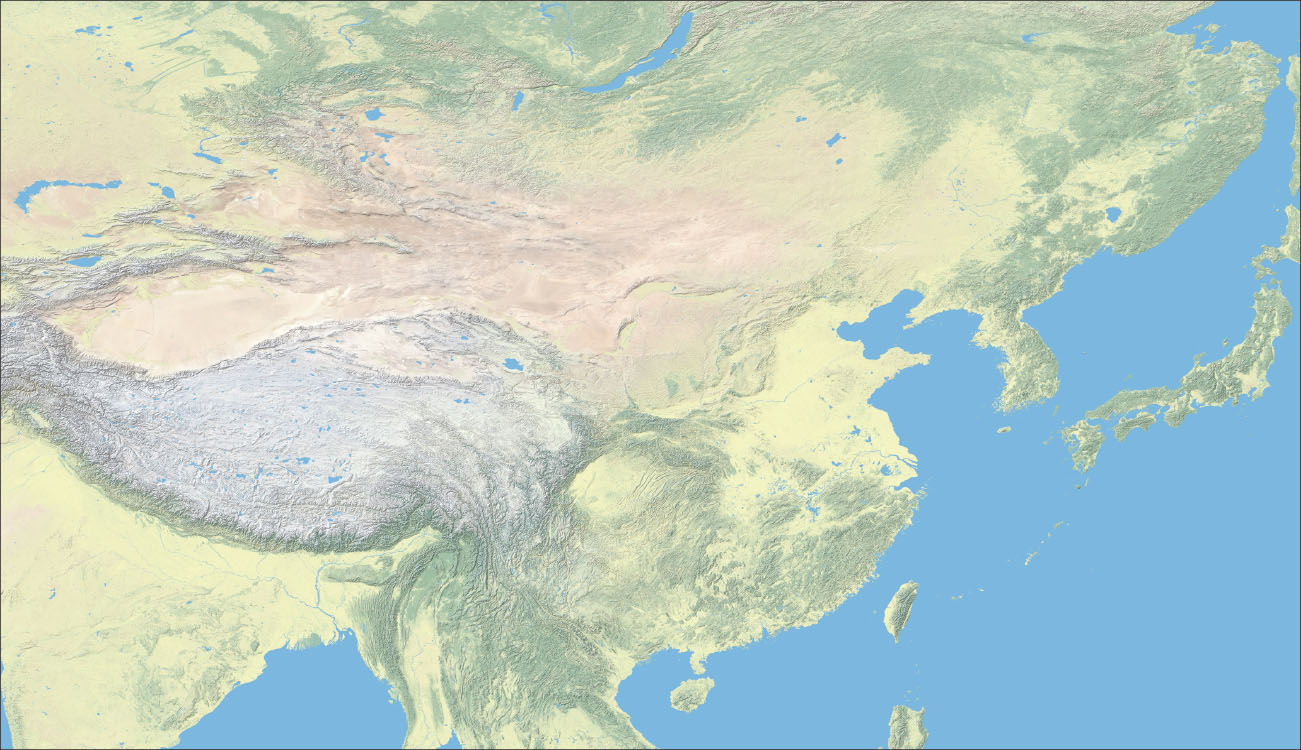
China’s diverse geography, climate, and terrain reinforced regional variations in these early cultures as well (Figure 5.4). The country today stretches for roughly a thousand miles from north to south and east to west, occupying a temperate zone dominated by two major river systems, the Yellow and the Yangtze. Mountains, deserts, grasslands, high plateaus, jungles, and a variety of climates exist, such as the frozen environs surrounding the city of Harbin in the north and the subtropical climate around Hong Kong in the south. Most of the early cultures and later dynasties that produced Chinese civilization lay in a much smaller area, within a series of provinces along the Yellow and Yangtze Rivers, ringed by the outer areas of Manchuria, Mongolia, Xinjiang, and Tibet. Today these provinces make up the most densely populated areas of the People’s Republic of China, inhabited almost entirely by the majority ethnic group in China, Han Chinese. The outlying areas have been the traditional homelands of a great many religious and ethnic minorities, such as Mongolians, Tibetans, Uyghurs, and Manchu, who did not become incorporated into the first dynasties of ancient China. Early inhabitants of China found that each region offered advantages and challenges to meeting the necessities of daily life: food, shelter, and security.
英語のヒント
中国の多様な地理・気候・地形も、こうした初期文化の地域差を強めた(図5.4)。今日の中国は南北・東西ともおよそ1000マイルに広がり、黄河と長江という二つの大きな水系が卓越する温帯に位置する。山岳、砂漠、草原、高原、密林があり、北のハルビン周辺の凍てつく環境から南の香港周辺の亜熱帯まで、気候も多様である。中国文明を形成した初期文化と後の王朝の大半は、もっと狭い範囲、黄河・長江沿いの一連の省に分布していた。その外側を満洲・モンゴル・新疆・チベットが取り囲んでいる。今日これらの省は中華人民共和国で最も人口密度の高い地域を構成し、中国の多数民族である漢族が住民のほぼ全体を占めている。外縁部は、モンゴル人・チベット人・ウイグル人・満洲人など、多数の宗教的・民族的少数集団の伝統的な故郷だった。これらの人びとは古代中国の最初の王朝には組み込まれなかった。中国の初期住民は、食料・住居・安全という日々の必需品を確保するうえで、地域ごとに利点と難しさがあることを知った。
Topography of Ancient China.古代中国の地形。
(credit: “China topography” by Tom Patterson, US National Park Service Natural Earth/Wikimedia Commons, Public Domain) · Public Domain
Figure 5.4 This map shows the varied topography of ancient China, which included fertile plains, river valleys, numerous mountain ranges, deserts, and a long running coastline on the eastern edge. (credit: “China topography” by Tom Patterson, US National Park Service Natural Earth/Wikimedia Commons, Public Domain)
図5.4 この地図は、肥沃な平野、河谷、多数の山脈、砂漠、東端に長く続く海岸線を含む、古代中国の多様な地形を示している。(出典: “China topography”/Tom Patterson, US National Park Service Natural Earth/Wikimedia Commons, パブリックドメイン)
More than twenty sites that produced unique Neolithic cultures have been found in China. The earliest such culture was the Nanzhuangtou (8500 to 7700 BCE) in Hebei, a province in the northeast, and the last known was the Yueshi culture (1900 to 1500 BCE) found in Shandong, an eastern coastal province. All were capable of farming, domesticating animals, and manufacturing textiles and ceramics.
英語のヒント
中国では、独自の新石器文化を生み出した遺跡が20か所以上発見されている。最古の文化は北東部の河北省にあった南荘頭文化(前8500~前7700年)で、知られているうちで最後のものは東海岸の山東省の岳石文化(前1900~前1500年)だった。いずれも農耕、動物の家畜化、織物や土器の製作を行う能力を持っていた。
China’s Neolithic cultures are notable for their independent growth and regional diversity, and for the differences between those in the north and those in the south. For example, in the southeastern part of the country, near Shanghai, a site dated to around 8000 BCE was home to people who cultivated rice, used boats, constructed standing homes, and made pottery with geometric designs. Evidence suggests their language was more closely related to those of the peoples living in Southeast Asia today, so calling them “Chinese” is open to debate. To the north, the colder climate forced early communities in today’s Hebei province to rely on another grain, millet, for their primary foodstuff. These farmers used stone tools such as sickles and made simple jars to store their grain. Wooden spears and hoes were more common in the south than stone tools, and while both north and south domesticated dogs and pigs, in the north grazing animals such as sheep were tamed, while in the south farmers harnessed the power of water buffalo.
英語のヒント
中国の新石器文化は、独立した発展と地域的な多様性、とりわけ北と南の違いで知られる。例えば南東部の上海近くにある約前8000年の遺跡では、稲を栽培し、舟を使い、地上に住居を建て、幾何学模様の土器を作る人びとが暮らしていた。証拠によれば、彼らの言語は今日の東南アジアの諸民族の言語により近かったため、彼らを「中国人」と呼ぶことには議論の余地がある。北部では寒い気候のため、現在の河北省の初期共同体は主食として別の穀物であるアワなどの雑穀に頼らざるを得なかった。これらの農民は鎌などの石器を使い、穀物を貯蔵する簡単な壺を作った。南部では石器より木製の槍や鍬が一般的だった。南北とも犬と豚を家畜化したが、北では羊など草を食べる動物を飼いならし、南では農民が水牛の力を利用した。
There were distinctive Neolithic cultures in the east and west of China. From about 4100 to 2600 BCE, the Dawenkou culture arose near Shandong in the east, characterized by the manufacture of exquisite works of pottery and the use of turquoise, ivory, and jade. The burial practices of the Dawenkou became more elaborate over time, eventually leading to the use of wooden coffins and the creation of ledges of earth to surround the graves. Later eastern cultures lavished treasures on the deceased, burying them with necklaces and beads, showing an increasing sophistication in the decorative arts.
英語のヒント
中国の東部と西部には、それぞれ特色ある新石器文化があった。前4100~前2600年ごろ、東の山東付近では大汶口文化が興り、精緻な土器の製作とトルコ石・象牙・玉の使用を特徴としていた。大汶口文化の埋葬の習慣は時とともに複雑になり、やがて木棺が使われ、墓を囲む土の段が設けられるようになった。後の東方の文化では、死者に財宝を惜しみなく捧げ、首飾りやビーズとともに埋葬した。これは装飾工芸の洗練が進んだことを示している。
To the west lay the Yangshao culture, dating to 5000 BCE, whose people farmed millet and dug homes in the earth to protect themselves from a cool climate. In Yangshao, burying the dead was a simpler process, but artists decorated pottery with painted designs and intricate geometric patterns. To the east there are few examples of painted bowls, jars, or cups. Instead, eastern cultures devoted their creative efforts to the slow, painstaking process of shaping jade. The Hongshan culture in Liaoning province and the Liangzhu complex in Jiangsu fashioned beautiful jade talismans, ornaments, and treasures for spiritual ceremonies. The great distance between these two cultures—with Hongshan far in the northeast near today’s border with North Korea and the Liangzhu located around the Yangtze River delta in the southeast—shows the breadth of jade’s influence along China’s eastern seaboard. In the west, jade remained a much rarer object.
英語のヒント
西部には前5000年にさかのぼる仰韶文化があり、その人びとはアワなどの雑穀を栽培し、寒い気候から身を守るため地面を掘って住居を作った。仰韶文化では埋葬はより簡素だったが、工人は彩色の意匠や複雑な幾何学模様で土器を飾った。東部には、彩色された鉢・壺・杯の例は少ない。その代わり、東の文化は、時間と丹念な作業を要する玉の加工に創意を注いだ。遼寧省の紅山文化と江蘇省の良渚文化複合は、宗教的儀式のために美しい玉の護符・装身具・宝物を作った。紅山ははるか北東、現在の北朝鮮との国境付近にあり、良渚は南東の長江デルタ周辺に位置する。二つの文化を隔てる大きな距離は、中国東海岸に沿って玉の影響がいかに広く及んだかを示す。西部では、玉ははるかに珍しい品であり続けた。
Later networks of exchange connected these regional cultures, which increasingly borrowed from each other, accelerating change, innovation, and collision. From roughly 3000 to 2000 BCE, China’s Neolithic cultures created and shared new implements for cooking and artistic styles such as geometric patterns on ceramics. With contact, however, came growing conflict as well, suggested in the archaeological record by the emergence of metalworking and cities defended by walls of rammed earth. The need to coordinate defense and construct such ramparts likely required a political evolution within these cultures, giving rise to an elite military class led by chiefs. Thereafter, military elites were shrouded in spiritual rituals revolving around human sacrifice, possibly of captives of war, who were entombed beneath buildings in sites found in northern China. Increasing exchange between Neolithic cultures and the prominence of war may also have led to greater social differentiation. Burial sites for elites show evidence of increasingly elaborate ceremonies to please the gods or ancestors and to honor the deceased and denote their status.
英語のヒント
後には交流のネットワークがこれらの地域文化を結びつけ、互いの要素をますます取り入れるようになって、変化・革新・衝突が加速した。およそ前3000~前2000年には、中国の新石器文化の間で新たな調理道具や、土器の幾何学模様などの美術様式が生み出され、共有された。しかし接触とともに争いも増した。金属加工の出現や、版築の城壁で守られた都市が、そのことを考古学的に示唆している。防衛を調整し、こうした城壁を建設する必要は、おそらく各文化の政治的な変化を促し、首長に率いられた軍事エリート層を生んだ。その後、軍事エリートは人身供犠を中心とする宗教儀礼に包まれるようになった。犠牲者は戦争捕虜だった可能性があり、中国北部の遺跡では建物の下に埋葬されていた。新石器文化間の交流の拡大と戦争の重要性の高まりは、社会的な分化も進めたかもしれない。エリートの墓には、神々や祖先を喜ばせ、死者をたたえ、その地位を示す儀式が、ますます手の込んだものになった証拠がある。
Women were often buried with the same quantity of items and laid in the same position as their male counterparts. Archaeological remains such as graves, figurines, tools, and other materials suggest that many Neolithic Chinese communities were matrilineal societies, in which lines of kinship were traced through the mother’s family. While weaving textiles became an important occupation for many women, the division of labor was far less rigid in this period. Carvings depicting goddesses, symbols of fertility, and women’s genitalia are prevalent in many of the cultures and seem to suggest women were on a par with men in the Neolithic era, especially when compared with later periods in Chinese history.
英語のヒント
女性はしばしば男性と同じ数量の品々とともに、同じ姿勢で埋葬された。墓・小像・道具などの考古学的遺物は、新石器時代の中国の多くの共同体が、母方の家族を通じて親族の系譜をたどる母系社会だったことを示唆している。織物を織ることは多くの女性にとって重要な仕事になったが、この時代の分業はそれほど厳格ではなかった。女神、多産の象徴、女性器を表した彫刻は多くの文化に広く見られる。これは、新石器時代の女性が、とりわけ中国史の後の時代と比べると、男性と対等な位置にあったことを示唆しているように見える。