第5章古代のアジアAsia in Ancient Times
The Zhou Dynasty周王朝
The Zhou dynasty, which supplanted the Shang dynasty in 1045 BCE, borrowed extensively from its predecessors. But the Zhou people were originally independent of the Shang, with their homeland lying in today’s Shaanxi province in north-central China, in a large fertile basin surrounded by mountains just beyond the core Shang territory that lay to the east. Once settled there, Zhou nobility became vassals of the Shang kings, equipped to defend them and campaign against their hated rivals the Qiang, a proto-Tibetan tribe.
英語のヒント
前1045年に商王朝に取って代わった周王朝は、前の王朝から多くを取り入れた。しかし周の人びとはもともと商から独立しており、その故郷は現在の中国中北部の陝西省にあった。そこは山に囲まれた大きな肥沃な盆地で、東に位置する商の中核領域のすぐ外側にあたった。周の貴族はそこへ定着すると商王の臣下になり、王を防衛し、商が敵視する羌という原チベット系の部族を征討するための装備を与えられた。
The Zhou combined the practices of farming learned from the Shang with livestock raising learned from nomadic groups living outside the Chinese core. From the Shang, the Zhou also acquired the arts of bronze-making and divination before later developing their own ritual vessels and spiritual practices. Armed by the Shang with chariots, bows, and bronze armor, the Zhou eventually overthrew the Shang kings and founded a new dynastic ruling house. Inheriting the Shang logographic script, the Zhou dynasty became the first to transmit texts such as the Book of Documents, records of dozens of speeches and announcements attributed to historical leaders, from the ancient world directly to future generations.
英語のヒント
周は、商から学んだ農耕の技法に、中国の中核地域の外に暮らす遊牧集団から学んだ牧畜を組み合わせた。商からは青銅器製作と占いの技術も獲得し、その後、独自の儀礼用器物や宗教的慣行を発展させた。商によって戦車・弓・青銅の鎧を与えられた周は、やがて商王を倒し、新しい王朝の王家を築いた。商の表語文字を受け継いだ周は、『書経』などの文献を、古代世界から後世へ直接伝える最初の王朝になった。『書経』には、歴史上の指導者によるものとされる数十の演説や布告が記録されている。
But for all that the Zhou inherited from the Shang, their dynasty also introduced influential changes to ancient China. Likely in order to distance themselves from the Shang, the Zhou allowed the scale of human sacrifices in burials to decline and phased out the use of divination with oracle bones. Above the deity Di, they introduced the concept of a higher power referred to as heaven, and they situated themselves as mediators by performing rituals designed to show that the cosmos legitimated their right to rule (Table 5.1).
英語のヒント
周は商から多くを受け継いだとはいえ、古代中国に大きな影響を及ぼす変化ももたらした。おそらく商との差を示すため、周は埋葬に伴う人身供犠の規模を縮小させ、甲骨を用いる占いを段階的に廃止した。さらに神である帝より上に、「天」と呼ばれる高次の力の概念を導入した。そして宇宙が自分たちの統治権を正当化していることを示す儀礼を行い、自らをその仲介者として位置づけた(表5.1)。
Chinese Dynasty 中国の王朝 |
Approximate Duration おおよその存続期間 |
|---|---|
Shang dynasty 商(殷)王朝 |
1600–1050 BCE 前1600~前1050年 |
Zhou (pronounced “Jeo”) dynasty 周王朝(中国語の発音は「ジョウ」)
|
1046–256 BCE 前1046~前256年 |
Qin (pronounced “chin”) dynasty 秦王朝(中国語の発音は「チン」) |
221–206 BCE 前221~前206年 |
Han dynasty 漢王朝
|
206 BCE–220 CE 前206~後220年 |
Six Dynasties Period 六朝時代
|
220–589 CE 220~589年 |
Sui (pronounced “sway”) dynasty 隋王朝(中国語の発音は「スイ」) |
581–618 CE 581~618年 |
Tang dynasty 唐王朝 |
618–907 CE 後618~907年 |
Five Dynasties Period 五代時代 |
907–960 CE 907~960年 |
Song dynasty 宋王朝
|
960–1279 960~1279年 |
Yuan dynasty 元王朝 |
1279–1368 1279~1368年 |
Ming dynasty 明王朝 |
1368–1644 1368~1644年 |
Qing dynasty 清王朝 |
1644–1912 1644~1912年 |
More than just spiritual changes, these policy shifts helped the Zhou spread a political ideology that fostered a shared cultural identity that was formative to Chinese civilization. According to the Zhou, the Shang rulers over time had grown despotic, ruining the lives of their subjects and squandering the bountiful resources of China. Around 1046 BCE, the Zhou, having grown tired of their abuses, rose up against the Shang and, led by King Wu, defeated them in battle.
英語のヒント
こうした政策の転換は宗教上の変化にとどまらず、周が政治理念を広めるのを助けた。その理念は、中国文明の形成を支える共通の文化的帰属意識を育んだ。周の主張によれば、商王は時がたつにつれて専制的になり、臣民の生活を破壊し、中国の豊かな資源を浪費するようになった。前1046年ごろ、その横暴に耐えかねた周は商に反旗を翻し、武王に率いられて戦いに勝利した。
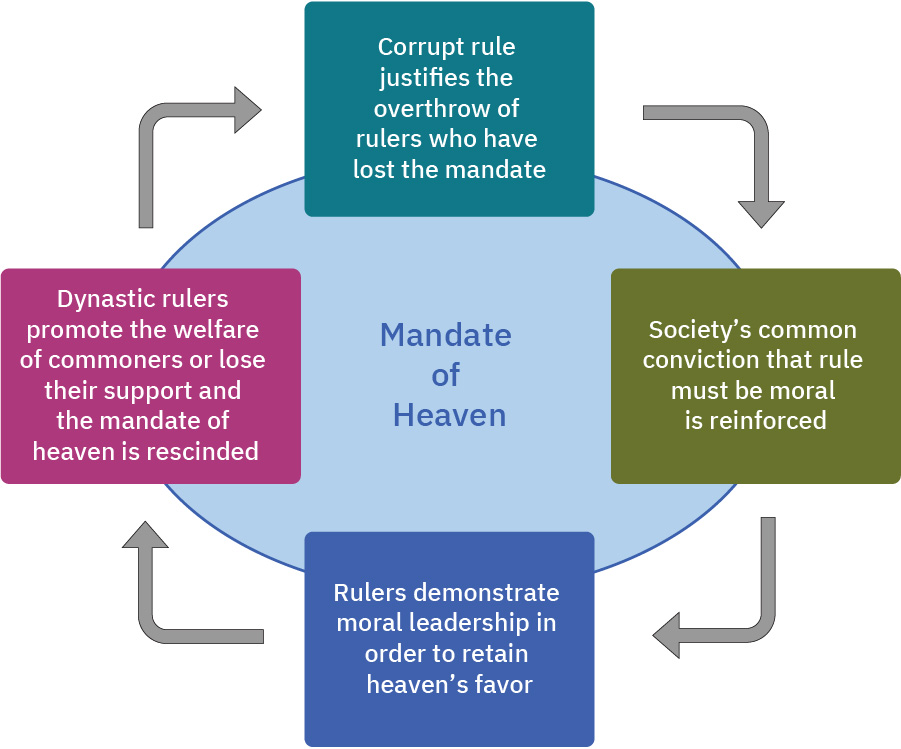
The Zhou victory and Shang defeat were recorded in various Chinese classical texts as proof that the heavens had revoked the Shang’s right to rule and conferred it upon the new Zhou dynasty. This “Mandate of Heaven” shaped Chinese ideology and understanding of dynastic cycles for centuries to come (Figure 5.6). It justified the overthrow of bad governments and corrupt or inept rulers and reinforced a common conviction that in order to govern, a ruling house must demonstrate morality and order to retain heaven’s favor. The concept also pressured dynastic rulers to deserve the mandate by exhibiting moral leadership and proving their legitimacy through support for agriculture, the arts, and the welfare of the common people. Thereafter, natural disasters such as flood or famine and social upheaval in the form of rebellions or poverty were read as signs that a dynasty was in peril of having its mandate to rule rescinded.
英語のヒント
周の勝利と商の敗北は、天が商の統治権を取り消して新しい周王朝に与えた証拠として、さまざまな中国の古典に記録された。この「天命」は、以後何世紀もの間、中国の思想と王朝交代の理解を形づくった(図5.6)。天命は、悪政や腐敗した統治者、無能な統治者を倒すことを正当化した。また統治する王家は、天の加護を保つために道徳性と秩序を示さなければならない、という共通の確信を強めた。この概念はさらに、道徳的な指導力を発揮し、農業・芸術・民衆の福祉を支援して正統性を証明することで、天命にふさわしくなるよう王朝の支配者に迫った。それ以降、洪水や飢饉などの自然災害、反乱や貧困として現れる社会の動揺は、王朝が統治の天命を取り消される危機にある徴候として読まれた。
The Mandate of Heaven.天命。
(attribution: Copyright Rice University, OpenStax, under CC BY 4.0 license) · CC BY 4.0
Figure 5.6 The Zhou dynasty’s belief that imperial rule must be sanctioned by a mandate from the gods shaped China’s history and culture for centuries to follow. (attribution: Copyright Rice University, OpenStax, under CC BY 4.0 license)
図5.6 皇帝の統治には神々からの天命による承認が必要だという、周王朝の信念は、その後数世紀にわたる中国の歴史と文化を形作った。(出典: 著作権:Rice University, OpenStax/CC BY 4.0)
The Mandate of Heaven also ensured continuity between dynasties because it became an element of a core ideology passed from one ruling house to the next, even as non-Chinese groups such as Mongols and Jurchen later invoked it as conquerors. Thus, the mandate created a basis for increasing political unity of the Chinese under a supreme sovereign, while also promoting dissent and latent revolution against unpopular rulers. From this ideology sprang new terms for subjects, identified as denizens of Zhongguo (China), a name formed from the terms for central and state, or as Huaxia (Chinese) in the Zhou dynasty, to express their membership in a shared culture defined by farming, writing, and metalworking and inherited from mythical figures and common ancestors.
英語のヒント
天命は一つの王家から次の王家へ受け継がれる中核的な理念の一要素となり、王朝間の連続性も保証した。後にはモンゴル人や女真人など、中国人でない集団も、征服者としてこの理念を持ち出した。したがって天命は、最高の君主の下で中国人の政治的統一を強める土台となると同時に、支持されない統治者への異議や、潜在的な革命も促した。この理念から、臣民を表す新しい呼称が生まれた。「中央」と「国」を組み合わせた名である中国の住民、あるいは周代には華夏の人びと、とされるようになった。こうした名は、農耕・文字・金属加工を特徴とし、神話的人物や共通の祖先から受け継いだ文化への帰属を表した。
To consolidate their political control, the early Zhou rulers led military campaigns to extend their territory east over the Yellow River and relied on a complex system of decentralized rule. Leniency was shown to the Shang, with a son of the dynasty left to rule his own city and preside over rituals to honor his ancestors. Other Shang nobles were uprooted and moved to new cities to keep them under the watch of the Zhou, whose relatives and trusted advisors governed walled garrisons and cities on the frontier to guard against rising threats. In other areas, the Zhou cooperated with largely autonomous leaders, granting aristocratic titles in return for tribute and military service from local chiefs and nobility. To cement these ties, the Zhou brokered marriages between the royal line and the families of local lords, who within their own domains performed the same spiritual and administrative functions as the ruling family. Like the Zhou, local lords were served by ministers, scribes, court attendants, and warriors, and they enjoyed the fruits of the efforts of ordinary laborers and farmers who lived on their estates.
英語のヒント
初期の周王は、政治的支配を固めるため、黄河を越えて東へ領域を広げる遠征を率い、複雑な分権的統治の仕組みに頼った。商には寛大な措置が取られ、王家の息子の一人が自分の都市を治め、祖先をたたえる祭祀を取り仕切ることを許された。商のほかの貴族たちは、周の監視下に置くため、従来の土地から引き離されて新しい都市へ移された。周王の親族や信頼する助言者は、新たな脅威を防ぐため、辺境の城壁付き駐屯地や都市を統治した。ほかの地域では、周は大幅な自治を持つ指導者と協力し、地域の首長や貴族から貢納と軍役を受ける代わりに貴族の称号を与えた。こうした結びつきを固めるため、周は王家と地方の領主の家との婚姻を仲介した。領主は自らの領域で王家と同じ宗教的・行政的役割を果たした。周王と同じく、領主には大臣・書記・宮廷の従者・戦士が仕え、その領地の一般の労働者や農民の働きが生み出す成果を享受した。
The Zhou proved more durable than the Shang but, especially in later centuries, their power was diffused among many smaller, competing kingdoms only nominally under their control. The Zhou’s decentralized feudal system, in which land and power was granted by the king to local leaders in return for special privileges, gradually weakened as those regional lords ignored the commands of kings, instead amassing armies and searching for alliances and technological advantages over their neighbors.
英語のヒント
周は商より長く存続した。しかし、とりわけ後の数世紀には、その権力は、名目上のみ周の統制下にある多数の小さな競合する王国へ分散した。周の分権的な封建制度では、特別な特権と引き換えに、王から地方の指導者へ土地と権力が与えられた。この制度は次第に弱まった。地方の領主が王の命令を無視し、軍隊を集め、隣国に対抗する同盟や技術的な優位を求めるようになったためである。
As a result, scholars typically divide the Zhou dynasty into several periods. The Western Zhou (c. 1046–771 BCE) refers to the first half of the dynasty’s rule, from its founding to the sack of its capital in Haojing by nomadic armies in 771 BCE. Afterwards the Zhou reestablished their capital in the east, in Luoyang, inaugurating the period called the Eastern Zhou (771–256 BCE). The Eastern Zhou dynasty itself is often divided into two halves—the Spring and Autumn (771–476 BCE) and the Warring States (475–256 BCE) periods. The first half of the Eastern Zhou dynasty derives its name from the Spring and Autumn Annals. That chronicle, from about the fifth century BCE, documents the gradual erosion of the Zhou kings’ power as outlying territories such as Chu, Qin, and Yan became increasingly autonomous. Not surprisingly, then, the Warring States era was characterized by open warfare between these regional powers to enlarge their territories, absorb neighboring kingdoms, and replace the Zhou as the new sovereigns of ancient China.
英語のヒント
そのため、学者は通常、周王朝をいくつかの時期に区分する。西周(前1046年ごろ~前771年)は、建国から、前771年に遊牧民の軍隊によって都の鎬京が略奪されるまでの、王朝の前半を指す。その後、周は東の洛陽に都を再建し、東周(前771~前256年)と呼ばれる時代が始まった。東周そのものも、しばしば春秋時代(前771~前476年)と戦国時代(前475~前256年)の二つに分けられる。東周前半の名は、前5世紀ごろの年代記『春秋』に由来する。この書物は、楚・秦・燕などの外縁の領域が自立性を増すにつれて、周王の権力が徐々に損なわれる過程を記録している。したがって戦国時代が、これらの地域勢力による公然たる戦争の時代となったのは不思議ではない。各国は領域を広げ、隣国を吸収し、周に代わる古代中国の新たな君主になろうとした。
Bridging the two eras of the Spring and Autumn and the Warring States was a period defined by a flourishing of literature and philosophy known as the Hundred Schools of Thought (770–221 BCE). Inspired by political turmoil and rivalries between various Chinese states, those who wished to retain power were drawn to the study of the military arts, diplomacy, and political intrigue. Those who lamented the lack of order and waning loyalty to authority and tradition turned to the study of morality and ethics. In a political climate of competition and reform, new schools of thought informed a swelling class of capable administrators and military strategists contesting for the patronage of rulers. Philosophers such as Mozi and Sunzi, author of The Art of War, created their own rival traditions and contributed to courtly debates on morality, war, government, technology, and law.
英語のヒント
春秋と戦国の二つの時代にまたがって、百家争鳴(前770~前221年)として知られる、文学と哲学が花開く時期があった。中国の諸国の政治的混乱と対立に刺激され、権力の維持を望む人びとは、軍事・外交・政治的策略の研究に引きつけられた。秩序の欠如や、権威・伝統への忠誠の衰えを嘆く人びとは、道徳と倫理の研究に向かった。競争と改革の政治状況の中で、新しい思想の学派は、統治者の庇護を争う有能な行政官や軍事戦略家の、膨張しつつある階層を導いた。墨子や、『孫子』の著者である孫子などの思想家は、互いに競合する独自の伝統を生み出し、道徳・戦争・統治・技術・法についての宮廷の議論に貢献した。
In this marketplace of ideas, Chinese civilization as a whole rapidly grew more sophisticated. At the same time, rulers sought to expand their revenues, increase the size of their populations, implement new techniques for farming such as draining marshes, and create new forms of currency such as bolts of silk. This era also fostered dynamic new forms of art as the Zhou court became home to musicians skilled with chimes, drums, lutes, flutes, and bells. States such as Chu and Zheng became famous for their artists and styles of dance, while popular hymns were later translated into poems and recorded in the Book of Songs. These intellectual traditions and cultural forms, though varied, served as the foundational core for Chinese politics, education, and art in the ancient world.
英語のヒント
こうした思想の競い合いの中で、中国文明全体は急速に洗練を深めた。同時に統治者は、収入を増やし、人口を拡大し、湿地の排水などの新しい農業技術を導入し、絹の反物などを新たな交換手段として使おうとした。この時代は、活力ある新しい芸術の形も育んだ。周の宮廷には、編鐘などの打楽器、太鼓、リュート類、笛、鐘に熟達した音楽家が集まった。楚や鄭などの国は芸術家や舞踊の様式で名高くなり、広く歌われた賛歌は、後に詩の形にまとめられて『詩経』に記録された。こうした知的伝統や文化の形態は多様でありながら、古代中国の政治・教育・芸術の基礎的な中核となった。
Foremost among the new schools of thought was Confucianism, a philosophical system that shaped morality, governance, and social relations in China before spreading to Korea, Vietnam, and Japan in later centuries. Its founding philosopher, known as Kong Fuzi, or Confucius, was probably born about 551 BCE and lived in relative obscurity as a teacher in the small state of Lu. Later his descendants and disciples made his teachings on the family, society, and politics known in ancient China via The Analects, a collection of brief statements attributed to him and recorded long after his death. Later scholars influenced by Confucius, such as Mengzi, went on to win renown for their teachings, attracting throngs of new students while gaining influential positions as advisers in the service of rulers.
英語のヒント
新しい思想の学派の中で特に重要だったのが儒教である。この哲学体系は、中国の道徳・統治・社会関係を形づくり、後の世紀には朝鮮・ベトナム・日本へ広まった。その始祖である思想家は孔夫子、すなわち孔子と呼ばれる。おそらく前551年ごろに生まれ、小国の魯で、教師として比較的目立たない生涯を送った。後に子孫と弟子たちは、孔子の家族・社会・政治についての教えを、『論語』を通じて古代中国に広めた。『論語』は孔子の言葉とされる短い発言を集めたもので、死後かなりたってから記録された。孟子など孔子の影響を受けた後の学者は、教えによって名声を得て、大勢の新しい学生を引きつける一方、統治者に仕える助言者として影響力のある地位を獲得した。
A central tenet of Confucianism is the importance of exemplifying virtuous leadership by living a moral life, studiously observing rituals, and being tirelessly devoted to the duties owed to the leader’s subjects. Confucian texts such as the Book of Documents promoted habits like literacy, critical thinking, the search for universal truth, humility, respect for ancestors and elders, and the valuing of merit over aristocratic privilege. Confucius also considered family relationships to be central to an orderly society. Specifically, he delineated five cordial relationships—between king and subjects, father and son, husband and wife, elder brother and younger siblings, and friends. Each relationship consisted of an authority figure who required obedience and honor from the other person or persons, except for friends who were to honor one another. In return, the person in authority was supposed to embody ren, an attitude of generosity and empathy for those beneath him. So long as everyone behaved as they should, good order would flourish.
英語のヒント
儒教の中心的な教えの一つは、徳のある指導力を自ら示すことの重要性である。そのためには、道徳的な生活を送り、儀礼を丁寧に守り、指導者として臣民に対して負う務めに倦まず献身しなければならない。『書経』などの儒教文献は、読み書き、批判的に考えること、普遍的な真理の探究、謙虚さ、祖先や年長者への敬意、貴族の特権よりも実力を重んじることを勧めた。孔子はまた、秩序ある社会の中心に家族関係があると考えた。具体的には、君主と臣民、父と子、夫と妻、兄と年下のきょうだい、友人同士という五つの親和的な関係を示した。互いに敬意を払う友人を除き、各関係には、相手に服従と敬意を求める権威ある人物がいた。その代わり、権威を持つ人は、自分より下位の者への寛大さと共感という姿勢である「仁」を体現すべきだった。すべての人がふさわしく振る舞うかぎり、よい秩序が栄えるのである。
Later Confucian teachers such as Xun Kuang (also known as Xunzi), witnessing the violence of the Warring States period, argued that humanity’s base impulses necessitated rigorous self-cultivation and discipline. Among devout Confucians, such ideas spawned a constant search for internal self-improvement and concern for the well-being of others and society as a whole. During this period, Zhou kings presided over rites to honor royal ancestors, but they also made greater use of written works to magnify their prestige and power. Yijing, or The Book of Changes, presented a new system of divination later included as a seminal text in the Confucian canon.
英語のヒント
荀況、別名荀子のような後の儒者は、戦国時代の暴力を目の当たりにし、人間の卑しい衝動には厳格な修養と規律が必要だと論じた。篤実な儒者の間で、こうした思想は、絶えず内面を高めようとする努力と、他者や社会全体の安寧への配慮を生んだ。この時代、周王は王家の祖先をたたえる儀式を主宰するとともに、威信と権力を高めるために文献もいっそう活用した。『易経』は新しい占いの体系を示し、後に儒教の正典の重要な文献に含まれた。