第5章古代のアジアAsia in Ancient Times
Ancient Japan古代日本
As in Korea, geography shaped much of Japan’s early development and history. Four main islands make up Japan. The northernmost is Hokkaido. Then comes Honshu, which is home to Tokyo and the largest present-day population. Continuing south, the next island is Shikoku, and finally Kyushu, which is closest to the Asian mainland. Japan today also includes the islands of Okinawa and thousands of others strewn across the Pacific. But much of the story of ancient Japan concerns only the main isles, the inland Sea of Japan, the country’s countless mountains, and a few fertile plains fed by monsoon rains that sustain agriculture.
英語のヒント
朝鮮と同様、日本の初期の発展と歴史の多くも、地理に形づくられた。日本は主な四つの島からなる。最も北にあるのが北海道、次が東京を擁し、現在の人口が最も多い本州である。さらに南へ行くと四国、そしてアジア大陸に最も近い九州がある。現在の日本には沖縄の島々と、太平洋に散在するほかの何千もの島も含まれる。しかし古代日本の歴史の大部分は、主要な島々、内海である日本海、無数の山々、そして農耕を支えるモンスーンの雨に潤されたいくつかの肥沃な平野に関わる。
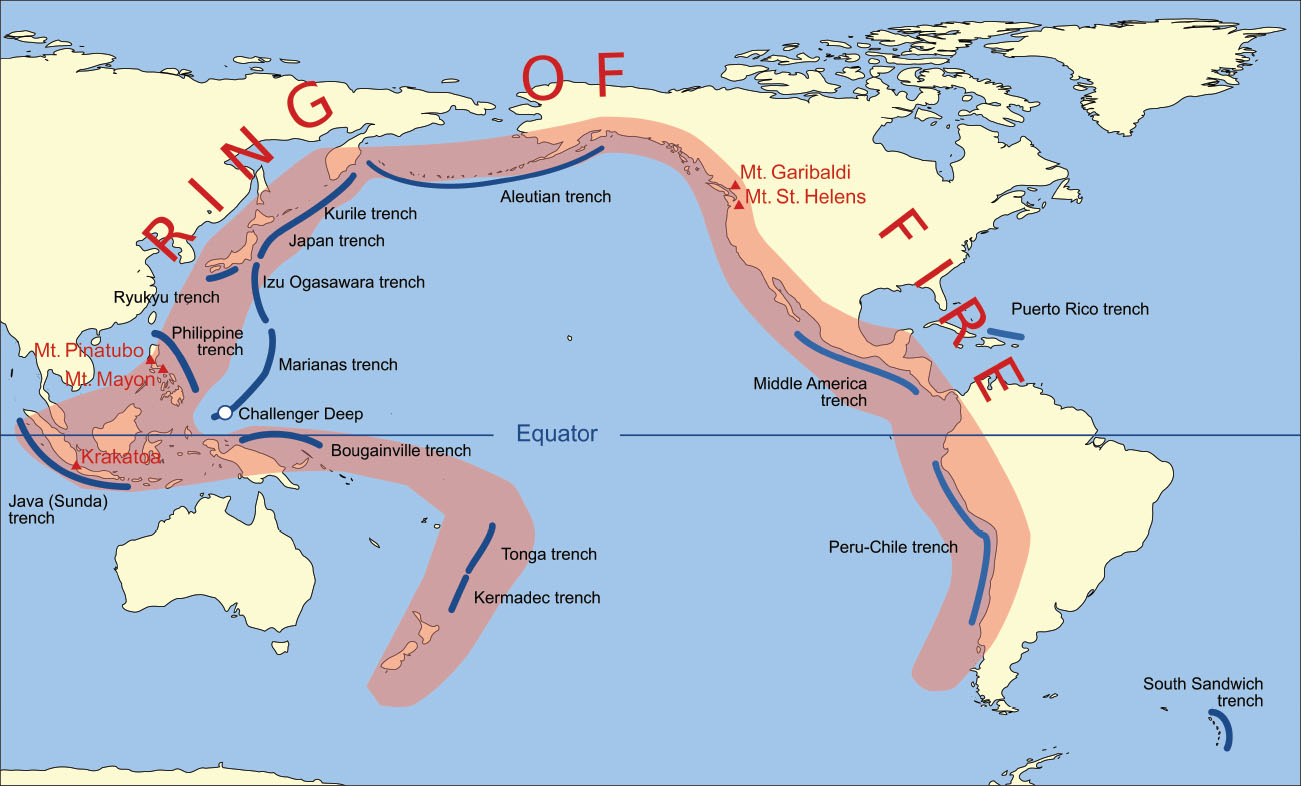
Critical to the formation of the main islands and their geographical features is the belt known as the Ring of Fire (Figure 5.15), mapped by a horseshoe-shaped line drawn around the rim of the Pacific Ocean to mark a zone of frequent earthquake and volcanic activity that has generated countless tsunamis in Japan’s distant past and modern day.
英語のヒント
主要な島々とその地形の形成に決定的なのが、「環太平洋火山帯」と呼ばれる帯状の地域である(図5.15)。太平洋の周縁を囲む馬蹄形の線として地図に描かれ、地震と火山活動が頻発する区域を示す。これらの活動は、日本の遠い過去にも現代にも、無数の津波を生んできた。
The Ring of Fire.環太平洋火山帯。
(credit: “Pacific Ring of Fire” by “Gringer”/Wikimedia Commons, Public Domain) · Public Domain
Figure 5.15 A horseshoe-shaped line running around the rim of the Pacific Ocean marks the Ring of Fire, an area where frequent shifts of tectonic plates cause earthquakes, volcanic activity, and tsunamis that have plagued Japan for centuries. (credit: “Pacific Ring of Fire” by “Gringer”/Wikimedia Commons, Public Domain)
図5.15 太平洋の縁を巡る馬蹄形の線は、環太平洋火山帯を示す。ここではプレートが頻繁に動き、数世紀にわたって日本を苦しめてきた地震・火山活動・津波を引き起こす。(出典: “Pacific Ring of Fire”/“Gringer”/Wikimedia Commons, パブリックドメイン)
The story of prehistoric Japan is typically divided into two halves: the era of Jōmon hunters, ranging from 14,500 to 300 BCE, and that of the Yayoi agriculturalists who emerged after them to dominate the centuries from 300 BCE to 300 CE. These groups had no concept of themselves as “Japanese” in a sense recognizable to us today. But they left their imprint on the main isles via migration, settlement, and the development of practices for making the fertile plains, mountainous forests, and innumerable ocean bays and rivers their homes. Without written records, our knowledge of the Jōmon and Yaoyi is almost wholly based on the archaeological evidence and contemporary theories about the pathways humanity followed out of Africa and across the world. Early hominids likely made their way to the Japanese archipelago when it was still connected to the Asian continent, perhaps over 100,000 years ago. Hunting giant mammals such as elephants, wolves, and enormous deer, many of these early hunters moved to an area near today’s Sea of Japan. Much later, changing climates led ocean levels to slowly rise and cover the stretches of land that connected Japan to the Asian mainland.
英語のヒント
先史時代の日本は、一般に二つの時期に分けられる。前1万4500~前300年の縄文の狩猟民の時代と、その後に現れ、前300~後300年の数世紀に優勢となった弥生の農耕民の時代である。これらの集団には、今日の私たちが理解する意味での「日本人」という自己認識はなかった。しかし、移住と定住、そして肥沃な平野・山地の森・無数の湾や川を住みかとする方法の発達を通して、主要な島々に痕跡を残した。文字記録がないため、縄文・弥生についての知識はほぼ全面的に考古学的証拠と、人類がアフリカを出て世界へ広がった経路に関する現在の学説に基づいている。初期の人類は、日本列島がまだアジア大陸とつながっていたころ、おそらく10万年以上前に列島へ到来したと考えられる。象・狼・巨大な鹿などの大きな哺乳類を狩りながら、多くの初期狩猟民は現在の日本海に近い地域へ移った。それからずっと後、気候の変化で海面がゆっくり上がり、日本とアジア本土を結んでいた陸地を覆った。
Linguists theorize that ultimately three early waves of foragers and hunters made their way overland or across the Tsushima Strait that separates the four main isles from the Asian mainland. These groups were descended from Ural-Altaic, Chinese, and Austro-Asiatic peoples. The climate shift that severed Japan from the Asian continent around twelve thousand years ago transformed the newly formed isles and the game these people once hunted. Grasslands for bison disappeared, for example, and wolves became smaller.
英語のヒント
言語学者の説では、最終的に採集・狩猟民の初期の移動は3度の波となり、陸路、または日本の四つの主要な島々をアジア本土から隔てる対馬海峡を越えて到来した。これらの集団は、ウラル=アルタイ系・中国系・オーストロアジア系の人びとに由来していた。約1万2000年前、日本をアジア大陸から切り離した気候の変化は、新たに形成された島々と、人びとがかつて狩っていた獲物を変えた。例えばバイソンの暮らす草原は消え、狼は小型化した。
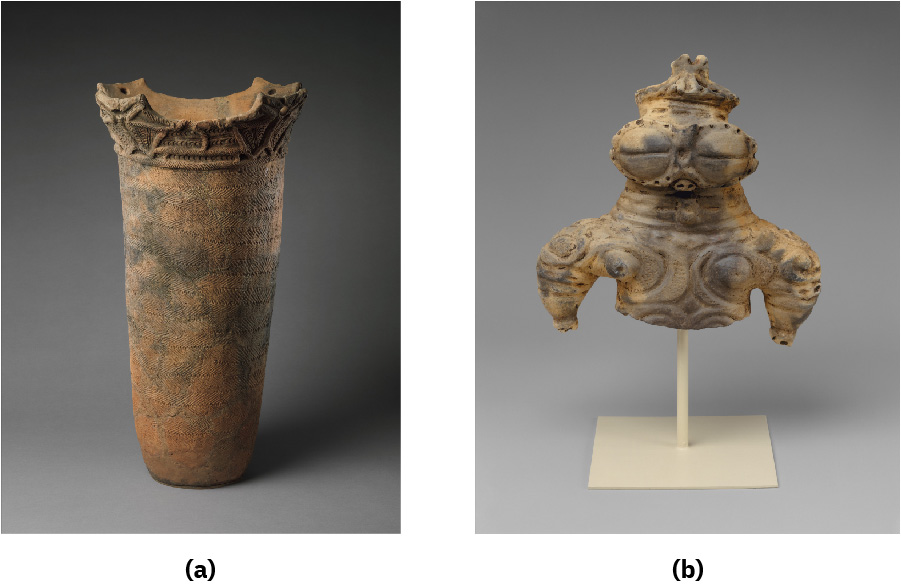
But the early inhabitants adapted, inventing new technologies to enhance their chances for survival. In the caves of Kyushu, archaeologists have found evidence of one of the world’s earliest technological breakthroughs, the development of pottery. Known for its elaborate handles and distinctive cord patterns around rims, this pottery allowed Japan’s inhabitants to become more sedentary and less dependent on finding wild game and foraging for edible plants. First used to store vegetables and boil water from the sea to make salt, the pottery called Jōmon was likely later used for rituals to promote unity and cooperation (Figure 5.16). The increasingly sophisticated culture of the people, also called Jōmon, was characterized by settlements with shared spaces for burials, food storage, and elaborate ceremonies. Among the important cultural symbols were earthenware figurines known as dogu.
英語のヒント
しかし初期の住民は、生き残る可能性を高める新しい技術を発明して適応した。九州の洞窟で、考古学者は世界最初期の技術的飛躍の一つである、土器の発達の証拠を発見した。複雑な把手や、口縁の独特の縄目模様で知られるこの土器によって、日本の住民はより定住的になり、野生の獲物や食用植物を探すことへの依存を減らせた。縄文と呼ばれるこの土器は、当初は野菜の貯蔵や海水を煮て塩を作るのに用いられ、後には結束と協力を促す儀礼にも使われたと考えられる(図5.16)。同じく縄文と呼ばれる人びとの文化はますます高度になり、埋葬・食料貯蔵・複雑な儀礼のための共用空間を持つ集落を特徴とした。重要な文化的象徴には、土偶という土製の小像があった。
Jōmon Artifacts.縄文時代の遺物。
(credit a: modification of work “Deep Vessel” by The Harry G. C. Packard Collection of Asian Art, Gift of Harry G. C. Packard, and Purchase, Fletcher, Rogers, Harris Brisbane Dick, and Louis V. Bell Funds, Joseph Pulitzer Bequest, and The Annenberg Fund Inc. Gift, 1975/Metropolitan Museum of Art, Public Domain; credit b: modification of work “Dogū (Clay Figurine)” by The Harry G. C. Packard Collection of Asian Art, Gift of Harry G. C. Packard, and Purchase, Fletcher, Rogers, Harris Brisbane Dick, and Louis V. Bell Funds, Joseph Pulitzer Bequest, and The Annenberg Fund Inc. Gift, 1975/Metropolitan Museum of Art, Public Domain) · Public Domain
Figure 5.16 (a) This Jōmon pottery food container (c. 3500–2500 BCE) is among the earliest examples of the craft of pottery found in the world. (b) The dogu figurine (c. 1000–300 BCE) likely represents a female god, hinting at the spiritual life of the early inhabitants of Japan’s main isles. Such figures are thought to have served as forms of sympathetic magic that healed illness and helped with childbirth. (credit a: modification of work “Deep Vessel” by The Harry G. C. Packard Collection of Asian Art, Gift of Harry G. C. Packard, and Purchase, Fletcher, Rogers, Harris Brisbane Dick, and Louis V. Bell Funds, Joseph Pulitzer Bequest, and The Annenberg Fund Inc. Gift, 1975/Metropolitan Museum of Art, Public Domain; credit b: modification of work “Dogū (Clay Figurine)” by The Harry G. C. Packard Collection of Asian Art, Gift of Harry G. C. Packard, and Purchase, Fletcher, Rogers, Harris Brisbane Dick, and Louis V. Bell Funds, Joseph Pulitzer Bequest, and The Annenberg Fund Inc. Gift, 1975/Metropolitan Museum of Art, Public Domain)
図5.16 (a)この縄文土器の食物容器(前3500~前2500年ごろ)は、世界で見つかった最も初期の土器製作の実例の一つである。(b)この土偶(前1000~前300年ごろ)は、おそらく女神を表し、日本の主要な島々に暮らした初期の人びとの精神生活をうかがわせる。こうした像は、病気を治し、出産を助ける類感呪術の手段として使われたと考えられている。(出典a: 原作品を加工:“Deep Vessel”/Harry G. C. Packard アジア美術コレクション。Harry G. C. Packard の寄贈、および Fletcher・Rogers・Harris Brisbane Dick・Louis V. Bell の各基金、Joseph Pulitzer の遺贈、The Annenberg Fund Inc. の寄贈による購入、1975年/メトロポリタン美術館, パブリックドメイン;出典 b: 原作品を加工:“Dogū (Clay Figurine)”/Harry G. C. Packard アジア美術コレクション。Harry G. C. Packard の寄贈、および Fletcher・Rogers・Harris Brisbane Dick・Louis V. Bell の各基金、Joseph Pulitzer の遺贈、The Annenberg Fund Inc. の寄贈による購入、1975年/メトロポリタン美術館, パブリックドメイン)
Skeletal remains of the Jōmon people suggest that despite their diverse diet of fruits, nuts, and seafood such as clams and fish, they lived with the constant threat of starvation and malnutrition. Another shift in the region’s climate produced a deadly drop in temperatures that led to a decline in the populations of game such as deer and boar. To survive, many Jōmon moved to the coastal areas to supplement their food supply by fishing. Others likely began experimenting with early forms of agriculture; evidence suggests the cultivation of yams and lily-bulbs in the years from 3000 to 2400 BCE. Further evidence of early agriculture comes from traces of rice found in jars dated to the later years of the Jōmon era.
英語のヒント
縄文人の骨格遺存体は、果物・木の実・貝や魚などの海産物を食べる多様な食生活にもかかわらず、人びとが常に飢餓と栄養不良の脅威の中に暮らしていたことを示唆する。地域の気候が再び変わると、命にかかわるほど気温が下がり、鹿や猪などの獲物の数が減った。生き残るため、多くの縄文人は沿岸へ移り、漁労によって食料を補った。ほかの人びとは初期の農耕を試し始めた可能性があり、前3000~前2400年にはヤムイモやユリの球根を栽培していたことを示す証拠がある。縄文時代後期の壺から見つかった米の痕跡も、初期農耕の証拠を提供する。