第5章古代のアジアAsia in Ancient Times
A mystical indigenous religion that venerated nature, Daoism borrowed from various ideological systems, such as the dualism of yin-yang with its emphasis on the complementary poles of light and dark cosmological forces. Daoism’s thousands of texts, temples, and priests did not flower until the later Han dynasty, but during the Zhou era, this school emerged as a major influence thanks to teachers like Laozi and Zhuang Zhou (commonly known as Zhuangzi) and the circulation of the books attributed to them, the Tao Te Ching and the Zhuangzi. From them, Daoists learned a litany of poems, sayings, parables, and folktales teaching that dao (or “the way”) was an underlying influence that shaped and infused all humans, the natural world, and the cosmos. Daoists encouraged dwelling on the beauty of the natural world, exploring mystic rituals, and contemplating the comparative insignificance of the individual against the vastness of time and space. Perhaps the most important political concept introduced by Daoists was the idea of wuwei (or “nonaction”), implying to those in power that the best form of governance was a minimalist approach that avoided interfering in the lives of their subjects.
英語のヒント
自然を敬う神秘的な土着宗教である道教は、さまざまな思想体系から要素を取り入れた。その一つが陰陽の二元論であり、宇宙の明と暗という補い合う二つの力を重んじた。道教の膨大な文献・寺観・祭司が花開くのは後の漢代だが、周代にも、老子や荘周(一般には荘子と呼ばれる)といった教師と、彼らの作とされる『道徳経』『荘子』の流通によって、この学派は大きな影響力を持つようになった。道家の人びとは、これらの書物から数々の詩・格言・たとえ話・民話を学んだ。そこでは道が、すべての人間、自然界、宇宙を形づくり、そのすべてに浸透する根底の作用だと教えられた。道家は自然界の美をじっくり味わい、神秘的な儀礼を探究し、広大な時間と空間に比べた個人の小ささを考えることを勧めた。道家のもたらした政治概念のうち、おそらく最も重要なのが「無為」、すなわち作為しないという考えである。これは権力者に対し、臣民の生活に干渉することを避ける、介入を最小限にとどめる統治が最善だと示唆した。
Counter to the Daoist tradition and Confucianism ran the school of thought known as Legalism, the focal point of which was the accumulation of power. Legalists argued that governments drew power from a written legal code backed by an expansive system of rewards and punishments to ensure enforcement and order. A few of its exponents, like the thinker Han Feizi, studied Confucianism first, but came to see its proponents and teachings as too idealistic and naïve. Legalists downplayed the need for morality and asserted that the bedrock of a good government was a “rich country and a strong army.”
英語のヒント
道家の伝統や儒教と対立したのが、権力の蓄積を中心に据える法家の思想だった。法家は、広範な賞罰の仕組みで裏づけられた成文法典から政府は力を引き出し、それによって法の執行と秩序を確保すると論じた。韓非子のように初めは儒教を学んだ論者もいたが、やがて儒者とその教えは理想主義的すぎ、世間知らずだと見るようになった。法家は道徳の必要性を低く評価し、よい政治の土台は「富国強兵」にあると主張した。
While Confucianism, Daoism, and Legalism remained distinct, they borrowed liberally from each other and incorporated values, themes, and terminology to round out their own philosophies. All were open, eclectic systems reacting to historical circumstances and conditions. Moreover, each of these schools of thought and even the more minor traditions formed a common frame of reference within which Chinese rulers, philosophers, scribes, and even hermits expressed their own views. Confucianism and Legalism encouraged the study of texts over mystic rites, or society and its history over the supernatural and the afterlife, while other thinkers continued to ponder the yin and yang and work out principles applicable to astronomy, medicine, and the calendar. The world of spirits, ancestor worship, and folktales was no less prevalent than before. Still, it was the emergence of these new systems and their contributions that make this era an “axial age,” a critical stage in the evolution of not just Chinese civilization but the world.
英語のヒント
儒教・道家・法家はそれぞれ独自性を保ちながらも、互いから幅広く要素を借り、価値観・主題・用語を取り入れて自らの哲学を充実させた。いずれも、歴史的な状況や条件に応じて変化する、開かれた折衷的な体系だった。さらに、これらの学派や、より小さな思想的伝統も含めて、中国の統治者・哲学者・書記、さらには隠者が自らの見方を表現するための共通の枠組みが形成された。儒教と法家は、神秘的な儀礼より文献研究を、超自然や死後の世界より社会とその歴史を学ぶことを勧めた。ほかの思想家は陰陽について考え続け、天文学・医学・暦に適用できる原理を練り上げた。霊の世界、祖先崇拝、民話は、以前と同じく広く浸透していた。それでも、こうした新しい体系の登場と貢献こそが、この時代を「枢軸時代」、すなわち中国文明だけでなく世界の発展にとっても決定的な段階にしている。
The Warring States Era and Qin Unification戦国時代と秦の統一
Over the course of the long Eastern Zhou era (771–256 BCE), the means and methods of warfare changed, with dramatic consequences for ancient China. Initially war was regulated by chivalrous codes of conduct, complete with rituals of divination conducted before and after battle. Battles were fought according to a set of established rules by armies of a few thousand soldiers fighting for small Chinese states. The seasons and the rhythms of agricultural life limited the scope of campaigns. Victorious armies followed the precedent set by the early Zhou conquerors, sparing aristocratic leaders in order to maintain lines of kinship and preserve an heir who would perform rites of ancestor worship.
英語のヒント
長い東周の時代(前771~前256年)に、戦争の手段と方法は変化し、古代中国に劇的な結果をもたらした。当初、戦争は武人の礼節を重んじる行動規範に従い、戦いの前後には占いの儀式も行われた。小国のために戦う数千人規模の軍隊は、定められた規則に従って戦闘を行った。季節と農業生活の周期が、軍事行動の範囲を制限した。勝った軍隊は初期の周の征服者の先例に倣い、親族の系譜を維持し、祖先祭祀を行う後継者を残すために、貴族の指導者を殺さずにおいた。
With the advent of the Warring States era (475–256 BCE), these rules were cast aside, and values such as honor and mercy went out of fashion. New military technologies provided the catalyst for these changes. The invention of the crossbow made the advantages once owned by cavalry and chariots nearly obsolete. The result was ballooning conscript armies of hundreds of thousands, making military service nearly universal for men. Protected by leather armor and iron helmets, soldiers skilled in the art of mounted archery trickled into Chinese states from the steppes. Discipline, drilling, logistics, organization, and strategy became paramount to success. Treatises on deceptive military maneuvers and the art of siege craft proliferated among the various states of the Zhou.
英語のヒント
戦国時代(前475~前256年)が始まると、こうした規則は捨てられ、名誉や慈悲といった価値も顧みられなくなった。新しい軍事技術がこの変化を促した。弩の発明によって、かつて騎兵や戦車が持っていた優位は、ほぼ時代遅れになった。その結果、徴集された軍隊は数十万人規模に膨れ上がり、ほぼすべての男性が軍役に就くようになった。革の鎧と鉄の兜で身を守り、騎射に熟達した兵士が、草原から中国諸国へ少しずつ流入した。規律・訓練・補給・組織・戦略が成功を左右する最重要事項となり、敵を欺く機動や攻城術についての論書が、周の諸国に広まった。
Not all the changes wrought by war in the late Zhou period were unwelcome. For example, common farmers gained the right to include their family names on registration rolls and pressure sovereigns for improvements to their lands such as new irrigation channels. Iron technology was developed for weapons, but was also used for new agricultural tools. Together, increasing agricultural productivity and advancements in iron technology were part of a late Zhou surge in economic growth. Mobilization for war stimulated a cross-regional trade in furs, copper, salt, and horses. And with that long-distance trade came increased coinage. The destruction of states through war also created social volatility, reducing the status of formerly great aristocratic families while giving rise to new forms of gentry and a more powerful merchant class. The only way back up the social ladder was through merit, and many lower-level aristocrats proved themselves as eager bureaucrats in the service of new sovereigns.
英語のヒント
周末期に戦争がもたらした変化は、すべてが望ましくないものだったわけではない。例えば一般の農民は、自分の姓を登録簿に記載し、新たな灌漑水路など土地の改良を君主に求める権利を得た。武器のために発展した製鉄技術は、新しい農具にも利用された。農業生産性の上昇と鉄の技術の進歩は、ともに周末期の急速な経済成長の一部を成した。戦争のための動員は、毛皮・銅・塩・馬の地域間交易を活発にし、その遠距離交易に伴って貨幣の流通も増えた。戦争による国家の滅亡は社会を流動化させ、かつて有力だった貴族の地位を低下させる一方、新しい形の地方有力者層と、より強力な商人層を生んだ。社会の階梯を再び上る唯一の道は実力によるもので、多くの下級貴族が新たな君主の下で意欲的な官僚として能力を示した。
One of the many warring states in this period, the state of Qin, capitalized on these economic and social changes by adopting Legalist reforms to justify an agenda of power and expansionism. The arrival of Lord Shang, a migrant born in a rival territory in approximately 390 BCE, who soon took the position of prime minister, was the turning point, when Legalism came to dominate the thinking of Qin’s elite. Before this, the Qin state had been a marginal area within the lands of the Zhou, a frontier state on the western border charged with defending the borderlands and raising horses. The Qin state leveraged this location by trading with peoples from central Asia. At the same time, their vulnerability on the periphery kept them in a state of constant alert and readiness for war, creating a more militaristic culture and an experienced army that proved invaluable when set against their Chinese neighbors in the east.
英語のヒント
この時代の諸国の一つだった秦は、法家の改革を採用して権力強化と拡張政策を正当化し、こうした経済・社会の変化を利用した。転機となったのは、前390年ごろに敵対する領域で生まれた移住者、商鞅の到来だった。彼はほどなく宰相となり、法家が秦のエリートの考えを支配するようになった。それ以前の秦は周の領域内の周縁的な地域であり、西の国境を守り、馬を育てる役目を負った辺境国家だった。秦はこの立地を生かし、中央アジアの人びとと交易した。同時に、周辺に位置することの危うさは、絶えず警戒し戦争に備える状態を生んだ。その結果、より軍事的な文化と経験豊かな軍隊が育ち、東の中国諸国と対峙するときには計り知れない価値を発揮した。
To offset their initial disadvantages, the Qin leaders wisely embraced immigrant talent such as Lord Shang and solicited help from advisors, militarists, and diplomats from rival domains. They adopted new techniques of governance, appointing officials and delegates to centralize rule rather than relying on hereditary nobles. Theirs became a society with new opportunities for social advancement based on talent and merit. Under Shang’s advisement, the Qin scorned tradition and introduced new legal codes, unified weights and measures, and applied a system of incentives for able administrators that helped create an army and bureaucracy based more on merit than on birth. Over time, these changes produced an obedient populace, full coffers, and higher agricultural productivity.
英語のヒント
当初の不利を埋め合わせるため、秦の指導者は商鞅のような移住者の才能を賢明にも受け入れ、敵対する領域の助言者・軍事家・外交官に協力を求めた。世襲貴族に依存する代わりに官吏や代理人を任命して統治を中央集権化する、新しい統治技術を採用した。秦は、才能と実績に応じた社会的上昇の新たな機会を持つ社会になった。商鞅の助言の下、秦は伝統を退け、新たな法典を導入し、度量衡を統一した。また、有能な行政官への報奨制度を適用し、生まれよりも実績に基づく軍隊と官僚組織を作るのに役立てた。時とともにこれらの変化は、従順な民衆、満ちた国庫、より高い農業生産性を生んだ。
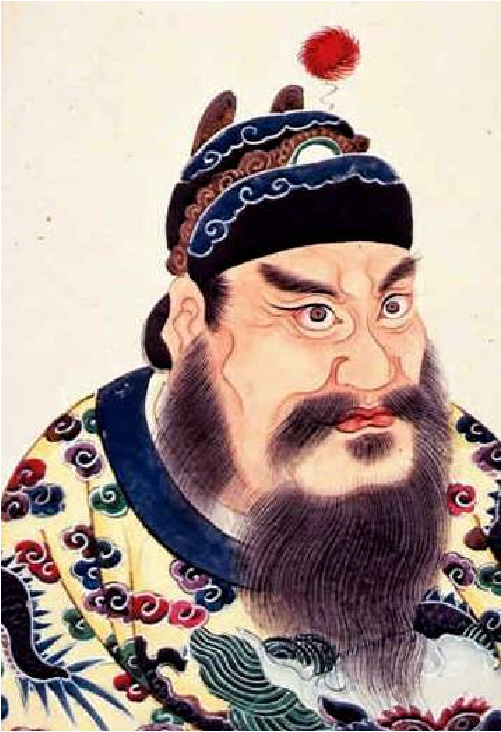
The Qin state’s rising strength soon overwhelmed its rivals, propelling to victory its king Ying Zheng, who anointed himself China’s first emperor and was known as Qin Shi Huang, or Shihuangdi, literally “first emperor” (Figure 5.7). The Qin war machine defeated the states of Han, Wei, Zhao, Chu, Yan, and Qi in less than a decade. Under Shihuangdi’s rule, the tenets of Legalism fostered unity as the emperor standardized the writing system, coins, and the law throughout northern China. Defeated aristocratic families were forced to uproot themselves and move to the new capital near Xi’an. To consolidate political control and reverse the fragmentation of the Zhou era, officials appointed by the emperor were dispatched to govern on his behalf, which cast aside the older feudal system of governance. Officials who performed poorly were removed and severely punished. Those who did well wrote regular detailed reports closely read by the emperor himself.
英語のヒント
秦の増大する力はやがて諸国を圧倒し、秦王の嬴政を勝利へ押し出した。彼は中国最初の皇帝を称し、秦始皇、あるいは文字どおり「最初の皇帝」を意味する始皇帝として知られるようになった(図5.7)。秦の軍事機構は、10年足らずで韓・魏・趙・楚・燕・斉を打ち破った。始皇帝の統治の下では、皇帝が中国北部全体の文字・貨幣・法を統一し、法家の教えが一体性を促した。敗れた貴族の家々は故郷を離れ、西安近くの新たな都へ移ることを強いられた。政治的支配を固め、周代の分裂を覆すため、皇帝が任命した官吏を各地へ派遣し、皇帝に代わって統治させた。これにより、古い封建的な統治制度は捨て去られた。職務成績の悪い官吏は解任され、厳しく罰せられた。よく働く者は定期的に詳しい報告を書き、皇帝自らが注意深く読んだ。
Qin Shi Huang.秦の始皇帝。
(credit: “A portrait painting of Qin Shi Huangdi, first emperor of the Qin dynasty” by Richard R. Wertz/18th century album of portraits of 86 emperors of China, with Chinese historical notes, British Library/Wikimedia Commons, Public Domain) · Public Domain
Figure 5.7 This image of China’s first emperor was painted by an anonymous eighteenth-century Chinese artist for an album of emperors’ portraits. Shihuangdi’s reign was typified by expansionist campaigns and enormous construction projects such as his tomb. (credit: “A portrait painting of Qin Shi Huangdi, first emperor of the Qin dynasty” by Richard R. Wertz/18th century album of portraits of 86 emperors of China, with Chinese historical notes, British Library/Wikimedia Commons, Public Domain)
図5.7 中国初の皇帝を描くこの絵は、18世紀の作者不詳の中国人画家が、皇帝肖像集のために描いたものである。始皇帝の治世を特徴づけたのは、領土拡大のための遠征と、自らの陵墓などの巨大な建設事業だった。(出典: “A portrait painting of Qin Shi Huangdi, first emperor of the Qin dynasty”/Richard R. Wertz/18th century album of portraits of 86 emperors of China, with Chinese historical notes, British Library/Wikimedia Commons, パブリックドメイン)
Qin militarism also turned outward, enlarging the bounds of Chinese territory as far as the Ordos Desert in the northwest. In the south, Shihuangdi’s armies ranged into modern-day Vietnam, laying a Chinese claim to the people and territory in this area for the first time in history. These expansions and the need for defense generated new infrastructure, such as fortified towns and thousands of miles of new roads to transport the Qin’s armies to the borders. Northern nomadic and tribal civilizations known to Chinese as the Hu (or Donghu) and Yuezhi were seen as formidable threats. To guard against these “barbarians,” hundreds of thousands of laborers, convicts, and farmers were sent to connect a series of defensive structures of rammed earth built earlier by states in northern China. Once completed, the Qin’s Great Wall illustrated how fortifying the north and guarding against the steppes became the focal point of statecraft in ancient China. Successive empires in China followed a similar wall-building pattern. The walls commonly referred to as the Great Wall of China today are in fact Ming dynasty walls built between the fourteenth and seventeenth centuries CE.
英語のヒント
秦の軍事的な活動は国外にも向かい、中国の領域を北西のオルドス砂漠まで広げた。南では始皇帝の軍隊が現在のベトナムにまで進み、史上初めて、その地域の人びとと領土に対する中国の権利を主張した。こうした拡張と防衛の必要から、城塞都市や、秦軍を国境へ運ぶ数千マイルもの新たな道路など、社会基盤が生まれた。中国人が胡(または東胡)や月氏と呼んだ北方の遊牧・部族社会は、強大な脅威と見なされた。これらの「蛮族」を防ぐため、数十万人の労働者・囚人・農民が派遣され、以前に中国北部の諸国が版築で造った一連の防御施設をつなぎ合わせた。完成した秦の長城は、北方を要塞化し、草原の勢力から守ることが、古代中国の統治術の焦点になったことを示した。後の中国の帝国も同じように城壁を築いた。今日一般に万里の長城と呼ばれる壁は、実際には14~17世紀に建てられた明代のものである。
Shihuangdi was also ruthless in defending himself from criticism at home. Informed by his chancellor in 213 BCE that literate Chinese were using commentary on classical texts and literary works to critique his rule, the emperor ordered the destruction of thousands of texts, hoping to leave in print only technical treatises on topics such as agriculture or medicine. An oft-cited story of Shihuangdi’s brutality credits him with calling for the execution of hundreds of Confucian and Daoist intellectuals by burying them alive. Recent scholars have scrutinized these tales, questioning how much about his reign was distorted and exaggerated by the scholars of his successors, the Han dynasty, to strengthen their own legitimacy. In studying the ancient past, we must likewise always question the veracity of historical sources and not just reproduce a history “written by the winners.”
英語のヒント
始皇帝は、国内で自分を批判から守る際にも容赦しなかった。前213年、宰相から、読み書きのできる中国人が古典や文学作品への注釈を用いて自らの統治を批判していると聞くと、皇帝は何千もの文献の破棄を命じた。農業や医学などの技術的な論書だけを、文字で残そうとしたのである。始皇帝の残虐さを語るよく知られた話では、数百人の儒家や道家の知識人を生き埋めにして処刑するよう命じたとされる。近年の学者はこれらの物語を精査し、後継の漢王朝の学者が自らの正統性を強めるために、始皇帝の統治をどれほど歪め、誇張したのかを問い直している。古代を学ぶ私たちも同じく、史料の真実性を常に問い、「勝者が書いた」歴史をただ再生産するだけであってはならない。
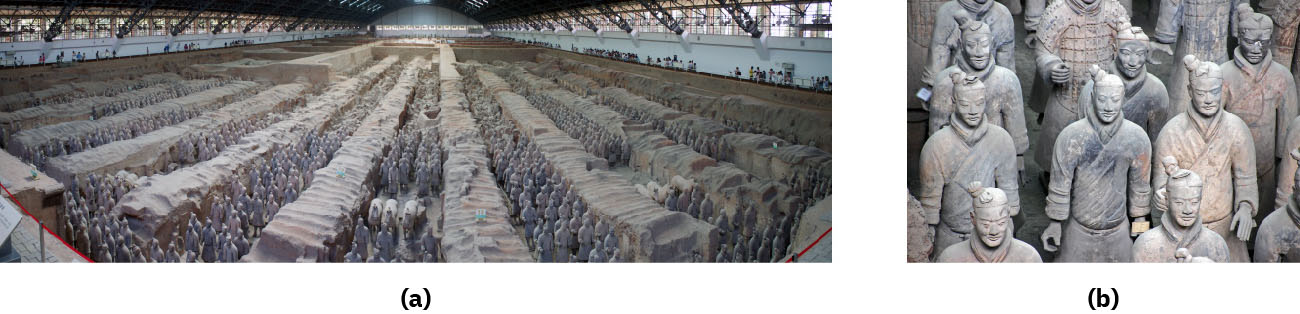
Another monumental feat of Shihuangdi’s reign was the creation of the Terracotta Army, thousands of life-sized clay soldiers fully armed with bronze weaponry and horses. From the time he was a young boy, the emperor had survived a series of assassination attempts, leaving him paranoid and yearning for immortality. Trusted servants were sent in search of paradise and magical elixirs, while hundreds of thousands of others were charged with the years-long process of constructing an enormous secret tomb to protect him in the afterlife. Almost immediately upon ascending the throne in 221 BCE, Shihuangdi began planning for this imperial tomb to be filled with clay replicas of his imperial palace, army, and servants. The massive underground pits, which cover an area of approximately thirty-eight square miles, were discovered with their innumerable contents near Xi’an in the 1970s (Figure 5.8). Labor for projects such as the Great Wall and the Terracotta Army came from commoners as a form of tax or as a requirement under the Qin’s law codes. Penalties for violating the criminal code were severe—forced labor, banishment, slavery, or death.
英語のヒント
始皇帝の統治が成し遂げたもう一つの巨大な事業は、兵馬俑の建造だった。青銅製の武器で武装した数千体の等身大の粘土製兵士と、馬の像が並んでいる。皇帝は少年時代から何度も暗殺未遂を生き延びたため、強い猜疑心を持ち、不死を求めるようになった。信頼する従者たちが仙境や不老不死の霊薬を求めて派遣される一方、何十万人もの人びとが、死後の皇帝を守る巨大な秘密の墓を造る、何年にも及ぶ仕事を命じられた。前221年に帝位に就くとほぼ同時に、始皇帝はこの陵墓を、宮殿・軍隊・従者の粘土製の複製で満たす計画を立て始めた。約38平方マイルの面積を覆う巨大な地下の坑と、その無数の内容物は、1970年代に西安近くで発見された(図5.8)。長城や兵馬俑などの事業の労働力は、税の一形態として、または秦の法典に定める義務として、庶民から集められた。刑法に違反した者への罰は厳しく、強制労働・追放・奴隷化・死刑があった。
The Terracotta Army.兵馬俑。
(credit a: modification of work “Terracotta Soldier Panorama” by Walter-Wilhelm/Flickr, CC BY 2.0; credit b: modification of work “Terracotta warriors exhibit” by “scott1346”/Flickr, CC BY 2.0) · CC BY 2.0
Figure 5.8 (a) Discovered in the 1970s, the buried treasures of China’s first emperor, Qin Shi Huang, include thousands of life-size clay soldiers, known today as the Terracotta Army. (b) Small details of their dress and facial features distinguish the individual soldiers. (credit a: modification of work “Terracotta Soldier Panorama” by Walter-Wilhelm/Flickr, CC BY 2.0; credit b: modification of work “Terracotta warriors exhibit” by “scott1346”/Flickr, CC BY 2.0)
図5.8 (a)1970年代に発見された、中国初の皇帝・秦の始皇帝の埋蔵物には、今日「兵馬俑」と呼ばれる、数千体の等身大の粘土製兵士像が含まれる。(b)服装や顔立ちの細かな違いによって、個々の兵士を見分けられる。(出典a: 原作品を加工:“Terracotta Soldier Panorama”/Walter-Wilhelm/Flickr, CC BY 2.0;出典 b: 原作品を加工:“Terracotta warriors exhibit”/“scott1346”/Flickr, CC BY 2.0)
The Qin Empire quickly collapsed in the wake of the emperor’s death in 210 BCE. Conspiracy within the royal court by one of the emperor’s sons led to the deaths of his rightful heir, a loyal general, and a talented chancellor. Beyond the court, the Legalist philosophy and practices that had helped the Qin accrue strength now made them brittle. Imperial power exercised in the form of direct rule and harsh laws inspired revolts by generals and great families calling for a restoration of the aristocratic feudal society of the Zhou.
英語のヒント
秦帝国は、前210年の皇帝の死を受けて急速に崩壊した。皇帝の息子の一人が宮廷内で企てた陰謀によって、正統な後継者、忠実な将軍、有能な宰相が死に追いやられた。宮廷の外では、秦の力の蓄積に役立った法家の思想と実践が、今や秦をもろくしていた。直接統治と苛酷な法として行使された皇帝権力は、周の貴族的な封建社会の復活を求める将軍や名家の反乱を招いた。
The armies of the Qin’s second emperor failed against Liu Bang, a commoner who rose to become Emperor Gaozu of the newly formed Han dynasty. The Han’s early emperors distanced themselves from Shihuangdi’s legacy by reducing taxes and burdens on the common people. But the Qin’s imperial blueprint—uniform laws, consistent weights and measurements, a centralized bureaucracy, and early focus on expansionism to ward off “barbarians” in the north—provided the scaffolding for the Han’s greatness.
英語のヒント
秦の第2代皇帝の軍隊は、庶民出身の劉邦に敗れた。劉邦は新しく建てた漢王朝の高祖となった。漢の初期の皇帝たちは、一般民衆の税と負担を軽くすることで、始皇帝の遺産から距離を置いた。しかし、統一された法、一定の度量衡、中央集権的な官僚制度、そして北方の「蛮族」を防ぐための早くからの拡張重視という、秦が示した帝国の設計図は、漢の繁栄を支える足場となった。