第5章古代のアジアAsia in Ancient Times
Early Dynastic China中国の初期王朝
The Yellow River had an enormous impact on the development of Chinese civilization. It stretches for more than 3,395 miles, beginning in the mountains of western China and emptying into the Bohai Sea from Shandong province. (Only the Yangtze River to the south is longer.) Critical to the development of farming and human settlement along the Yellow River was the soil, which is loess—a sediment that is highly fertile, but easily moved by winds roaming the plain and driven along as silt by the power of the river. This portability of the soil and the human-built dikes along the river have caused it to constantly evolve and change over the centuries, leaving the surrounding areas prone to regular flooding and subjecting farmers to recurring cycles of bountiful harvests and natural disasters. Rainfall around the Yellow River is limited to around twenty inches annually, meaning that the river’s floods have usually been paired with periodic droughts.
英語のヒント
黄河は中国文明の発展に巨大な影響を与えた。中国西部の山岳から始まり、山東省から渤海へ注ぐその長さは、3395マイルを超える。(これより長いのは南の長江だけである。)黄河沿いの農耕と定住の発展に決定的だったのは、黄土と呼ばれる土壌である。黄土は非常に肥沃な堆積物だが、平原を吹く風に容易に運ばれ、川の力によってもシルトとして流される。土がこのように移動しやすいことと、人が川沿いに築いた堤防のために、黄河は何世紀にもわたって絶えず姿や流路を変えてきた。その結果、周辺地域では洪水が繰り返され、農民は豊作と自然災害の周期にさらされてきた。黄河流域の降水量は年間約20インチに限られ、洪水と周期的な干ばつが併存するのが常だった。
Near the Yellow River, the site of Erlitou in Henan province reveals a culture defined by the building of palaces, the creation of bronze vessels for rituals, and the practice of forms of ancestor worship. Sites such as these have led to debate about whether they prove the existence of the Xia dynasty, a fabled kingdom said to have been founded by one of China’s mythological heroes, the Great Yu. No site has yet been found with documents written by the Xia. Instead, all references to it come from records written many centuries after the possible mythical kingdom ceased to exist.
英語のヒント
黄河に近い河南省の二里頭遺跡は、宮殿の建設、儀礼用の青銅器の製作、ある種の祖先崇拝によって特徴づけられる文化を示している。このような遺跡が、夏王朝の実在を証明するかどうかをめぐって議論が起きた。夏は、中国の神話的英雄の一人である禹が建てたと伝えられる王国である。夏の人びとが書いた文書を伴う遺跡は、まだ一つも見つかっていない。夏への言及はすべて、この実在したかどうかも定かでない王国が終わってから、何世紀も後に書かれた記録に由来する。
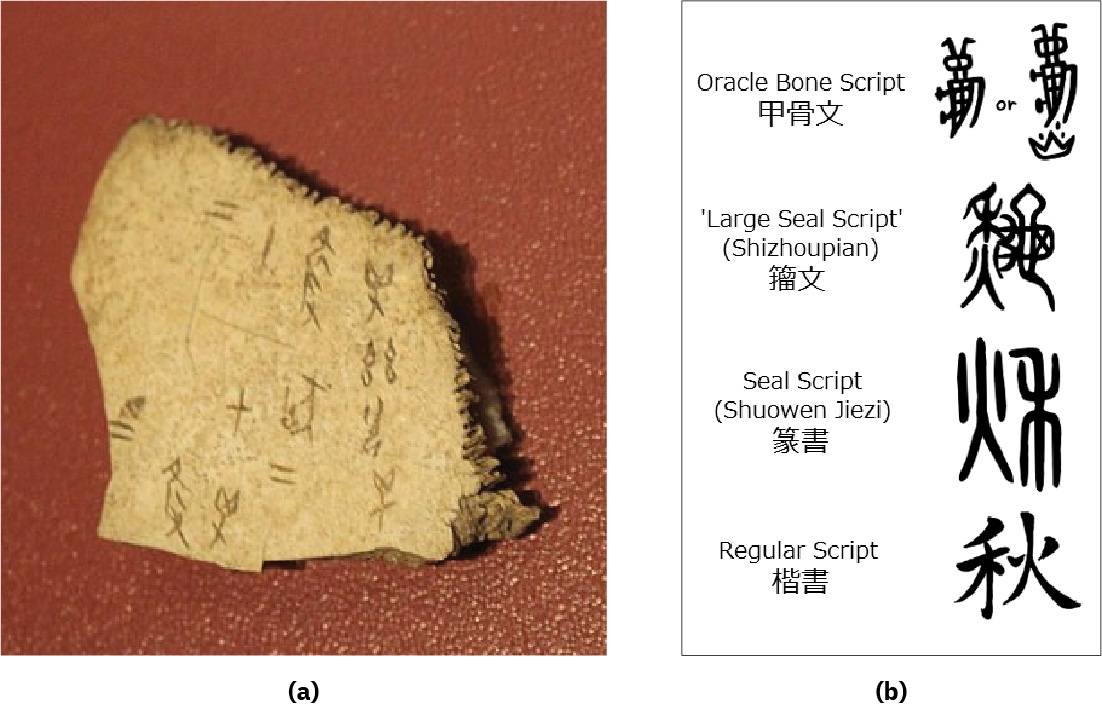
The first Chinese dynasty for which we have solid evidence is the Shang. It created a complex, socially stratified Bronze Age civilization whose signature achievement was the creation of a written script. The Shang were long thought to be a mythological dynasty like the Xia until scholars in the late nineteenth century discovered old turtle shells inscribed with Chinese characters in a medicine shop. Eventually, these shells and other “oracle bones,” once used in the art of divination, were found to be written records from China’s first dynasty (Figure 5.5).
英語のヒント
確かな証拠のある中国最初の王朝は商(殷)である。商は、社会的な階層分化の進んだ複雑な青銅器文明を築き、その代表的な業績は文字体系の創出だった。商も夏と同じように神話的な王朝だと長く考えられていた。しかし19世紀末、学者たちは薬屋で、漢字の刻まれた古い亀の甲羅を発見した。やがて、これらの甲羅や、かつて占いに使われたほかの「甲骨」が、中国最初の王朝の文字記録であることが判明した(図5.5)。
Bronze Age Script.青銅器時代の文字。
(credit a: modification of work “Shang Ox Bone Oracle Bone” by Gary Todd/Flickr, Public Domain; credit b: modification of work “Comparison of Chinese characters for autumn” by “Pat457”/Wikimedia Commons, CC0 1.0) · Public Domain + CC0 1.0
Figure 5.5 (a) This ancient oracle bone is carved with early variations of Chinese characters. (b) Oracle bone script went through a number of stages to evolve into the contemporary form of script we see today, as evidenced by the early iterations of the characters for the word “autumn,” shown here. (credit a: modification of work “Shang Ox Bone Oracle Bone” by Gary Todd/Flickr, Public Domain; credit b: modification of work “Comparison of Chinese characters for autumn” by “Pat457”/Wikimedia Commons, CC0 1.0)
図5.5 (a)この古代の甲骨には、中国の文字の初期の形が刻まれている。(b)ここに示された「秋」の初期の字形が示すように、甲骨文字はいくつもの段階を経て、今日見るような現代の文字の形へ発展した。(出典a: 原作品を加工:“Shang Ox Bone Oracle Bone”/Gary Todd/Flickr, パブリックドメイン;出典 b: 原作品を加工:“Comparison of Chinese characters for autumn”/“Pat457”/Wikimedia Commons, CC0 1.0)
Shang kings exerted their authority through rituals of ancestor worship drawn from the Erlitou culture and adapted to the art of bone divination. First carving written characters onto shells and animal bones and then applying heat to crack and shatter them, they posed questions to spirits and divined from the bones the spirits’ predictions regarding impending harvests, military campaigns, or the arrival of an heir. From there, the Shang developed a logographic script whose characters visually represented words and ideas, combining symbols to make new concepts and sounds as needed. These characters served in a number of tasks such as keeping records, making calendars and organizing time, and preserving knowledge and communicating it from generation to generation.
英語のヒント
商王は、二里頭文化から取り入れ、骨を使う占いに適合させた祖先崇拝の儀礼を通して権威を行使した。まず甲羅や動物の骨に文字を刻み、次に熱を加えてひび割れさせ、霊に問いを投げかけた。そこから、来るべき収穫・軍事遠征・後継者の誕生について霊がどう予言するかを占った。これを出発点に商は、文字が語や観念を視覚的に表す表語文字の体系を発達させた。必要に応じて記号を組み合わせ、新しい概念や音を表した。これらの文字は、記録を残すこと、暦を作って時を整理すること、知識を保存して世代から世代へ伝えることなど、さまざまな仕事に使われた。
The earliest forms of Chinese writing were likely forged on fragile materials such as bamboo or even silk and have not survived. But the Shang’s passing on to future dynasties a logographic script, rather than a phonographic alphabet, meant that for centuries literacy was the preserve of elites. Reading required memorizing hundreds and eventually thousands of symbols and their meanings, rather than learning the sounds of a far fewer number of letters as is the case with an alphabet. Chinese ideas, values, and spiritual beliefs stored in this logographic script long outlived the Shang, becoming a key element of continuity from one dynasty to the next.
英語のヒント
中国で最初期の文字は、竹や、あるいは絹のような傷みやすい素材に記されていた可能性が高く、残っていない。しかし商が後の王朝に、音を表すアルファベットではなく表語文字を伝えたことは、何世紀にもわたり読み書きがエリートの専有物になることを意味した。読むためには、アルファベットのように比較的少数の字母の音を覚えるのではなく、数百、やがては数千の記号とその意味を記憶する必要があった。この表語文字に蓄えられた中国の観念・価値観・宗教的信仰は、商が滅びた後も長く生き続け、王朝から次の王朝へと続く連続性の重要な要素になった。
Through their invention of writing, the Shang were also able to command enormous resources for two centuries. They developed the organizational capacity to mine metal ores and transport them to foundries to make bronze cups, goblets, and cauldrons that grew to weigh hundreds of pounds. Shang artisans began weaving silk into cloth, and the city walls around an early capital in Zhengzhou were erected by ten thousand workers moving earth into bulwarks that stood thirty feet high and sixty feet wide.
英語のヒント
文字を発明したことにより、商は2世紀にわたり膨大な資源を動員することもできた。金属の鉱石を採掘して鋳造所へ運び、青銅製の杯・高脚杯・大釜を作る組織的能力を発達させた。そうした器は、重さが数百ポンドにも達するようになった。商の職人は絹糸を織って布を作り始めた。初期の都である鄭州を囲む城壁は、1万人の労働者が土を運び、高さ30フィート、幅60フィートの防塁として築いた。
But the Shang became China’s first dynasty largely because of their military prowess, expanding their power through conquest, unlike the earlier and more trade-oriented cultures. Through warfare and the construction of a network of walled towns, the Shang built one of the world’s first large territorial states controlled by a noble warrior class. This area included territory in Henan, Anhui, Shandong, Hebei, and Shanxi provinces. The Shang used bronze spears, bows, and later horse-drawn chariots to make raids against neighboring cultures, distributing the prizes to vassals and making enemies into allies for a share of the plunder. The prizes included captives of war, enslaved by the Shang warrior elite or sacrificed. An aristocratic and militaristic culture, the Shang also organized royal hunts for game such as deer, bear, and even tigers and elephants to hone their skills.
英語のヒント
しかし商が中国最初の王朝になったのは、主として軍事力による。以前の、より交易を重視した文化とは異なり、商は征服によって勢力を広げた。戦争と城壁都市のネットワーク建設を通じて、商は貴族的な戦士階級に支配された、世界でも最初期の大規模な領域国家の一つを築いた。その領域には、河南・安徽・山東・河北・山西の各省の地域が含まれた。商は青銅の槍や弓、後には馬に引かせる戦車を使って周辺の文化を襲撃し、戦利品を臣下に分け与え、略奪品の分け前を条件に敵を味方にした。戦利品には捕虜も含まれ、商の戦士エリートの奴隷にされるか、犠牲として捧げられた。貴族的で軍事を重んじる商の文化では、技量を磨くために、鹿・熊、さらには虎や象を獲物とする王の狩猟も組織した。
The oracle bones suggest that religion and ritual were the backbone of Shang society. The kings were not just military leaders but high priests who worshipped their ancestors and the supreme deity known as Di. Shang queens and princesses were also active in politics and warfare, with a few notable women such as the general Fu Hao leading large armies onto the battlefield. Aristocratic women also regularly served as priests in the royal ancestral cult. Like many other ancient societies, the Shang dynasty exhibited a theocratic dimension, with the kings claiming the exclusive right to act as intermediaries between their subjects and the spirit world.
英語のヒント
甲骨は、宗教と儀礼が商社会の根幹だったことを示唆している。王は軍事指導者であるだけでなく、祖先と「帝」と呼ばれる最高神を崇拝する高位の祭司でもあった。王妃や王女も政治と戦争に積極的に関わり、将軍の婦好のように、大軍を率いて戦場に立った著名な女性もいた。貴族の女性も、王家の祖先祭祀で日常的に祭司を務めた。他の多くの古代社会と同様、商王朝にも神権政治の側面があった。王は、臣民と霊の世界の仲立ちをする排他的な権利を主張した。
To stage this royal role, the Shang built palaces, temples, and altars for worship in their capital cities, served by artisans making a host of goods. They developed enormous tombs tunneled beneath the earth for royals and nobility, signifying their capacity to organize labor and resources on a vast scale. Fu Hao’s tomb, for example, was small by comparison to many others for Shang royals, but it was dug twenty-five feet deep into the earth and was large enough to hold sixteen human sacrifices and hundreds of bronze weapons, mirrors, bells, and other items fashioned from bone, jade, ivory, and stone. A comparison of early Shang tombs in Zhengzhou with those of a later period discovered in Anyang suggests that human sacrifices became ever more spiritually significant, and also more extreme. Later kings were found buried not with a few victims but with hundreds of servants and prisoners of war, as well as animals such as dogs and horses. By spilling human blood, Shang royalty hoped to appease Di and their ancestors to ward off problems such as famine. But the scale of these rituals ballooned, with one record indicating that King Wu Ding went so far as to sacrifice more than nine thousand victims in one ritual bloodletting.
英語のヒント
この王の役割を演出するため、商は都に宮殿・神殿・祭壇を建設し、多種多様な品を作る職人がそれらを支えた。王族や貴族のためには地下を掘り進めて巨大な墓を造り、大規模に労働力や資源を組織できることを示した。例えば婦好の墓は、ほかの商王族の墓の多くに比べれば小さかったが、地中25フィートまで掘られ、16人の人身供犠と、数百点の青銅製武器・鏡・鐘、さらに骨・玉・象牙・石で作られた品々を収める広さがあった。鄭州にある初期の商の墓と、安陽で発見された後の時代の墓を比べると、人身供犠の宗教的重要性が増し、規模も激化していったことがうかがえる。後の王の埋葬には、数人の犠牲者だけでなく、数百人の使用人や戦争捕虜、さらに犬や馬などの動物が伴っていた。商の王族は人の血を流すことで帝や祖先をなだめ、飢饉などの問題を防ごうとした。しかし儀式の規模は膨れ上がり、ある記録によれば、武丁は一度の儀礼的な殺害で9000人以上を犠牲にするまでに至った。
Under the sway of the Shang, the disparate Neolithic cultures of northern China grew more uniform, while even groups beyond the Shang’s control in the Yangtze River valley and the west were influenced by their artistic styles and motifs. Yet over the course of their reign, the Shang’s reliance on constant warfare and a religion centered on human sacrifices bred discontent and may have fueled the perception of their kings as corrupt and sadistic. It might even have precipitated revolt against the Shang rulers and the culture’s eventual demise.
英語のヒント
商の支配の下で、中国北部の互いに異なる新石器文化は、いっそう共通性を増した。長江流域や西部など商の支配の及ばない集団まで、その美術様式や文様の影響を受けた。しかし商の統治が続くにつれ、絶え間ない戦争への依存と、人身供犠を中心とした宗教は不満を生んだ。王たちが腐敗し、残酷さを楽しんでいるという見方を強めた可能性もある。それが商王への反乱と、文化の最終的な滅亡を引き起こしたのかもしれない。