第5章古代のアジアAsia in Ancient Times
5.2 The Steppes5.2 ステップ地帯
Learning Objectives学習の目標
By the end of this section, you will be able to:
この節を学ぶと、次のことができるようになる。
Discuss the role climate played in the ancient history of the steppes
ステップの古代史で気候が果たした役割を論じる。
Describe the daily life of people who lived in the region of the steppes
ステップ地帯に暮らした人びとの日常生活を説明する。
Analyze the relationship between the people of the steppes and nearby civilizations
ステップの人びとと近隣の文明との関係を分析する。
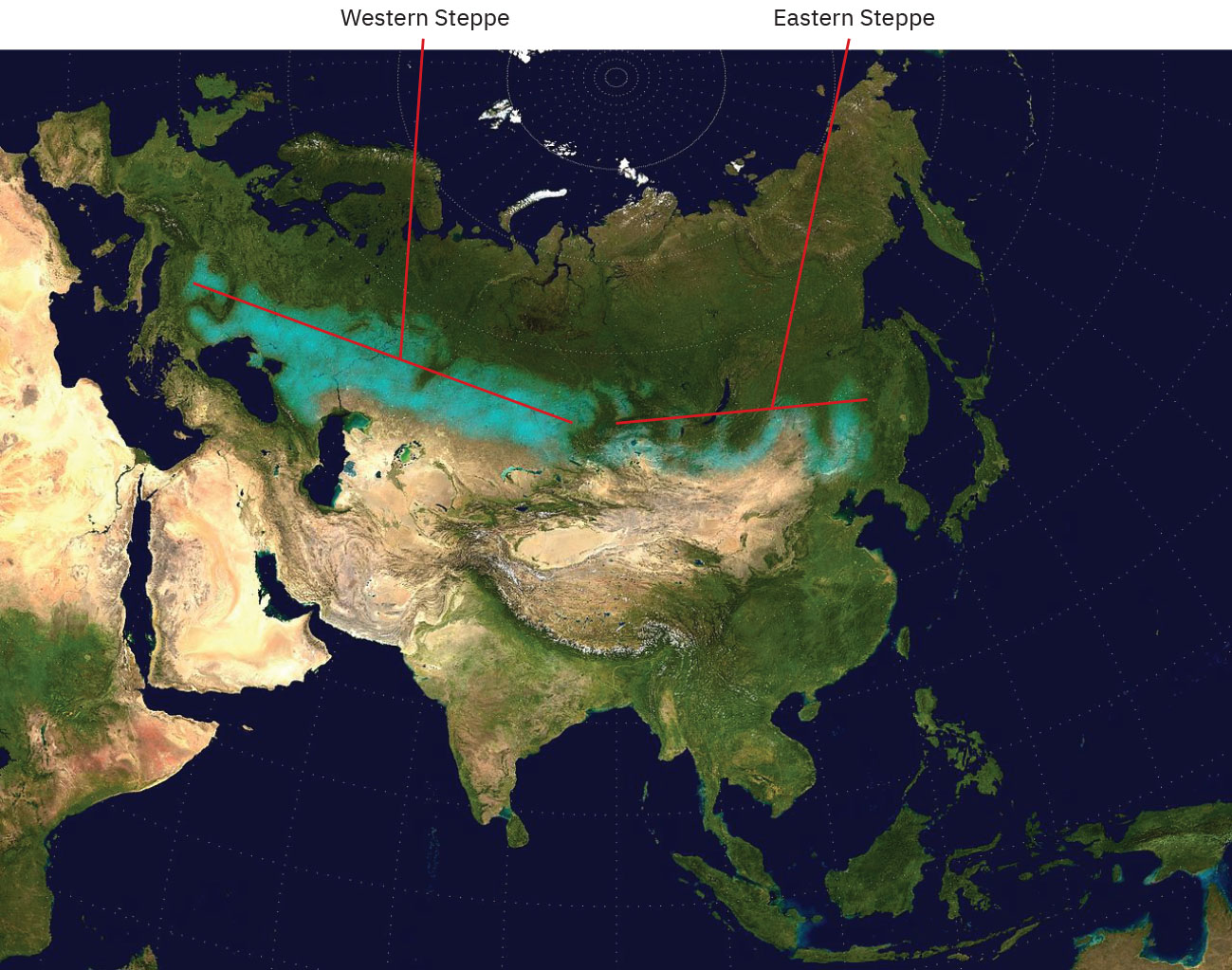
The Eurasian Steppe is a vast stretch of grassland running from Eastern Europe over the top of central Asia and China into Mongolia. For much of human history, the area was home to traveling bands of nomadic pastoralists who grazed herds and collided with settled agricultural societies in Persia, Russia, and China. Geographers divide the Eurasian Steppe into two zones: One is in the west near Ukraine, Russia, and Kazakhstan, and the other is in the east, close to China and Mongolia (Figure 5.9). In both areas, the vastness of the land supported large herds of goat, cattle, and sheep. The prevalence of horses enabled powerful warriors of many cultures to rule from the saddle but also gave their people the freedom to roam, migrate, and resist absorption into a large unified state. While much of their history is still debated, these various tribes of the steppes provided the origins for a great number of Turkic, Iranian, Mongolic, Uralic, Tibeto-Burman, and multiethnic peoples today.
英語のヒント
ユーラシア草原は、東ヨーロッパから中央アジア・中国の北側を通り、モンゴルに至る広大な草原地帯である。人類史の大部分にわたって、ここには移動する遊牧民の集団が暮らし、家畜の群れを放牧し、ペルシア・ロシア・中国の定住農耕社会と衝突した。地理学者はユーラシア草原を、西のウクライナ・ロシア・カザフスタン付近と、東の中国・モンゴル付近の二つの区域に分ける(図5.9)。両地域とも広大な土地が山羊・牛・羊の大きな群れを養った。馬が広く飼われたことで、各文化の有力な戦士は馬上から支配することができた。同時に馬は、人びとに移動や移住の自由を与え、大きな統一国家への吸収に抵抗することも可能にした。歴史の多くにはなお議論があるが、草原のこれらの多様な部族は、今日の数多くのテュルク系・イラン系・モンゴル系・ウラル系・チベット=ビルマ系、さらに複合的な出自を持つ諸民族の起源となった。
The Eurasian Steppe.ユーラシアのステップ。
(credit: modification of work “Approximate extent of the Eurasian Steppe grasslands ecoregion, and Eurasia cultural region” by “Mdf”/Wikimedia Commons, Public Domain) · Public Domain
Figure 5.9 The Eurasian Steppe, consisting of a western and an eastern half and shown here in light blue, reaches from the Caspian Sea in Europe to the Pacific Ocean. Its distinctive climate and vegetation are well-suited to pasturing livestock but less welcoming to settled agriculture. (credit: modification of work “Approximate extent of the Eurasian Steppe grasslands ecoregion, and Eurasia cultural region” by “Mdf”/Wikimedia Commons, Public Domain)
図5.9 西半分と東半分からなり、ここでは水色で示されるユーラシアのステップは、ヨーロッパのカスピ海から太平洋まで延びている。その独特な気候と植生は家畜の放牧によく適しているが、定住農業にはあまり向かない。(出典: 原作品を加工:“Approximate extent of the Eurasian Steppe grasslands ecoregion, and Eurasia cultural region”/“Mdf”/Wikimedia Commons, パブリックドメイン)
The Nomadic Culture of the Steppesステップの遊牧文化
The eastern half of the Eurasian Steppe, sometimes referred to as the Inner Asian Steppe, now contains vast grasslands, mountains, and deserts not suitable to agriculture and only sparsely populated. Its history has been shaped to a great extent by climate change. Rainfall across the grasslands in Mongolia once supported pasturing herds of sheep, camels, goats, and horses, but in periods of a cooling climate, the grasslands could shrink, forcing nomads to roam in search of new pastures. Or droughts could drive them to desperate measures: If nearby societies were unwilling to trade, the nomads were often left with no choice but to make raids on farms and cities as a means to survive. Scholars now theorize that shifts to a colder, drier climate around 1500 BCE forced many peoples living here to abandon agriculture for livestock herding. However, grazing animals required mobile human communities that could readily find new pastures and protect their herds from predators. Thus the need to care for livestock forced cultural adaptation as people mastered the art of horseback riding.
英語のヒント
ユーラシア草原の東半分は、内陸アジア草原とも呼ばれ、現在は農耕に向かない広大な草原・山地・砂漠が広がり、人口もまばらである。その歴史は気候変動に大きく形づくられた。モンゴルの草原に降る雨は、羊・ラクダ・山羊・馬の群れの放牧を支えたが、寒冷化する時期には草原が縮小し、遊牧民は新たな牧草地を求めて移動を迫られた。また干ばつは、人びとを窮余の手段へ追い込むこともあった。近隣社会が交易に応じなければ、遊牧民には、生存のため農場や都市を襲う以外の選択肢がなくなることが多かった。学者は現在、前1500年ごろのより寒冷で乾燥した気候への変化によって、この地域の多くの人びとが農耕を捨て、家畜の飼育へ移らざるを得なかったと考えている。しかし家畜を放牧するには、新しい牧草地をすぐ見つけ、捕食者から群れを守れる移動性のある人間集団が必要だった。そのため、家畜の世話の必要に迫られた人びとは騎馬の技術を身につけ、文化を適応させた。
As livestock herders, many people of the Inner Asian Steppe consumed a great deal of meat and dairy and made products from animal flesh and furs that could be traded in agricultural villages. They spoke languages unrelated to Chinese, such as Turkic or Mongolic, but a few such as the Jie may have even spoken Indo-European tongues. Due to the constraints set on pastoralism by a changing climate, the peoples of the steppes were in constant contact with agrarian civilizations such as the Chinese, who often looked on the nomads and their herds as a pestilence and threat to their own livelihoods. Yet while Chinese and Koreans for centuries tried to erect physical and cultural barriers between their civilizations and the “foreign” groups on the steppes, the ethnic and ancestral lines between Asia’s nomads and their neighbors were porous.
英語のヒント
内陸アジア草原の多くの人びとは、牧畜民として大量の肉や乳製品を消費し、動物の肉や毛皮から、農村で交易できる品を作った。テュルク系やモンゴル系など、中国語とは系統を異にする言語を話したが、羯のような少数の集団はインド=ヨーロッパ系の言語を話していた可能性さえある。変化する気候が牧畜に制約を課したため、草原の人びとは中国などの農耕文明と絶えず接触していた。中国人はしばしば、遊牧民とその群れを、自らの生計を脅かす災厄と見なした。しかし中国人や朝鮮人が何世紀にもわたって、自らの文明と草原の「異邦」の集団の間に物理的・文化的な障壁を築こうとしたにもかかわらず、アジアの遊牧民と隣人の民族・祖先の境界は、人や文化が行き来できるものだった。
Prizes taken by peoples of the steppes during raids, such as silk, lacquerware, grain, and war captives, were distributed by chieftains to their loyal supporters, who in turn conferred upon their leaders new titles such as chanyu, or khan, signifying a supreme leader with claims to spiritual and military supremacy. The khans’ command over thousands of horses in an age of cavalry warfare further enhanced their power. Tribal confederations of the steppes wielded control over the Silk Roads, a series of trade routes circulating luxury goods to and from China and parts of central Asia, India, and the Middle East. To a mobile society, manufactured and luxury goods had material, social, and political value of enormous worth. Silk, for example, was treasured by nomads because its lightness was ideal for clothing in hot summers and its softness was desirable for lining beds. Powerful generals and khans who amassed huge quantities of the fabric used it as an indicator of their power. The same was largely true of other luxury goods such as wine.
英語のヒント
草原の人びとが襲撃で得た絹・漆器・穀物・戦争捕虜などの戦利品は、首長によって忠実な支持者に分配された。その見返りに支持者は、首長に単于やハンなどの新しい称号を与えた。これらは宗教上・軍事上の至上権を主張する最高指導者を意味した。騎兵戦の時代に何千頭もの馬を掌握していたことが、ハンたちの権力をさらに高めた。草原の部族連合は、中国と、中央アジア・インド・中東の各地との間で奢侈品を流通させる一連の交易路、シルクロードを支配した。移動する社会にとって、製造品や奢侈品は、物質的にも社会的にも政治的にも極めて大きな価値があった。例えば絹は、軽さが暑い夏の衣服に最適で、柔らかさが寝床の敷物に好まれたため、遊牧民に珍重された。大量の絹を蓄えた有力な将軍やハンは、それを自らの権力のしるしとして使った。葡萄酒など、ほかの奢侈品にもおおむね同じことが当てはまった。
Most nomadic groups in Asia lived in small units of families or in a clan, a small group of several families that shared an encampment and herded or hunted together. Clans were united by loyalty to a chieftain selected for prowess as a mounted warrior. Compared with many other cultures in the ancient world, however, the societies of the steppes were more egalitarian. Role and status differences between men and women were more muted than in cities or farming settlements. Recent archaeological discoveries of female skeletons from the Xiongnu, Xianbei, and Turkic peoples of the steppes show evidence that women engaged in horseback riding and combat skills such as archery. They likely formed the historical basis for folktales about legendary female warriors such as Mulan that began circulating in Chinese society in the sixth century. Mobile lifestyles put a limit on the acquisition of wealth and its display in the form of architecture and clothing, which might explain why the development of written scripts was less common as well. Conversely, it was also true that most cultures of the Inner Asian Steppe readily absorbed technologies, goods, and ideas from neighboring civilizations.
英語のヒント
アジアの遊牧集団の多くは、小さな家族単位か、複数の家族が同じ野営地を使い、ともに牧畜や狩猟をする氏族で暮らした。氏族を結びつけたのは、騎馬の戦士としての力量によって選ばれた首長への忠誠だった。しかし古代世界のほかの多くの文化と比べ、草原社会はより平等主義的だった。男女の役割や地位の差は、都市や農耕集落より目立たなかった。近年、草原の匈奴・鮮卑・テュルク系諸民族の女性の骨格が考古学的に発見され、女性が騎馬や弓術などの戦闘技能を実践していた証拠が示された。これは、6世紀に中国社会で広まり始めた木蘭のような伝説的女性戦士の物語の、歴史的な土台となった可能性が高い。移動生活は、富を蓄積し、建築や衣服によってそれを見せることに限界を設けた。それが、文字体系の発達も比較的少なかった理由を説明するかもしれない。逆に、内陸アジア草原の多くの文化が、近隣の文明から技術・商品・思想を容易に取り込んだことも事実である。
Where the peoples of the steppes pioneered was in domesticating the horse, giving them a significant military advantage over their neighbors. Horseback riding and hunting provided the education in martial arts needed for war, and people began both activities at an early age. Hunting was a fixture of nomadic culture and the core of rituals that marked progress from child to adult, or from lowly member of society to one of the higher ranks. Touching both Europe and Asia, the steppes formed a bridge from which developments such as the chariot and cavalry warfare slowly spread to the rest of Asia. Chariots and mounted warriors in turn sparked the development of confederations that constituted a formidable military threat. Campaigns led by conquerors from the steppes—such as Modun, who came to power in 209 BCE—thus marked a turning point in the relationship between the Inner Asian Steppe, the rest of China, and the developing Silk Roads as arteries of exchange across the ancient world.
英語のヒント
草原の人びとが先駆けたのは馬の家畜化であり、それが隣人に対する大きな軍事的優位を与えた。騎馬と狩猟は戦争に必要な武術の訓練となり、人びとは幼いころから両方を始めた。狩猟は遊牧文化に欠かせない営みで、子供から大人へ、あるいは社会の低い身分から高い地位へ進むことを示す儀礼の中心だった。ヨーロッパとアジアの双方に接する草原は橋となり、戦車や騎兵戦などの発展が、そこからアジアのほかの地域へ少しずつ広がった。戦車や騎馬戦士はさらに、強大な軍事的脅威となる連合の形成を促した。そのため、前209年に権力を握った冒頓のような草原の征服者が率いる遠征は、内陸アジア草原と中国のほかの地域、そして古代世界を横断する交流の大動脈として発達しつつあったシルクロードの関係に、転機をもたらした。