第5章古代のアジアAsia in Ancient Times
Tribes, Confederations, and Settled Neighbors部族・連合体・近隣の定住民
The earliest written records about many non-Chinese people living along the steppes come from Chinese sources, which referred to these people collectively as the Hu (or Donghu) and divided them into five large groups. These were the Xiongnu, the Di, the Qiang, the Xianbei, and the Jie. Later inhabitants of the steppes in the ancient world included the Khitan and many smaller groups.
英語のヒント
草原沿いに暮らす多数の非中国系の人びとについての最初期の文字記録は、中国の史料に由来する。その史料は、これらの人びとを胡(または東胡)と総称し、匈奴・氐・羌・鮮卑・羯という五つの大きな集団に分けた。古代の草原の後の住民には、契丹や、数多くのより小さな集団も含まれた。
Among the more powerful confederations noted by Chinese scribes were the Xiongnu, who controlled the lands near Mongolia from the third to the first century BCE. The Xiongnu became the dominant military confederation after forcing their rivals the Yuezhi to migrate west. In many periods, the relationship between the Xiongnu and Chinese dynasties such as the Han was complicated. Sometimes the Xiongnu and the Chinese were natural trading partners, exchanging horses for grain and silk. Access to Chinese civilization normally demanded that the Xiongnu submit tribute, accepting inferior status in return for trade rights and other rewards such as Chinese brides to establish stronger ties between the two cultures. At other times, the Xiongnu preferred to assert military and cultural dominance by raiding China and inciting war as well as constructing defenses such as the many northern fortification walls built by successive dynasties. At several points in their history, the Xiongnu were strong enough militarily to force the Chinese to adopt a policy of appeasement, exacting huge sums of silk, rice, and cash for peace. As a result, the tribute flowing between Xiongnu and Han Chinese often became a bribe meant to appease the nomadic tribes.
英語のヒント
中国の書記が記録した有力な連合の一つが、前3~前1世紀にモンゴル付近を支配した匈奴だった。匈奴はライバルの月氏を西へ移住させた後、最有力の軍事連合となった。匈奴と漢などの中国王朝との関係は、さまざまな時期に複雑なものとなった。匈奴と中国人は、馬と穀物・絹を交換する自然な交易相手であることもあった。中国文明との接触には通常、匈奴が貢納し、下位の地位を受け入れることが求められた。その代わりに交易権や、両文化の結びつきを強める中国人の花嫁などの見返りを得た。別の時には、匈奴は中国を襲い戦争を誘発することで、軍事的・文化的な優位を示そうとした。また、歴代王朝が北方に築いた多くの防壁のような防御施設も建設した。何度かは、匈奴の軍事力が中国に宥和策を取らせるほど強くなり、平和と引き換えに大量の絹・米・貨幣を取り立てた。その結果、匈奴と漢の中国人の間を流れる貢納は、遊牧部族をなだめるための買収金となることが多かった。
Simultaneously, tribal chieftains could often be employed as vassals of the Chinese, acting as a buffer to protect their border with the steppes or to sow division and conflict between various other bands of the Xiongnu. Chinese officials and soldiers also often found it convenient to defect to the Xiongnu, marrying into powerful families who sought their skills and expertise as administrators. For all these reasons, the border between the steppes and China was fluid and constantly changing, even as Han historians began to refer to groups such as the Xiongnu as “barbarians” and the antithesis of what it meant to be Chinese. Conversely, the nomads and tribes of the steppes often looked on Chinese farmers as lowly, weak, and servile peoples, in contrast to their own identity and values.
英語のヒント
同時に、部族の首長が中国の臣下として用いられ、草原との国境を守る緩衝役となったり、匈奴のほかの集団の間に分裂や争いを起こさせたりすることも多かった。中国の官吏や兵士も、匈奴へ移ることが有利だと判断することがあり、行政官としての技能や専門知識を求める有力な家へ婿入りした。こうしたさまざまな理由から、草原と中国の境界は流動的で、絶えず変化していた。漢の歴史家が匈奴などを「蛮族」、中国人であることの対極と呼び始めてからも、それは変わらなかった。逆に、草原の遊牧民や部族は、中国の農民を卑しく弱く隷属的な人びとと見なし、自らの帰属意識や価値観と対比することが多かった。
Critical to the struggle between the two were the Silk Roads. The balance of power, which initially favored the Xiongnu, shifted as two Han military expeditions went in search of allies in central Asia. These campaigns succeeded in subjugating the Xiongnu and gaining control over the eastern terminus of the Silk Roads. The Xiongnu were later weakened by years of civil war over their system of succession during the middle of the first century BCE. Less powerful groups in these wars tended to move toward the frontier of the Chinese empire and try to secure Chinese support against their rivals.
英語のヒント
両者の争いに決定的だったのはシルクロードである。当初は匈奴に有利だった勢力の均衡は、中央アジアの同盟者を探しに漢が2度の軍事遠征を行うと変化した。これらの遠征は匈奴を服属させ、シルクロード東端の支配を獲得することに成功した。後に匈奴は、前1世紀半ばの継承制度をめぐる長年の内戦によって弱体化した。これらの戦争で力の弱い集団は、中国帝国の国境に近づき、敵対勢力に対抗するため中国の支持を得ようとする傾向があった。
Thus the Southern Xiongnu, with their homeland threatened by natural disasters and resource scarcity, became vassals of the Han fighting against the Northern Xiongnu. Acceptance of tributary status required sending an aristocratic prince as hostage to live in the Han capital and be given a classical Chinese education, part of the continued cultural exchange between the Inner Asian Steppe and China. Channels between the two cultures widened as the later Han moved settlers west and tried to create military colonies along the frontiers for defense, staffed by non-Chinese auxiliary forces. Hundreds of thousands of Xiongnu lived inside the borders of China’s empire, often becoming more settled and assimilated in their lifestyles and cultural practices.
英語のヒント
こうして、自然災害と資源不足に故郷を脅かされた南匈奴は、漢の臣下となり、北匈奴と戦った。貢納する地位を受け入れるには、貴族の王子を人質として漢の都に住まわせ、中国の古典教育を受けさせる必要があった。これも、内陸アジア草原と中国の継続的な文化交流の一部だった。後の漢が入植者を西へ移し、防衛のため国境沿いに非中国系の補助部隊を配した軍事植民地を作ろうとすると、二つの文化の間の通路はいっそう広がった。何十万人もの匈奴が中国帝国の領内に住み、生活様式や文化的慣行の面で、定住化や同化が進むことも多かった。
Following the collapse of the Han dynasty, various branches of the Xiongnu tribes founded dynastic states across northern China during a period known as the Six Dynasties (220–589 CE). With innovations such as the stirrup and new forms of armor covering the whole of the mounted warrior and his horse, heavy cavalry units made these nomadic groups the supreme fighting force in Asia for the next two centuries. During this time, much of northern China and the Inner Asian Steppe was dominated by large, multiethnic conquest states ruled by chiefs claiming mixed ancestry from both Chinese and nomadic groups. Dynasties such as the Later Zhao and the Han Zhao were founded by powerful Xiongnu chiefs such as Shi Le and Liu Yuan, respectively. However, these dynasties often invoked claims to legitimacy staked in their ancestral and cultural ties to the Han dynasty. The ethnic markers and identity of the Xiongnu as distinct from Chinese and other groups on the steppes slowly melted away in these centuries. At the same time, an economy rooted in ranching and herding spread from the Inner Asian Steppe to northern China in a period that saw long-distance trade and grain agriculture decline.
英語のヒント
漢王朝の崩壊後、六朝時代(220~589年)として知られる時期に、匈奴の諸支族は中国北部の各地に王朝国家を建てた。鐙や、騎馬戦士と馬の全身を覆う新しい鎧などの革新によって、重装騎兵部隊を持つこれらの遊牧集団は、その後2世紀にわたってアジア最強の戦闘力となった。この間、中国北部と内陸アジア草原の大半は、中国人と遊牧集団双方の祖先を持つと主張する首長に率いられた、大きな多民族の征服国家に支配された。後趙や漢趙などの王朝は、それぞれ石勒や劉淵といった有力な匈奴の首長によって建てられた。しかしこれらの王朝は、漢王朝との祖先上・文化上のつながりに根ざした正統性を主張することも多かった。この数世紀の間に、中国人や草原のほかの集団とは異なるという匈奴の民族的な特徴と帰属意識は、ゆっくりと薄れていった。同時に、遠距離交易と穀物農業が衰える中、牧畜を基盤とした経済が、内陸アジア草原から中国北部へ広がった。
Meanwhile, another ethnic nomadic group known as the Xianbei also emerged as a powerful force in the world of East Asia in this period. Originally hailing from southern Manchuria, the Xianbei were once subordinate to larger nomadic groups on the steppes such as the Xiongnu. After the fall of the Han, the Xianbei grabbed territory inside China proper by conducting raids for horses, war captives, and herds of cattle and sheep. Their military might forced a massive reshuffling of populations in northern China, while many Chinese sought employment with the Xianbei as advisers and administrators.
英語のヒント
その間、この時代の東アジアでは、鮮卑という別の遊牧集団も強力な勢力として登場した。もともと満洲南部に出自を持つ鮮卑は、かつて匈奴など草原のより大きな遊牧集団に従属していた。漢が滅びると、鮮卑は馬や戦争捕虜、牛・羊の群れを求める襲撃を行い、中国本土内の領域を獲得した。その軍事力は中国北部の人口の大規模な再配置を引き起こした。一方、多くの中国人は助言者や行政官として鮮卑に雇われようとした。
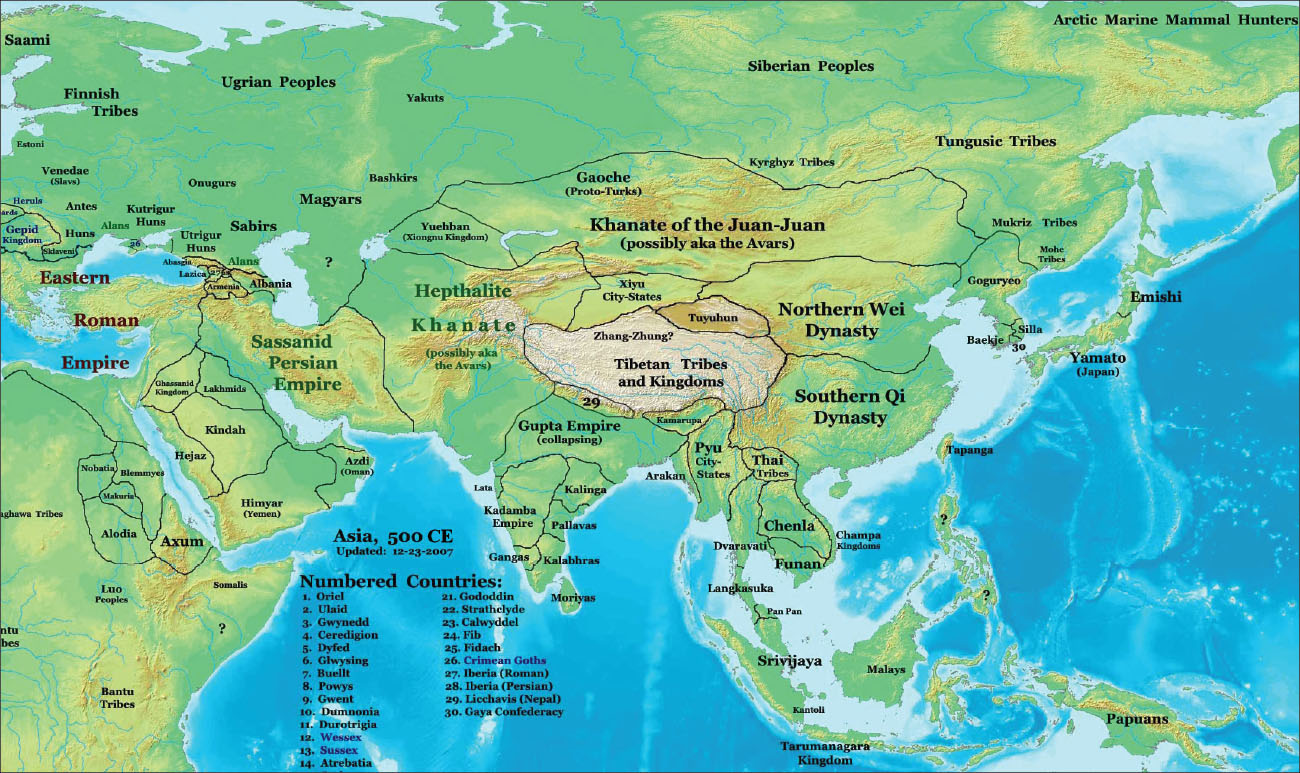
Drawing on the wealth of Chinese farmers, a branch of the Xianbei known as the Tuoba clan founded the Northern Wei dynasty (386–534 CE). Adopting the imperial title of emperor, Xianbei rulers such as Xiaowen in the late fifth century tried to remake their society into a true Chinese dynasty along the blueprint of the Han (Figure 5.10). During Xiaowen’s reign, for example, elite Xianbei families arranged marriages between their daughters and wealthy, well-educated Chinese from the Southern dynasties. Such reforms proved dangerous. The opulence and culture of the courtly center of the Northern Wei alienated Xianbei soldiers of the garrisons along its frontier, who rebelled in 524 CE. The result was years of civil war and the sack of the capital in Luoyang. Still, the Xianbei proved a considerable force in the affairs of East Asia well into the later Sui and Tang dynasties.
英語のヒント
中国の農民の富を利用して、拓跋氏という鮮卑の一支族が北魏(386~534年)を建てた。皇帝の称号を採用した鮮卑の統治者の中でも、5世紀末の孝文帝などは、漢の設計図に沿って自分たちの社会を真の中国王朝へ作り変えようとした(図5.10)。例えば孝文帝の治世には、鮮卑の有力家が、その娘と南朝の裕福で教養ある中国人との婚姻を取り決めた。しかし、こうした改革には危険があった。北魏の中心にある宮廷の贅沢と文化は、辺境の駐屯地にいた鮮卑兵士を疎外し、彼らは524年に反乱を起こした。その結果、何年もの内戦と洛陽の都の略奪が生じた。それでも鮮卑は、後の隋・唐の時代に入ってもなお、東アジアの動向を大きく左右する勢力であり続けた。
Northern Wei Dynasty.北魏。
(credit: modification of work “Map of the Eastern Hemisphere 500 CE” by Thomas Lessman/Wikimedia Commons, CC BY 3.0) · CC BY 3.0
Figure 5.10 Xiaowen’s reign over the Northern Wei dynasty marked a dynamic period of cultural exchange and assimilation between Xianbei and Han Chinese royals and nobility, but it also led to rebellion and violence by nomadic warriors charged with guarding the kingdom. (credit: modification of work “Map of the Eastern Hemisphere 500 CE” by Thomas Lessman/Wikimedia Commons, CC BY 3.0)
図5.10 北魏の孝文帝の治世は、鮮卑と漢人の王族・貴族の間で、活発な文化交流と同化が進んだ時期だった。しかしそれは、王国の警備を任された遊牧民の戦士による反乱と暴力にもつながった。(出典: 原作品を加工:“Map of the Eastern Hemisphere 500 CE”/Thomas Lessman/Wikimedia Commons, CC BY 3.0)
While the Xianbei and Xiongnu faded, after the fourth century another group known as the Khitan began a slow steady ascent toward power on the steppes and beyond. Organized for centuries as small clans of hunters, fishers, herders, and warriors in an area stretching from Mongolia to Siberia, the Khitan later founded the Liao dynasty (907–1125). Even more impressive were later empires that conquered the entirety of the Inner Asian Steppe and all of China, founded by the Mongols and Jurchen.
英語のヒント
鮮卑と匈奴が衰えていく一方、4世紀以後、契丹という別の集団が、草原とその外側で、ゆっくりと着実に勢力を伸ばし始めた。モンゴルからシベリアへ広がる地域で、何世紀もの間、狩猟民・漁労民・牧畜民・戦士の小さな氏族として組織されていた契丹は、後に遼王朝(907~1125年)を建てた。さらに大きな規模を持ったのが、後にモンゴル人と女真人が建てた、内陸アジア草原の全域と中国全土を征服する帝国だった。