第5章古代のアジアAsia in Ancient Times
Southeast Asia東南アジア
The term “Southeast Asia” describes a large area in subtropical Asia that can also include thousands of islands in the Pacific. Today it often refers to Brunei, Burma, Thailand, Laos, Cambodia, Vietnam, Malaysia, Singapore, and Indonesia. For much of human history, travel across this area was far easier by boat along the shore and between islands than overland. Lands were more sparsely populated than in India, China, Japan, and Korea, and most communities were isolated from their closest neighbors by forests and mountains. Early on, however, they became able to engage with other peoples through the sea lanes.
英語のヒント
「東南アジア」という語は、太平洋の何千もの島々を含むこともある、アジアの亜熱帯の広大な地域を指す。今日では、ブルネイ・ビルマ・タイ・ラオス・カンボジア・ベトナム・マレーシア・シンガポール・インドネシアを指すことが多い。人類史の大部分にわたり、この地域の移動は、陸路よりも岸沿いや島の間を舟で進む方がはるかに容易だった。人口はインド・中国・日本・朝鮮よりまばらで、共同体の多くは、最も近い隣人からも森林や山で隔てられていた。しかし早くから、海路を通してほかの人びとと関わることができるようになった。
In general, communities in Southeast Asia settled first along coastlines near rivers, lakes, and the oceans and seas. But archaeological sites in Thailand, Burma, and Laos prove that many chose to make upland regions their homes as well. As in India, early agriculture was driven by the rhythms of monsoon season. Farmers developed rainwater tanks to manage their supply of water and learned how to grow rice in paddies. A reliance on slash-and-burn agriculture meant that many Southeast Asians had to migrate after the soil had been exhausted, making the population fluid as people moved from one area to the next. The social structure, too, was less stratified than in India and China. Only with the later arrival of new religions such as Buddhism and Hinduism did priestly and kingly classes start to form and play a central role in religion and politics.
英語のヒント
一般に、東南アジアの共同体は、まず海岸沿いや、川・湖・海の近くに定住した。しかしタイ・ビルマ・ラオスの考古遺跡は、多くの人が高地も住みかとして選んだことを証明している。インドと同様、初期の農耕はモンスーン期の周期に左右された。農民は水量を管理する雨水貯水池を作り、水田で米を育てる方法を学んだ。焼畑農業への依存は、土壌が痩せると移住しなければならないことを意味した。人びとが地域から地域へ移るため、人口は流動的だった。社会構造もインドや中国ほど階層化していなかった。後に仏教やヒンドゥー教などの新宗教が到来して初めて、祭司や王の階層が形成され、宗教と政治で中心的な役割を果たし始めた。
Despite its great territorial expanse and varying climates and topography, the region does have broad commonalities that make it useful to see Southeast Asia as one geographic and cultural zone (Figure 5.17). For example, its location between India and China led to the growth of royal courts that borrowed from foreign traditions to develop rituals and diplomatic relations, assert control over ordinary farmers and fishers, and create trading-post empires. The region’s geography and climate also made sailing a universally efficient craft. For centuries, merchants and adventurers traveling from the Indian landmass along the coastlines of Asia have exploited monsoon winds from June to November that easily push boats all the way to the Malaysian peninsula. Return voyages were made possible by a second set of monsoon winds blowing in the opposite direction from December to May. The holdover period between the two monsoon seasons proved ample time for merchants and missionaries to transplant customs, religion, and art from India to new environs in Southeast Asia. At the same time, the arrival of boats and merchants traveling from Vietnam and Malaysia to China and back as early as 300 BCE meant residents of Southeast Asia enjoyed a rich marketplace of ideas, goods, and cultures at a very early stage in world history.
英語のヒント
広大な領域と多様な気候・地形を持ちながらも、この地域には広い共通性がある。そのため東南アジアを一つの地理的・文化的区域として見ることには意味がある(図5.17)。例えばインドと中国の間という立地は、外来の伝統を取り入れて儀礼や外交関係を発展させ、一般の農民・漁民を統制し、交易拠点の帝国を作る王廷の成長を促した。地理と気候も、航海を各地で効率的な技術にした。何世紀にもわたり、インドの陸地からアジアの沿岸を進む商人や冒険者は、6~11月のモンスーンを利用して、容易にマレー半島まで舟を進めた。帰路の航海は、12~5月に逆向きに吹くもう一つの季節風によって可能になった。二つの季節風の間の滞在期間は、商人や伝道者がインドの習慣・宗教・美術を、東南アジアの新しい環境へ移すのに十分な時間だった。同時に、前300年もの早い時期から、ベトナムやマレーシアと中国を往復する舟や商人が訪れた。そのため東南アジアの住民は、世界史の非常に早い段階で、思想・商品・文化の豊かな交流の場を享受した。
Southeast Asia.東南アジア。
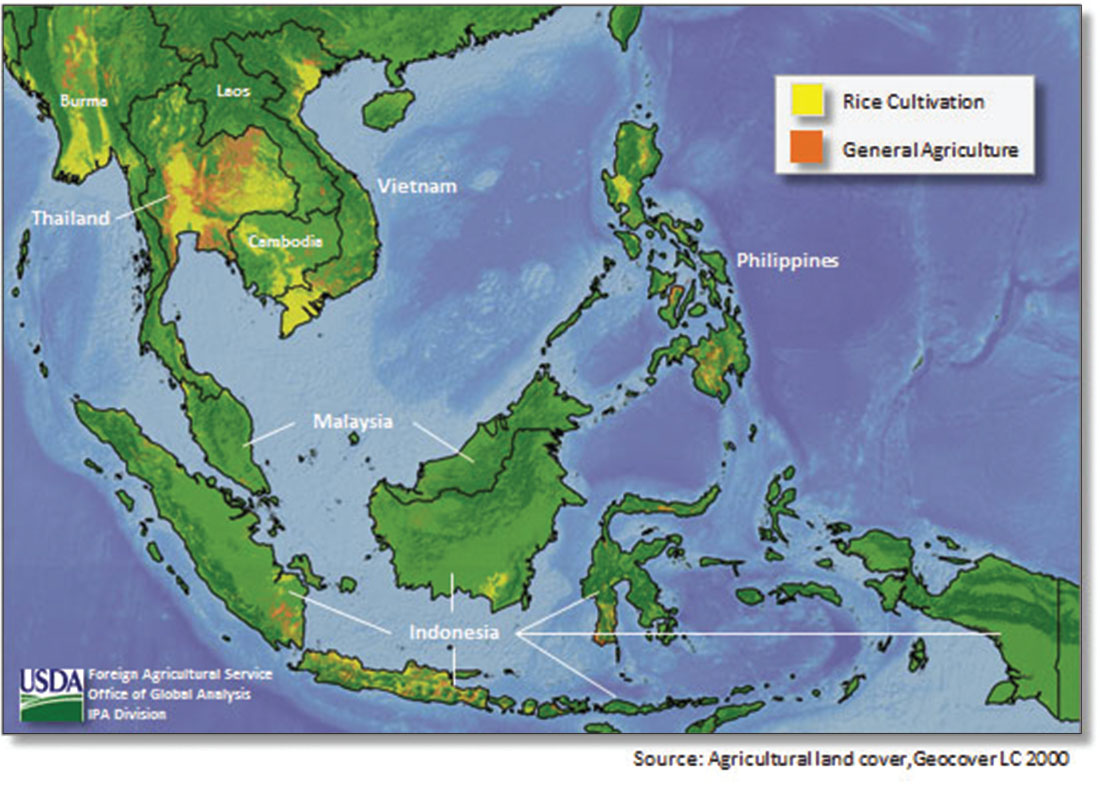
(credit: “SE Asia: Distribution of Agricultural Lands” by Agricultural land cover, Geocover LC 2000”/USDA: Foreign Agricultural Service, Public Domain) · Public Domain
Figure 5.17 The expanse of Southeast Asia includes varied topographies and climates but also some common historical and cultural features, such as the practice of wet-rice agriculture and religions such as Buddhism. (credit: “SE Asia: Distribution of Agricultural Lands” by Agricultural land cover, Geocover LC 2000”/USDA: Foreign Agricultural Service, Public Domain)
図5.17 広大な東南アジアは、多様な地形と気候を持つが、水稲農業の実践や仏教などの宗教をはじめ、共通する歴史的・文化的特徴も持つ。(出典: “SE Asia: Distribution of Agricultural Lands”/Agricultural land cover, Geocover LC 2000”/USDA: Foreign Agricultural Service, パブリックドメイン)
While the influx of foreign ideas was critical to the development of societies across Southeast Asia, each local community made selective adaptations and preserved its indigenous customs. For example, the importance of the individual family was a point of commonality for many societies in Southeast Asia, in contrast to the weight given extended families and clans in India and China. Most peasant communities in Southeast Asia also afforded women higher status than their counterparts in China were allowed under the stricter Confucian values system.
英語のヒント
外来思想の流入は東南アジア各地の社会の発展に決定的だったが、各地域の共同体は選択的に手を加え、土着の習慣を守った。例えば、インドや中国で大家族や氏族が重視されたのに対し、東南アジアの多くの社会では、一つひとつの家族の重要性が共通点となっていた。東南アジアの農民共同体の多くは、中国のより厳格な儒教的価値体系の下で認められたものより高い地位を、女性に与えていた。
Archaeological remains of the region’s prehistory show that inhabitants of northeast Thailand used bronze and mastered agriculture as early as 3000 BCE. Evidence found at Non Nok Tha shows that they grew rice and cast bronze in factories using molds, later producing iron objects. The spread of rice cultivation produced densely populated centers along the region’s smaller fertile plains. Expanding populations were often forced into hilly regions, which they made suitable for farming by creating terraces. Migration chains and artifacts such as simple tools suggest that by the time the inhabitants of India began making contact with Southeast Asia, the islands and coastline settlements there were dominated by peoples related to Malays, who had made their way from southern China. Expert sailors working with finished stone tools and navigating by the stars, these peoples developed long, narrow boats that navigated Southeast Asia’s water with speed and grace. Moreover, they left behind cultures with maritime traditions that echo today with Malaysians, Indonesians, and the people of Singapore.
英語のヒント
先史時代の考古遺物は、タイ北東部の住民が、前3000年という早い時期から青銅を用い、農耕に熟達していたことを示している。ノンノックタで見つかった証拠によれば、彼らは稲を育て、鋳型を用いて工房で青銅を鋳造し、後には鉄製品も作った。稲作が広まると、地域の比較的小さな肥沃な平野に人口の密集する中心地が生まれた。人口が増えると、人びとは丘陵へ進出せざるを得なくなり、段々畑を作って耕作に適した土地へ変えた。移住の連なりや単純な道具などの遺物は、インドの住民が東南アジアと接触し始めるころまでに、その島々や沿岸集落では、中国南部から来たマレー人に近い人びとが優勢だったことを示唆する。巧みな船乗りであり、仕上げ加工した石器を使い、星を頼りに航行した彼らは、東南アジアの水域を速く軽やかに進む、細長い舟を発達させた。さらに彼らは海事の伝統を持つ文化を残し、それは今日のマレーシア人・インドネシア人・シンガポールの人びとの中にも反映されている。
The archaeological record of Southeast Asia’s prehistory is less clear than that of many other areas of the world, however, and its study has been hampered by many circumstances, including the political volatility of countries such as Vietnam and Cambodia after 1945. As a result, historians often look to the region’s villages and families for insights into its remote past. For example, cultivating rice in terraced rice paddies requires skill and cooperation among many families, likely making this task the basis for village leadership and unity. Elders with experience in selecting breeds, transplanting young plants, and negotiating water resources likely used their authority to foster consensus around values and politics oriented toward giving deference to seniority. It is also possible that growing rice is particularly suited to cultures with animist religions, which venerate deities and spirits thought to inhabit nature. Rites and festivals to honor grains and timber and to appease forces that control wind and rain are still important to local cultures in Southeast Asia today, even as many people also participate in universal religions such as Buddhism.
英語のヒント
しかし、東南アジアの先史時代の考古学的記録は、世界の多くのほかの地域ほど明確ではない。1945年以後のベトナムやカンボジアなどの政治的不安定をはじめ、多くの事情が研究を妨げてきた。そのため歴史家は、遠い過去を知る手がかりを、この地域の村や家族に求めることが多い。例えば棚田の稲作には、多くの家族の技能と協力が必要であり、この作業が村の指導力と結束の土台になった可能性が高い。品種の選択、苗の移植、水資源の調整に経験のある年長者は、その権威を用い、年長者を敬う価値観や政治をめぐる合意を育てたと考えられる。稲作が、自然に宿ると考えられる神や霊を敬うアニミズムの宗教を持つ文化に、特によく適合する可能性もある。穀物や木材をたたえ、風雨を支配する力をなだめる儀式や祭りは、多くの人が仏教などの世界宗教にも参加する今日でも、東南アジアの地域文化にとって重要である。
Occupations offer another important point of continuity. Fishing, farming, and craftwork in fabrics are depicted in carvings found in caves, temples, and mountainsides and remain the primary labor activities of rural peoples today. For example, in Brunei many people still live much of their life on the water—at work as fishers and divers as well as at play when racing boats and swimming. Houses and many other buildings are still situated in the hills or on stilts to protect them from flooding, and many people share a diet of fish, simple grains, and coconut, just as their ancestors did.
英語のヒント
職業も、連続性のもう一つの重要な点を示す。洞窟・寺院・山腹で見つかる彫刻には、漁労・農耕・織物の手工業が描かれており、これらは今日も農村の人びとの主な仕事である。例えばブルネイでは、多くの人が今なお生活の大部分を水上で過ごす。漁師や潜水漁師として働くときだけでなく、舟の競走や水泳を楽しむときもそうである。住居やほかの多くの建物は、洪水から守るため、現在も丘の上や高床に設けられている。多くの人が、祖先と同じく、魚・素朴な穀物・ココナツを食べる生活を共有している。
In early Southeast Asia, trade and the arrival of outside religion were critical to the development of larger states and powerful kingdoms. Even in the interior, Buddhist artwork and texts flowed in steadily from 300 to 600 CE. The mouths of great rivers linked the interiors and the coasts, and capitals and small principalities that developed there taxed the trade on goods traveling to and from the wider world. During these centuries, Southeast Asians also traveled to India to trade and learn Sanskrit. When Indian elites and literate Buddhists arrived, they came to be known as purohita, advisers to Southeast Asia’s powerful chiefs and nobility. Other immigrants became teachers and founded temples across the region’s landscape, critical hubs that promoted travel, learning, and commerce.
英語のヒント
初期の東南アジアでは、交易と外来宗教の到来が、より大きな国家や強力な王国の発展に不可欠だった。300~600年には、内陸部にも仏教美術と文献が絶えず流れ込んだ。大河の河口は内陸と海岸を結び、そこに発達した都や小さな君侯国は、外の世界と行き来する商品の交易に税を課した。この数世紀には、東南アジアの人びとも、交易しサンスクリットを学ぶためインドへ赴いた。インドの有力者や読み書きのできる仏教徒が到来すると、プーローヒタ、すなわち東南アジアの有力な首長や貴族の助言者として知られるようになった。ほかの移住者は教師となり、各地に寺院を建てた。寺院は旅・学問・商業を促す重要な拠点になった。
As they did in India, Buddhism and Hinduism coexisted with local religions in much of Southeast Asia. In areas such as the kingdom of Srivijaya, which ruled over the island of Sumatra and southern Malaya Peninsula from the seventh to the twelfth centuries CE, Indian merchants and missionaries were welcomed, while the people retained their own religious traditions rooted in the worship of spirits that inhabited trees, rocks, water, and various physical features of the land. Proclaiming themselves “Lord of the Mountains,” Srivijaya’s rulers patronized Buddhism to foster trade relations across the Malaccan Straits and Indian Ocean.
英語のヒント
インドと同様、東南アジアの多くの地域では、仏教とヒンドゥー教が地域の宗教と共存した。7~12世紀にスマトラ島とマレー半島南部を支配したシュリーヴィジャヤ王国のような地域では、インドの商人や伝道者を歓迎した。その一方で人びとは、木・岩・水・さまざまな地形に宿る霊の崇拝に根ざす、独自の宗教伝統を保った。シュリーヴィジャヤの統治者は自らを「山の主」と称し、マラッカ海峡やインド洋を越える交易関係を育てるため、仏教を庇護した。
Other communities, such as nearby Borobudur, which controlled central Java in Indonesia, were more firmly devoted to Buddhism. There, Buddhism inspired countless converts and the later Shailendra Kings (775–860 CE) to erect the world’s largest Buddhist monument, a structure more than one hundred feet above the ground and adorned with magnificent artwork (Figure 5.18). Buddhists from all over Southeast Asia made pilgrimages to Borobudur, leaving behind thousands of clay tablets and pots as offerings. Wreckage from a nearby ship dated to the ninth century shows that the people of Borobudur were engaged in commerce that connected them to Islamic and Arabic cultures in the Middle East. Like many heads of Southeast Asian states, Borobudur rulers staked their political legitimacy on setting a pious example for their subjects and thrived economically by opening their ports to the wider world. Thus India’s centrality to much of Southeast Asia in the ancient world was founded on trade, religion, and art. India was a repository of desired goods and a source of inspiration for religion and state-building, but also a bridge to the wider Eurasian world.
英語のヒント
近隣のボロブドゥールのように、インドネシアのジャワ中部を支配したほかの共同体は、いっそう強く仏教に帰依した。そこでは仏教が無数の改宗者と、後のシャイレーンドラの王たち(775~860年)を鼓舞し、世界最大の仏教建造物が造られた。地面から100フィート以上そびえ、壮麗な美術で飾られた構造物である(図5.18)。東南アジア各地の仏教徒がボロブドゥールへ巡礼し、供物として何千もの粘土板や壺を残した。近くで見つかった9世紀の沈没船の遺物は、ボロブドゥールの人びとが、中東のイスラームやアラブの文化と結びつく商業に携わっていたことを示す。東南アジアの多くの国家の長と同様、ボロブドゥールの統治者は、臣民に敬虔な手本を示すことに政治的正統性を置き、外の世界へ港を開くことで経済的に栄えた。このように古代世界の東南アジアの多くでインドが中心的な位置を持ったのは、交易・宗教・美術による。インドは望まれる商品の集積地であり、宗教や国家形成の着想の源であり、さらに広いユーラシア世界への橋でもあった。
Borobudur.ボロブドゥール。
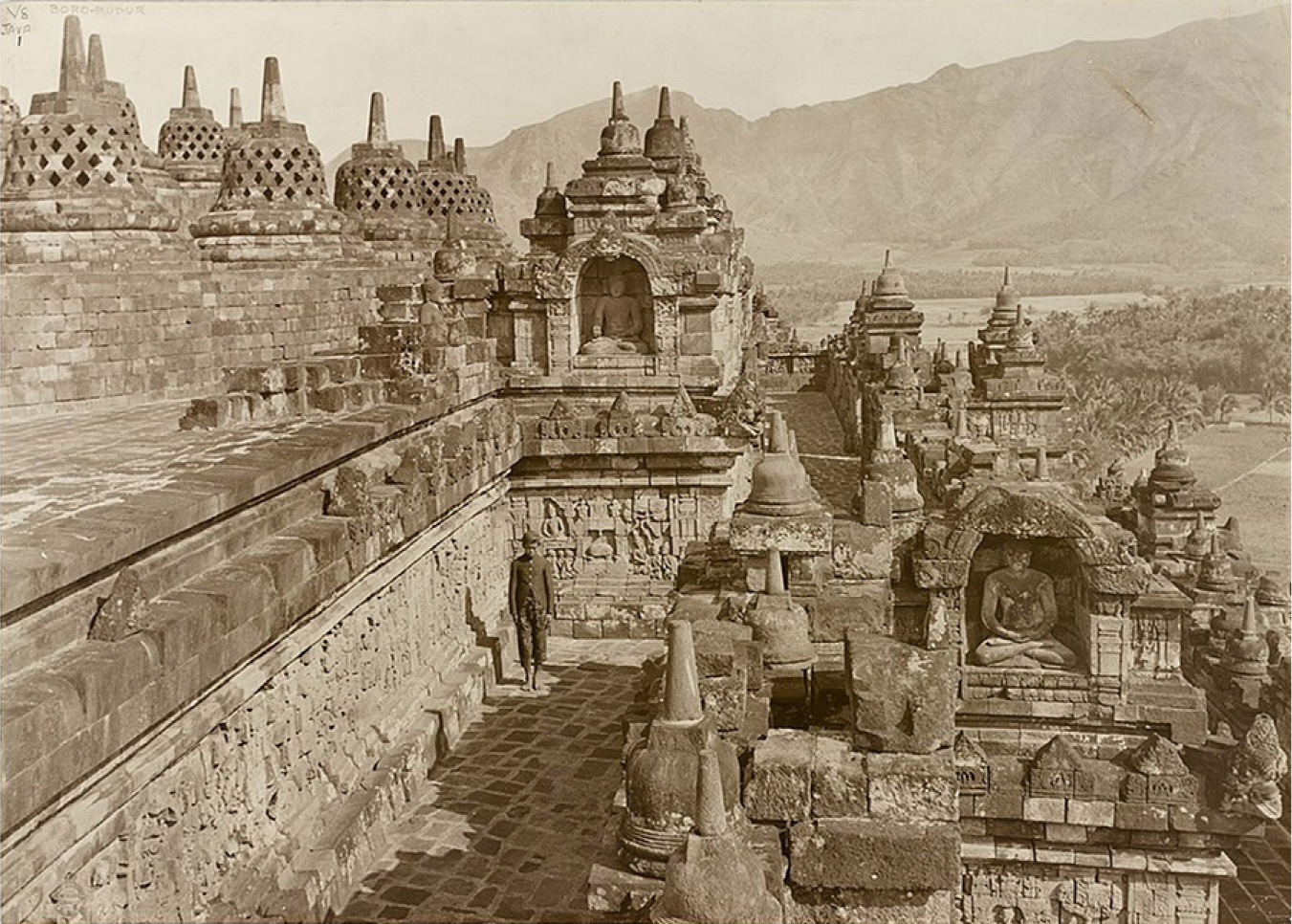
(credit: modification of work “A terrace on the temple of Borobudur, Java, Indonesia, 1913” by State Library of New South Wales, PXD 162/150/Wikimedia Commons, Public Domain) · Public Domain
Figure 5.18 This 1913 photograph of the temple of Borobudur shows one side of the massive Buddhist structure with the local mountains in the background. In the upper left, one can see several of the seventy-two perforated stupas surrounding the central dome. Behind and to the left of the man posing for the photograph are just some of the over 2,600 decorated relief panels that adorn the site. (credit: modification of work “A terrace on the temple of Borobudur, Java, Indonesia, 1913” by State Library of New South Wales, PXD 162/150/Wikimedia Commons, Public Domain)
図5.18 1913年に撮影されたこのボロブドゥール寺院の写真は、巨大な仏教建築の一面と、背景の近隣の山々を示す。左上には、中央のドームを囲む72基の透かし孔のあるストゥーパのうち、いくつかが見える。撮影のために立つ男性の後ろと左には、この遺跡を飾る2600枚を超える装飾浮彫パネルの、ごく一部が見える。(出典: 原作品を加工:“A terrace on the temple of Borobudur, Java, Indonesia, 1913”/State Library of New South Wales, PXD 162/150/Wikimedia Commons, パブリックドメイン)
While much of Southeast Asia faced west toward India as the center of trade, culture, and religion, the area near today’s Vietnam fell within the orbit of China’s cultural sphere emanating from the east. The natural geography of Vietnam creates three distinct zones that shaped the evolution of the country from ancient times to the present: one area in the north surrounding the Red River delta; below that, in the south, another densely populated center on the Mekong River delta; and lastly, a long narrow land bridge along the coast squeezing between mountains to join the other two areas together. Humans practicing wet-field rice agriculture developed settlements in the northern zone sometime around 2500 BCE, and a millennium after, there is evidence of bronze-making by the region’s inhabitants. But the most notable contribution to world history from this area in northern Vietnam came from the Dong Son culture (c. 600 BCE–200 CE), defined by its remarkable bronze drums decorated with cords and images of animals such as frogs. Dong Son drums have been found at sites all over Southeast Asia.
英語のヒント
東南アジアの多くが交易・文化・宗教の中心として西のインドを向く一方、現在のベトナムに近い地域は、東から広がる中国文化圏の影響下に入った。ベトナムの自然地理は三つの明確な区域を生み、古代から現在に至る国の発展を形づくった。一つは北の紅河デルタを囲む地域、もう一つはその南のメコン川デルタの人口密集地であり、最後は山地に挟まれた沿岸の細長い陸の通路で、二つの地域をつないでいる。北部では前2500年ごろ、水田稲作を行う人びとが集落を発達させた。その1000年後には、この地域の住民による青銅器製作の証拠がある。しかしベトナム北部のこの地域が世界史に与えた最も著名な貢献は、ドンソン文化(前600年ごろ~後200年)から生まれた。縄目や蛙などの動物の図像で飾られた、見事な青銅の太鼓を特徴とする。ドンソンの銅鼓は東南アジア各地の遺跡で発見されている。
Whether the Dong Son culture and its drums originated in Vietnam or inside China near Yunnan province is the subject of debate. Evidence suggests that southeast China below the Yangtze River was once home to peoples who were more strongly linked, culturally and linguistically, to Southeast Asia than to the dynasties in the north such as the Shang and Zhou. During the Zhou dynasty, many non-Chinese societies and kingdoms inhabiting provinces such as Fujian and Yunnan were known as the Yue, the Mandarin version of “Viet.” These areas and groups remained independent of Chinese control for centuries. Chinese records of the Yue demonstrate their sophistication and diversity. They were known for practicing wet-field rice cultivation, adorning their bodies with tattoos, and traveling widely by boat along the seas and the Red River that linked China to Vietnam.
英語のヒント
ドンソン文化とその銅鼓が、ベトナムで生まれたのか、中国内の雲南省付近で生まれたのかには議論がある。証拠によれば、長江以南の中国南東部には、かつて商・周など北方の王朝よりも、文化・言語の面で東南アジアに強く結びつく人びとが暮らしていた。周代には、福建や雲南などの地域に住む多くの非中国系の社会や王国が、ベトの中国語の読みである「越」と呼ばれていた。これらの地域と集団は何世紀も中国の支配から独立していた。越についての中国の記録は、その文化的な発達と多様性を示す。水田稲作を行い、体を入れ墨で飾り、海や、中国とベトナムを結ぶ紅河を舟で広く移動する人びととして知られていた。
These Chinese records further indicate that many early Vietnamese groups spoke a multitude of languages and were divided into as many as one hundred small polities, kingdoms, tribal clans, and autonomous villages. Unlike in northern China, there appears to have been no successful drive to centralize power under a unified dynasty in Vietnam’s prehistory. In later centuries, many Vietnamese accepted the mythological lore of a mighty king known as Van-Lang, who in the seventh century BCE united the various tribes of the Yue and established a dynastic line of Hung kings. This origin tale eventually evolved to include a divine origin for the Vietnamese people, telling of a union between a dragon lord and a female mountain deity that produced the Hung royalty.
英語のヒント
これらの中国の記録はさらに、初期のベトナムの多くの集団が多様な言語を話し、100もの小政体・王国・部族氏族・自治的な村に分かれていたことを示している。中国北部とは異なり、先史時代のベトナムでは、一つの王朝の下に権力を集中させる動きは成功しなかったように見える。後の世紀、多くのベトナム人は、前7世紀に越の諸部族を統一し、雄王の王統を開いた、ヴァンランという強大な王の神話的伝承を受け入れた。この起源の物語はやがて、ベトナム人の神聖な由来を語るものになり、竜の王と山の女神との結びつきから雄王家が生まれたとされた。
At best, Vietnam’s prehistoric record can only validate the idea that chiefdoms grew increasingly large around 258 BCE. By then, the rulers of a new kingdom known as Au Lac had constructed an impressive capital arranged in the shape of a widening spiral near today’s Hanoi. Later, around 179 BCE, Au Lac was conquered by another kingdom, Nam Viet, an offshoot of China’s Qin dynasty. The area was later retaken by the Han dynasty, which attempted to establish permanent control by dividing its territory spanning southern China and northern Vietnam into nine administrative units. In 40 CE, Han control of the Red River delta ran afoul of two rebellious daughters of a Vietnamese general known as Trung Trac and Trung Nhi. The uprising launched by these women rallied native resistance from southern China to central Vietnam (Figure 5.19). Briefly victorious, the Trung sisters’ rebellion was eventually squashed. Their legacy was indelible, however, and stories of their exploits riding elephants into battle became a source of Vietnamese nationalist pride and rejection of encroachment by outsiders such as the Chinese and, much later, the French.
英語のヒント
ベトナムの先史記録から確認できるのは、せいぜい前258年ごろに首長国が拡大したということまでである。そのころまでに、アウラックという新しい王国の統治者は、現在のハノイ近くに、外へ広がる渦巻きの形で配置された見事な都を築いていた。後の前179年ごろ、アウラックは、中国の秦王朝から派生した別の王国、ナムベト(南越)に征服された。この地域は後に漢王朝によって再征服された。漢は恒久的な支配を確立しようと、中国南部とベトナム北部にまたがる領域を九つの行政単位に分けた。40年、紅河デルタに対する漢の支配は、ベトナムの将軍の娘である徴側と徴弐の反乱に直面した。姉妹の蜂起は、中国南部からベトナム中部までの土着の抵抗勢力を集めた(図5.19)。一時は勝利したものの、徴姉妹の反乱は結局鎮圧された。しかしその遺産は消えなかった。象に乗って戦う武勇の物語は、ベトナムの民族的誇りと、中国人や、はるか後のフランス人など、外部からの侵入を拒む精神の源になった。
Trung Trac and Trung Nhi.チュン・チャクとチュン・ニー。
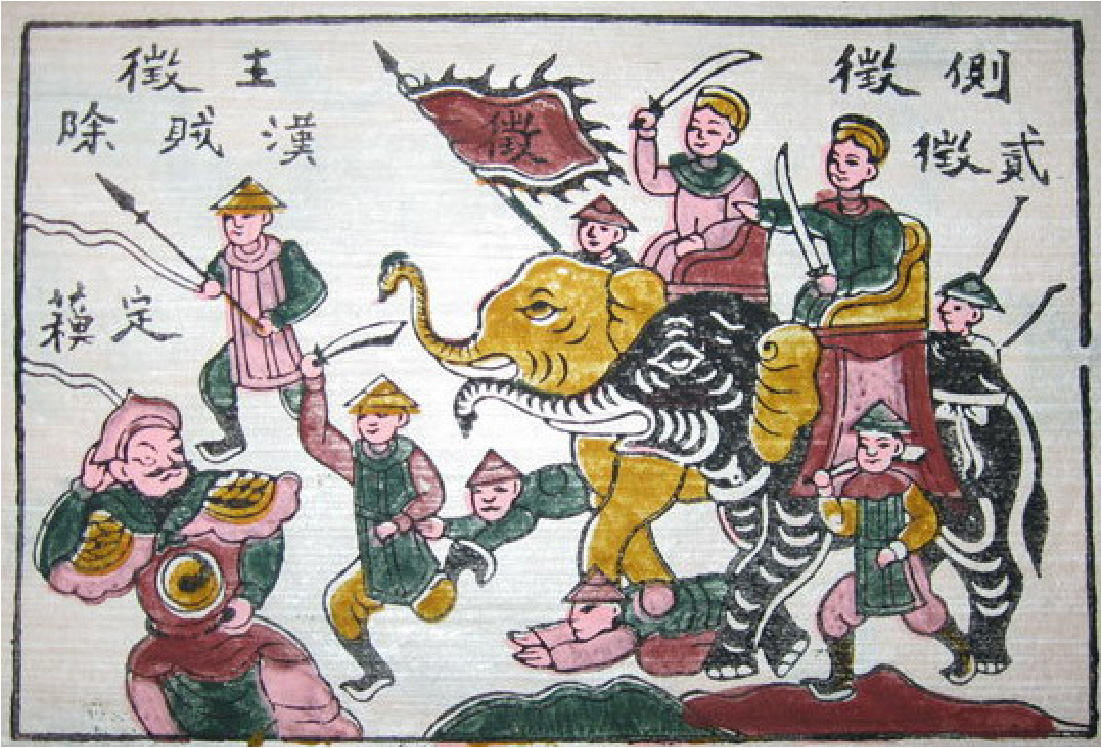
(credit: “Hai ba trung Dong Ho painting” by “LuckyBirdie”/Wikimedia Commons, Public Domain) · Public Domain
Figure 5.19 The sisters Trung Trac and Trung Nhi launched a short-lived rebellion against Chinese domination that has lived on popular memory as a potent symbol of Vietnamese national identity. Images such as this folk painting of them riding elephants into battle have long been a source of inspiration for resistance to foreign empires and, more recently, helped promote a role for women in politics and the military. (credit: “Hai ba trung Dong Ho painting” by “LuckyBirdie”/Wikimedia Commons, Public Domain)
図5.19 チュン・チャクとチュン・ニーの姉妹は、中国の支配に対する短命な反乱を起こした。それは、ベトナム人としての自覚の強い象徴として、人びとの記憶に生き続けている。象に乗って戦いへ向かう姉妹を描いたこの民衆絵画のような像は、長い間、外国の帝国への抵抗を鼓舞してきた。近年では、政治や軍事で女性が役割を果たすことを促す助けにもなっている。(出典: “Hai ba trung Dong Ho painting”/“LuckyBirdie”/Wikimedia Commons, パブリックドメイン)