第5章大西洋世界の形成Foundations of the Atlantic World
5.4 The Atlantic Slave Trade5.4 大西洋奴隷貿易
Learning Objectives学習の目標
By the end of this section, you will be able to:
この節を学ぶと、次のことができるようになる。
Explain the workings of the triangular trade
三角貿易の仕組みを説明する。
Compare slavery in Africa and slavery in the Americas
アフリカの奴隷制とアメリカ大陸の奴隷制を比較する。
Discuss the way market forces influenced the development of labor-intensive agriculture in the Americas
市場の力が、アメリカ大陸における労働集約的農業の発展に与えた影響を論じる。
Describe the human toll of slavery
奴隷制が人々にもたらした犠牲を説明する。
To extract the greatest possible wealth from their American colonies, the nations of Europe planted them with cash crops Europeans craved but could not produce at home. To maximize profit, they drove workers hard without regard for their health or safety. When Indigenous peoples and European servants could not satisfy their demands, they turned to enslaved labor taken from Africa. The latter decision affected the lives of millions of people for centuries to come.
英語のヒント
アメリカ植民地から最大限の富を引き出すため、ヨーロッパ諸国は、ヨーロッパ人が渇望しながら本国では生産できない換金作物を、植民地に植えた。利益を最大化するため、健康や安全を顧みずに労働者を酷使した。先住民やヨーロッパ人奉公人では要求を満たせなくなると、アフリカから連れてきた奴隷労働へ頼った。この最後の決定は、その後何世紀にもわたり、何百万人もの人生に影響した。
Slavery and the Triangular Trade奴隷制と三角貿易
One of the largest migrations in history took place between the late fifteenth and early nineteenth centuries, as Europeans forcefully transported approximately twelve million Africans across the Atlantic Ocean to the Americas to provide labor for Europe’s economic enterprises. Some two million people died on the voyages across the Atlantic. The survivors made possible the extraction of wealth from European colonies on which the system of mercantilism was based.
英語のヒント
15世紀末から19世紀初めにかけて、史上最大級の人口移動が起きた。ヨーロッパ人が、自らの経済事業の労働力とするため、約1200万人のアフリカ人を、大西洋を越えてアメリカ大陸へ強制的に運んだのである。約200万人が横断航海中に死亡した。生存者は、重商主義の制度の基盤となった、ヨーロッパ植民地からの富の収奪を可能にした。
The majority of Africans brought across the Atlantic were destined to labor on sugar plantations in the Caribbean and Brazil. Many enslaved Africans were also sent to the Spanish colonies in South America; relatively few went to the North American mainland, mostly Mexico. European colonists had originally considered using enslaved Indigenous peoples to perform the difficult and dangerous labor of harvesting sugar cane and other cash crops, but these efforts failed. Indigenous people died in large numbers from infectious diseases, leaving too few to labor in the fields. On the island of Hispaniola, for example, where both the Spanish and the French established sugar plantations, the native Taíno population was at least several hundred thousand strong when Columbus arrived in 1492. By 1514, however, only about thirty-two thousand Taíno remained. Some had been deliberately killed by the Spanish, and others had died from hard labor and poor living conditions after being enslaved. The vast majority, though, had died of disease.
英語のヒント
大西洋を越えて連れてこられたアフリカ人の大多数は、カリブ海とブラジルの砂糖プランテーションで働かされることになっていた。南アメリカのスペイン植民地へも多数送られたが、北アメリカ本土へ渡った人々は比較的少なく、その大半はメキシコへ行った。ヨーロッパの入植者は当初、サトウキビや他の換金作物を収穫する困難で危険な労働に、奴隷化した先住民を使おうと考えた。しかし、その試みは失敗した。感染症で先住民が大量に死亡し、畑で働く人数が足りなくなったからである。例えばスペイン人とフランス人の双方が砂糖プランテーションを設けたイスパニョーラ島では、1492年のコロンブス到来時、タイノの人口は少なくとも数十万人いた。しかし1514年までに、約3万2000人しか残っていなかった。一部はスペイン人に意図的に殺され、他の人々は奴隷化された後、重労働や劣悪な生活条件で死んだ。しかし圧倒的多数は、病気で命を落とした。
For Europeans, the ideal laborers would be people as unfamiliar with the terrain as they were, because unlike enslaved Indigenous people who knew the best places to hide, they could more easily be recaptured if they ran away. In addition, they would be less affected by many of the infectious diseases from which Europeans suffered. Although Europeans did not understand what caused immunity, they knew those who had previously contracted certain diseases like smallpox and survived would not contract that disease again. They also knew, from long contact with Africans, that they did not die from European diseases in the same numbers that Indigenous Americans did. In the European view, Africans satisfied both their key requirements.
英語のヒント
ヨーロッパ人にとって理想の労働者は、自分たちと同じように土地勘のない人々だった。隠れるのに最適な場所を知る先住民の奴隷と違い、逃げても再び捕らえやすかったからである。また、ヨーロッパ人がかかる多くの感染症の影響も、比較的小さいことが望まれた。ヨーロッパ人は免疫が生じる原因を理解していなかったが、天然痘など特定の病気にかかって生き延びた人は、再びその病気にかからないことを知っていた。長年のアフリカ人との接触から、アフリカ人がヨーロッパの病気で死ぬ人数は、アメリカ先住民ほど多くないことも知っていた。ヨーロッパ人の見方では、アフリカ人はこの二つの主要な条件を満たしていた。
European indentured servants would also have fit the bill, but the hot Caribbean climate and diseases like malaria and yellow fever, brought from Africa with cargoes of enslaved people, led to high death rates among Europeans within the first year and discouraged most others from immigrating there. Indentured servitude did not satisfy the labor needs of tobacco planters in Virginia and Maryland either, where the death rate among Europeans was also high. Although some indentured servants were convicts sentenced to be transported to the colonies, the vast majority left Europe voluntarily, but they were not enough. In addition, a French law passed in 1664 that restricted planters’ right to beat their indentured servants made servants a less desirable form of labor in the eyes of French colonists. Thus, Europeans eager to extract a profit looked to Africa as the solution, and to slavery instead of indentured servitude. They believed Africans were physically better suited to hard labor than Europeans were, and Africans could also be enslaved for a lifetime, ensuring a constant supply of field hands.
英語のヒント
ヨーロッパ人の年季奉公人も条件には合ったはずだった。しかし、カリブ海の暑い気候と、奴隷化された人々を積む船によってアフリカから持ち込まれたマラリアや黄熱病のため、ヨーロッパ人は到着後1年以内の死亡率が高く、他の人々の大半も移住をためらった。ヨーロッパ人の死亡率が同じく高かったヴァージニアとメリーランドでも、年季奉公はタバコ農園主の労働力需要を満たさなかった。一部の奉公人は植民地への流刑を宣告された囚人だったが、大多数は自発的にヨーロッパを離れた人々であり、それでも人数は足りなかった。加えて、1664年にフランスで成立した法律が、農園主による奉公人への殴打権を制限したため、フランス人入植者には、奉公人は以前ほど望ましい労働力でなくなった。こうして利益の収奪に熱心なヨーロッパ人は、解決策をアフリカに求め、年季奉公ではなく奴隷制へ向かった。彼らは、アフリカ人の身体がヨーロッパ人より重労働に適していると信じた。またアフリカ人は一生奴隷化でき、畑の働き手を絶えず確保できた。
The Portuguese, already using enslaved Africans to grow sugar on islands off the coast of Africa, were the first to bring them in large numbers to the Americas. The initial Portuguese voyage to do so transported two hundred Africans to the Spanish colony of Santo Domingo, on the island of Hispaniola, in 1525. Most were forced to grow sugar for Portuguese colonists in Brazil or were sold to the Spanish for this purpose. Captured Africans were also sold to the Spanish to work in mines in Mexico and Peru or to be employed as domestic servants. Soon the British, French, Spanish, Dutch, and Danes were also exporting captives from Africa to produce sugar, rice, indigo, tobacco, and, by the eighteenth century, coffee in the Americas.
英語のヒント
すでにアフリカ沖の島々で、奴隷化されたアフリカ人に砂糖を生産させていたポルトガル人が、初めて大量のアフリカ人をアメリカ大陸へ連れてきた。最初の航海は1525年で、200人をイスパニョーラ島のスペイン植民地サント・ドミンゴへ運んだ。大多数は、ブラジルのポルトガル人入植者のためにサトウキビを栽培させられるか、その目的でスペイン人に売られた。捕らえられたアフリカ人は、メキシコやペルーの鉱山労働、または家内使用人にするためにも、スペイン人へ売られた。まもなく、イギリス、フランス、スペイン、オランダ、デンマークの人々も、アメリカ大陸で砂糖、米、藍、タバコ、そして18世紀までにはコーヒーを生産するため、アフリカから捕虜を輸出するようになった。
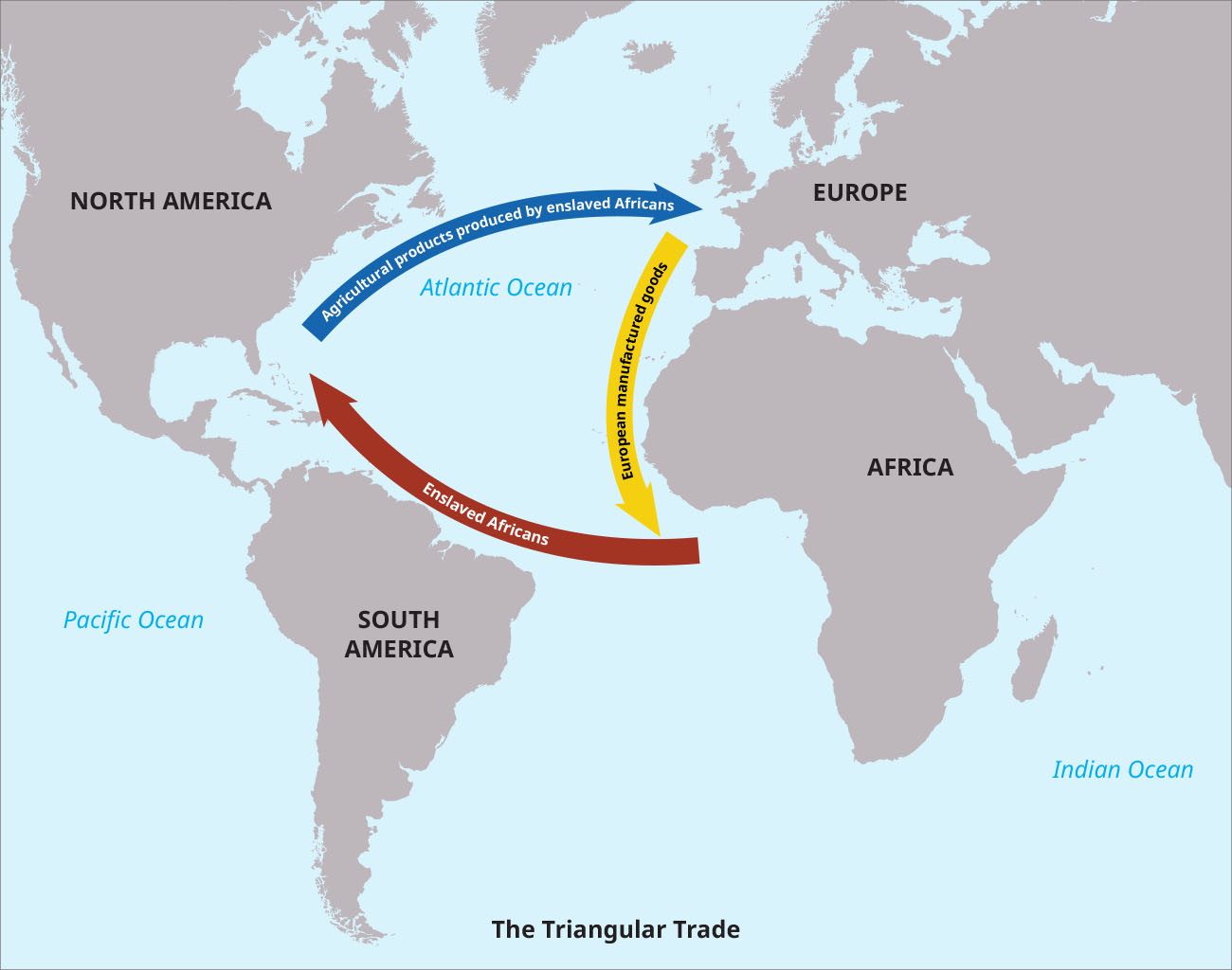
Although the economic system that relied on the labor of enslaved Africans to grow sugar and other crops for European colonists in the Americas was a complex one, for purposes of simplification, it is often characterized as the triangular trade because it linked three regions (the Americas, Europe, and West Africa) in a network of exchange (Figure 5.20). The shipment of enslaved Africans across the Atlantic was one leg of the triangular trade. In the first leg, Europeans exchanged manufactured goods with African traders for enslaved Africans. The enslaved people were then shipped across the Atlantic to European colonies in the Americas. This journey was called the Middle Passage because it was the middle (or second) leg of the three-legged exchange. The money earned from the sale of enslaved Africans in the colonies was used to purchase the products grown by existing enslaved laborers. In the third leg of the triangle, those goods were shipped to Europe or to a European country’s other American colonies, where they were transformed into finished products.
英語のヒント
アメリカ大陸のヨーロッパ人入植者のために、奴隷化されたアフリカ人の労働で砂糖などの作物を育てる経済制度は、複雑なものだった。しかし説明を単純にするため、しばしば三角貿易と呼ばれる。アメリカ大陸、ヨーロッパ、西アフリカという三地域を、交換のネットワークで結んだからである(図5.20)。アフリカ人を奴隷として大西洋の向こうへ輸送することは、三角貿易の一つの区間だった。最初の区間で、ヨーロッパ人はアフリカの商人に工業製品を渡し、奴隷化されたアフリカ人と交換した。次に人々は大西洋を越えて、アメリカ大陸のヨーロッパ植民地へ運ばれた。三つの区間の中央、すなわち第二の区間であるため、この旅はミドル・パッセージと呼ばれた。植民地でアフリカ人を売って得た金で、すでに奴隷化されて働く人々の生産物を買った。三角形の第三の区間では、その商品がヨーロッパ、または同じ国がアメリカ大陸に持つ別の植民地へ送られ、完成品に加工された。
The Triangular Trade.三角貿易。
(attribution: Copyright Rice University, OpenStax, under CC BY 4.0 license) · CC BY 4.0
Figure 5.20 As its name suggests, the triangular trade consisted of three legs. Enslaved Africans were sent along the so-called Middle Passage (the red arrow) and sold in Europe’s American colonies, while the agricultural products they produced were shipped to Europe. European manufactured goods were exchanged in Africa for more enslaved people. (attribution: Copyright Rice University, OpenStax, under CC BY 4.0 license)
図5.20 その名が示すとおり、三角貿易は三つの区間から構成された。奴隷化されたアフリカ人は、いわゆるミドル・パッセージ(赤い矢印)を通って送られ、ヨーロッパ諸国のアメリカ植民地で売られた。彼らが生産した農産物はヨーロッパへ輸送され、ヨーロッパの工業製品は、さらに多くの奴隷化された人々とアフリカで交換された。(出典表示:著作権ライス大学、OpenStax、CC BY 4.0ライセンス)
For example, English slave traders exchanged rum for captives in African ports. The captives then traveled across the Atlantic in chains to England’s Caribbean colonies, where they were sold to the owners of plantations who set them to work growing sugar cane. The plantation owners then shipped molasses, a by-product of sugar production, to other English settlers in the colony of Massachusetts, who transformed it into rum and shipped that to England. English ship captains in Africa then exchanged rum along with manufactured products like cloth, guns, and ammunition for captives. African slave traders used the guns to capture more people to send along the Middle Passage, and the cycle continued. Enslaved people were the base on which the triangle rested. Without the sugar, tobacco, coffee, indigo, and rice produced through their labor, the trade would have collapsed.
英語のヒント
例えばイングランドの奴隷商人は、アフリカの港でラム酒と捕虜を交換した。捕虜は鎖につながれて大西洋を渡り、イングランドのカリブ海植民地へ行き、プランテーション所有者に売られ、サトウキビ栽培に就かされた。農園主は次に、砂糖生産の副産物である糖蜜を、マサチューセッツ植民地の他のイングランド人入植者へ送った。彼らは糖蜜をラム酒に加工してイングランドへ送り、アフリカのイングランド船長は、そのラム酒に布、銃、弾薬などの工業製品を加えて捕虜と交換した。アフリカの奴隷商人は銃を使ってさらに人々を捕らえ、ミドル・パッセージへ送り出した。この循環は続いた。奴隷化された人々こそが、この三角形を支える基盤だった。彼らの労働による砂糖、タバコ、コーヒー、藍、米がなければ、この貿易は崩壊したはずである。
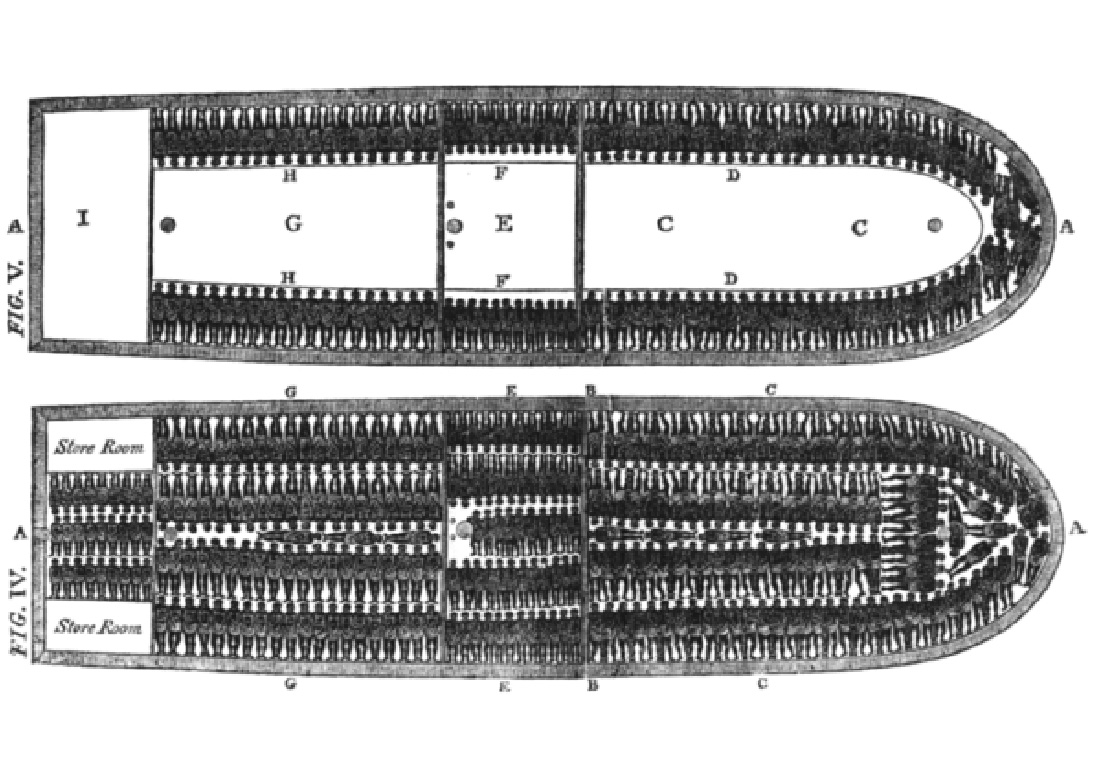
The human toll of the transatlantic slave trade was immense. Conditions on the Middle Passage were brutal, and some ships held as many as five to six hundred people. Some captains, knowing that 10 to 20 percent would die on the voyage, packed as many people as possible into the hold, hoping enough would survive to earn them a good profit. In the hold, men were separated from women and children and were chained side by side on their backs, sometimes with only a few inches of space above them (Figure 5.21). In 1713, the Royal Africa Company, a British company, instructed captains that enslaved people should be allotted a space five feet long, eleven inches wide, and twenty inches high. The implication was that captains usually packed people into even smaller spaces.
英語のヒント
大西洋奴隷貿易が人々にもたらした犠牲は甚大だった。ミドル・パッセージの状況は残酷で、500〜600人も収容する船があった。航海中に10〜20%が死ぬと知りながら、十分な人数が生き残って大きな利益をもたらすことを期待し、可能なかぎり人を船倉へ詰め込む船長もいた。船倉では、男性は女性や子どもと分けられ、仰向けで並べて鎖につながれた。体の上の空間がわずか数インチしかないこともあった(図5.21)。1713年、イギリスの王立アフリカ会社は、奴隷化された人々に、長さ5フィート、幅11インチ、高さ20インチの空間を割り当てるよう船長に指示した。これは、普段はそれより狭い空間に詰め込んでいたことを示唆する。
Plan of a Slave Ship.奴隷船の配置図。
(credit: modification of work “Slave ship diagram” by Lilly Library of Rare Books and Manuscripts, Indiana University/Wikimedia Commons, Public Domain) · Public Domain
Figure 5.21 This eighteenth-century diagram of a slave ship reveals how tightly packed the hold was with human beings. Captains stowed people in every possible space. (credit: modification of work “Slave ship diagram” by Lilly Library of Rare Books and Manuscripts, Indiana University/Wikimedia Commons, Public Domain)
図5.21 この18世紀の奴隷船の図は、船倉に人間がどれほど密に詰め込まれたかを示す。船長は、使えるあらゆる空間へ人々を積み込んだ。(クレジット:インディアナ大学リリー稀覯書・写本図書館/Wikimedia Commons「奴隷船の図」を改変、パブリックドメイン)
During the voyage, sailors gave the enslaved people food and water usually once a day. There were no facilities for bathing, and men and women alike relieved themselves in buckets or tubs that often overturned in rough seas. Ventilation was poor, the stench was horrible, and the heat excruciating. At times crews would bring the enslaved Africans onto the deck for fresh air and make them jump and dance to exercise their muscles, since buyers would not pay high prices for those who looked weak. Removing captives from the hold was always a risk for the crew, however, since this was the time when a revolt was most likely to take place. Slave ship captains harshly punished any attempt at rebellion. Taking enslaved people to the deck was also risky because many used the opportunity to commit suicide rather than endure the misery on board ship or the uncertain fate that awaited them. Some captains strung nets below the ships’ rails to catch those who jumped overboard.
英語のヒント
航海中、船員は奴隷化された人々に、通常1日1回、食料と水を与えた。入浴設備はなく、男女とも桶で排泄したが、荒海では桶がしばしばひっくり返った。換気は悪く、悪臭はひどく、暑さは耐えがたかった。ときには乗組員が、アフリカ人を新鮮な空気のある甲板へ連れ出し、筋肉を動かすために跳ねたり踊ったりさせた。弱く見える人に買い手は高値を払わなかったからである。しかし捕虜を船倉から出すことは、常に乗組員にとって危険だった。反乱が最も起こりやすい時だったからである。船長は、いかなる反抗の試みも厳しく処罰した。甲板へ連れ出すことには、別の危険もあった。多くの人が、船内の苦しみや待ち受ける不確かな運命に耐えるよりも、その機会に自殺を図ったのである。船外に飛び込む人を捕らえるため、船の手すりの下に網を張る船長もいた。
Illness was the slave ship captains’ constant fear. In the close quarters of the ship, infectious disease could sweep like wildfire, and every person who died reduced the captain’s profit. The most feared of all diseases was trachoma, an infection of the eyes that did not kill but left its victims blind. Enslaved people who could not see would not be purchased. Even more frightening was the possibility that the infection would spread to the crew. If the sailors lost their sight, everyone on board faced a slow death from starvation as the ship sat adrift in the water, unable to reach any port.
英語のヒント
病気は奴隷船の船長が絶えず恐れるものだった。船の密集した空間では、感染症が野火のように広がりうる。一人死ぬごとに、船長の利益は減った。最も恐れられた病気はトラコーマという目の感染症で、死には至らないが失明させるものだった。目の見えない奴隷は買い手が付かなかった。さらに恐ろしかったのは、感染が乗組員に広がる可能性だった。船員が失明すれば、船は港へ着けずに漂流し、乗船者全員が飢餓による緩慢な死に直面した。
Slave voyages were often heavily insured against loss. The captain of the Zong took full advantage of this. When bad weather slowed his ship’s voyage across the Atlantic in 1781, members of the crew and the enslaved cargo began to die of illness. Realizing that the ship owner’s insurance policy would pay for captives lost at sea but not for those who died of sickness, the captain ordered 132 enslaved people thrown overboard to drown.
英語のヒント
奴隷航海には、損失に備えて高額の保険が掛けられることが多かった。ゾング号の船長はこれを最大限に利用した。1781年、悪天候で大西洋横断が遅れると、乗組員と、積荷とされた奴隷化された人々が、病気で死に始めた。船主の保険は、海で失われた捕虜には支払われるが、病死者には支払われないと気づいた船長は、132人を船外へ投げ込んで溺死させるよう命じた。