第5章大西洋世界の形成Foundations of the Atlantic World
The Treaty of Tordesillasトルデシリャス条約
Word of Columbus’s discoveries on behalf of the Spanish alarmed and angered the Portuguese. Under the terms of the 1479 Treaty of Alcáçovas, Portugal had renounced any claim to the Spanish throne and granted Spain control of the Canary Islands. In exchange, Portugal received the coast of Guinea in Africa, which was rich in gold, and all islands in the Atlantic south of the Canaries. This included not only those territories Portugal already controlled (Madeira, the Azores, and Cape Verde) but also any that might be discovered in the future. In 1481, the pope also issued a decree that granted Portugal territories in the Atlantic.
英語のヒント
スペインのためにコロンブスが発見を行ったという報告は、ポルトガル人を警戒させ、怒らせた。1479年のアルカソヴァス条約の条件に従い、ポルトガルはスペイン王位へのあらゆる要求を放棄し、カナリア諸島の支配をスペインに認めていた。その代わり、ポルトガルは金の豊富なアフリカのギニア海岸と、カナリア諸島以南の大西洋の全島嶼を得た。これには、すでに支配していたマデイラ、アゾレス、カーボヴェルデだけでなく、将来発見されるかもしれない島々も含まれた。1481年には教皇も、大西洋の領土をポルトガルに与える勅書を発した。
Spain’s claim to the Caribbean islands Columbus had explored thus seemed to violate both the treaty and the pope’s decree. The Portuguese king announced his intention to send an armed fleet to take control of them. Unable to challenge Portugal’s dominance at sea, Isabella and Ferdinand asked Pope Alexander VI to intercede. The pope, who was Spanish, decreed that all lands belonged to Spain that fell west of a line drawn one hundred leagues west of any of the Azores and Cape Verde Islands.
英語のヒント
したがって、コロンブスが探検したカリブ海の島々へのスペインの領有主張は、条約にも教皇の勅書にも違反するように見えた。ポルトガル王は、島々を支配するため武装艦隊を送る意思を表明した。海上でのポルトガルの優位に対抗できなかったイサベルとフェルナンドは、教皇アレクサンデル6世に仲裁を求めた。スペイン出身の教皇は、アゾレス諸島またはカーボヴェルデ諸島のいずれかから西へ100リーグの位置に引いた線より西にあるすべての土地は、スペインに属すると布告した。
Portugal accordingly began negotiations with Spain, which consented to move the line dividing Spanish from Portuguese possessions farther to the west. The new line cut across the eastern bulge of the South American continent (now part of Brazil) but left the rest of the Americas to Spain. This agreement, the Treaty of Tordesillas, was signed in 1494 and endorsed in 1506 by a decree of Pope Julius II (Figure 5.13). Thus, when the explorer Pedro Álvares Cabral landed on the eastern coast of South America in 1500, he was able to claim it for Portugal.
英語のヒント
そこでポルトガルはスペインと交渉を始めた。スペインは両国の領有地を分ける線を、さらに西へ動かすことに同意した。新しい線は、南アメリカ大陸の東へ突き出した部分、現在のブラジルの一部を横切り、アメリカ大陸の残りはスペイン側となった。この合意がトルデシリャス条約であり、1494年に調印され、1506年に教皇ユリウス2世の勅書によって承認された(図5.13)。こうして、1500年に探検家ペドロ・アルヴァレス・カブラルが南アメリカ東岸に上陸したとき、彼はそこをポルトガルの領土と主張することができた。
Treaty of Tordesillas.トルデシリャス条約。
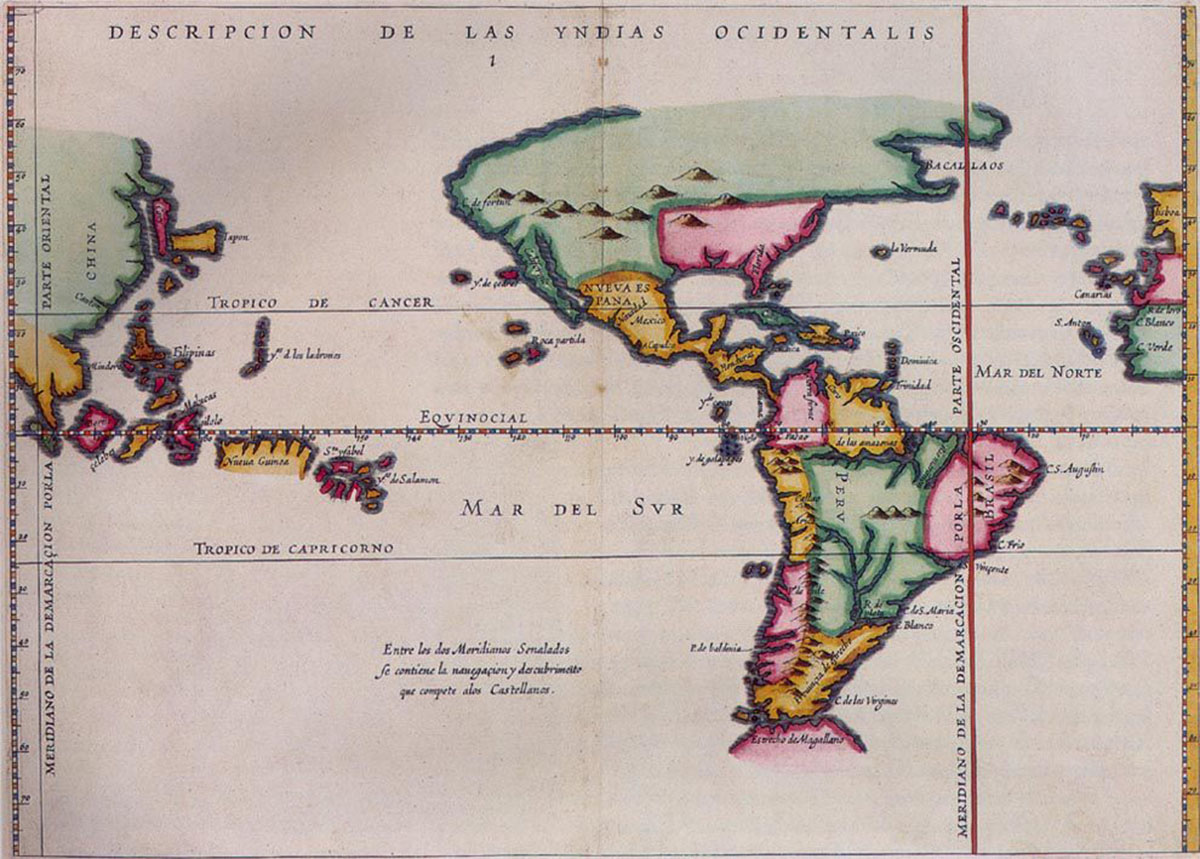
(credit: “Map of Meridian Line set under the Treaty of Tordesillas” by Library of Congress/Wikimedia Commons, Public Domain) · Public Domain
Figure 5.13 This Spanish map from 1622 shows in red the vertical dividing line described in the Treaty of Tordesillas. It cuts north to south through the Atlantic Ocean and across the eastern portion of Brazil. All land to the right of the line was deemed to belong to Portugal, and all land to the left to Spain. (credit: “Map of Meridian Line set under the Treaty of Tordesillas” by Library of Congress/Wikimedia Commons, Public Domain)
図5.13 1622年のこのスペインの地図では、トルデシリャス条約の分割線が、赤い縦線で示されている。線は大西洋とブラジル東部を南北に横切る。線の右のすべての土地はポルトガル、左のすべての土地はスペインに属するとされた。(クレジット:米国議会図書館/Wikimedia Commons「トルデシリャス条約で設定された子午線の地図」、パブリックドメイン)
By the time Cabral made landfall in Brazil in 1500, Portuguese sailors had already rounded the Cape of Good Hope at the tip of southern Africa and sailed up that continent’s eastern coast and on to India. Hoping to lay claim to the riches of Asia, Spain then argued that the line dividing the Atlantic continued to the other side of the globe, bisecting the Pacific and giving the Spanish the right to territories in Asia as well. Portugal objected and turned to the Vatican again for help. In 1514, Pope Leo X declared that the line described in the Treaty of Tordesillas allocated territories in the Atlantic but not the Pacific. Spain had no claim to the lands of Asia.
英語のヒント
カブラルが1500年にブラジルへ上陸したころには、ポルトガルの船乗りはすでにアフリカ南端の喜望峰を回り、大陸東岸を北上し、さらにインドへ達していた。アジアの富への権利を主張したかったスペインは、大西洋を分ける線は地球の反対側にも続き、太平洋を二分して、スペインにアジアの領土への権利も与えると論じた。ポルトガルは異議を唱え、再びヴァティカンに助けを求めた。1514年、教皇レオ10世は、トルデシリャス条約の線が割り当てるのは大西洋の領土であり、太平洋ではないと宣言した。スペインにはアジアの土地に対する権利はないとされた。
Spain renewed its argument in 1522 when an expeditionary fleet that had been captained by Ferdinand Magellan returned to Europe after circumnavigating the globe. Magellan had been in the employ of Spain when he found a means of reaching Asia by sailing around the southern tip of South America. The expedition had reached the Maluku Islands (or the Moluccas, in modern Indonesia), the source of valuable spices, and Spain wished to claim this territory, which Portugal had already explored in 1512. To settle their claims to the islands, in 1529 Portugal and Spain signed the Treaty of Zaragoza, dividing the Pacific Ocean between them. The treaty awarded the Maluku Islands to Portugal with the understanding that should Spain wish to claim them it could, but it would have to compensate Portugal for its loss. Spain did not have the money to do so, and this fact, along with a convenient marriage of the Spanish and Portuguese kings to one another’s sisters, led Spain to abandon its claim to the Malukus.
英語のヒント
1522年、フェルディナンド・マゼランが船長を務めていた探検艦隊が世界一周を終え、ヨーロッパへ戻ると、スペインは再び主張を持ち出した。マゼランは、スペインに雇われている間に、南アメリカ南端を回ってアジアへ達する方法を見つけていた。遠征隊は貴重な香辛料の産地、現在のインドネシアのマルク諸島、別名モルッカ諸島に到達した。スペインは、ポルトガルがすでに1512年に探検していたこの地域の領有を望んだ。島々への権利要求を解決するため、1529年、両国は太平洋を分割するサラゴサ条約に調印した。条約はマルク諸島をポルトガルに与えた。ただし、スペインが領有を望めば可能であるが、ポルトガルの損失を補償しなければならないという了解があった。スペインにはその金がなかった。この事実に加え、両国王が互いの姉妹と結婚するという好都合な縁組もあり、スペインはマルク諸島への要求を断念した。
In the treaties of Zaragoza and Tordesillas, two of the world’s nations divided the globe between them, never questioning their right to do so and turning repeatedly to the pope to give God’s sanction to their claims. Unsurprisingly, however, the world’s other nations ignored both treaties. England and the Netherlands, which had become Protestant nations during the Reformation, felt no need to abide by papal decrees, nor did France, though it remained Roman Catholic. As the French king Francis I explained, “The sun shines for me as it does for others.” As the fortunes of Spain and Portugal declined in the seventeenth century, England, France, and the Netherlands claimed territory in Asia and the Americas and established their own trading posts on the African coast. Spain and Portugal also failed to acknowledge the rights of the Indigenous peoples in the lands they claimed. Indeed, many Europeans believed that by conquering the inhabitants of the Americas and giving them no choice but to convert to Christianity, they were saving their souls.
英語のヒント
サラゴサ条約とトルデシリャス条約で、世界の二つの国が地球を二分した。そうする権利を疑うことなく、主張に神の承認を与えてもらおうと、繰り返し教皇に頼った。しかし当然ながら、他の国々は両条約を無視した。宗教改革でプロテスタント国家となったイングランドとオランダは、教皇の勅書に従う必要を感じなかった。ローマ・カトリックにとどまったフランスも同じだった。フランス王フランソワ1世は、「太陽は他の者と同じように、私のためにも輝く」と述べた。17世紀にスペインとポルトガルの国運が衰えると、イングランド、フランス、オランダはアジアとアメリカ大陸で領土を主張し、アフリカ沿岸に独自の交易拠点を設けた。また、スペインとポルトガルは、領有を主張する土地の先住民の権利を認めなかった。実際、多くのヨーロッパ人は、アメリカ大陸の住民を征服し、キリスト教に改宗する以外の選択肢を与えないことで、その魂を救っていると信じた。
The Columbian Exchangeコロンブス交換
The impact of Portuguese and Spanish exploration and settlement went far beyond the political and economic implications. The so-called Columbian Exchange began with the first contact between native peoples and Christopher Columbus in the Caribbean in 1492. This phrase refers to the back-and-forth flow of plants, animals, and diseases between the Eastern and Western Hemispheres. Far more than physical products were traded, however. Ideas, religious practices, enslaved peoples, and cultural traditions also crossed the Atlantic to reshape, blend, and sometimes destroy various civilizations in the process.
英語のヒント
ポルトガルとスペインの探検・入植の影響は、政治的・経済的な帰結をはるかに越えた。いわゆるコロンブス交換は、1492年、カリブ海で先住民とクリストファー・コロンブスが最初に接触したときに始まった。この語は、東半球と西半球の間を双方向に移動した、植物、動物、病気を指す。しかし交換されたのは、物理的な産物だけではなかった。思想、宗教的実践、奴隷化された人々、文化的伝統も大西洋を渡り、その過程でさまざまな文明を作り変え、混ぜ合わせ、ときには破壊した。
The world into which Columbus stepped in 1492 was just as complex, diverse, and dangerous as the one he left behind. In the Americas, empires rose and fell, people married and raised families, individuals sought to better their lives by moving and innovating. But key differences shaped the collisions to come. One of the most fundamental was the perception of human nature and human origins. For Europeans, the world, its history, and its progression were linear. Just as the Christian Bible described, in the beginning there was darkness. Then God created light along with the world, and one day that world would come to an end. This belief influenced Europeans’ perception that time progressed in a straight line along which humans were always moving forward. All things had a beginning, a point or climax, and an ending.
英語のヒント
コロンブスが1492年に足を踏み入れた世界は、彼が離れてきた世界と同じほど複雑で、多様で、危険だった。アメリカ大陸でも、帝国は興亡し、人々は結婚して家族を育み、個人は移住や革新によって生活を改善しようとしていた。しかし、重要な相違が、これから起きる衝突の形を決めた。最も根本的な違いの一つは、人間の本性と起源の捉え方だった。ヨーロッパ人にとって、世界、その歴史と進行は直線的だった。キリスト教の聖書が記すように、初めには闇があった。そして神が世界とともに光を創造し、いつかその世界は終わりを迎える。この信仰は、時間が直線状に進み、人間はその線上を常に前へ進むというヨーロッパ人の認識に影響した。すべてのものには、始まり、到達点または頂点、そして終わりがあった。
But for many Indigenous peoples, the world was cyclical and infinite. The Aztecs, for example, believed that the world in which they lived was but the latest in a series of worlds that had been created and destroyed. Their world would continue to exist only so long as they fed the sun with the blood of sacrificial victims. In Indigenous concepts of the cosmos, no hard separations existed between humans and nature, or between spiritual and human realms. Many religious belief systems were animistic, meaning the spiritual world resided not just in humans but also in animals, plants, and even rocks. This belief was very different from monotheism, in which all spiritual power resided in one single divine being. Indigenous religions did not focus on sin or on the nature of good and evil. Instead, the spiritual world was a place full of power that humans could harness for either good or evil. Though their specific beliefs varied widely, all Indigenous groups in the Western Hemisphere held these basic views about their existence and their relationship to others and to the world.
英語のヒント
しかし多くの先住民にとって、世界は循環し、限りなく続くものだった。例えばアステカ人は、自分たちの世界を、それまでに創造され破壊されてきた一連の世界の、単に最新のものと考えた。この世界が存続できるのは、犠牲者の血で太陽を養い続ける間だけだった。先住民の宇宙観では、人間と自然、あるいは霊的な領域と人間の領域の間に、厳密な境界はなかった。多くの宗教的信仰体系はアニミズム的であり、霊的なものは人間だけでなく、動物、植物、さらには岩にも宿ると考えた。この信仰は、すべての霊的な力が唯一の神的存在に宿る一神教とは大きく異なっていた。先住民の宗教は、罪や善悪の本質に重点を置かなかった。むしろ霊的世界は力に満ちた場所で、人間はその力を善にも悪にも用いることができた。具体的な信仰は大きく異なっていたが、西半球のすべての先住民集団は、自らの存在や他者・世界との関係について、こうした基本的な見方を共有していた。
Like humans, animals, and plants, the earth possessed sacred power; therefore, it could not be owned. The concept of owning land seemed nonsensical to many Indigenous groups, and their corresponding lack of emphasis on private property was one reason Europeans sometimes found it easy to lay claim to lands inhabited by native peoples.
英語のヒント
人間、動物、植物と同じく、大地も神聖な力を持っていた。したがって、所有の対象にはできなかった。多くの先住民集団にとって土地所有という発想は意味をなさず、それに対応して私有財産を重視しなかったことが、ヨーロッパ人が先住民の住む土地の領有を、ときに容易に主張できた理由の一つだった。
Indigenous Americans also differed from Europeans of the 1400s in their approach to gender. While Indigenous women did complete some of the same tasks as European women, such as cooking, making clothing, and raising children, they also took part in activities that Europeans believed should be done by men and that in Europe usually were. For example, in many Indigenous societies, women were the principal farmers and built the family’s dwelling. In many groups, women were revered as imbued with sacred powers to heal and to create. This power also gave them a strong voice in the leadership of their communities, and in some of these, women sat on tribal councils. Among the Iroquois of North America, for example, women often attended tribal councils to advise male clan representatives, and women chose the tribe’s male leaders. Among the Wampanoag of southern New England, women could serve as tribal leaders.
英語のヒント
アメリカ先住民は、ジェンダーへの考え方でも1400年代のヨーロッパ人とは異なっていた。先住民の女性は、料理、衣服作り、子育てなど、ヨーロッパの女性と同じ仕事の一部を確かに行っていたが、ヨーロッパ人が男性の仕事と考え、実際にヨーロッパでは通常男性が行った活動にも参加した。例えば、多くの先住民社会では、女性が農耕の中心となり、家族の住居を建てた。多くの集団で女性は、癒し、創造する神聖な力を授けられた存在として崇敬された。この力は、共同体の指導において強い発言権も与え、一部の共同体では女性が部族の評議会に加わった。例えば北アメリカのイロコイでは、女性がしばしば部族評議会に出席し、男性の氏族代表に助言し、部族の男性指導者を選んだ。ニューイングランド南部のワンパノアグでは、女性が部族指導者を務めることもできた。
In many tribes, individuals who did not accept the roles traditionally assigned to people of their sex had far more freedom to live as they desired than did such people in Europe. Women who wished to live as men and men who wished to live and dress as women did not necessarily face punishment or maltreatment as long as they contributed to society in other ways. For example, in some societies, women became hunters and warriors. In many societies, men who felt they had been born with the souls of women dressed as women, pursued women’s occupations, and became the second or third wives of other men. Such men were often regarded as possessing great spiritual power and were treated with respect.
英語のヒント
多くの部族では、自分の性に伝統的に割り当てられる役割を受け入れない人にも、ヨーロッパの同じような人々より、望むように生きる自由がはるかに多くあった。男性として生きたい女性や、女性として生き、女性の服装をしたい男性は、他の方法で社会に貢献しているかぎり、必ずしも処罰や虐待を受けなかった。例えば一部の社会では、女性が狩猟者や戦士になった。多くの社会では、女性の魂を持って生まれたと感じる男性が、女性の服装をし、女性の職業に従事し、他の男性の第二、第三の妻となった。そうした男性は大きな霊的な力を持つとみなされることが多く、敬意をもって扱われた。
When Columbus arrived, the Indigenous population of the entire Western Hemisphere likely numbered around seventy-five million (compared to Europe’s population of probably around seventy million), although historians’ estimates vary greatly. Indigenous peoples made up more than six hundred groups or tribes in North America alone. Some, such as the Inuit and the Dene, were mostly hunter-gatherers in cold climates inhospitable to farming. Others farther south, such as the Puebloans and the Creek, farmed extensively, growing maize as the staple of their food economies. These groups often adopted political organizations practical for their environment. Hunter-gatherers such as the Apache lived as small bands of unified family units with a designated leader. Among township societies such as the Iroquois, groups of towns joined to form political confederacies. In the Aztec and Inca empires, large urban populations were ruled by monarchs.
英語のヒント
コロンブス到来時、西半球全体の先住民人口は、おそらく約7500万人だった。ヨーロッパの人口はおそらく約7000万人である。ただし歴史家による推定は大きく異なる。北アメリカだけでも、先住民は600を超える集団や部族を構成していた。イヌイットやディネなどの一部は、農耕に適さない寒冷な気候の下で、おもに狩猟採集を行った。もっと南のプエブロやクリークなどは広く農耕を行い、食料経済の主食としてトウモロコシを栽培した。これらの集団は、しばしば環境に適した政治組織を採用した。アパッチのような狩猟採集民は、指名された指導者を持ち、複数の家族単位が結びつく小集団として暮らした。イロコイのような町を基盤とする社会では、町の集団が結びついて政治的連合を形成した。アステカ帝国とインカ帝国では、大きな都市人口が君主によって統治された。
As part of the Columbian Exchange, Europeans introduced to the Americas the crops they were familiar with at home, including wheat; the Vitis vinifera species of grape; fruits such as pears, peaches, and many varieties of apples; and vegetables such as onions and garlic. The first two were especially important for the Spanish and Portuguese. Wheat was needed to make the communion wafers that were a necessary part of the Roman Catholic mass, and European grapes were needed to make wine for the same ceremony. For the most part, Native Americans had little interest in adopting European foods, but the arrival of nonedible resources created an immediate impact. Metal cookware and metal weaponry gave great power to those who chose to adopt them.
英語のヒント
コロンブス交換の一環として、ヨーロッパ人は故郷でなじんだ作物をアメリカ大陸へ導入した。小麦、ヨーロッパブドウであるVitis vinifera種、ナシ・モモ・多様なリンゴなどの果物、タマネギやニンニクなどの野菜である。最初の二つは、スペイン人とポルトガル人にとって特に重要だった。小麦はローマ・カトリックのミサに不可欠な聖餐用の薄いパンを作るために、ヨーロッパのブドウは同じ儀式のワインを作るために必要だった。アメリカ先住民は、概してヨーロッパの食物を採用することにあまり関心を示さなかったが、食物以外の資源の到来は即座に影響した。金属製の調理器具や武器は、それを採用した人々に大きな力を与えた。
European, Asian, and African societies also changed as new plant life was brought eastward across the Atlantic. Indigenous peoples in North America had relied on maize (corn) for thousands of years, and varieties of potatoes, including sweet potatoes, had long been staples among Indigenous peoples in South America. Along with these foods, tomatoes, chili peppers, vanilla, manioc, pineapples, and peanuts were introduced to and became culinary staples of nations in Europe, Africa, and Asia. Chocolate, which had been consumed in liquid form by the Aztec and the Maya, and tobacco, another product from the Americas, became especially popular in Europe (Figure 5.14).
英語のヒント
新しい植物が大西洋を東へ運ばれると、ヨーロッパ、アジア、アフリカの社会も変化した。北アメリカの先住民は何千年もトウモロコシを頼りにしており、南アメリカの先住民の間では、サツマイモを含むさまざまなイモ類が長く主食となっていた。これらとともに、トマト、トウガラシ、バニラ、キャッサバ、パイナップル、落花生がヨーロッパ、アフリカ、アジアの諸国に伝えられ、料理の基礎的な食材となった。アステカ人やマヤ人が飲み物として消費していたチョコレートと、同じくアメリカ大陸の産物であるタバコは、ヨーロッパで特に人気を博した(図5.14)。
Chocolate.チョコレート。
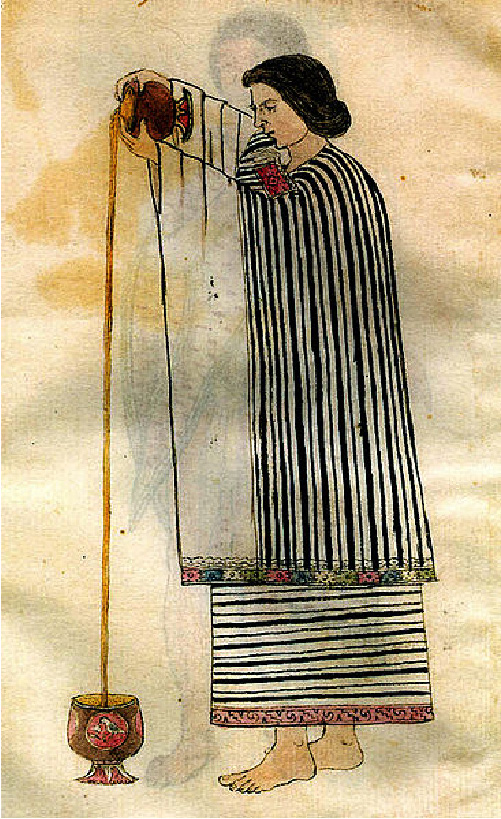
(credit: “Mujer vertiendo chocolate - Codex Tudela” by Museo de América/Wikimedia Commons, Public Domain) · Public Domain
Figure 5.14 Chocolate was one of the most popular crops introduced from the Americas to the rest of the world. In this image from the Tudela Codex, created c. 1553, an Aztec woman pours liquefied chocolate from one container into another to make it frothy. (credit: “Mujer vertiendo chocolate - Codex Tudela” by Museo de América/Wikimedia Commons, Public Domain)
図5.14 チョコレートは、アメリカ大陸から世界の他地域へ伝えられた、最も人気のある作物の一つだった。1553年ごろ制作の『トゥデラ絵文書』のこの図では、アステカの女性が泡立てるために、液状のチョコレートを一つの容器から別の容器へ注いでいる。(クレジット:アメリカ博物館/Wikimedia Commons「チョコレートを注ぐ女性――トゥデラ絵文書」、パブリックドメイン)
Coffee and sugar cane, introduced to the Americas by Europeans, grew exceedingly well in the tropical climates of the Caribbean, Central America, South America, and the southernmost portions of North America. The widespread adoption of these foods in the rest of the world began a chain reaction of increased demand for them and for agricultural labor. This need for labor eventually led to the plantation-style slavery that took hold in parts of the United States, islands in the Caribbean, and areas of South America such as Brazil.
英語のヒント
ヨーロッパ人がアメリカ大陸に持ち込んだコーヒーとサトウキビは、カリブ海、中央アメリカ、南アメリカ、北アメリカ最南部の熱帯気候で非常によく育った。これらの食物が世界の他の地域で広く受け入れられると、商品への需要と農業労働への需要が増す連鎖反応が始まった。この労働力の必要は、やがてアメリカ合衆国の一部、カリブ海の島々、ブラジルなど南アメリカの地域に定着した、プランテーション型の奴隷制につながった。
Plant life was not the only item exchanged across the Atlantic; a variety of animals accompanied Europeans as they journeyed across the ocean and back. Horses, cows, goats, sheep, pigs, and chickens all made the Atlantic crossing to the Americas. These animals transformed the life of many Indigenous communities. In North America, tribes such as the Lakota moved onto the Great Plains and created a way of life based on hunting bison following their adoption of the horse. The Navajo became sheep herders and expert weavers of woolen textiles. Tribes in Mexico and Central and South America began to raise chickens and goats, which provided valuable sources of protein.
英語のヒント
大西洋を越えて交換されたのは植物だけではない。さまざまな動物も、海を往復するヨーロッパ人に伴った。馬、牛、ヤギ、羊、豚、鶏はすべて大西洋を渡ってアメリカ大陸へ来た。これらの動物は、多くの先住民共同体の生活を変えた。北アメリカでは、ラコタなどの部族が馬を採用した後、グレートプレーンズへ移り、バイソン猟を基盤とする暮らしを作った。ナヴァホは羊飼いとなり、羊毛織物の熟練した織り手となった。メキシコ、中央・南アメリカの部族は、貴重なタンパク源になる鶏やヤギを飼い始めた。