第5章大西洋世界の形成Foundations of the Atlantic World
5.1 The Protestant Reformation5.1 プロテスタントの宗教改革
Learning Objectives学習の目標
By the end of this section, you will be able to:
この節を学ぶと、次のことができるようになる。
Explain the causes of the Protestant Reformation
プロテスタントの宗教改革の原因を説明する。
Describe differences between Protestant and Catholic beliefs
プロテスタントとカトリックの信仰の違いを説明する。
Discuss the spread of Protestantism in Europe and the wars of religion
ヨーロッパにおけるプロテスタントの広がりと宗教戦争を論じる。
Describe the Catholic response to the Protestant Reformation
プロテスタントの宗教改革に対するカトリックの対応を説明する。
When Columbus set sail across the Atlantic in 1492, the people of western and central Europe, regardless of their country or language, were united by a common religion. In the same year as Columbus’s momentous voyage, Spain defeated the last Muslim stronghold on the Iberian Peninsula and expelled Jewish people from the land. Muslims were given a brief respite, but in 1501 they too were ordered to leave or to convert to Catholicism. With the exception of small Jewish communities in the Low Countries (Belgium and the Netherlands) and the German lands, at the beginning of the sixteenth century, the people of western and central Europe were uniformly Roman Catholics. Challenges to the authority of the Catholic Church were brewing, however, and the passage of less than a century found Europeans hopelessly divided over matters of faith as the result of an event known as the Protestant Reformation.
英語のヒント
1492年にコロンブスが大西洋へ船出したとき、西・中央ヨーロッパの人々は、国や言語にかかわらず、共通の宗教で結ばれていた。その重大な航海と同じ年、スペインはイベリア半島最後のムスリムの拠点を破り、ユダヤ人を国外に追放した。ムスリムには短い猶予が与えられたが、1501年には、彼らも退去するかカトリックに改宗するかを命じられた。低地諸国、すなわちベルギーとオランダ、およびドイツ諸地域の小さなユダヤ人共同体を除けば、16世紀初めの西・中央ヨーロッパの人々は一様にローマ・カトリックだった。しかし、カトリック教会の権威への挑戦が生まれつつあった。プロテスタントの宗教改革と呼ばれる出来事の結果、1世紀もたたないうちに、ヨーロッパ人は信仰の問題をめぐって修復困難なほど分裂した。
The Origins of the Protestant Reformationプロテスタントの宗教改革の起源
The Protestant Reformation began in 1517, but its seeds had been sown years earlier. Over the course of the Middle Ages, the Catholic Church had grown richer, and its higher clerical offices had become dominated by people motivated more by the desire for wealth and power than by spiritual concerns. Although Europe’s peasants remained devoutly attached to their faith, critics claimed that popes acted less like Christ’s representatives on earth and more like secular princes, intervening in European political affairs and even commanding armies. Members of the clergy often lived lavishly in palatial surroundings and dressed themselves in silks and furs. Some had mistresses and illegitimate children, who were often given positions in the church. Wealthy families often purchased church offices for their members, and some men held bishoprics (areas under the authority of a bishop) in more than one place at a time by hiring other men to perform their offices. Secular rulers, kings, and princes jealous of the church’s power sometimes vied with the pope for control of the churches in their territory and welcomed opportunities to reject the church’s authority.
英語のヒント
プロテスタントの宗教改革は1517年に始まったが、その種は何年も前にまかれていた。中世を通じてカトリック教会は富を増し、上級の聖職は、精神的な関心よりも富と権力への欲望に動かされる人々によって占められるようになっていた。ヨーロッパの農民は信仰に敬虔に従い続けたが、批判者は、教皇が地上のキリストの代理人というより世俗の君主のように振る舞い、ヨーロッパの政治問題に介入し、軍隊さえ指揮していると主張した。聖職者はしばしば宮殿のような環境で豪奢に暮らし、絹や毛皮を身に着けた。愛人や非嫡出子を持つ者もおり、その子どもは教会内の地位を与えられることが多かった。裕福な家族は身内のために聖職を購入することが多かった。また、他人を雇って職務を代行させ、同時に複数の司教区、すなわち司教の権限下にある区域を保有する者もいた。教会の力を妬む世俗の支配者、国王、諸侯は、ときに領内の教会の支配をめぐって教皇と競い、教会の権威を拒否する機会を歓迎した。
During the fifteenth century, in the city-states of northern Italy, an intellectual movement called humanism had taken hold. Humanism stressed the value and dignity of human beings, and its scholars believed that, through the study of the philosophy, history, and literature of ancient Greece and Rome, people could improve themselves and live a “good life,” which, in turn, would improve the societies in which they lived. Italian humanists were often devout Christians, and their study of ancient authors did not lead them to reject the teachings of the Catholic Church.
英語のヒント
15世紀、イタリア北部の都市国家では、人文主義という知的運動が根づいていた。人文主義は人間の価値と尊厳を強調した。その学者たちは、古代ギリシアとローマの哲学、歴史、文学を学ぶことで、人は自らを向上させ、「よい人生」を送ることができ、それがさらに、自分たちの暮らす社会を改善すると信じた。イタリアの人文主義者は敬虔なキリスト教徒であることが多く、古代の著者を研究しても、カトリック教会の教えを否定することにはならなかった。
In the second half of the fifteenth century, northern European scholars championed a form of humanism whose explicit goal was to make people better Christians. Northern Renaissance humanism, also called Christian humanism, stressed the study of the works of Greece and Rome together with the teachings of the early Christian fathers to improve the state of the human soul. The goal of learning was to awaken an inner sense of piety, and northern Renaissance humanists such as Desiderius Erasmus encouraged people to use Christian teachings as a guide to daily life. This inner transformation, they believed, was superior to engaging in such outer forms of religious devotion as going on pilgrimage or fasting at prescribed times of the year. By becoming better Christians, people would ultimately reform the church.
英語のヒント
15世紀後半、北ヨーロッパの学者たちは、人々をよりよいキリスト教徒にすることを明確な目標とする人文主義を推進した。キリスト教人文主義とも呼ばれる北方ルネサンスの人文主義は、人間の魂の状態を改善するため、ギリシア・ローマの著作と初期キリスト教の教父の教えを併せて学ぶことを重視した。学ぶ目的は、内なる信仰心を目覚めさせることだった。デジデリウス・エラスムスのような北方ルネサンスの人文主義者は、日々の生活の指針としてキリスト教の教えを用いるよう促した。彼らは、この内面的な変化が、巡礼に出たり、年の定められた時期に断食したりするような外面的な信仰実践よりも優れていると考えた。よりよいキリスト教徒になることで、人々は最終的に教会を改革するはずだった。
Discontent among some European Catholics and an interest in spiritual transformation in northern Europe set the stage for a German monk named Martin Luther to try to eliminate the questionable practices of the medieval Roman Catholic Church. Luther’s actions began the Protestant Reformation.
英語のヒント
一部のヨーロッパのカトリック信徒の不満と、北ヨーロッパにおける内面的な変化への関心が、マルティン・ルターというドイツ人修道士の試みの土台となった。彼は中世ローマ・カトリック教会の疑わしい慣行を取り除こうとした。その行動がプロテスタントの宗教改革を始めた。
In 1517, Luther, then a professor at the University of Wittenberg in Germany, became outraged when the Dominican friar Johann Tetzel began to sell indulgences in Wittenberg, authorized by Albert, archbishop of the city of Mainz. Indulgences were a way to reduce or even cancel the time after death during which people needed to suffer in purgatory to atone for their sins before reaching heaven. These rewards could be earned by performing actions of great religious merit, such as going on Crusade. However, the church also taught that the pope controlled a store of merit amassed by Jesus and the Christian saints, whose virtue was so great they had entered heaven with grace left over. The church could allot this “extra” virtue to someone else in the form of an indulgence.
英語のヒント
1517年、当時ドイツのヴィッテンベルク大学の教授だったルターは、ドミニコ会修道士ヨハン・テッツェルが、マインツの大司教アルブレヒトの許可を得て、ヴィッテンベルクで贖宥状、いわゆる免罪符を売り始めたことに憤激した。贖宥とは、死後、天国に達する前に罪を償うため煉獄で苦しまなければならない期間を、短縮または全免する方法であった。この恩恵は、十字軍に参加するなど、宗教的な功徳の大きい行いによって得られた。しかし教会は、イエスとキリスト教の聖人が蓄積した功徳の宝庫を、教皇が管理しているとも教えた。彼らの徳は非常に大きく、恩寵を余らせて天国に入ったというのである。教会は、この「余分な」徳を、贖宥という形で他の人に割り当てることができた。
Luther had long been obsessed with thoughts of achieving salvation, the goal of all Christians. He was horrified at the idea that sinners might believe they could enter heaven not through repentance or God’s mercy but by paying for an indulgence. He drafted ninety-five arguments explaining why the sale of indulgences was wrong, and according to many historians, he then nailed the Ninety-five Theses to the door of the castle church at Wittenberg. He also distributed printed copies throughout Germany and sent a copy to Archbishop Albert, who passed it along to Rome.
英語のヒント
ルターは長い間、すべてのキリスト教徒の目標である救済をどう達成するかという考えに取りつかれていた。罪人が、悔い改めや神の慈悲によってではなく、贖宥状に金を払うことで天国に入れると考えるかもしれないということに、彼は恐怖を覚えた。贖宥状の販売が誤りである理由を説明する95の論点を起草し、多くの歴史家によると、その後『九十五か条の論題』をヴィッテンベルクの城教会の扉に釘で打ち付けた。また印刷した写しをドイツ各地に配布し、大司教アルブレヒトにも一部を送り、大司教はそれをローマへ転送した。
Although Luther had probably merely wished to reform the practices of the church, such as ending the sale of indulgences, and not to spark a rebellion against the church, his actions were not seen that way. In 1518, he was summoned by church authorities to answer questions regarding the position he expressed in the Ninety-five Theses. At a meeting in the German city of Augsburg, Luther denied that the church had the power to distribute merits amassed by Jesus and the saints. His beliefs were officially condemned by Pope Leo X, and he was ordered to recant, which he refused to do. In 1521, he was excommunicated (excluded from participating in the life of the church).
英語のヒント
ルターはおそらく、贖宥状の販売を終わらせるなど、教会の慣行を改革することだけを望み、教会への反乱を引き起こすつもりではなかった。しかし、その行動はそのようには受け取られなかった。1518年、彼は『九十五か条の論題』で示した立場についての質問に答えるため、教会当局に召喚された。ドイツの都市アウクスブルクでの会合で、ルターは、イエスと聖人が蓄積した功徳を配分する力を教会が持つことを否定した。彼の信条は教皇レオ10世に正式に非難され、撤回を命じられたが、これを拒否した。1521年、彼は破門され、教会の営みへの参加から排除された。
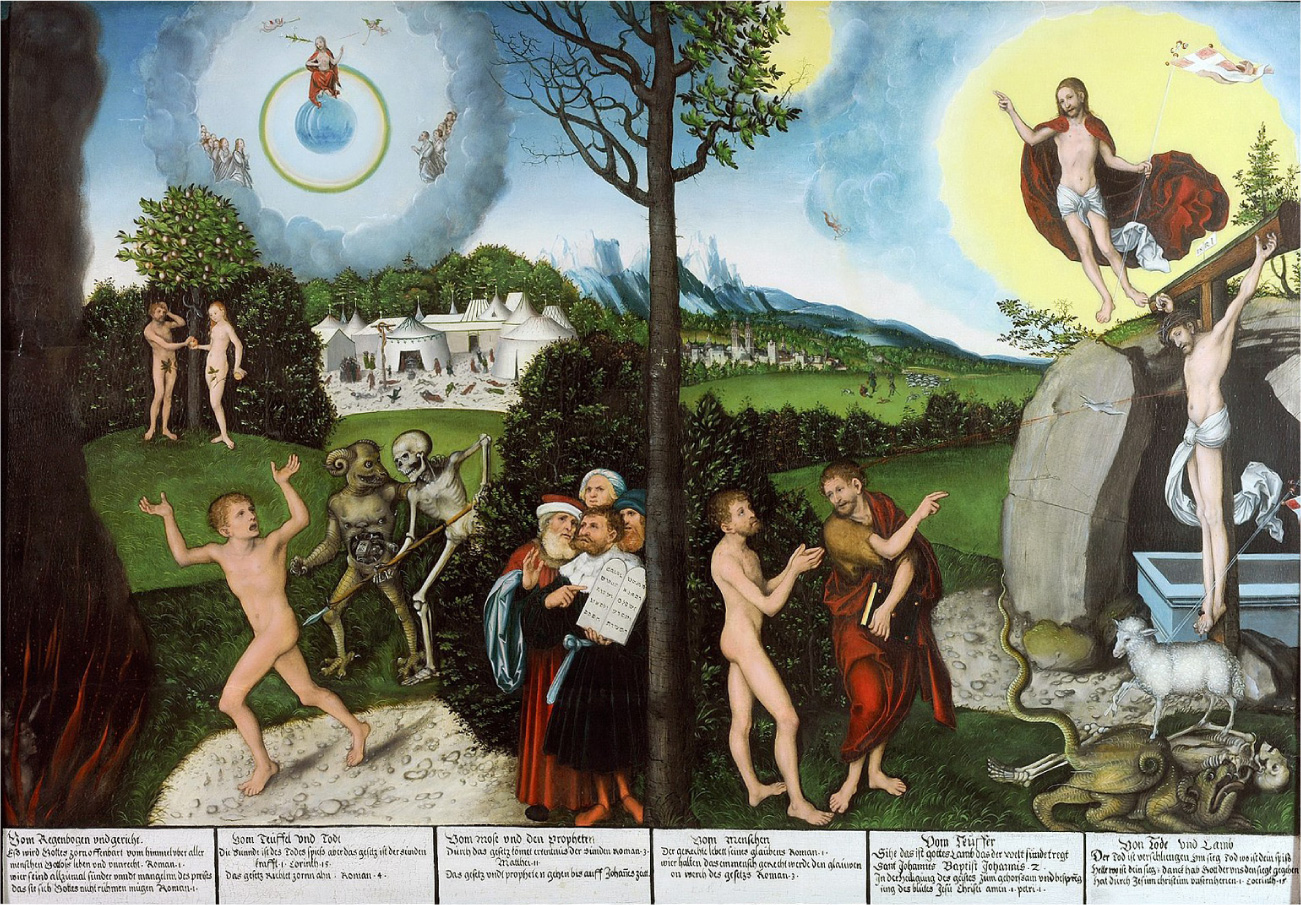
The version of Christianity that developed from Luther’s ideas, and that formed the basis for what became the Protestant faith, differed from the official teachings of the Roman Catholic Church in important ways. The Catholic Church taught that salvation was achieved through a combination of religious faith and good works. Buying an indulgence was regarded as a good work because the money went to the church. Luther taught that faith alone was sufficient for salvation and that humans were unable to work toward their own redemption, which depended entirely upon God (Figure 5.4). Furthermore, adherence to centuries’ worth of Catholic tradition was not necessary to be a good Christian. Luther contended that scripture alone should be the source of Christian belief and practice. His followers thus abandoned many traditional Catholic practices, including clerical celibacy. Luther, a monk, married Katharina von Bora, a former nun, and began a family. Protestants also called for the abolition of religious orders of monks and nuns. A life in the clergy, which the Catholic Church had proclaimed the greatest of all callings, was considered no better than the pursuit of any other vocation in life. The printing press with movable type, developed in Europe during the Renaissance, aided Martin Luther in his efforts to spread his message, and thousands of copies of Luther’s writings circulated throughout Europe.
英語のヒント
ルターの思想から発展し、プロテスタントの信仰の基礎となったキリスト教の形は、重要な点でローマ・カトリック教会の公式な教えと異なっていた。カトリック教会は、救済は信仰と善行の組み合わせによって達成されると教えた。贖宥状を買うことは、その金が教会へ渡るため、善行とみなされた。ルターは、救済には信仰だけで十分であり、救いは全面的に神に依存するため、人間は自らの救いのために働くことはできないと教えた(図5.4)。さらに、よいキリスト教徒であるために、何世紀にもわたるカトリックの伝統に従う必要はないとした。ルターは、聖書のみがキリスト教の信仰と実践の源であるべきだと主張した。そのため信奉者は、聖職者の独身制を含む多くの伝統的なカトリックの慣行を捨てた。修道士だったルターは、元修道女のカタリーナ・フォン・ボラと結婚して家庭を築いた。プロテスタントは、男女の修道会の廃止も求めた。カトリック教会があらゆる召命の中で最も優れたものと宣言していた聖職者の生涯は、他のどんな職業に進むことよりも優れているとはみなされなかった。ルネサンス期のヨーロッパで発達した活版印刷機は、ルターが教えを広めるのを助け、その著作は何千部もヨーロッパ各地を流通した。
Allegory of Law and Grace.律法と恩寵の寓意。
(credit: modification of work “Law and Gospel” by Herzogliches Museum, Gotha/Wikimedia Commons, Public Domain) · Public Domain
Figure 5.4 The 1529 painting Allegory of Law and Grace by the German artist Lucas Cranach the Elder illustrates Martin Luther’s teachings. In the image on the left, the law, the Ten Commandments inscribed on a tablet, cannot save the sinner being chased by the devil into hell. On the right, John the Baptist in a red robe shows the sinner the crucified Jesus, a gift sent by God to save human beings. (credit: modification of work “Law and Gospel” by Herzogliches Museum, Gotha/Wikimedia Commons, Public Domain)
図5.4 ドイツ人画家ルーカス・クラナハ(父)による1529年の『律法と恩寵の寓意』は、マルティン・ルターの教えを表している。左では、石板に刻まれた十戒という律法は、悪魔に地獄へ追い立てられる罪人を救えない。右では、赤い長衣の洗礼者ヨハネが罪人に、磔刑にされたイエスを示す。イエスは人類を救うために神が送った贈り物である。(クレジット:ゴータ公爵博物館/Wikimedia Commons「律法と福音」を改変、パブリックドメイン)