第13章第二次世界大戦の原因と結果The Causes and Consequences of World War II
13.4 Out of the Ashes13.4 廃墟からの再出発
Learning Objectives学習の目標
By the end of this section, you will be able to:
この節を学ぶと、次のことができるようになる。
Describe the final stages of the war in Europe
ヨーロッパでの戦争の最終段階を説明する。
Identify the components of the agreements reached at Yalta and Potsdam
ヤルタ会談とポツダム会談で成立した合意の内容を明らかにする。
Analyze the decision to drop atomic bombs on Japan
日本に原子爆弾を投下するという決断を分析する。
Discuss the efforts to transform Japan after its surrender
降伏後の日本を変革する取り組みを論じる。
Just as it did after World War I, immense hope prevailed after World War II that genuine and lasting peace might arise. The future of the globe itself seemed to hang in the balance if humans could not avoid using violence to solve their problems. However, the use of nuclear weapons to end the fighting in the Pacific meant the postwar world had to grapple with new ethical and technological concerns. The rebuilding of war-torn and defeated countries added a new dimension to what victory looked like.
英語のヒント
第一次世界大戦後と同様、第二次世界大戦後にも、本物の持続的な平和が生まれるかもしれないという大きな希望が広がった。人類が問題を解決するために暴力を使うことを避けられなければ、地球そのものの未来が危うくなるように見えた。しかし、太平洋の戦闘を終わらせるために核兵器が使われたことで、戦後世界は新たな倫理上・技術上の問題に取り組まなければならなくなった。戦争で荒廃し、敗北した国々を再建することも、「勝利」とは何かに、新たな側面を加えた。
Victory in Europe and Plans for Peaceヨーロッパでの勝利と平和への計画
For more than five years after they met in Newfoundland and produced the Atlantic Charter’s plan for the end of the conflict, Roosevelt and Churchill exchanged more than 1,700 letters and messages and held many high-level meetings to closely coordinate their efforts at every level. At a specialized conference held at Bretton Woods, New Hampshire, in 1944, representatives of forty-four Allied countries together hammered out the International Bank for Reconstruction and Development and the International Monetary Fund, both intended to secure economic security and stability after the war.
英語のヒント
ニューファンドランド島で会談し、大西洋憲章で紛争終結への計画をまとめてから5年以上にわたり、ローズヴェルトとチャーチルは1700通を超える書簡・伝言を交わし、多数の首脳級会談を開いて、あらゆる水準で取り組みを緊密に調整した。1944年、ニューハンプシャー州ブレトン・ウッズで開かれた専門会議では、連合国44カ国の代表が協議を重ね、国際復興開発銀行と国際通貨基金を構想した。どちらも戦後の経済的な安全と安定を確保することを目的としていた。
As Allied troops marched toward the German border, however, their coalition began to fray. On a visit to Stalin late in 1944, Churchill signed the Percentages Agreement in which the two decided to divide up eastern Europe into spheres of influence, with Britain getting a 90 percent share of Greece, the USSR getting 90 percent of Romania, and both holding 50 percent of the political power in Hungary and Yugoslavia. Churchill thought Stalin should burn the document afterward because “[Quotation omitted for rights reasons.]”
英語のヒント
しかし連合軍がドイツ国境へ進むにつれ、その連携はほころび始めた。1944年末にスターリンを訪ねたチャーチルは、パーセンテージ協定に署名した。両者は東ヨーロッパを勢力圏に分け、ギリシャではイギリスが90パーセント、ルーマニアではソ連が90パーセントの影響力を持ち、ハンガリーとユーゴスラヴィアでは政治的な力を半分ずつ持つことにした。チャーチルは、その後スターリンがこの文書を焼くべきだと考えた。その理由を次のように述べている。〔権利の関係で割愛〕
Finally, several months after the Soviet victory at Kursk, General Eisenhower prepared to open a second front in the European theater of the war. By May 1944, the German military was facing a dilemma. The Soviet Red Army was relentlessly rolling back German positions in the east, and it seemed obvious that the British and U.S. troops were preparing for an invasion of the continent. Given the brutality of the battles on the eastern front, the Germans chose to retain 228 divisions to counter the Soviets and assigned the defense of Europe to fifty-eight divisions, only fifteen of which were in the vicinity of Normandy, France.
英語のヒント
ついに、ソ連がクルスクで勝利してから数カ月後、アイゼンハワー将軍は、ヨーロッパ戦域に第二戦線を開く準備を整えた。1944年5月までに、ドイツ軍は難しい選択を迫られていた。ソ連赤軍が東部のドイツ軍陣地を容赦なく押し戻す一方、英米軍が大陸への侵攻を準備していることも明らかに見えた。東部戦線の戦闘が苛烈だったため、ドイツはソ連に対抗する228個師団を維持し、ヨーロッパの防衛には58個師団を割り当てた。そのうちフランスのノルマンディー付近にいたのは、わずか15個師団だった。
Normandy, however, was the secret site of the coming invasion. After months of assembling and training troops, the Allies began their invasion of France at 2 a.m. on June 6, 1944—D-Day. Having assumed responsibility for nearly every detail but not convinced he had done enough, Eisenhower wrote a letter of resignation the night before in case things did not go well. But they did. By the second day of the operation, approximately 160,000 Allied troops with considerable armor were linking up in a continuous line through Europe and punching holes in German defenses. Paris was liberated just two months later.
英語のヒント
しかし、間近に迫る侵攻の場所は、ひそかにノルマンディーと決められていた。数カ月かけて兵を集め、訓練した連合軍は、1944年6月6日、Dデーの午前2時にフランス侵攻を開始した。ほぼすべての細部に責任を負いながら、十分な準備をしたという確信が持てなかったアイゼンハワーは、前夜、うまくいかなかった場合に備えて辞表を書いた。だが作戦はうまくいった。2日目までに、相当量の機甲戦力を伴う約16万人の連合軍兵士が合流し、ヨーロッパに連続した戦線を作って、ドイツ軍の防衛線に穴を開けていた。パリは、そのわずか2カ月後に解放された。
A race to capture Berlin then began, with Allied generals vying for the honor of getting there first. As British and U.S. troops approached from the west, the Soviets closed in on the city from the east. While clearing out German forces west of the Rhine River, Eisenhower decided to pause for resupply and prepare for the final push to Berlin.
英語のヒント
続いてベルリン攻略の競争が始まり、連合軍の将軍たちは一番乗りの栄誉を争った。英米軍が西から近づく一方、ソ連軍は東からベルリンへ迫った。ライン川以西のドイツ軍を排除する中、アイゼンハワーは、補給のためにいったん止まり、ベルリンへの最後の進撃に備えることを決めた。
Hitler believed there might still be hope for a German victory if he could divide the Allied armies from each other. Four days later. he committed 200,000 troops, one thousand tanks, and large numbers of aircraft to the Battle of the Bulge in a forested region of the western front. Eisenhower later admitted the Germans had indeed achieved a tactical surprise in this offensive by penetrating Allied defenses by some fifty miles. Despite the German successes, however, he felt that by capitalizing on their fatigue, he could stem the tide of the war. Germany had in fact suffered major losses in what proved to be their final European offensive and another turning point in the war.
英語のヒント
ヒトラーは、連合軍を互いに引き離せれば、ドイツの勝利にはまだ望みがあると考えた。4日後、西部戦線の森林地帯でのバルジの戦いに、20万人の兵士、1000両の戦車、多数の航空機を投入した。アイゼンハワーは後に、ドイツ軍がこの攻勢で連合軍の防衛線を約50マイル突破し、戦術的な奇襲を実際に成功させたことを認めた。しかしドイツ軍の成功にもかかわらず、アイゼンハワーは、相手の疲弊につけ込めば、戦局の流れを食い止められると感じていた。実際にはドイツは、ヨーロッパで最後の攻勢となったこの戦いで大きな損失を被り、これも戦争の転換点となった。
With the conflict nearing its end, the Big Three met again to plan the peace at the Yalta Conference in the Soviet Crimea from February 4 to 11, 1945 (Figure 13.17). Roosevelt’s agenda asked for Soviet support in the U.S. Pacific War against Japan, specifically in invading Japan. He also hoped for support for the creation of a new institution—the United Nations—that would be modeled on the premise of collective security but would be a stronger body than the League of Nations had been. Churchill pressed for free elections and democratic governments in eastern and central Europe (specifically Poland), while Stalin demanded a Soviet sphere of political influence in eastern and central Europe.
英語のヒント
戦争の終わりが近づく中、ビッグ・スリーは再び集まり、1945年2月4〜11日、ソ連領クリミアでのヤルタ会談で平和の計画を話し合った(図13.17)。ローズヴェルトは、米国が太平洋で日本と戦う上で、特に日本への侵攻において、ソ連の支援を求めた。また、集団安全保障の理念に基づき、国際連盟よりも強力な組織となる新たな機関、国際連合の創設への支持も期待した。チャーチルは東・中央ヨーロッパ、とりわけポーランドでの自由選挙と民主的政府を強く求めた一方、スターリンは、東・中央ヨーロッパにソ連の政治的な勢力圏を設けるよう要求した。
The Big Three.ビッグ・スリー
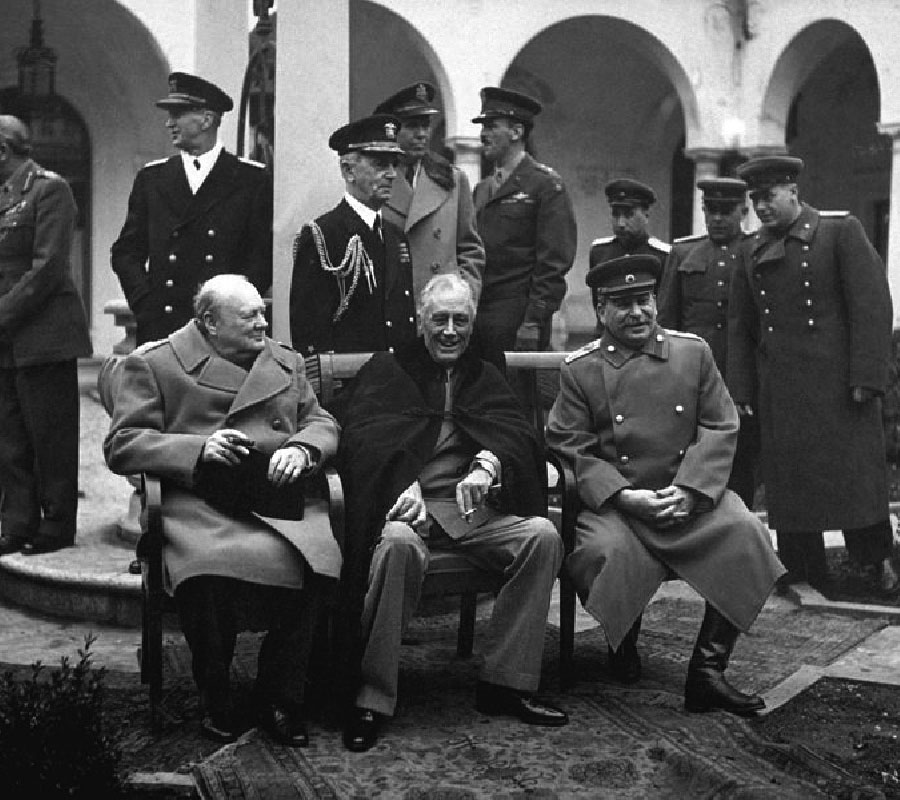
(credit: “‘Big Three’ met at Yalta” by National Archives and Records Administration/Wikimedia Commons, Public Domain) · Public Domain
Figure 13.17 The Allies were represented at the Yalta Conference in 1945 by (left to right) Prime Minister Winston Churchill of Britain, U.S. president Franklin Roosevelt, and the Soviet leader Joseph Stalin. (credit: “‘Big Three’ met at Yalta” by National Archives and Records Administration/Wikimedia Commons, Public Domain)
図13.17 1945年のヤルタ会談で連合国を代表した、左からイギリスのウィンストン・チャーチル首相、米国のフランクリン・ローズヴェルト大統領、ソ連の指導者ヨシフ・スターリン。(クレジット:米国国立公文書記録管理院/Wikimedia Commons「‘Big Three’ met at Yalta」。パブリックドメイン)
Stalin promised free elections in Poland, despite having recently installed a government in Polish territories occupied by the Red Army. His preconditions for the Soviet Union’s declaring war against Japan were U.S. recognition of Mongolian independence from China and of Soviet interests in the Manchurian railways and Port Arthur. These were agreed upon without Chinese representation or consent, and Stalin promised that the Soviet Union would enter the Pacific War three months after the defeat of Germany. Roosevelt met Stalin’s price in the hope that the USSR could be dealt with after the war via the United Nations, which the Soviets had agreed to join.
英語のヒント
スターリンは、赤軍が占領するポーランド領に最近政府を設置していたにもかかわらず、ポーランドでの自由選挙を約束した。ソ連が日本に宣戦する前提条件として、モンゴルの中国からの独立と、満州の鉄道および旅順におけるソ連の権益を米国が認めることを求めた。これらは中国の代表の参加も同意もないまま合意され、スターリンはドイツの敗北から3カ月後に、ソ連が太平洋の戦争へ参戦すると約束した。ローズヴェルトは、戦後はソ連も加盟に同意した国際連合を通じてソ連に対処できると期待し、スターリンの求める代償を受け入れた。
In the Declaration on Liberated Europe, the three leaders agreed that all original governments would be restored in the invaded countries (except France, Romania, and Bulgaria and the Polish government-in-exile in London), and that all displaced civilians would be repatriated. Other key points of the meeting were reaffirmation of the unconditional surrender of Nazi Germany, and of the division of Germany and Berlin into three occupied zones (later expanded to four).
英語のヒント
「解放ヨーロッパ宣言」で、3首脳は、侵略された国々で以前の政府をすべて復活させることに同意した。ただし、フランス、ルーマニア、ブルガリア、そしてロンドンのポーランド亡命政府は除かれた。また、住まいを追われたすべての民間人を本国へ送還することにも合意した。会談のほかの重要事項は、ナチス・ドイツの無条件降伏を再確認すること、ドイツとベルリンを三つ、後に四つとなる占領地区に分割することだった。
Germany was to undergo demilitarization and denazification and make reparations, partly in the form of forced labor by German prisoners of war and others who would work in agricultural and industrial roles in both Eastern and Western Europe after the war. At the same time, Nazi war criminals were to be hunted down and brought to justice. Stalin insisted that given the pain and destruction the Germans had visited upon the Soviet Union, reparations ought to go to the nation that had suffered the most. Resolution of this issue was postponed to a future conference. After Yalta, Eisenhower conferred with Moscow and laid out a plan, adhering to the Yalta Agreement, for the exact placement of the postwar occupation zones in Berlin. Eisenhower knew the German leaders were preparing to move to another city, making Berlin of only psychlogical significance.
英語のヒント
ドイツは非軍事化と非ナチ化を進め、賠償を行うことになった。その一部は、ドイツ人捕虜などが戦後の東西ヨーロッパで農業・工業の仕事に就く強制労働という形を取るものだった。同時に、ナチスの戦争犯罪人を捜し出し、裁判にかけることとされた。スターリンは、ドイツがソ連に与えた苦痛と破壊を考えれば、最も大きな被害を受けた国が賠償を得るべきだと主張した。この問題の解決は、将来の会議へ持ち越された。ヤルタ会談の後、アイゼンハワーはモスクワと協議し、ヤルタ協定に従って、戦後のベルリン占領地区の正確な配置計画を示した。ドイツの指導者たちが別の都市へ移る準備をしていることを、アイゼンハワーは知っていた。そのため、ベルリンの意味は心理的なものにとどまると考えた。
On April 30, 1945, Hitler and his wife of one day, Eva Braun, committed suicide. Various German commanders then began surrendering to Soviet or Allied forces. Hermann Göring surrendered on May 6, and the next day the chief of staff of German forces, General Alfred Jodl, unconditionally surrendered all German forces. Victory in Europe had been achieved.
英語のヒント
1945年4月30日、ヒトラーと、結婚して1日の妻エヴァ・ブラウンは自殺した。その後、各地のドイツ軍司令官がソ連軍や連合軍に降伏し始めた。ヘルマン・ゲーリングは5月6日に降伏し、翌日にはドイツ軍参謀長アルフレート・ヨードル将軍が、ドイツ全軍を無条件降伏させた。ヨーロッパでの勝利が達成された。
Advancing Soviet armies had begun the process of liberating the death camps in July 1944, and in January 1945, they freed those held in Auschwitz. In April, U.S. and British units liberated Buchenwald, Bergen-Belsen, and Dachau. Eisenhower and his staff went into the camps on a number of occasions. To make sure the world became aware of German inhumanity, Eisenhower arranged for American and British reporters to tour the camps as well.
英語のヒント
進撃するソ連軍は1944年7月に絶滅収容所の解放を始め、1945年1月にはアウシュヴィッツの被収容者を解放した。4月には米英の部隊がブーヘンヴァルト、ベルゲン=ベルゼン、ダッハウを解放した。アイゼンハワーとその幕僚は、何度も収容所に入った。ドイツの非人道的な行為を世界に確実に知らせるため、アイゼンハワーは米英の記者にも収容所を視察させた。