第13章第二次世界大戦の原因と結果The Causes and Consequences of World War II
Poland provided the Germans an opportunity to test their strategy for victory, known as blitzkrieg or “lightning war.” It consisted of quick, massive air strikes to secure domination of the air, destroy the enemy’s ammunition stockpiles and the transportation and communications infrastructure, and generally disorient the enemy and depress morale. Then a massive land invasion of troops, fast-moving armor, and heavy artillery would overwhelm defenses. The Polish army of a million troops lacked modern equipment and was saddled with older strategic thinking that urged confronting the Germans head-on. The relatively flat landscape of western Poland offered few natural barriers to traffic and suited Germany’s battle plan well, enabling the Germans to successfully employ several maneuvers to penetrate and encircle.
英語のヒント
ポーランドはドイツに、ブリッツクリーク、すなわち「電撃戦」と呼ばれる勝利の戦略を試す機会を与えた。それはまず、迅速で大規模な空襲によって制空権を確保し、敵の弾薬備蓄や交通・通信基盤を破壊するとともに、敵全体を混乱させ、士気を低下させるものだった。その後、歩兵、高速で移動する機甲部隊、重砲による大規模な地上侵攻で、防衛線を圧倒する。100万人の兵力を持つポーランド軍は、近代的な装備に乏しく、ドイツ軍と正面から対決すべきだとする古い戦略思想にも縛られていた。ポーランド西部の比較的平坦な地形には、移動を妨げる自然の障害が少なく、ドイツの作戦に好都合だった。そのためドイツ軍は、突破と包囲を狙ういくつもの機動を成功させることができた。
The British quickly discovered there was no practical way to render much assistance to the Poles. Instead, they relied on the French to engage the Germans. But the French felt they could not sustain an offensive against Germany’s western front. They preferred to prepare their defenses for an eventual German offensive against France. Britain joined the French by deploying the British Expeditionary Force (BEF) to defend the French-Belgian border. By then, Poland was already lost and had been folded into Hitler’s plans of dominating Europe. During the winter of 1939–1940, little action took place on the French-German border save for a few clashes of patrols and reconnaissance units. That period of waiting has sometimes been referred to as the Phony War or, derisively, as the sitzkrieg (“sitting war”).
英語のヒント
イギリスは、ポーランド人に大きな援助を与える現実的な方法がないことを、すぐに悟った。そこでフランスがドイツ軍と交戦することを頼みにした。しかしフランスは、ドイツの西部戦線で攻勢を続けることはできないと考えた。むしろ、いずれ起こるドイツの対仏攻勢に備え、防御を整えることを選んだ。イギリスはフランスに協力し、仏白国境を守るためイギリス海外派遣軍(BEF)を送った。その時点でポーランドはすでに敗れ、ヒトラーのヨーロッパ支配計画に組み込まれていた。1939〜1940年の冬、仏独国境では、哨戒隊や偵察部隊による少数の衝突を除き、ほとんど戦闘が起こらなかった。この待機期間は「まやかし戦争」、あるいは揶揄を込めてジッツクリーク、すなわち「座り込み戦争」と呼ばれることがある。
The German advance westward began with some forays into Norway and Denmark to the north on April 9, 1940. Not wanting to provoke German invasions, both Belgium and the Netherlands declared neutrality. This disadvantaged the British and French, since they were then not allowed to coordinate defenses with Dutch and Belgian forces or station troops in their territory. The Germans then launched their full westward offensive on May 10, 1940. Within a matter of weeks, German troops had overrun western Europe, storming through the Netherlands, Luxembourg, and Belgium and into France, avoiding the Maginot Line, a system of fortifications and weapons installations that had been built on the French border in the 1930s in order to protect France from another German invasion. Early in the morning of May 23, 1940, the British commander in France, seeing the perils of his position, gave the order to begin a withdrawal toward Dunkirk on the French coast. Eventually, this culminated in the extraordinary evacuation across the English Channel of much of the BEF and thousands of French and other Allied forces between June 15 and 25 using every British boat capable of crossing the Channel. The retreat saved 200,000 troops.
英語のヒント
ドイツの西方進撃は、1940年4月9日の、北方のノルウェーとデンマークへの侵攻から始まった。ドイツの侵攻を招きたくなかったベルギーとオランダは、ともに中立を宣言した。その結果、英仏両国はオランダ・ベルギー軍と防衛計画を調整することも、その領土に部隊を駐留させることも認められず、不利な立場に置かれた。ドイツ軍は続いて1940年5月10日、西方への全面攻勢を開始した。わずか数週間で、ドイツ軍はオランダ、ルクセンブルク、ベルギーを突破し、フランスへなだれ込んで西ヨーロッパを席巻した。その際、ドイツの再侵攻からフランスを守るため、1930年代に国境沿いへ築かれた要塞と兵器施設の防衛網、マジノ線を迂回した。1940年5月23日早朝、フランスにいたイギリス軍司令官は、自軍の危険な状況を見て取り、フランス沿岸のダンケルクに向かう撤退を命じた。やがて、イギリス海峡を渡れるあらゆるイギリス船を使い、6月15日から25日にかけて、海外派遣軍の大部分と、数千人のフランス軍・その他の連合軍兵士を海峡の向こうへ退避させる、異例の撤収が行われた。この撤退で20万人の兵士が救われた。
French prime minister Paul Reynaud resigned rather than sign the armistice agreement with Germany in June 1940. Instead, Marshall Philippe Pétain, a hero of World War I, became the prime minister of a truncated French government based in Vichy, France, that, although nominally independent, cooperated with Germany.
英語のヒント
フランスのポール・レノー首相は、1940年6月、ドイツとの休戦協定に署名することを拒み、辞任した。代わって、第一次世界大戦の英雄フィリップ・ペタン元帥が、フランスのヴィシーを拠点とする、領域の縮小したフランス政府の首相となった。この政府は名目上独立していたが、ドイツに協力した。
The remarkable success of the German blitzkrieg in Europe during the summer of 1940 presented the Japanese military with some significant strategic opportunities. For instance, the isolation of European colonies in Asia might make them ripe for seizing. Consequently, to provide for mutual defense and perhaps to frighten the United States away from giving more substantial assistance against them, Japan joined Germany and Italy in the defensive military alliance called the Tripartite Pact in September 1940. (Japan and Germany had earlier signed the Anti-Comintern Pact against the Soviet Union, which Japan saw as a rival for dominance in Asia, in 1936, and Italy had joined in a year later. Japan had parted ways with Germany in 1939, however, when the German-Soviet Nonaggression Pact was signed, and a new agreement was thus in order.) The U.S. ambassador to Japan, Joseph Grew, felt discouraged in the attempt to maintain peace. He observed to a colleague in February 1941, “[Quotation omitted for rights reasons.]”
英語のヒント
1940年夏、ヨーロッパにおけるドイツの電撃戦の目覚ましい成功は、日本軍に重要な戦略上の機会をもたらした。たとえば、アジアのヨーロッパ植民地は孤立し、奪取に適した状況になるかもしれなかった。そこで日本は、相互防衛を図り、おそらくは米国を威嚇して、対日・対独伊勢力へのより本格的な援助を思いとどまらせるため、1940年9月にドイツ・イタリアと日独伊三国同盟という防衛上の軍事同盟を結んだ。日本とドイツはすでに1936年、ソ連に対抗する防共協定に調印し、イタリアも翌年加わっていた。日本はソ連をアジアの覇権を争う相手と見ていた。しかし1939年に独ソ不可侵条約が結ばれると、日本はドイツと袂を分かったため、新たな協定が必要になっていた。駐日米国大使ジョセフ・グルーは、平和を維持しようとする努力に落胆を覚えていた。1941年2月、同僚に次のように述べている。〔権利の関係で割愛〕
Sleeping Giants眠れる巨人たち
Hitler planned to finish off Britain with a cross-channel invasion using air and submarine bases in both Norway, which had surrendered in June 1940, and northern France. Through the late summer and into the fall of 1940, the Battle of Britain raged in the skies over Britain as a duel between the German Luftwaffe and the Royal Air Force (RAF). The Germans initially focused their attacks on shipping in the English Channel and then began to bomb weapons-production facilities. The British gradually built up the RAF with new recruits of non-British volunteers, including a few U.S. pilots. Aided in part by the innovation of radar, which gave some advance warning of German onslaughts, the RAF prevailed. By October 1940, having lost approximately 40 percent of its planes of all types, the Luftwaffe had failed to achieve the air superiority needed to capture Britain. When the Luftwaffe shifted its focus from military to civilian targets, particularly the bombing of London, it inadvertently gave the British the opportunity to rebuild their airfields and defense plants and assemble more planes.
英語のヒント
ヒトラーは、1940年6月に降伏したノルウェーとフランス北部の航空基地・潜水艦基地を利用し、海峡を越える侵攻でイギリスにとどめを刺す計画だった。1940年の晩夏から秋にかけ、イギリス上空では、ドイツ空軍ルフトヴァッフェとイギリス空軍(RAF)が激しく争う「バトル・オブ・ブリテン」が続いた。ドイツ軍は初め、イギリス海峡の船舶を集中的に攻撃し、その後、兵器生産施設への爆撃を始めた。イギリスは、少数の米国人操縦士を含む外国人志願兵を新たに採用し、空軍を徐々に増強した。ドイツ軍の攻撃を事前にある程度察知できる新技術、レーダーの助けも受けて、イギリス空軍は優勢を保った。1940年10月までにドイツ空軍は、すべての機種を合わせて航空機のおよそ40パーセントを失い、イギリス攻略に必要な制空権を獲得できなかった。攻撃の重点を軍事目標から民間の目標、特にロンドン爆撃へ移したことで、ドイツ空軍は図らずもイギリスに、飛行場や軍需工場を再建し、航空機をさらに組み立てる機会を与えた。
In the 1930s, the United States wanted to insulate itself from conflicts in the rest of the world. Aroused by dramatic hearings into the causes of the country’s entry into World War I, Congress passed the Neutrality Acts in 1935, 1936, and 1937, forbidding the export of arms and the making of loans to belligerent nations. These acts effectively handcuffed the government. President Franklin D. Roosevelt, who took office in 1933 just two months after Hitler became chancellor of Germany, was prevented from rendering much assistance to China against Japan, to Ethiopia against Italy, or to Republican Spain against fascist General Franco. But the 1937 Neutrality Act granted Roosevelt a little leeway. The United States could render nonmilitary assistance such as oil to a belligerent nation if that nation could both pay cash for the goods and carry them home itself.
英語のヒント
1930年代、米国は世界各地の紛争に巻き込まれないようにしたいと考えていた。第一次世界大戦への米国参戦の原因を調べる劇的な公聴会に動かされ、議会は1935年、1936年、1937年に中立法を制定した。交戦国への武器輸出と融資を禁じるもので、これらの法律は事実上、政府の手を縛った。1933年、ヒトラーがドイツ首相になったわずか2カ月後に就任したフランクリン・D・ローズヴェルト大統領は、日本に対抗する中国、イタリアに対抗するエチオピア、ファシストのフランコ将軍に対抗するスペイン共和国へ十分な援助を行えなかった。ただ、1937年の中立法は、ローズヴェルトにわずかな裁量の余地を与えた。交戦国が代金を現金で支払い、自国で物資を持ち帰れるならば、米国は石油などの非軍事的援助を提供できたのである。
As the world watched Hitler annex Czechoslovakia and then invade Poland, Roosevelt sought to offer more substantial military assistance to Britain and France. To beef up the defenses of the United States, Roosevelt pressed Congress to approve a two-ocean navy in 1938 and began to funnel aid to Britain and China within the confines of what was allowable. After much debate, in November 1939 Congress repealed provisions of earlier Neutrality Acts and authorized trade in military hardware on a cash-and-carry basis. With the Luftwaffe struggling in the summer of 1940, the responsibility for subduing England increasingly fell to the German submarine fleet, on the theory that England could be starved to death. Roosevelt created the Atlantic squadron in January 1939 and gradually expanded a U.S. naval patrol and escort service for shipping headed for England.
英語のヒント
世界がヒトラーによるチェコスロヴァキア併合と、その後のポーランド侵攻を目にする中、ローズヴェルトはイギリスとフランスに、より本格的な軍事援助を提供しようとした。米国の防備を強化するため、1938年に議会へ両洋海軍の承認を迫り、許される範囲内でイギリスと中国へ援助を送り始めた。長い議論の末、1939年11月、議会は従来の中立法の条項を撤廃し、現金払い・自国輸送の条件で軍需物資の取引を認めた。1940年夏、ドイツ空軍が苦戦すると、イギリスを屈服させる役割は、イギリスを飢えさせて降伏に追い込めるとの考えから、次第にドイツ潜水艦隊へ移った。ローズヴェルトは1939年1月に大西洋戦隊を設け、イギリスへ向かう船舶のため、米海軍の哨戒と護衛を徐々に拡大した。
In one ten-day period in July 1940, German submarines sank eleven British destroyers, prompting the British prime minister, Winston Churchill, to appeal to the United States for help. Liberally interpreting the Neutrality Act of 1939, Roosevelt agreed to exchange fifty World War I–era destroyers for lease rights at British naval bases in Newfoundland and the Caribbean. Critics and isolationists like aviator Charles Lindbergh, a leader of the America First Committee, took Roosevelt to task. But in March 1941, the president persuaded Congress to approve the Lend-Lease Act, which allowed the government to “sell, transfer title to, exchange, lease, lend or otherwise dispose of, to any such government any defense article.” The United States could now provide these materials to any country deemed vital to its own defense. It was a way to aid those countries already fighting but without taking direct military action.
英語のヒント
1940年7月のある10日間に、ドイツ潜水艦はイギリスの駆逐艦11隻を沈めた。これを受け、ウィンストン・チャーチル首相は米国に支援を求めた。ローズヴェルトは1939年中立法を広く解釈し、第一次世界大戦時代の駆逐艦50隻と引き換えに、ニューファンドランド島とカリブ海のイギリス海軍基地の租借権を得ることに同意した。批判者や、「アメリカ第一委員会」の指導者だった飛行家チャールズ・リンドバーグら孤立主義者は、ローズヴェルトを厳しく非難した。しかし1941年3月、大統領は議会を説得して武器貸与法を承認させた。同法は政府に対し、「そのような政府に、いかなる防衛物資も、売却し、所有権を移転し、交換し、賃貸し、貸与し、その他の方法で処分する」ことを認めた。これにより米国は、自国の防衛に不可欠と判断したどの国にも、これらの物資を提供できるようになった。これは、直接軍事行動を取らずに、すでに戦っている国々を援助する方法だった。
The defeat of Poland removed a buffer between German-occupied and Soviet territory. When Germany invaded Poland on September 1, 1939, Stalin began to take steps to prepare the USSR for what might happen next. At the end of 1939, he launched the “Winter War” against Finland to obtain territory near Leningrad (the city formerly known as St. Petersburg or Petrograd) that would bolster Soviet defenses. In April 1941, the Soviets signed a Neutrality Pact with Japan, freeing both nations from the prospect of a multiple-front war. The Kremlin in Moscow received a continuous stream of intelligence warning of an impending invasion. After receiving one such report outlining German battle plans, Stalin called up half a million reservists. Yet, fearing to provoke the Germans into action, he was cautious with his forces.
英語のヒント
ポーランドの敗北は、ドイツ占領地域とソ連領の間の緩衝地帯を取り除いた。1939年9月1日にドイツがポーランドへ侵攻すると、スターリンは次に起こりうる事態に備えてソ連を準備させる措置を取り始めた。1939年末、ソ連の防衛を強化するため、レニングラード近郊の領土を獲得しようと、フィンランドに対して「冬戦争」を開始した。レニングラードは、以前はサンクトペテルブルク、またはペトログラードと呼ばれていた都市である。1941年4月、ソ連は日本と中立条約を結び、両国とも複数の戦線で戦う可能性から解放された。モスクワのクレムリンには、侵攻が迫っていると警告する情報が絶えず入ってきた。ドイツの作戦計画の概要を示す報告を受けたスターリンは、50万人の予備役兵を召集した。しかし、ドイツ軍の行動を誘発することを恐れ、自軍の運用には慎重だった。
Having detected flaws in the Soviet Union’s invasion of Poland and its struggle against Finland in the Winter War, Hitler was confident he could defeat Stalin. Betraying the German-Soviet Nonaggression Pact, he assembled the largest land-invasion force in world history, more than three million troops, including contributions from countries with their own grievance against the Soviet Union such as Finland, Romania, Hungary, Yugoslavia, Italy, Slovakia, and Spain. Operation Barbarossa began on June 22, 1941, leading the Soviet Union to formally join the Allies in opposing Germany (Figure 13.10).
英語のヒント
ソ連のポーランド侵攻と、冬戦争でのフィンランドに対する苦戦から弱点を見抜いたヒトラーは、スターリンを打ち破れると確信した。独ソ不可侵条約を裏切り、300万人を超える、世界史上最大の地上侵攻軍を集結させた。そこには、フィンランド、ルーマニア、ハンガリー、ユーゴスラヴィア、イタリア、スロヴァキア、スペインなど、ソ連に対してそれぞれ不満を抱く国々からの兵力も含まれた。1941年6月22日にバルバロッサ作戦が始まり、ソ連はドイツに対抗する連合国へ正式に加わった(図13.10)。
Operation Barbarossa.バルバロッサ作戦
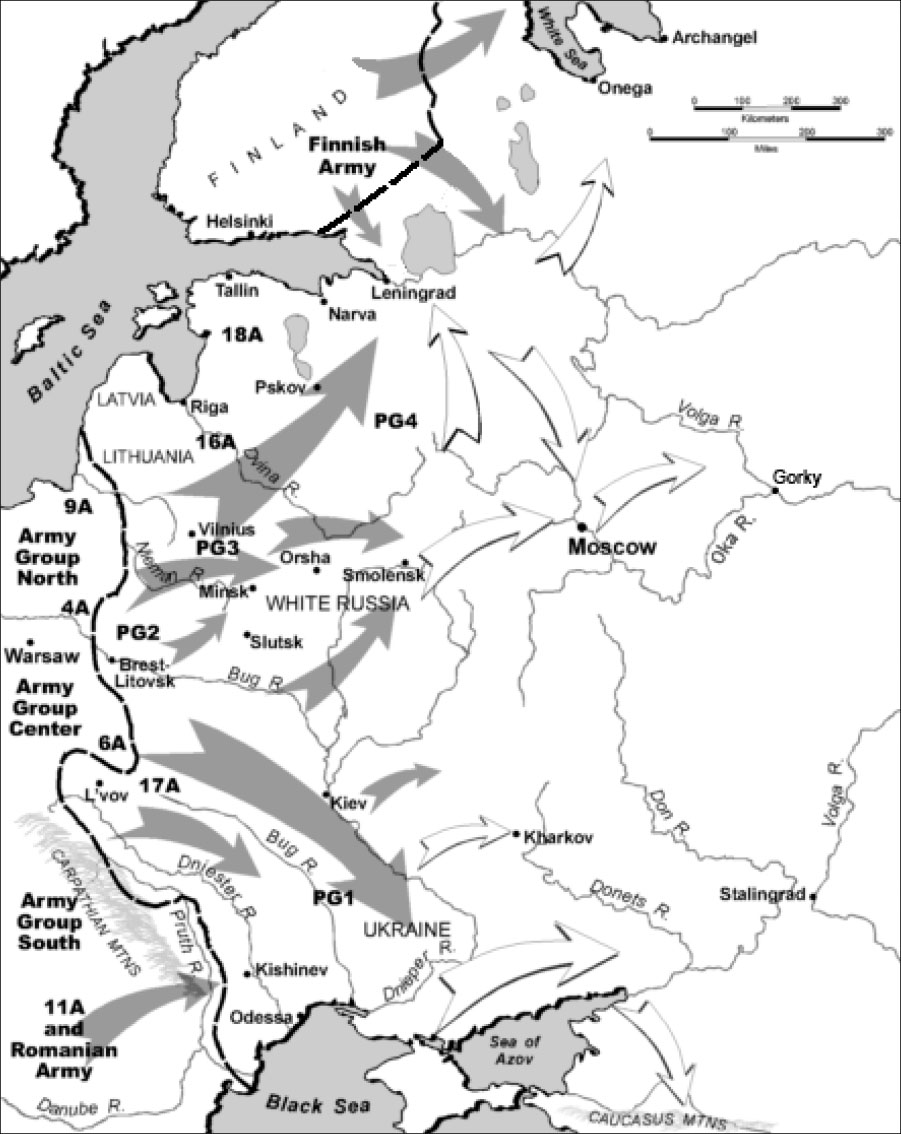
(credit: modification of work “Operation Barbarossa corrected border” by U.S. Army/Wikimedia Commons, Public Domain) · Public Domain
Figure 13.10 The goal of Hitler’s Operation Barbarossa was the invasion of the Soviet Union. The arrows show the routes taken by the invading German army (field armies and Panzer groups) and its allies as they moved to capture major Soviet cities such as Leningrad and Moscow and to gain control of ports on the Black Sea. (credit: modification of work “Operation Barbarossa corrected border” by U.S. Army/Wikimedia Commons, Public Domain)
図13.10 ヒトラーのバルバロッサ作戦の目標は、ソ連への侵攻だった。矢印は、侵攻するドイツ軍の野戦軍・装甲集団とその同盟軍が、レニングラードやモスクワなどの主要都市を占領し、黒海の港を支配するために進んだ経路を示している。(クレジット:米陸軍/Wikimedia Commons「Operation Barbarossa corrected border」を改変。パブリックドメイン)
In the first two days of the campaign, two thousand Soviet planes were destroyed on the ground. The speed of the German attack was greater than anticipated, and within weeks, Belorussia, Lithuania, Latvia, and Estonia had been occupied by the German army, which was called the Wehrmacht (“defense power”). By August, the Germans had captured Kyiv, an industrial center that contained a large portion of the Soviet economic infrastructure at that time. By November, Hitler had gone farther into Russia than Napoleon had. The German army stood at the gates of Leningrad, on the outskirts of Moscow, and on the Don River. Of the 4.5 million troops with which the Soviets had begun, 2.5 to 3 million were lost; of their fifteen thousand tanks, only seven hundred were left. Moscow was in panic, and a German victory seemed imminent.
英語のヒント
作戦開始から2日間で、ソ連の航空機2000機が地上で破壊された。ドイツ軍の攻撃は予想以上に速く、数週間のうちに、ベラルーシ、リトアニア、ラトヴィア、エストニアは、ヴェーアマハト、すなわち「防衛力」と呼ばれたドイツ国防軍に占領された。8月までに、ドイツ軍は、当時ソ連経済の基盤の大きな部分を担っていた工業都市キーウを占領した。11月までには、ヒトラーはナポレオンよりもロシアの奥深くまで進出していた。ドイツ軍はレニングラードの目前、モスクワ郊外、そしてドン川に達していた。ソ連は開戦時の450万人の兵力のうち、250万〜300万人を失い、1万5000両あった戦車も700両しか残っていなかった。モスクワは恐慌状態に陥り、ドイツの勝利は目前のように見えた。
But serious problems arose that came back to haunt the Germans. The speed of the advance had strained the delivery of supplies. The force advancing on Moscow needed nearly thirty train shipments of fuel each day to maintain its pace, but by November, it was receiving only three. In August, a shortage of clean water had spread dysentery and cholera among the troops. When the late summer rains came, German soldiers found that they could neither drive fast (because of mud) nor keep themselves and their equipment dry. Once the Russian winter began, it became so cold that bread rations froze and had to be chopped into portions with axes.
英語のヒント
しかし、ドイツ軍を後に苦しめる深刻な問題が生じた。進撃の速さが補給に過大な負担をかけていた。モスクワへ進軍する部隊が速度を維持するには、毎日、列車約30本分の燃料が必要だったが、11月には3本分しか届いていなかった。8月には清潔な水の不足により、兵士の間に赤痢とコレラが広がっていた。晩夏の雨が降り始めると、ドイツ兵は、泥のせいで車両を速く走らせることも、自分たちや装備をぬれずに保つこともできなくなった。ロシアの冬が来ると寒さは激しくなり、配給パンが凍って、斧でたたき割って分けなければならないほどになった。
The siege of Leningrad lasted 872 days and was one of the longest and deadliest in world history. In early 1942, nearly 100,000 people in the city starved to death each month, and some of the remaining residents resorted to cannibalism to survive. Overall, a million and a half people perished. Facing this, Stalin seems to have momentarily faltered. By the end of 1941, his head of security was instructed to send feelers to the Germans through the Bulgarian ambassador to Moscow, broaching the possibility of peace.
英語のヒント
レニングラード包囲は872日間に及び、世界史上でも最も長く、死者の多い包囲戦の一つとなった。1942年初めには、市内で毎月ほぼ10万人が餓死し、生き残った住民の一部は生存のため人肉食にまで頼った。全体で150万人が命を落とした。この事態を前に、スターリンは一時、動揺したようである。1941年末までに、治安部門の責任者は、モスクワ駐在のブルガリア大使を通じてドイツ側を探り、和平の可能性を持ちかけるよう指示された。