第13章第二次世界大戦の原因と結果The Causes and Consequences of World War II
13.2 Theaters of War13.2 各地の戦場
Learning Objectives学習の目標
By the end of this section, you will be able to:
この節を学ぶと、次のことができるようになる。
Describe the Allied and Axis operations in Europe and Africa during World War II
第二次世界大戦中、ヨーロッパとアフリカで行われた連合国と枢軸国の作戦を説明する。
Explain why the Battles of Stalingrad and Midway are considered turning points in World War II
スターリングラードの戦いとミッドウェー海戦が、第二次世界大戦の転換点とされる理由を説明する。
Discuss U.S. operations in East Asia and the Pacific during World War II
第二次世界大戦中、東アジアと太平洋で行われた米国の作戦を論じる。
Describe the evolution of the Holocaust after the German invasion of Poland
ドイツのポーランド侵攻後、ホロコーストがどのように展開したかを説明する。
World War II was perhaps history’s most globalizing event. Troops fought battles on three continents, in the air, and at sea. Britain and the United States planned early in the war to focus on defeating Italy and Germany before Japan but left the Soviet Union to battle Germany alone. In Asia, the “liberation” of the inhabitants of European and U.S. colonies by Japanese troops only replaced Western rule with Japanese rule, igniting or giving impetus to nationalist movements. Fought on so many fronts, World War II proved to be the deadliest conflict in history. Among those who perished were millions of noncombatants, including the victims of the Nazi death camps. The experiences of survivors shaped the rest of their lives and the course of the societies to which they returned.
英語のヒント
第二次世界大戦は、おそらく歴史上、世界を最も広く結びつけた出来事だった。部隊は三つの大陸と、空と海で戦った。イギリスと米国は戦争の初期、日本より先にイタリアとドイツを倒すことに力を集中する計画を立てたが、ドイツとの戦いではソ連を単独で戦わせた。アジアでは、日本軍によるヨーロッパ・米国植民地住民の「解放」は、西洋の支配を日本の支配に置き換えただけであり、民族主義運動を引き起こしたり、勢いづけたりした。非常に多くの戦線で戦われた第二次世界大戦は、歴史上最も多くの命を奪う紛争となった。死者の中には、ナチスの絶滅収容所の犠牲者を含む、数百万人の非戦闘員がいた。生存者の経験は、その後の人生と、彼らが戻った社会の進路を形づくった。
Europe and Africaヨーロッパとアフリカ
Beginning in 1938 and through the spring of 1941, U.S. military leaders produced several plans of action in the event of war with the Axis powers. Immediately after winning an unprecedented third term in 1940, Roosevelt was briefed by his chief of naval operations, Admiral Harold R. Stark, who advised him that the best military strategy was “Plan D”—a Europe First plan. This focused the United States and Britain on defeating Germany and Italy first and adopting a defensive posture against Japan if it entered the war.
英語のヒント
1938年から1941年春にかけ、米軍首脳は枢軸国との戦争に備え、いくつかの行動計画を策定した。1940年に前例のない3選を果たした直後、ローズヴェルトは海軍作戦部長ハロルド・R・スターク大将から説明を受けた。スタークは、最善の軍事戦略はヨーロッパを優先する「D計画」だと進言した。この計画は、米英がまずドイツとイタリアを倒すことに力を集中し、日本が参戦した場合には、日本に対して防御的な態勢を取るというものだった。
Mussolini decided to expand his African holdings and in August 1940 occupied British Somaliland, threatening the British in Egypt. The British counterattacked. Losing ground in Africa from June through December 1940, Mussolini turned his eyes on the Balkans. In October 1940, expecting an easy victory, Italian units invaded Greece but were badly defeated. To forestall further disaster, Hitler dispatched General Erwin Rommel and his Afrika Korps to duel with the British in northeast North Africa. Not only did Germany wish to support its Italian ally, but it also sought to gain control of the Suez Canal and guarantee its access to Middle Eastern oil, which would be crucial in winning the war. To further aid his faltering ally and deal with an anti-German uprising in Yugoslavia, Hitler postponed his invasion of the Soviet Union by several weeks and invaded Greece on April 6, 1941.
英語のヒント
ムッソリーニはアフリカの領土を拡大することを決め、1940年8月にイギリス領ソマリランドを占領し、エジプトのイギリス勢力を脅かした。イギリス軍は反撃した。1940年6月から12月にかけてアフリカで後退したムッソリーニは、バルカン半島へ目を向けた。1940年10月、容易な勝利を見込んだイタリア軍部隊はギリシャへ侵攻したが、大敗した。さらなる惨敗を防ぐため、ヒトラーはエルヴィン・ロンメル将軍とアフリカ軍団を派遣し、北アフリカ北東部でイギリス軍と戦わせた。ドイツは同盟国イタリアを支えたいだけでなく、スエズ運河を支配し、勝利に不可欠となる中東の石油への道を確保しようとしていた。苦戦する同盟国をさらに助け、ユーゴスラヴィアの反ドイツ蜂起にも対処するため、ヒトラーはソ連侵攻を数週間延期し、1941年4月6日にギリシャへ侵攻した。
Fearing that any substantial British effort against the Germans in Norway or northern France would become a slaughter, Winston Churchill conceived Operation Gymnast, a plan to engage the Germans in northwest Africa instead. On a military mission to London in July 1942, General Eisenhower was deeply disappointed in Churchill’s approach, considering how badly the Soviets were suffering from German offensives. General George C. Marshall favored opening a front in northern Europe in order to draw German resources away from its attack on the Soviet Union before the Soviets collapsed. But Churchill prevailed, and the Allies, now including the United States, invaded French North Africa (Algeria, Morocco, and Tunisia) in November 1942. Key British possessions Egypt and the Suez Canal were saved, and in a January 1943 summit meeting at Casablanca in French Morocco, Churchill and Roosevelt planned the next phase of the war, Operation Husky, the invasion of Sicily. This choice disappointed Stalin, who had been hoping for an invasion of western Europe instead, to draw German troops away from the fighting in the east and the Soviet Union.
英語のヒント
ノルウェーやフランス北部でイギリス軍がドイツ軍に大規模な攻撃を仕掛ければ、多数の犠牲者が出ると恐れたウィンストン・チャーチルは、代わりに北西アフリカでドイツ軍と戦うジムナスト作戦を構想した。1942年7月、軍事任務でロンドンを訪れたアイゼンハワー将軍は、ソ連がドイツ軍の攻勢でどれほど苦しんでいるかを考え、チャーチルの方針に深く失望した。ジョージ・C・マーシャル将軍は、ソ連が崩壊する前にドイツの戦力を対ソ攻撃からそらすため、北ヨーロッパに戦線を開くことを支持した。しかしチャーチルの意見が通り、米国を含む連合国は1942年11月、フランス領北アフリカのアルジェリア、モロッコ、チュニジアへ侵攻した。イギリスにとって重要なエジプトとスエズ運河は守られた。1943年1月、フランス領モロッコのカサブランカで開かれた首脳会談で、チャーチルとローズヴェルトは戦争の次の段階として、シチリア侵攻のハスキー作戦を計画した。この選択はスターリンを失望させた。スターリンは、東部およびソ連で戦うドイツ軍をそらすため、代わりに西ヨーロッパへ侵攻することを望んでいた。
All the while, desperate battles were being waged on the eastern front in the Soviet Union. In August 1941, given the initial success of the German invasion and poised to capture Moscow, Hitler delayed the advance to decide strategy. The German general staff wanted to drive directly for Moscow and take it before winter. Hitler, however, diverted a significant part of his forces to the south. Both Allied and Axis thinkers had long recognized the strategic military importance of oil. For some time prior to the war, the British government had interjected itself into the politics of Iraq, Persia, Afghanistan, and Egypt for this reason. The Germans too had taken a keen interest in the Middle East and central Asia in the 1930s. In 1925, in Iran, Reza Shah had consolidated his rule and commenced a program of modernization, increasing ties with Germany and employing hundreds of Germans.
英語のヒント
その間も、ソ連の東部戦線では必死の戦いが続いていた。1941年8月、ドイツの侵攻が当初成功を収め、モスクワを攻略できる位置に迫ったところで、ヒトラーは戦略を決めるため進撃を遅らせた。ドイツ軍参謀本部はモスクワへ直進し、冬が来る前に占領したいと考えた。しかしヒトラーは、部隊の相当部分を南へ振り向けた。連合国・枢軸国の双方の戦略家は、以前から石油の軍事的な重要性を認識していた。そのためイギリス政府は戦前から、イラク、ペルシア、アフガニスタン、エジプトの政治に介入していた。ドイツも1930年代に中東と中央アジアへ強い関心を持った。イランでは、1925年にレザー・シャーが支配を固め、近代化計画を始めた。ドイツとの関係を強化し、数百人のドイツ人を雇い入れた。
To block potential German access to Iranian oil, the British first demanded the possibly pro-German Shah expel Germans and sever ties with Berlin. Taking no chances, British and Soviet forces then invaded Iran in August 1941. Iranian resistence collapsed in a couple of days, and Reza Shah was forced to abdicate in favor of his son Mohammad Reza Pahlavi. The Germans were expelled, and the Allied occupation lasted until 1946. During those years, Iran became a funnel through which much Allied aid, especially from the United States, was delivered to Stalin as he struggled to hold out against the Wehrmacht.
英語のヒント
ドイツがイランの石油を手にする可能性を断つため、イギリスはまず、親ドイツ的と見られたシャーに、ドイツ人を追放し、ベルリンとの関係を断つよう要求した。危険を冒したくなかったイギリス軍とソ連軍は、続いて1941年8月にイランへ侵攻した。イランの抵抗は数日で崩れ、レザー・シャーは息子モハンマド・レザー・パフラヴィーへ王位を譲って退位させられた。ドイツ人は追放され、連合国の占領は1946年まで続いた。この間イランは、ドイツ国防軍に持ちこたえようとするスターリンへ、多くの連合国援助、とりわけ米国からの援助を届ける輸送路となった。
By 1939, the global supply of oil was in the hands of seven oil conglomerates—none of which were German. Consequently, Germany was heavily reliant on Romanian and Soviet oil between 1939 and 1941. The oil fields in the Soviet Republic of Azerbaijan, one thousand kilometers from Stalingrad, looked like a possible solution, so the German army moved to capture the city of Baku, the center of the Soviet oil-drilling industry. Thus, both winter and the German drive for oil saved Moscow.
英語のヒント
1939年までに、世界の石油供給は七つの巨大石油企業の手に握られていたが、その中にドイツ企業は一つもなかった。そのためドイツは、1939年から1941年にかけて、ルーマニアとソ連の石油に大きく依存していた。スターリングラードから1000キロメートル離れた、ソ連のアゼルバイジャン共和国の油田は、解決策になりそうだった。そこでドイツ軍は、ソ連の石油採掘産業の中心地バクーを占領しようと動いた。こうして、冬の到来とドイツの石油獲得への進撃の両方が、モスクワを救った。
In the summer of 1942, the Germans resumed the offensive on all fronts but were unable to get far, except for approaching Stalingrad. Hitler was determined to take the city and Stalin to hold it. In July, Stalin issued Order No. 227 forbidding Soviet troops from retreating: “Not one step backwards!” By the fall of 1942, German troops had actually broken into Stalingrad, but their progress thereafter was gruesomely slow and difficult. For more than two months, the Battle of Stalingrad raged with ferocity, sometimes building by building (Figure 13.11).
英語のヒント
1942年夏、ドイツ軍は全戦線で攻勢を再開したが、スターリングラードに迫ったほかは、大きく前進できなかった。ヒトラーは同市を奪う決意を固め、スターリンは守り抜く決意を固めた。7月、スターリンはソ連軍の退却を禁じる第227号命令を出した。「一歩も退くな!」という命令だった。1942年秋までに、ドイツ軍はスターリングラードの市内へ実際に突入していたが、その後の前進は凄惨を極め、きわめて遅く困難だった。2カ月以上にわたり、スターリングラードの戦いは激しく続き、ときには建物一棟ごとを奪い合った(図13.11)。
The Battle of Stalingrad.スターリングラードの戦い
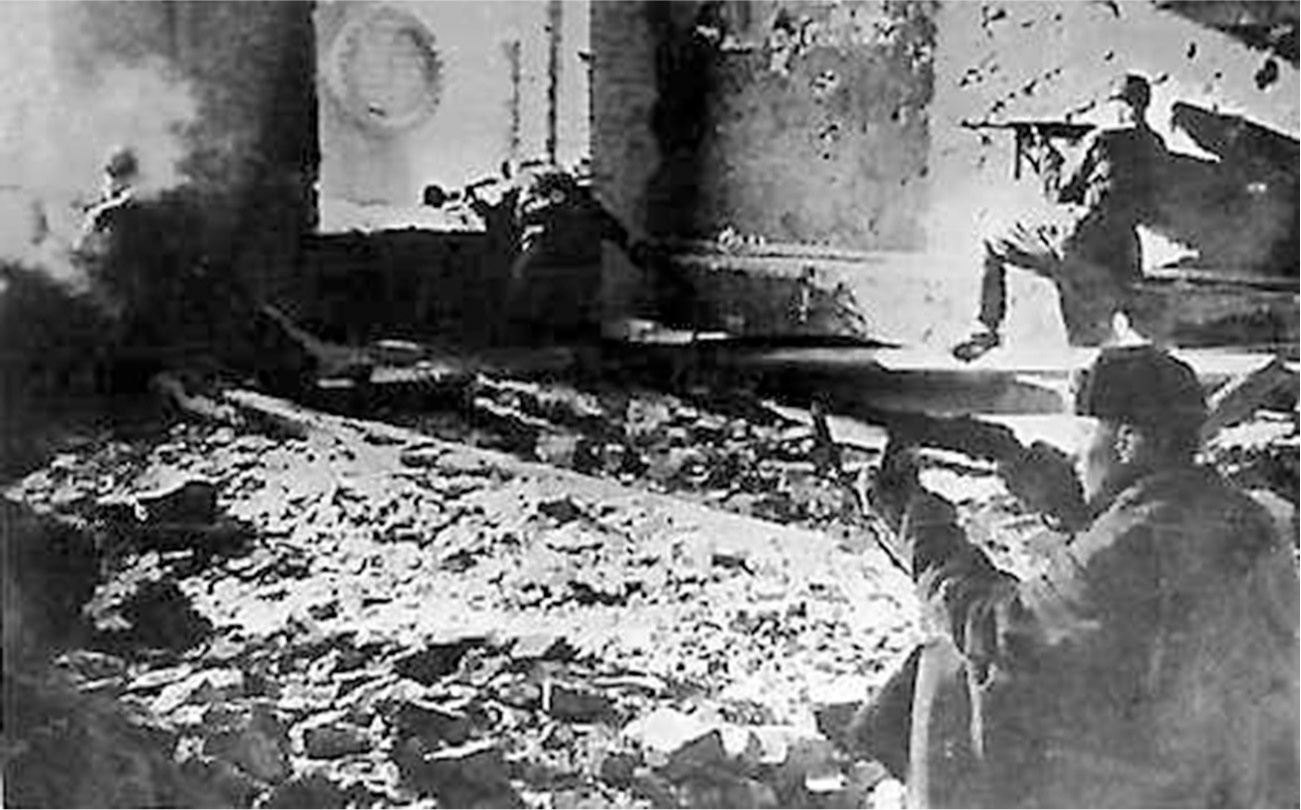
(credit: “Stalingrad war 1942” by Unknown/Wikimedia Commons, Public Domain) · Public Domain
Figure 13.11 In 1942, these Russian fighters battled German troops for control of Stalingrad from within the ruins of a bombed building. (credit: “Stalingrad war 1942” by Unknown/Wikimedia Commons, Public Domain)
図13.11 1942年、爆撃された建物の廃墟から、スターリングラードの支配をめぐってドイツ軍と戦うソ連兵。(クレジット:作者不明/Wikimedia Commons「Stalingrad war 1942」。パブリックドメイン)
Having assembled sufficient forces, in November 1942 the Soviet Red Army counterattacked at Stalingrad and managed to trap the Germans in a noose. The only way for the Germans to resupply was by air, which was far too limited to sustain them for very long. Despite being specifically forbidden to do so, on January 31, 1943, German field marshal Friedrich Paulus surrendered what was left of his Sixth Army. The Soviets captured close to 100,000 German troops. Total casualties in the battle had reached nearly two million, including substantial numbers of civilians. The Battle of Stalingrad stopped the German advance into the Soviet Union. It was the first clear defeat for Hitler’s Germany and the turning point of the war in Europe, setting the Nazis on a defensive course for the remainder of the war.
英語のヒント
十分な兵力を集結させたソ連赤軍は、1942年11月、スターリングラードで反撃し、ドイツ軍を包囲網に閉じ込めることに成功した。ドイツ軍の補給手段は空輸しかなかったが、それでは長く持ちこたえるにはあまりにも不十分だった。降伏を明確に禁じられていたにもかかわらず、1943年1月31日、ドイツのフリードリヒ・パウルス元帥は、生き残っていた第6軍を降伏させた。ソ連は10万人近いドイツ兵を捕虜にした。この戦いの死傷者は、大勢の民間人を含め、合計で約200万人に達した。スターリングラードの戦いは、ドイツ軍のソ連奥地への進撃を止めた。ヒトラーのドイツにとって最初の明白な敗北であり、ヨーロッパの戦争の転換点となった。その後、終戦までナチスは守勢に回ることになった。
From the time of his first meeting with Churchill in August 1942, a frustrated Stalin had been calling for a second front against the Nazis in Europe. In the summer of 1943, the Soviets, fresh from saving Stalingrad, went on the offensive against the Germans. The ensuing Battle of Kursk was the biggest land battle of the war and the largest tank battle in history. The Soviet victory damaged Germany’s war-making capacity by compromising its armaments.
英語のヒント
1942年8月にチャーチルと初めて会談した時から、苛立つスターリンは、ヨーロッパでナチスに対する第二戦線を開くよう要求していた。1943年夏、スターリングラードを救ったばかりのソ連軍は、ドイツ軍に対して攻勢に出た。続くクルスクの戦いは、この戦争で最大の地上戦であり、歴史上最大の戦車戦となった。ソ連の勝利は、ドイツの兵器戦力を損ない、その戦争遂行能力を傷つけた。
Mussolini had insisted on contributing 200,000 troops to the invasion of the Soviet Union, and by early 1943, half of them had become casualties. Allied victories in North Africa and Sicily, along with the Allied bombing of Rome in July 1943, further humiliated Mussolini. In Italy, a coalition of former fascist supporters, military officers, the few surviving liberal politicians, and the king himself reached the conclusion that Mussolini must go. The Grand Fascist Council met for the first time in three years on July 24, 1943, and voted overwhelmingly to remove him from power and place him under arrest.
英語のヒント
ムッソリーニはソ連侵攻に20万人の兵士を出すと主張し、1943年初めまでにその半数が死傷するなどの損耗を被っていた。連合国が北アフリカとシチリアで勝利し、1943年7月にはローマを爆撃したことで、ムッソリーニの威信はさらに傷ついた。イタリアでは、かつてのファシスト支持者、軍人、生き残っていた少数の自由主義政治家、国王本人が結びつき、ムッソリーニを退けなければならないという結論に達した。1943年7月24日、ファシズム大評議会は3年ぶりに開かれ、圧倒的多数で彼を権力の座から追い、逮捕することを決めた。
A government was formed under Marshal Pietro Badoglio, who initiated secret negotiations with the Allies. The Allied invasion of the mainland of Italy at the beginning of September provided the impetus for Italy’s surrender on September 8, 1943. Four days later, Hitler had German special forces rescue Mussolini. German troops already in Italy then moved to disarm the remnants of the Italian army and established a government called the Republic of Salo in northern Italy, with Mussolini as its figurehead. However, Italian communist partisans captured and executed Mussolini in April 1945.
英語のヒント
ピエトロ・バドリオ元帥の下で政府が成立し、連合国との秘密交渉を始めた。9月初めの連合国によるイタリア本土侵攻が、1943年9月8日のイタリア降伏を促した。4日後、ヒトラーはドイツ特殊部隊にムッソリーニを救出させた。すでにイタリアにいたドイツ軍は、残存するイタリア軍の武装解除に乗り出し、ムッソリーニを名目上の首班として、北イタリアにサロ共和国と呼ばれる政府を樹立した。しかし1945年4月、イタリアの共産主義パルチザンがムッソリーニを捕らえ、処刑した。
Earlier, with Iran secured through the Allied invasion, Tehran had been the site of the first of the World War II conferences between the “Big Three”: Churchill, Roosevelt, and Stalin. From November 28 to December 1, 1943, the Tehran conference addressed relations between the Allies, relations between Turkey and Iran, operations in Yugoslavia, the fight against Japan, and plans for the postwar settlement. A protocol signed at the conference pledged the Big Three’s recognition of Iran’s independence. The Big Three also agreed on a cross-channel invasion of Europe scheduled for May 1944, in conjunction with a Soviet attack on Germany’s eastern border. Stalin dominated the conference, using Soviet victories to get preliminary agreements on the borders of Poland after the war. Churchill and Roosevelt also consented to the USSR setting up governments sympathetic to itself in the Baltic states. Roosevelt and Stalin continued their discussions of a general international organization that had been proposed a few months earlier.
英語のヒント
それ以前、連合国の侵攻によってイランが確保されると、テヘランは第二次世界大戦中の「ビッグ・スリー」、すなわちチャーチル、ローズヴェルト、スターリンによる最初の会談の開催地となった。1943年11月28日から12月1日まで開かれたテヘラン会談では、連合国間の関係、トルコとイランの関係、ユーゴスラヴィアでの作戦、日本との戦い、戦後処理の計画が話し合われた。会談で調印された議定書は、3首脳がイランの独立を認めることを約束した。3首脳はまた、1944年5月に予定する海峡越えのヨーロッパ侵攻と、ドイツ東部国境へのソ連の攻撃を連動させることで合意した。スターリンは会談を主導し、ソ連の勝利を背景に、戦後ポーランドの国境について予備的な合意を得た。チャーチルとローズヴェルトは、ソ連がバルト諸国に親ソ政権を樹立することも認めた。ローズヴェルトとスターリンは、数カ月前に提案されていた包括的な国際機構についての協議も続けた。