第13章第二次世界大戦の原因と結果The Causes and Consequences of World War II
The Human Toll失われた命
The end of the war saw the world grapple with the conflict’s astronomical human toll. Germany had suffered 5.5 million military deaths and lost as many as three million civilians. Japan lost 2.1 million military and another million civilians. China’s military deaths can only be approximated but may have been as high as four million, with another sixteen million civilians. The United States and the United Kingdom emerged less battered, with 416,000 American and 384,000 British deaths. However, their ally the Soviet Union arguably suffered more than any other single country. Soviet military deaths were estimated at 8.8 to 10.7 million, and more than thirteen million civilian deaths were attributed to the war. Some of these deaths were the result of military actions; other Soviet civilians died of starvation or disease caused by wartime conditions. The German and Japanese surrenders ended the combat phase of the war. However, much work was needed to rebuild the world as the victors thought it should be.
英語のヒント
戦争が終わると、世界は桁外れに大きな人的犠牲と向き合わなければならなかった。ドイツの軍人の死者は550万人、民間人の死者は最大300万人に達した。日本は軍人210万人と、さらに民間人100万人を失った。中国の軍人の死者は概算しかできないが、最大400万人だった可能性があり、さらに民間人1600万人が死亡した。米国とイギリスの損失は比較的少なく、米国人41万6000人、イギリス人38万4000人が死亡した。しかし、その同盟国ソ連は、おそらく単独の国としては最大の被害を受けた。軍人の死者は880万〜1070万人と推定され、1300万人以上の民間人の死が戦争によるものとされた。軍事行動による死もあれば、戦時の状況が引き起こした飢えや病気で亡くなった民間人もいた。ドイツと日本の降伏によって、戦争の戦闘段階は終わった。しかし、勝者があるべきだと考える世界を再建するためには、多くの仕事が残っていた。
The Aftermath: Europe戦後のヨーロッパ
The right-wing dictatorships in Spain and Portugal, by staying out of the actual conflict, were able to avoid the reconstructive policies and action of the Allies. But fascism had been dealt a severe defeat in Europe.
英語のヒント
スペインとポルトガルの右派独裁政権は、実際の戦闘に加わらなかったため、連合国の再建政策や措置を免れた。しかしヨーロッパのファシズムは、深刻な敗北を喫していた。
The Soviets exacted retribution on the Germans largely by removing and transporting back to the Soviet Union virtually anything they considered useful to rebuilding their own industrial sector destroyed by the war. Thus, the Soviet occupation zone, which became the communist satellite of East Germany, was left with little to sustain itself. The western Allies, wanting relief from the burden of supporting destitute Germans and their largely destroyed economy, began to rebuild Germany’s industries in their occupation zones. Stalin perceived these efforts as a sign of greed, continued capitalist hostility to socialism, and the West’s desire to dominate the world economy.
英語のヒント
ソ連は、戦争で破壊された自国の工業部門の再建に役立つと考えたものを、事実上ほとんどすべてドイツから撤去して運び去るという形で、ドイツに報復を求めた。そのため、後に共産主義の衛星国、東ドイツとなるソ連占領地区には、自らを支えるものがほとんど残らなかった。西側連合国は、困窮するドイツ人と、ほぼ破壊された経済を支える負担を軽減したいと考え、自らの占領地区でドイツの産業を再建し始めた。スターリンはこうした取り組みを、強欲、資本主義による社会主義への変わらぬ敵意、そして西側が世界経済を支配しようとする欲望の表れと見た。
Efforts were also made to establish some measure of justice via war crimes trials. In August 1945, Britain, the Soviet Union, and the United States agreed to create the International Military Tribunal to try Germans accused of committing war crimes, crimes against peace, and crimes against humanity. The Nuremberg Trials sought justice for Germany’s crimes against humanity; they lasted through 1946. Twenty-two individuals and seven Nazi organizations were indicted. Nineteen defendants were convicted and received sentences ranging from fifteen years in prison to death by hanging. Three of the Nazi organizations were ruled to be criminal organizations.
英語のヒント
戦争犯罪裁判を通じて、一定の正義を実現しようとする取り組みも行われた。1945年8月、イギリス、ソ連、米国は、戦争犯罪、平和に対する罪、人道に対する罪に問われたドイツ人を裁く国際軍事裁判所を設けることで合意した。ニュルンベルク裁判は、ドイツの人道に対する罪を裁こうとし、1946年まで続いた。個人22人とナチスの7組織が起訴された。被告19人が有罪となり、15年の禁錮から絞首刑までの刑を言い渡された。ナチスの組織のうち三つは、犯罪組織と認定された。
There remained the huge task of repatriating all those displaced by the war. Millions of people had been shuttled around Europe by the Germans as they drew forced labor to Germany and dispatched Jewish people and others to concentration/death camps. The Soviets demanded the return of all their citizens. The Allies agreed to the controversial “Operation Keelhaul,” whereby people who had cooperated with the Germans against the Soviets, including Cossacks, Ukrainians, and Russians, were forcibly repatriated to the Soviet Union with the probability of a harsh and possibly fatal reception. Millions of others were also forcibly moved back to their “home” nations at the end of the war, such as Germans living in areas now belonging to Poland who were forced to leave for Germany. The hope was that this would help avoid ethnic tensions that might lead to another conflict. At the same time, 250,000 Jewish survivors of the Holocaust languished in camps for displaced persons because their home countries refused to take them back. About eighty thousand were eventually able to relocate to the United States, and more than 100,000 settled in the British Mandate of Palestine.
英語のヒント
戦争によって住まいを追われた人々をすべて本国へ戻すという、大きな課題も残った。ドイツ側が強制労働者をドイツへ集め、ユダヤ人などを強制収容所・絶滅収容所へ送ったため、何百万人もの人々がヨーロッパ中を移動させられていた。ソ連は、自国民全員の帰還を要求した。連合国は、論争を呼ぶ「キールホール作戦」に同意した。コサック、ウクライナ人、ロシア人など、ソ連に対抗してドイツに協力した人々を、厳しい、場合によっては死をもたらす扱いが待つと考えられたにもかかわらず、ソ連へ強制送還した。戦争の終わりには、ほかにも何百万人もの人々が「祖国」へ強制的に移された。たとえば、今やポーランド領となった地域のドイツ人は、ドイツへ退去させられた。こうすれば、再び戦争を引き起こしかねない民族間の緊張を避けられると期待された。同時に、ホロコーストを生き延びたユダヤ人25万人は、母国が受け入れを拒んだため、避難民収容所で苦しい生活を続けた。最終的に約8万人が米国へ移住でき、10万人以上がイギリス委任統治領パレスチナへ移り住んだ。
The Aftermath: Japan戦後の日本
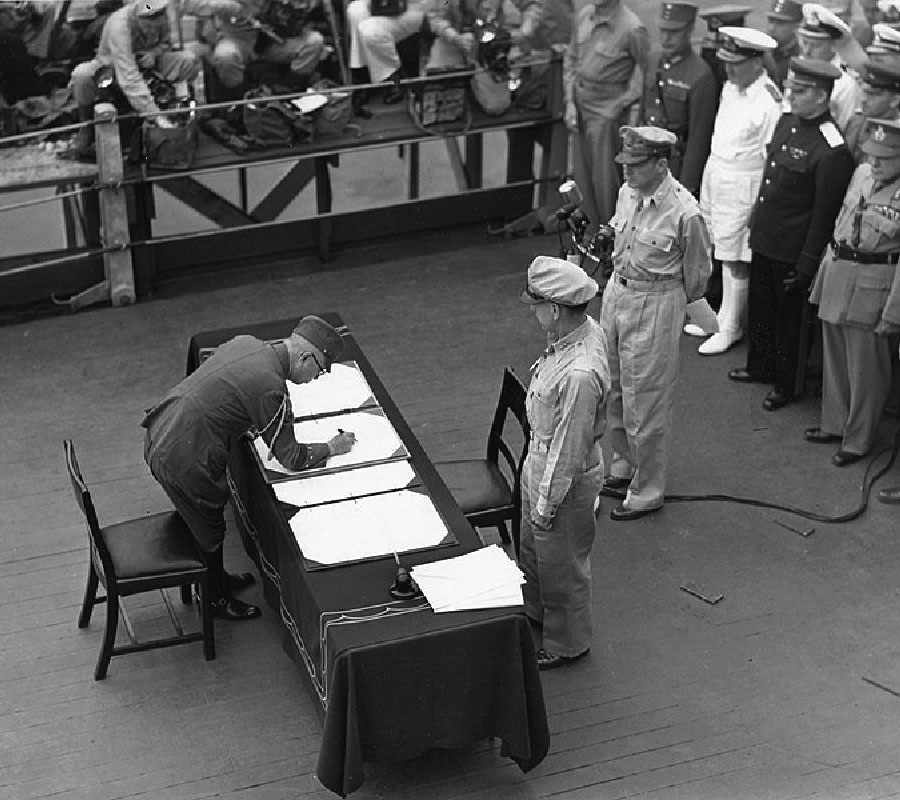
On August 10, 1945, in the wake of the atomic attacks and the Soviet invasion of Manchukuo, Japanese Emperor Hirohito had informed his Privy Council that he accepted the Potsdam Declaration regarding Japan’s unconditional surrender, and soon thereafter the Allies were informed to that effect. Hirohito himself followed up on August 15 with the first public broadcast any emperor had ever made to the Japanese people, saying he would bear the pain of defeat and accept the Allied terms. A month later on September 2, General Yoshijirō Umezu, the army’s chief of staff, signed a surrender document aboard the USS Missouri at anchor in Tokyo Bay (Figure 13.19).
英語のヒント
原爆攻撃とソ連の満州国侵攻を受け、1945年8月10日、日本の裕仁天皇は、日本の無条件降伏に関するポツダム宣言を受諾すると枢密院に伝え、その後まもなく、その旨が連合国に通告された。8月15日には裕仁自身が、天皇として初めて国民に向けた放送を行い、敗北の苦痛に耐え、連合国の条件を受け入れると述べた。1カ月後の9月2日、陸軍参謀総長の梅津美治郎大将は、東京湾に停泊する米戦艦ミズーリ号上で降伏文書に署名した(図13.19)。
The Japanese Surrender.日本の降伏
(credit: “Japanese surrender, Tokyo Bay, September 2, 1945” by U.S. National Archives/Wikimedia Commons, Public Domain) · Public Domain
Figure 13.19 General Yoshijirō Umezu, chief of the Japanese Army General Staff, signed the articles of surrender for Japan aboard the USS Missouri on September 2, 1945. Opposite him were representatives of the Allied Powers, standing behind General Douglas MacArthur at the microphones (with hands behind his back). (credit: “Japanese surrender, Tokyo Bay, September 2, 1945” by U.S. National Archives/Wikimedia Commons, Public Domain)
図13.19 1945年9月2日、米戦艦ミズーリ号上で日本の降伏文書に署名する、陸軍参謀総長の梅津美治郎大将。向かい側では、マイクの前で手を後ろに組むダグラス・マッカーサー元帥の後方に、連合国の代表たちが立っている。(クレジット:米国国立公文書館/Wikimedia Commons「Japanese surrender, Tokyo Bay, September 2, 1945」。パブリックドメイン)
As supreme commander for the Allied powers, General Douglas MacArthur was ordered to exercise authority during the Allied occupation of Japan through the Japanese governmental system, including Emperor Hirohito. MacArthur charged the Japanese government to immediately repeal the Peace Preservation Law, which allowed for the arrest of anyone perceived to be posing a threat to—or critical of—the Japanese government, and to begin open and free discussion of the entire Imperial government and its institutions. Political prisoners were released, and the Special Police were disbanded. On New Year’s Day 1946, the emperor publicly disclaimed his divine status: “The ties between us and our people have always stood upon mutual trust and affection. They do not depend upon mere legends and myths. They are not predicated on the false conception that the Emperor is divine and that the Japanese people are superior to other races and fated to rule the world.”
英語のヒント
連合国軍最高司令官ダグラス・マッカーサー元帥は、日本占領中、裕仁天皇を含む日本の統治機構を通じて権限を行使するよう命じられた。マッカーサーは日本政府に対し、政府への脅威と見なされた者や批判者を逮捕できる治安維持法を直ちに廃止し、帝国の統治体制と諸制度の全体について、公開の自由な議論を始めるよう命じた。政治犯は釈放され、特別高等警察は解体された。1946年元日、天皇は自らが神であるという地位を公に否定した。「われわれと国民との結びつきは、常に相互の信頼と敬愛によって成り立ってきた。単なる伝説や神話に基づくものではない。天皇が神であり、日本人がほかの人種に優越し、世界を支配する運命にあるという誤った観念に基づくものではない」。
In Tokyo, the International Military Tribunal for the Far East emerged from the Potsdam Declaration. (Since the Soviet Union had not declared war on Japan at that time, it was not a party to the agreement.) The trials began in 1946 and lasted until November 1948. Eighteen members of the Japanese military and nine senior politicians were indicted. All were found guilty but one, who was found mentally unfit to stand trial; six were executed and the rest sentenced to prison.
英語のヒント
東京では、ポツダム宣言を基に極東国際軍事裁判所が設けられた。宣言当時、ソ連は日本に宣戦していなかったため、宣言の当事国ではなかった。裁判は1946年に始まり、1948年11月まで続いた。日本の軍人18人と高位の政治家9人が起訴された。裁判を受けられる精神状態にないと判断された1人を除いて全員が有罪となり、6人が処刑され、残りは禁錮刑を宣告された。
For six years, from 1946 to 1952, the United States dominated the occupation of Japan. General MacArthur and his occupation authorities partnered energetically in almost all aspects of Japanese politics, economics, and society to try to reform and rebuild Japan. The overall goals of the occupation were demilitarization, democratization, and the fostering of respect for fundamental human rights. The Constitution imposed by MacArthur and his Government Section in 1947 was the sort of fundamental change no single group in Japan itself could have effected. The fact that it has survived virtually unchanged suggests that the Japanese themselves came to terms with it and bent the system to reflect their habits of mind and politics. The emperor was made a figurehead, “the symbol of the State and of the unity of the people.” Real sovereign power was vested in the people via the Diet, an elected two-chamber legislature. An extensive Bill of Rights guaranteed academic freedom, women’s suffrage, the right to choose residence, collective bargaining, and full employment.
英語のヒント
1946年から1952年までの6年間、米国は日本の占領を主導した。マッカーサー元帥と占領当局は、日本を改革・再建するため、政治、経済、社会のほぼすべての面に、積極的に関わった。占領全体の目標は、非軍事化、民主化、基本的人権の尊重を育てることだった。1947年にマッカーサーとその民政局が日本に課した憲法は、日本国内の一つの集団だけでは実現できなかったような、根本的な変革だった。それが事実上変更されずに存続してきたことは、日本人自身がそれを受け入れ、自らの思考や政治の習慣を反映するよう制度を運用したことを示唆する。天皇は実権を持たない存在とされ、「日本国の象徴であり日本国民統合の象徴」となった。実際の主権は、選挙で選ばれる二院制の議会、国会を通じて、国民に属するものとされた。広範な権利の規定は、学問の自由、女性参政権、居住地を選ぶ権利、団体交渉、完全雇用を保障した。
Demilitarization was immediately begun, and the Japanese accepted that a realistic appraisal of world conditions after World War II strongly suggested force was not a good way to protect Japan and secure access to economic resources. The preamble to the Japanese Constitution begins, “We, the Japanese people, desire peace for all time.” Land reform began to make more small farmers owners of their farms instead of renters, and union membership was supported in the industrial sector, but many large corporations remained and were deliberately not broken up. Japan was severely limited militarily; no Japanese army was allowed, nor was Japan permitted to go to war in the future.
英語のヒント
非軍事化は直ちに始まった。日本人は、第二次世界大戦後の世界情勢を現実的に評価すれば、日本を守り、経済資源へのアクセスを確保するために武力を用いることは、よい方法ではないと強く示されることを受け入れた。日本国憲法の前文は、「われらは、恒久の平和を念願し」で始まる。農地改革によって、より多くの小農が借り手ではなく農地の所有者となり始め、工業部門では労働組合への加入が支援された。しかし、大企業の多くは残され、意図的に解体されなかった。日本の軍事力は厳しく制限され、日本の陸軍は認められず、将来戦争をすることも許されなかった。
Attempts took place across the globe to achieve some form of just and lasting peace. One glimmer of hope was the United Nations, an international body agreed to by the Allied leaders during wartime conferences and finally established in New York City in April 1945. The United Nations was pledged to “save succeeding generations from the scourge of war, which twice in our lifetime has brought untold sorrow to mankind, and to reaffirm faith in fundamental human rights, in the equal rights of men and women and of nations large and small . . . to promote social progress and better standards of life in larger freedom.”
英語のヒント
世界各地で、何らかの公正で長続きする平和を実現しようとする試みが行われた。希望の光の一つは国際連合だった。この国際機関は、戦時中の会談で連合国首脳が合意し、1945年4月、ついにニューヨークで設立された。国際連合は、「われわれの生涯に二度まで言い尽くせない悲しみを人類にもたらした戦争の惨害から、後の世代を救い、基本的人権、男女および大小各国の同等の権利への信念を再確認し……より大きな自由の下で、社会の進歩と生活水準の向上を促す」ことを誓った。
Judicial actions in both Germany and Japan were the beginning of attempts to define such concepts as genocide and crimes against humanity, as a way to counter the possibility that the conflict had actually normalized total war, mass violence, brutalization, and totalitarianism. The war had also brought into stark view the cruel consequences of racism and racist ideologies. Even liberal democracies could be poisoned by such thinking, as was revealed in the United States by the groundless displacement of Japanese residents and nationals and Japanese American citizens.
英語のヒント
ドイツと日本の双方で行われた司法上の措置は、ジェノサイドや人道に対する罪といった概念を定義しようとする試みの始まりだった。それは、この紛争によって、総力戦、大規模な暴力、残虐化、全体主義が、実際に当たり前のものになってしまった可能性に対抗するためでもあった。戦争はまた、人種差別や人種主義の思想がもたらす残酷な結果を、鮮明に見せた。自由民主主義国でさえ、そのような考えに汚染されうる。米国で、日本人の居住者や日本国籍者、日系米国市民が、根拠なく立ち退かされたことが、それを示していた。
As another aftermath of the war, women worldwide found themselves enjoying some of the freedoms and responsibilities of their fuller citizenship and participation in their nation’s fortunes. And populations in Africa and Asia, feeling they had earned liberation from prewar colonialism, began to reach for more self-determination and national legitimacy. It was widely felt that the struggles and sacrifices of so many could not and should not have been in vain.
英語のヒント
戦争が残したもう一つの変化として、世界各地の女性は、より十分な市民としての地位と、自国の行く末への参加によって、一定の自由と責任を得るようになった。また、アフリカとアジアの人々は、戦前の植民地主義から解放される資格を勝ち取ったと感じ、より大きな自決権と国家としての正当性を求め始めた。これほど多くの人々の苦闘と犠牲は、むだであったはずがなく、むだにしてはならないという思いが、広く共有された。