第13章第二次世界大戦の原因と結果The Causes and Consequences of World War II
13.3 Keeping the Home Fires Burning13.3 銃後の暮らしを支える
Learning Objectives学習の目標
By the end of this section, you will be able to:
この節を学ぶと、次のことができるようになる。
Describe life on the home fronts in World War II
第二次世界大戦中の銃後の暮らしを説明する。
Explain how the war affected women’s lives in the Axis and Allied nations
戦争が枢軸国と連合国の女性たちの生活に及ぼした影響を説明する。
Describe how new technologies developed during World War II and affected its outcome
第二次世界大戦中、新しい技術がどのように発達し、戦争の結果に影響したかを説明する。
Those left behind on the home front during the war followed the fates of their absent loved ones wherever they were. They often coped with shortages of needed items and new workloads as the conflict continued year after year. Research also continued at home as the countries engaged in the war sought to gain an advantage over one another. As a result, new technologies and scientific understandings emerged that affected not only the war and its outcome but the postwar global society as well.
英語のヒント
戦時中、銃後に残された人々は、離れている大切な人がどこにいようと、その消息と運命を気にかけた。戦争が年を重ねて続く中、必要な物資の不足や、新たに増えた仕事への対応を迫られることも多かった。参戦国が互いに優位に立とうとする中、国内では研究も続けられた。その結果、新しい技術と科学的な理解が生まれ、戦争とその結末だけでなく、戦後の世界社会にも影響を与えた。
Life on the Home Fronts銃後の暮らし
For European countries in World War II, the distance between the battlefield and the home front was often very short or nonexistent. Total war, fought using all available resources with no restrictions on weapons or their targets, took the conflict to millions. The occupation of territory and the resulting resistance movements meant that homes, farms, and factories became minor battlefields. Places farther from actual combat, in Africa and the Americas, were more traditional home fronts.
英語のヒント
第二次世界大戦中のヨーロッパ諸国では、戦場と銃後の距離は、しばしばきわめて短いか、まったく存在しなかった。使える資源をすべて動員し、兵器や攻撃目標に制限を設けない総力戦は、何百万人もの人々を紛争に巻き込んだ。領土の占領と、それに対する抵抗運動によって、家、農場、工場も小さな戦場になった。実際の戦闘から遠いアフリカや南北アメリカの地域では、より従来型の銃後の暮らしが営まれた。
Partisan resistance groups sprang up, the largest among the Dutch, the French, the Polish, the Soviets, and the Yugoslavs. On December 7, 1941, Hitler responded to this resistance with his “Night and Fog Decree” in which he stated that people threatening German security should disappear into the night and fog. Consequently, thousands of brutal reprisals for resistance were visited on local populations. In the Kragujevac massacre in October 1941, Germans killed 2,700 Serbians in retaliation for a partisan attack that had killed ten German soldiers and wounded another twenty-six. Such brutality sometimes recruited more resistance. In Yugoslavia, for example, German cruelty enabled Josip Broz Tito to recruit and lead 650,000 people against the Germans, tie down thirty-five German divisions, and destroy eighteen thousand supply trains. In the Soviet Union, the Germans faced perhaps 150,000 partisans. In the Netherlands, railroad workers went on strike in support of Allied offensives in the winter of 1944, and the Germans retaliated by cutting off their food supplies, leading to thirty thousand deaths by starvation.
英語のヒント
パルチザンの抵抗組織が各地に生まれ、とりわけオランダ、フランス、ポーランド、ソ連、ユーゴスラヴィアで大きな勢力となった。ヒトラーは1941年12月7日、この抵抗に対して「夜と霧の布告」を出し、ドイツの安全を脅かす者は夜と霧の中へ消えるべきだと述べた。その結果、抵抗への残酷な報復が数千件にわたり、各地の住民に加えられた。1941年10月のクラグイェヴァツ虐殺では、ドイツ兵10人が死亡し、26人が負傷したパルチザンの攻撃への報復として、ドイツ側はセルビア人2700人を殺した。こうした残虐行為は、ときにさらなる抵抗者を生んだ。たとえばユーゴスラヴィアでは、ドイツの残虐さによってヨシップ・ブロズ・チトーが65万人を集めて率いることが可能になり、ドイツ軍35個師団を足止めし、補給列車1万8000本を破壊した。ソ連でも、ドイツ軍はおよそ15万人のパルチザンと戦った。オランダでは1944年冬、鉄道労働者が連合国の攻勢を支援するためストライキを行った。ドイツ軍は報復として食料供給を断ち、3万人の餓死を招いた。
The experiences of Europeans under German occupation varied greatly depending on their place of residence (rural or urban), social class, and ethnicity, as well as on the state of the national economy. Since most resources were funneled toward the Germans and away from local populations, much of Europe had to solve the problems of food shortages, rationing, and black markets. In the more industrialized countries, German policy sought to largely maintain the economies and just redirect them toward German needs. In Norway, for example, the Nazi collaborator Vidkun Quisling ruled as minister president in partnership with Josef Terboven, a German civilian administrator. The country lost all its foreign trade partners, and its entire economy became tilted toward Germany. The result was that only about 40 percent of Norwegian production was left for consumption by Norwegians, necessitating rationing (Figure 13.14).
英語のヒント
ドイツ占領下のヨーロッパ人の経験は、農村か都市かという居住地、社会階層、民族、そしてその国の経済状況によって大きく異なった。資源の大半が現地住民からドイツ側へ回されたため、ヨーロッパの多くの地域は、食料不足、配給、闇市場の問題に対処しなければならなかった。工業化の進んだ国々では、ドイツの政策は経済をできる限り維持しながら、その生産の向き先をドイツの需要へ変えようとした。たとえばノルウェーでは、ナチス協力者ヴィドクン・クヴィスリングが、ドイツ人の文民行政官ヨーゼフ・テルボーフェンと組み、首相として統治した。同国はすべての対外貿易相手を失い、経済全体がドイツ向けへ傾いた。その結果、ノルウェーの生産物のうち、自国民の消費に残されたのは約40パーセントにすぎず、配給が必要となった(図13.14)。
Shortages and Rationing.物資不足と配給
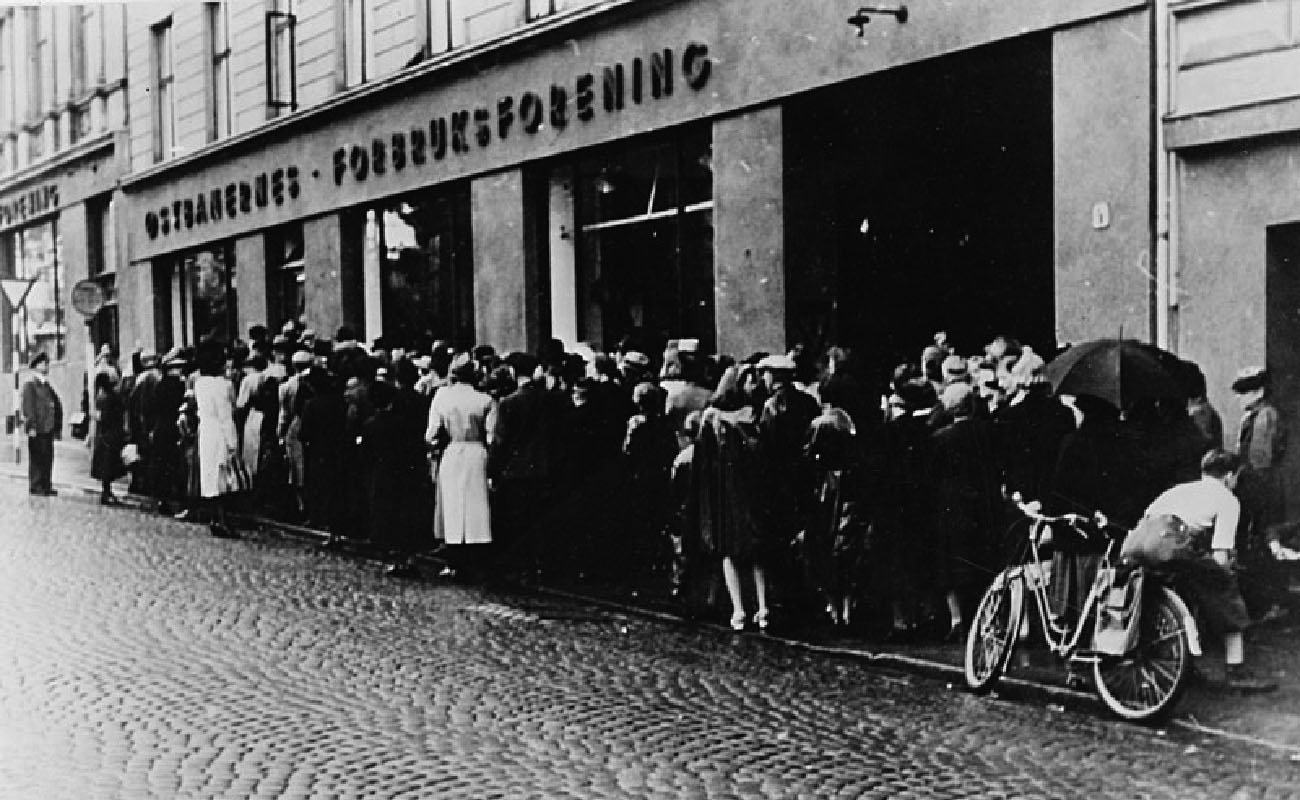
(credit: modification of work “Oslo queue ww2” by United States Library of Congress's Prints and Photographs division/Wikimedia Commons, Public Domain) · Public Domain
Figure 13.14 Because occupied Norway’s production was redirected to supplying German needs, Norwegians lined up for scarce and rationed goods in Oslo in 1942. (credit: modification of work “Oslo queue ww2” by United States Library of Congress's Prints and Photographs division/Wikimedia Commons, Public Domain)
図13.14 占領下のノルウェーでは、生産物がドイツの需要を満たすために回された。1942年のオスロで、不足し配給制となった物資を求めて並ぶノルウェー人。(クレジット:米国議会図書館版画写真部門/Wikimedia Commons「Oslo queue ww2」を改変。パブリックドメイン)
Where economies were less modern, it was difficult to increase production. Laborers were lost, either through death or because they were sent to Germany to work. As many as twelve million forced laborers from twenty different countries, mostly in eastern and central Europe, fell under German control, further depressing the production of civilian goods. Despite German hopes, eastern Europe exported to Germany only 800,000 tons of bread over the course of the war, and hunger and starvation became common experiences for resident populations. In Greece, the appropriation of foodstuffs led to a famine that killed a quarter of a million people in the winter of 1941–1942, including 90 percent of the babies born.
英語のヒント
経済の近代化があまり進んでいない地域では、生産を増やすことが難しかった。労働者は死亡したり、ドイツへ送られて働かされたりして失われた。主に東・中央ヨーロッパの20カ国から、最大1200万人の強制労働者がドイツの支配下に置かれたため、民需品の生産はさらに落ち込んだ。ドイツの期待に反し、東ヨーロッパが戦争中にドイツへ輸出したパンは80万トンにとどまり、現地住民にとって飢えと餓死が日常的な経験となった。ギリシャでは食料の接収によって飢饉が生じ、1941〜1942年の冬に25万人が死亡した。その中には、その時期に生まれた乳児の90パーセントが含まれた。
Across the globe, the rationing of food and products useful to the war effort affected life on the home fronts. The Germans instituted a four-year economic plan in 1936, and rationing began in August 1939. The first few years of the war brought little change in their standard of living, but by early 1945, rationing had grown uncomfortably tight. The Italians too had to adjust to rationing, which began in 1939 and progressively diminished the standard of living. In 1943, major labor strikes took place in protest against these measures in Italy, even in war-related industries. In the Soviet Union, the loss of Ukraine and other grain-producing areas necessitated strict rationing. China’s agricultural economy had been severely disrupted by the Japanese invasion in the 1930s, and the war did little to improve the situation. Food shortages in Japan were severe, and by 1944, the population was surviving on eight ounces of rice a day.
英語のヒント
世界各地で、食料や戦争遂行に役立つ製品の配給が、銃後の暮らしに影響した。ドイツは1936年に経済四カ年計画を導入し、1939年8月に配給を始めた。開戦後の数年間、生活水準に大きな変化はなかったが、1945年初めには配給量が苦痛を感じるほど厳しくなっていた。イタリア人も、1939年に始まり、生活水準を次第に下げた配給制に適応しなければならなかった。1943年には、これらの措置に抗議する大規模な労働争議がイタリアで起こり、軍需産業にまで広がった。ソ連では、ウクライナなどの穀物産地を失ったため、厳しい配給が必要になった。中国の農業経済は1930年代の日本の侵攻でひどく混乱し、戦争が状況を改善することはほとんどなかった。日本の食料不足も深刻で、1944年には国民は1日8オンスの米で生き延びていた。
Rationing was a fact of life in Allied countries as well. In Britain in 1939, oil and gasoline were rationed first, then a year later foods such as bacon, butter, meat, cheese, and eggs were rationed. In 1940, the Ministry of Food established canteens in factories and schools throughout the country to provide food and regulate its distribution. In the United States, the Office of Price Administration had been established in August 1941. It commenced rationing sugar, meat, butter, gasoline, tires, and canned goods three weeks after Pearl Harbor.
英語のヒント
連合国でも配給は日常の一部だった。イギリスでは1939年にまず石油とガソリンが配給され、その1年後にはベーコン、バター、肉、チーズ、卵などの食品も配給された。1940年、食糧省は、食事を提供し、その配分を調整するため、全国の工場と学校に食堂を設けた。米国では、1941年8月に価格管理局が設置されていた。同局は真珠湾攻撃の3週間後、砂糖、肉、バター、ガソリン、タイヤ、缶詰の配給を始めた。
Many nations sent their children abroad to safer areas. During the blitz of London, one million British children were evacuated to the countryside or to Canada. By 1942, the Germans, the Soviets, and the Japanese had sent hundreds of thousands of children out of their major cities, and sometimes their civilian parents as well.
英語のヒント
多くの国が、子どもを国外のより安全な地域へ送った。ロンドンへの集中空襲の間、100万人のイギリスの子どもが、地方やカナダへ疎開した。1942年までにドイツ、ソ連、日本も、数十万人の子どもを大都市から避難させ、ときにはその民間人の親も避難させていた。
The governments of nearly all the combatants sooner or later assumed command of their economies to direct labor and resources to their war efforts. As early as the mid-1920s, the Italian government had begun direct intervention in the economy, and by 1939, Italy had the second-highest percentage of state-owned enterprises in the world; only the Soviet Union had more. The Soviets had instituted state control and a centrally commanded economy in 1928 with the goal of industrializing rapidly. When the Germans attacked, about a third of the western portion of the nation, with most of the Soviet industrial base, fell into German hands. In anticipation of a conflict with capitalist nations, the Soviets had begun to establish industrial bases east of the Ural Mountains. During World War II, they intensified their efforts to save their industrial centers and moved twenty-five hundred factories and twenty-five million people east of the Urals, out of reach of the Wehrmacht. Steadily, Soviet productive capacity regained its balance and began to achieve impressive results.
英語のヒント
ほぼすべての交戦国政府は、遅かれ早かれ、労働力と資源を戦争遂行へ向けるため、経済の指揮権を握った。イタリア政府は早くも1920年代半ばから経済への直接介入を始め、1939年には国有企業の比率が世界で2番目に高くなっていた。上回るのはソ連だけだった。ソ連は急速な工業化を目標に、1928年に国家統制と中央指令型の経済を導入していた。ドイツ軍が攻撃すると、ソ連の工業基盤の大半を抱える西部地域の約3分の1がドイツの手に落ちた。ソ連は資本主義諸国との紛争を見越して、ウラル山脈の東に工業拠点を設け始めていた。第二次世界大戦中には、工業の中心地を救う取り組みを強め、2500の工場と2500万人を、ドイツ国防軍の手の届かないウラル山脈以東へ移した。ソ連の生産力は着実に均衡を取り戻し、目覚ましい成果を上げ始めた。
Germany’s four-year plan, begun in 1936, carried them into the early stages of the war, and in 1942 the economy was kicked into high gear. The Luftwaffe had taken delivery of 8,300 aircraft in 1939, a number that exploded to a peak of 39,800 by 1944. British factories similarly began turning out tens of thousands of planes in the last years of the war. The Japanese shifted to turning out planes to defend the nation from air attacks, and work on battleships and cruisers ceased altogether.
英語のヒント
1936年に始まったドイツの四カ年計画は、戦争の初期まで経済を支え、1942年には経済が本格的な高稼働態勢へ移された。ドイツ空軍が1939年に受領した航空機は8300機だったが、1944年には3万9800機という最高値へ急増した。イギリスの工場も、戦争の最後の数年間には数万機の航空機を生産するようになった。日本は空襲から国を守る航空機の生産へ転換し、戦艦や巡洋艦の建造は完全に止まった。
Government efforts to spur production led to nearly full employment in many nations. In the United States, unemployment dropped from 15 percent in 1939 to 1 percent in 1943 as seventeen million new civilian jobs were created. Workers achieved a nearly 100 percent increase in productivity and output. All these changes transformed the human landscape as workers from across the United States, and increasingly women and African Americans from the south, were drawn into defense industry work. Half the world’s war production came from the United States. The Lend-Lease program sent material and foodstuffs to forty Allied nations, mainly Britain and the Soviet Union but also other nations from Brazil and Belgium to Iran and Uruguay.
英語のヒント
政府の生産促進策によって、多くの国がほぼ完全雇用に達した。米国では1700万人分の新しい民間雇用が生まれ、失業率は1939年の15パーセントから、1943年には1パーセントへ下がった。労働者の生産性と生産量は、ほぼ100パーセント増加した。米国各地の労働者、さらに次第に多くの女性や南部のアフリカ系米国人が軍需産業の仕事に引き寄せられ、人々の分布や暮らしは大きく変わった。世界の軍需生産の半分は米国が担った。武器貸与計画は、主にイギリスとソ連をはじめ、ブラジル、ベルギーからイラン、ウルグアイまで、連合国40カ国に物資と食料を送った。
Total war meant that the enemy’s productive capabilities were fair targets for destruction. While the air raids on Britain often targeted civilian locations, the Allies initially attempted a program of strategic bombing of Axis locations in Europe. The plan was to disrupt industrial production, though reality often fell short of this goal. Bombs missed targets and hit purely civilian ones or simply did not inflict the necessary damage on a factory. Naples sustained nearly two hundred attacks from 1940 to 1944. The Royal Air Force conducted nighttime bombing campaigns over German cities, similar to those Germany carried out over England. The multiday attacks on Dresden by more than one thousand British and U.S. bombers in February 1945 dropped high explosives and firebombs on the center of the city, destroying most of it and killing more than twenty-five thousand people. Some of these bombing runs were deliberately aimed at civilian targets.
英語のヒント
総力戦では、敵の生産能力も正当な破壊目標と見なされた。イギリスへの空襲がしばしば民間の場所を狙ったのに対し、連合国は当初、ヨーロッパの枢軸国拠点を戦略爆撃する計画を試みた。狙いは工業生産の妨害だったが、現実はしばしば目標に届かなかった。爆弾は狙いを外れて純粋な民間目標を直撃したり、工場に必要な損害を与えられなかったりした。ナポリは1940年から1944年までに、約200回の攻撃を受けた。イギリス空軍は、ドイツがイギリスに行ったものと同様に、ドイツの都市へ夜間爆撃を実施した。1945年2月、1000機を超える英米の爆撃機による数日間のドレスデン空襲では、都市中心部へ高性能爆薬の爆弾と焼夷弾を投下し、その大半を破壊し、2万5000人を超える人々を殺した。これらの爆撃の一部は、意図的に民間目標を狙ったものだった。
The danger air raids posed to civilians was clear. Air raids killed 60,000 British people and injured 86,000 during the Battle of Britain. Nationwide German wartime losses reached 305,000 killed and 800,000 injured, with five million rendered homeless. The Allied bombing of Japan was severe as well. The U.S. Air Force destroyed sixty-nine Japanese cities. The March 1945 raid on Tokyo alone killed between 80,000 and 100,000 people and destroyed the homes of a million more. By 1945, Japan was on the verge of economic collapse.
英語のヒント
空襲が民間人にもたらす危険は明らかだった。バトル・オブ・ブリテンの間、空襲によってイギリス人6万人が死亡し、8万6000人が負傷した。ドイツ全土の戦時被害は、死者30万5000人、負傷者80万人に達し、500万人が家を失った。日本への連合国の爆撃も激しかった。米空軍は日本の69都市を破壊した。1945年3月の東京大空襲だけで8万〜10万人が死亡し、さらに100万人の住まいが破壊された。1945年までに、日本は経済崩壊の瀬戸際に立っていた。
But life was more than just working in war plants and rationing. Everywhere people tried to maintain some semblance of ordinary life through diversions and entertainment. Radio programming kept them informed and entertained. In England, “We’ll Meet Again,” probably the most popular wartime song, came out in 1939. The Germans banned jazz, but wherever they went, U.S. soldiers, known as GIs, introduced locals to jazz and the jitterbug, popular back in the States.
英語のヒント
しかし、暮らしは軍需工場での労働と配給だけではなかった。どこでも人々は、気晴らしや娯楽を通じて、少しでも日常らしさを保とうとした。ラジオ番組は人々に情報と楽しみを届けた。イギリスでは1939年、おそらく戦時中に最も人気を博した歌「We’ll Meet Again」が発表された。ドイツはジャズを禁じたが、GIと呼ばれた米国の兵士たちは、行く先々で、本国で人気のあったジャズとジルバを現地の人々に紹介した。
Movies were produced everywhere as both propaganda and distraction. German, Italian, Japanese, and Soviet films leaned heavily toward propaganda. Most German films were pro-war and heroic in theme, with significant portions of anti-Semitic propaganda. In general, the Japanese discouraged distractions from the war effort. Bars had their hours cut to restrict frivolous activities, but movie houses remained open. Japanese pro-war and propagandistic movies began to appear as early as 1937, starting with Marching Song about the fighting in China. Beginning in 1941 and often thereafter, many Japanese movies focused on Koreans who volunteered and heroically served the greater cause of Japan. Movie theater attendance in Britain increased 50 percent in 1944 and 1945, and in the United States it also reached new highs.
英語のヒント
映画はどこでも、宣伝と気晴らしの両方のために作られた。ドイツ、イタリア、日本、ソ連の映画は、宣伝色が強かった。ドイツ映画の多くは戦争を支持し、英雄的な主題を扱い、反ユダヤ宣伝もかなりの部分を占めた。日本では概して、戦争遂行から注意をそらす娯楽は抑えられた。軽薄と見なされた活動を制限するため、酒場の営業時間は短縮されたが、映画館は営業を続けた。日本では早くも1937年、中国での戦闘を扱う『進軍の歌』から、戦争を支持する宣伝映画が登場し始めた。1941年以降、多くの映画が、日本の大義のために志願し、英雄的に尽くす朝鮮人を取り上げた。イギリスの映画館入場者数は1944年と1945年に50パーセント増え、米国でも新たな最高値に達した。
The Japanese attack on Pearl Harbor had unleashed a cascade of racist assumptions about the Japanese, and it was generally feared that Japanese Americans living in the United States might engage in espionage or sabotage. Executive Order 9066, issued by President Roosevelt in February 1942, authorized West Coast military commanders to exclude from designated military areas anyone deemed a threat to national security. It thus allowed the widespread forced relocation of tens of thousands of Japanese and Japanese American families into ten relocation camps administered by the War Relocation Authority from 1942 until 1946 (Figure 13.15).
英語のヒント
日本の真珠湾攻撃は、日本人に対する人種差別的な思い込みを一気に噴き出させた。米国内に暮らす日系米国人が、諜報活動や破壊工作に関わるのではないかという恐れが広まった。1942年2月にローズヴェルト大統領が出した大統領令9066号は、西海岸の軍司令官に対し、国家の安全への脅威と判断した者を、指定された軍事地域から排除する権限を与えた。この命令により、日本人と日系米国人の何万もの家族が、広い範囲から強制的に立ち退かされ、10カ所の収容所へ移された。これらの収容所は、1942年から1946年まで戦時転住局が管理した(図13.15)。
The Enforcement of U.S. Executive Order 9066.米大統領令9066号の実施
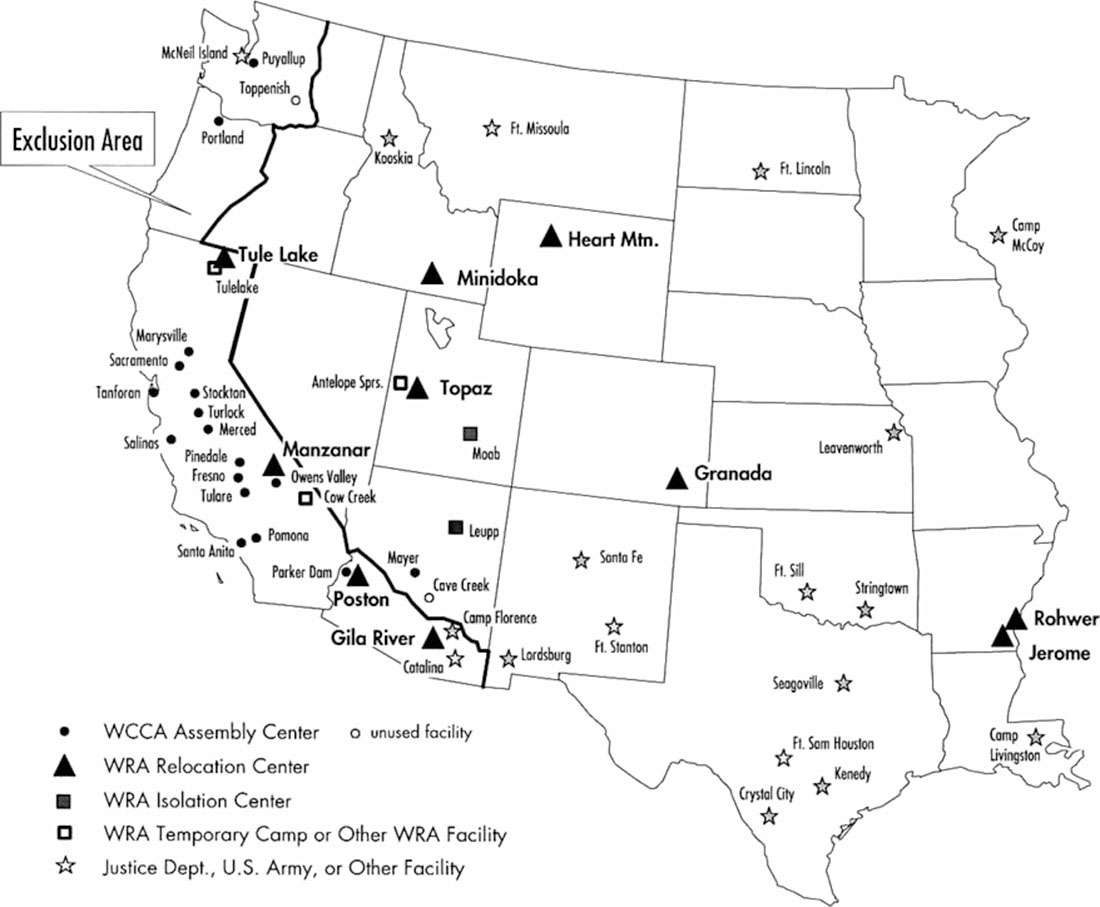
(credit: “Map of World War II Japanese American internment camps” by National Park Service/Wikimedia Commons, Public Domain) · Public Domain
Figure 13.15 This map shows the sites of relocation camps set up for forcibly displaced Japanese Americans during World War II. (credit: “Map of World War II Japanese American internment camps” by National Park Service/Wikimedia Commons, Public Domain)
図13.15 第二次世界大戦中、強制的に立ち退かされた日系米国人のために設けられた収容所の位置を示す地図。(クレジット:米国国立公園局/Wikimedia Commons「Map of World War II Japanese American internment camps」。パブリックドメイン)
The internees at these camps, many of them U.S. citizens, were forced to abandon their homes and businesses, and most never recovered them. Conditions in the camps were bleak. Families were separated, and men were often sent to different locations for investigation and interrogation. Most internees complied, many desiring to show their loyalty to the United States. Some even volunteered for and were later enlisted in the army. Others, however, felt betrayed and denounced the United States. An even smaller group were deemed recalcitrant and repatriated to Japan during and after the war.
英語のヒント
収容された人々の多くは米国市民だったが、住まいや商売を手放すことを強いられ、その大半は二度と取り戻せなかった。収容所の環境は厳しかった。家族は引き離され、男性は調査や尋問のため別の場所に送られることも多かった。被収容者の大半は命令に従い、その多くは米国への忠誠を示したいと考えていた。自ら志願し、後に陸軍に入った人もいた。しかし、裏切られたと感じ、米国を非難した人もいた。さらに少数の人々は反抗的だと判断され、戦中・戦後に日本へ送還された。
In 1944, the U.S. Supreme Court upheld the constitutionality of the relocation, but in the early 1980s, the federal court system reconsidered the issue. Several Japanese Americans who had been convicted for not complying with the executive order in the 1940s saw their convictions overturned, and in one case vacated. Fred Korematsu, a U.S. citizen, had been arrested in 1942 for defying the exclusion order and fought the abridgment of his civil liberties for forty years. His was one of the convictions finally overturned in the 1980s. In 1988, the U.S. government formally apologized to the people who had been interned and awarded $20,000 in reparations to each survivor. In an interview in 2000, Korematsu said, “[Quotation omitted for rights reasons.]”
英語のヒント
1944年、米連邦最高裁は強制移転を合憲とする判断を支持したが、1980年代初めに連邦裁判所でこの問題が再検討された。1940年代に大統領令に従わなかったことで有罪となった日系米国人のうち、何人かは有罪判決を覆され、ある事件では判決そのものが取り消された。米国市民のフレッド・コレマツは、排除命令に従わなかったため1942年に逮捕され、市民的自由の制限と40年にわたって闘った。彼も、1980年代にようやく有罪判決が覆された一人だった。1988年、米国政府は強制収容された人々に正式に謝罪し、生存者一人当たり2万ドルの補償金を支給した。2000年のインタビューで、コレマツは次のように述べた。〔権利の関係で割愛〕
While most Latin American countries did not participate in combat in the war (Brazil was an exception), none could avoid the harsh realities of the conflict. All became more dependent on trade with the United States and were subject to the shortages, rationing, and price controls that came along with the dearth of needed items on the home front. Some areas saw increased economic opportunity at home, such as Panama, where the canal had become extremely busy during the war as goods were transferred from ocean to ocean.
英語のヒント
ラテンアメリカの大半の国は戦争で戦闘に参加しなかったが、ブラジルは例外だった。とはいえ、どの国も紛争の厳しい現実から逃れることはできなかった。どの国も米国との貿易への依存を深め、銃後で必要な物資が欠乏するのに伴って、物不足、配給、価格統制の影響を受けた。国内で経済的な機会が増えた地域もあった。たとえばパナマでは、物資が一つの大洋からもう一つへ運ばれたため、戦時中、運河の交通が非常に活発になった。