第13章第二次世界大戦の原因と結果The Causes and Consequences of World War II
Hiroshima and Nagasaki広島と長崎
Early in 1945, the Japanese army and navy agreed to adopt the first joint operational plan in their histories. Operation Ten-go (“heaven”) called for suicide attacks by land and air units for defense in the Pacific, and a month later these attacks were combined with the shukketsu (“bleeding”) strategy in the Battle of Iwo Jima.
英語のヒント
1945年初め、日本の陸海軍は、両軍の歴史で初めての共同作戦計画を採用することに同意した。天号作戦は、太平洋での防衛のため、陸上部隊と航空部隊による自殺的な攻撃を求めるものだった。その1カ月後、硫黄島の戦いでは、これらの攻撃が「出血」戦略と組み合わされた。
Throughout the war, the Japanese had believed that high casualties would dishearten U.S. troops, who they felt could not tolerate suffering and loss. On Iwo Jima, the Japanese sacrificed twenty-one thousand soldiers and inflicted twenty-six thousand casualties on U.S. Marines (seven thousand were killed and the rest wounded). But the U.S. troops persisted and again absorbed high casualties as they later captured Okinawa. Japan’s struggle for Okinawa included the use of the island’s civilians, resulting in the death of 100,000 and demonstrating the resolve to be expected from the Japanese in defense of their main islands (Figure 13.18).
英語のヒント
日本側は戦争を通じて、大きな損害を与えれば米軍の士気をくじけると考えていた。米兵は苦痛と損失に耐えられないと思っていたのである。硫黄島では、日本側は2万1000人の兵士を犠牲にし、米海兵隊に2万6000人の死傷者を出させた。そのうち7000人が戦死し、残りは負傷者だった。しかし米軍は戦い続け、その後の沖縄攻略でも再び大きな損害を受けながら前進した。沖縄での日本側の戦闘には島の民間人も巻き込まれ、10万人が死亡した。これは、日本本土の防衛で日本側にどれほどの決意が予想されるかを示すものだった(図13.18)。
Japanese Women on the Home Front.銃後の日本女性
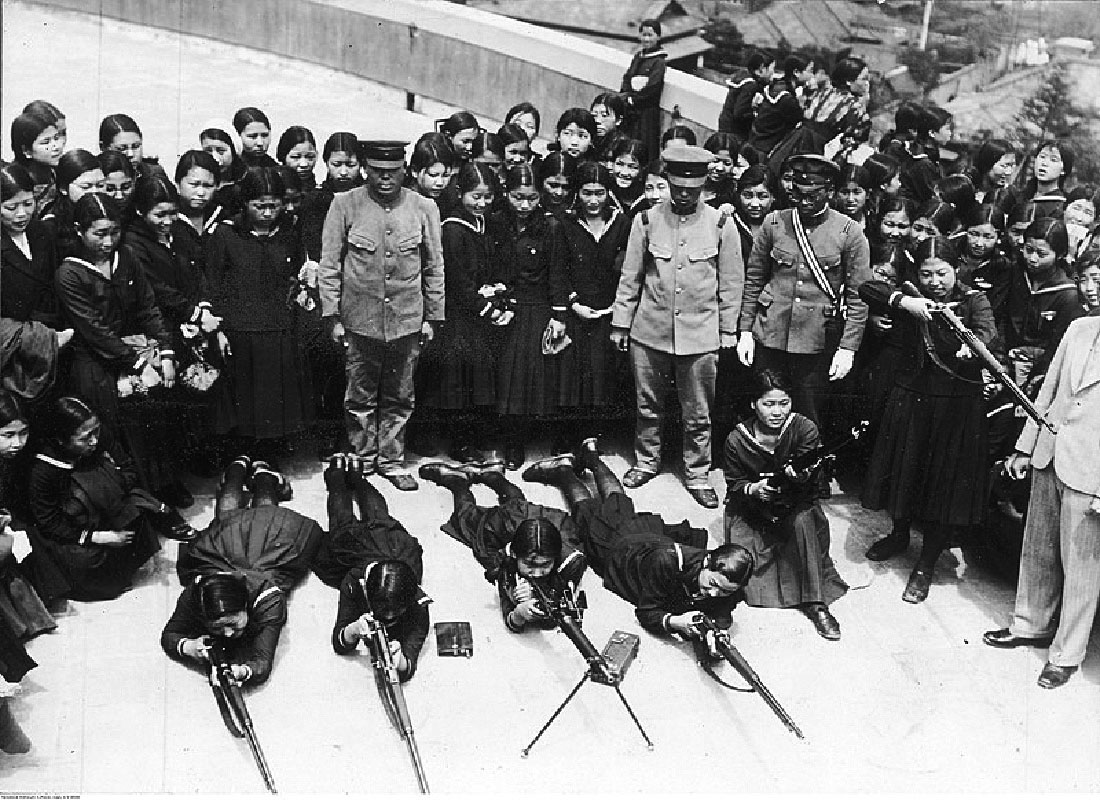
(credit: “Kokumin Giyutai” by Unknown/Wikimedia Commons, Public Domain) · Public Domain
Figure 13.18 Japanese female students receive weapons training in 1945. (credit: “Kokumin Giyutai” by Unknown/Wikimedia Commons, Public Domain)
図13.18 1945年、武器の扱いの訓練を受ける日本の女子学生たち。(クレジット:作者不明/Wikimedia Commons「Kokumin Giyutai」。パブリックドメイン)
The slogan gyokusai (“honorable death”), combined with shukketsu and commitment to the emperor, was exemplified by the kamikaze or suicide pilots, essentially human bombs trying to fend off U.S. naval forces. In the face of such near-fanatical defensive efforts, U.S. secretary of war Henry L. Stimson and General George C. Marshall, the U.S. Army chief of staff, estimated that an invasion of Japan could cost between 500,000 and one million U.S. casualties and last well into 1946. President Truman was briefed on these estimates, and they were widely discussed among the military planning circles and staff. Japan’s leaders, however, refused to consider an unconditional surrender that, among other things, may have led to the emperor’s being tried for war crimes. They came to the conclusion that an invasion of the home islands was inevitable. Private and secret initiatives were floated to persuade the Soviet Union to mediate with the United States and Britain to end the war.
英語のヒント
「名誉ある死」を意味する玉砕という標語は、「出血」戦略や天皇への献身と結びつき、神風、すなわち特攻の操縦士たちに体現された。彼らは実質的に、米海軍を食い止めようとする人間爆弾だった。このような狂信に近い防衛努力を前に、米陸軍長官ヘンリー・L・スティムソンと陸軍参謀総長ジョージ・C・マーシャル将軍は、日本侵攻による米軍の死傷者が50万〜100万人に達し、戦闘が1946年のかなり遅い時期まで続く可能性があると見積もった。トルーマン大統領はこれらの推計の説明を受け、軍の計画担当者や幕僚の間でも広く議論された。しかし日本の指導者たちは、天皇が戦争犯罪で裁かれることにもつながりかねない無条件降伏を、検討することを拒んだ。彼らは本土侵攻が避けられないと結論づけた。戦争を終わらせるため、ソ連に米英との仲介を求める、非公式で秘密の働きかけも持ち出された。
Between July 17 and August 2, 1945, the final Allied summit conference took place at Potsdam, a suburb of Berlin. This time, Harry S. Truman replaced the late Franklin Roosevelt, and Winston Churchill was replaced by Britain’s newly elected prime minister Clement Attlee. Truman was already troubled by Soviet actions in Europe. He disliked the concessions Roosevelt had made that allowed the Soviets to install a communist government in Poland. He also disapproved of Stalin’s plans, made known at the Yalta Conference, to demand large reparations from Germany. Truman feared the resulting burden on Germany might lead to another cycle of rearmament and aggression.
英語のヒント
1945年7月17日から8月2日まで、最後の連合国首脳会談が、ベルリン近郊のポツダムで開かれた。今回は、亡くなったフランクリン・ローズヴェルトに代わってハリー・S・トルーマンが出席し、ウィンストン・チャーチルも、選挙で新たに選ばれたクレメント・アトリー首相に交代した。トルーマンはすでに、ヨーロッパでのソ連の行動に不安を抱いていた。ローズヴェルトが譲歩し、ソ連にポーランドへの共産主義政権樹立を認めたことを好ましく思っていなかった。また、ヤルタ会談で明らかになった、ドイツに多額の賠償を求めるスターリンの計画にも反対した。その負担がドイツを再軍備と侵略の新たな循環へ追い込むのではないかと、トルーマンは恐れた。
After issuing a demand for the unconditional surrender of Japan, the conference turned toward the fate of postwar Europe. The Allied leaders agreed to demilitarize Germany and to divide the conquered nation and its capital of Berlin into four occupation zones: three in the west to be controlled by Britain, France, and the United States, and one in the east for the USSR. An Allied Control Council was created to administer occupied Germany, though the choice to make the council’s decisions unanimous later proved unrealistic. The German economy was to be decentralized and focused on agriculture and nonmilitary industries.
英語のヒント
日本の無条件降伏を求める要求を出した後、会談は戦後ヨーロッパの行方へ議題を移した。連合国首脳は、ドイツを非軍事化し、征服したドイツと首都ベルリンを四つの占領地区に分割することで合意した。西側の三地区はイギリス、フランス、米国が、東側の一区はソ連が管理する。占領下のドイツを統治する連合国管理理事会が設けられたが、決定を全会一致とする方針は、後に非現実的だと分かった。ドイツ経済は分権化し、農業と非軍事産業に重点を置くこととされた。
The debates about reparations stemming from the Yalta Conference were settled with a plan to exchange Germany’s western industrial production for its eastern agricultural production. In practice, however, this plan led to economic policies being instituted and managed by zones rather than for the nation as a whole, creating further disunity among the Allies. Finally, a program of denazification for Germany and Austria was confirmed that included punishment of war criminals. The settlement of the final borders of Poland was postponed, but Britain and the United States agreed to the transfer of designated German territory to Poland.
英語のヒント
ヤルタ会談以来の賠償をめぐる論争は、ドイツ西部の工業生産物と東部の農業生産物を交換する計画で決着した。しかし実際には、この計画は、ドイツ全体ではなく、占領地区ごとに経済政策を導入・運営することにつながり、連合国間の分裂をさらに深めた。最後に、戦争犯罪人の処罰を含む、ドイツとオーストリアの非ナチ化計画が確認された。ポーランドの最終的な国境の確定は先送りされたが、英米は、指定されたドイツ領をポーランドへ移すことに同意した。
Truman had known little about the Manhattan Project before becoming president and now relied on the advice of his experts. They shared a widely held faith in the justice of the U.S. cause and accepted technological approaches to ending the war. Informed of the success of the Trinity Test while at the conference, Truman noted his thinking about using the bomb in his July 25, 1945, diary entry. He favored using it only against military targets, not civilian ones:
英語のヒント
トルーマンは大統領になるまでマンハッタン計画についてほとんど知らず、今は専門家の助言に頼っていた。彼らは、米国の大義は正しいという広く共有された信念を持ち、戦争を終わらせるための技術的な手段を受け入れていた。会談中にトリニティ実験の成功を知らされたトルーマンは、1945年7月25日の日記に、原爆使用についての考えを記した。民間の目標ではなく、軍事目標にだけ使うことを望んでいた。
This weapon is to be used against Japan between now and August 10. I have told the secretary of war, Mr. Stimson, to use it so that military objectives and soldiers and sailors are the target and not women and children. Even if Japs are savages, ruthless, merciless, and fanatic, we as the leader of the world for the common welfare cannot drop this terrible bomb on the old capital or the new. He and I are in accord. The target will be a purely military one and we will issue a warning statement asking the Japs to surrender and save lives. I’m sure they will not do that, but we will have given them the chance. It is certainly a good thing for the world that Hitler’s crowd or Stalin’s did not discover this atomic bomb. It seems to be the most terrible thing ever discovered, but it can be made the most useful.
英語のヒント
この兵器は、今から8月10日までの間に日本に対して使うことになっている。私はスティムソン陸軍長官に、女性や子どもではなく、軍事目標と陸海軍の兵士を標的として使うよう伝えた。ジャップども〔原文の日本人蔑称〕が野蛮で、残酷で、無慈悲で、狂信的であっても、共通の福祉を目指す世界の指導者たるわれわれは、この恐ろしい爆弾を旧都にも新しい首都にも落とすことはできない。彼と私は同意見である。目標は純粋に軍事的なものとし、日本人に降伏して命を救うよう求める警告声明を出す。彼らは応じないだろうと確信しているが、それでも、われわれは彼らに機会を与えたことになる。ヒトラーやスターリンの一味がこの原子爆弾を発見しなかったことは、世界にとって確かによいことだ。これは、これまでに発見された中で最も恐ろしいもののように思えるが、最も有用なものにもできる。
The bomb was used, first against Hiroshima on August 6, 1945, and three days later on Nagasaki, both cities populated by civilians including women and children.
原爆はまず1945年8月6日に広島へ、3日後には長崎へ投下された。どちらも、女性や子どもを含む民間人が暮らす都市だった。
A variety of factors likely influenced Truman in making his decision. The desire to save American lives perhaps played the greatest role. The desire to justify the expense of the Manhattan Project also likely influenced him. Some have suggested that Truman hoped to demonstrate to the Soviet Union the technological superiority of the United States. Others believe that a desire for revenge for Pearl Harbor also played a role. Some have suggested that a long history of anti-Asian sentiment in the United States made the use of the atomic bomb against Japan seem less horrific than its use against Europeans would have been.
英語のヒント
トルーマンの決断には、さまざまな要因が影響したと考えられる。米国人の命を救いたいという思いが、おそらく最も大きな役割を果たした。マンハッタン計画の費用を正当化したいという思いも、影響した可能性が高い。トルーマンはソ連に米国の技術的優位を示したかったのだと指摘する人もいる。真珠湾への報復願望も役割を果たしたと考える人もいる。また、米国に長く続く反アジア感情が、日本への原爆使用を、ヨーロッパ人への使用ほど恐ろしいことに見えなくしたのではないか、という指摘もある。
Little Boy, as the first atomic bomb was called, was dropped on Hiroshima from the U.S. bomber the Enola Gay. Survivors referred to August 6 as “the day of two suns”; the blast was so bright that it burned the shadows of victims into walls and concrete. More than seventy thousand people were killed instantly. Immediately afterward, the sky turned purple and gray, even black, from the dust and debris suspended in the air. Hundreds of wooden and paper houses were ignited. Thousands of shocked and confused people whose flesh had burned off began roaming about, almost instinctively moving toward any pool or stream of water. Over the following days, months, and even years, people continued to succumb to their wounds and injuries, bringing the total deaths to more than 100,000. Three days later, Fat Man, the second bomb, similarly descended upon Nagasaki, killing forty thousand Japanese immediately. Including the aftermath, deaths there totaled seventy thousand.
英語のヒント
最初の原子爆弾は「リトルボーイ」と呼ばれ、米爆撃機エノラ・ゲイから広島へ投下された。生存者は8月6日を「二つの太陽の日」と呼んだ。閃光は非常に強く、犠牲者の影が壁やコンクリートに焼き付いた。7万人以上が即死した。直後、空は浮遊するほこりや瓦礫のために紫色や灰色に、さらには黒く変わった。木材と紙でできた何百もの家に火が付いた。皮膚が焼け落ちた何千人もの人々が、衝撃と混乱の中でさまよい始め、ほとんど本能的に、水のたまった場所や流れへ向かった。その後、数日、数カ月、さらには何年にもわたり、傷や障害によって人々は亡くなり続け、死者の総数は10万人を超えた。3日後、2発目の原爆「ファットマン」が同じように長崎へ落とされ、日本人4万人を即死させた。後に亡くなった人を含め、長崎の死者は7万人に達した。
Meanwhile, keeping the promise made at Yalta, after the bombing of Hiroshima the Soviets broke their nonaggression pact with Japan and invaded Manchukuo and Korea. Japanese defenses there quickly crumbled in the face of tens of thousands of casualties, ending any hope that the Soviets might act as an intermediary in some negotiated settlement with the Allies. Japan surrendered shortly after.
英語のヒント
一方、ソ連はヤルタでの約束を守り、広島への原爆投下後、日本との不可侵条約を破って、満州国と朝鮮へ侵攻した。日本側の防衛は、数万人の死傷者を出す中で急速に崩れ、ソ連が連合国との何らかの交渉による解決を仲介してくれるという望みは失われた。その後まもなく、日本は降伏した。