第13章第二次世界大戦の原因と結果The Causes and Consequences of World War II
East Asia and the Pacific東アジアと太平洋
When the Japanese invaded the Philippines beginning in December 1941, the limited U.S. and Filipino forces put up stiff resistance in jungle fighting. Outnumbered, however, they surrendered their positions on the Bataan Peninsula on April 9, 1942. The command headquarters surrendered at Corregidor Island nearly a month later. The resulting sixty-mile forced march to an internment camp led to the deaths of more than a quarter of the estimated eighty thousand Allied prisoners and became known as the Bataan Death March. Over the course of the war, the Japanese held approximately 140,000 Allied troops under severe conditions at various camps in the Greater East Asia Co-Prosperity Sphere and on the Japanese home islands. By the end of the war, as many as thirty thousand had perished there.
英語のヒント
1941年12月に日本軍がフィリピンへの侵攻を開始すると、兵力に限りのある米軍とフィリピン軍は、密林の戦闘で激しく抵抗した。しかし数で劣り、1942年4月9日にバターン半島の陣地で降伏した。司令部は約1カ月後、コレヒドール島で降伏した。その後、収容所までの60マイルの強制行進で、推定8万人の連合軍捕虜の4分の1以上が死亡した。これは「バターン死の行進」として知られるようになった。戦争中、日本は大東亜共栄圏の各地や日本本土の収容所に、約14万人の連合軍兵士を過酷な条件で拘束した。終戦までに、最大で3万人がそこで死亡した。
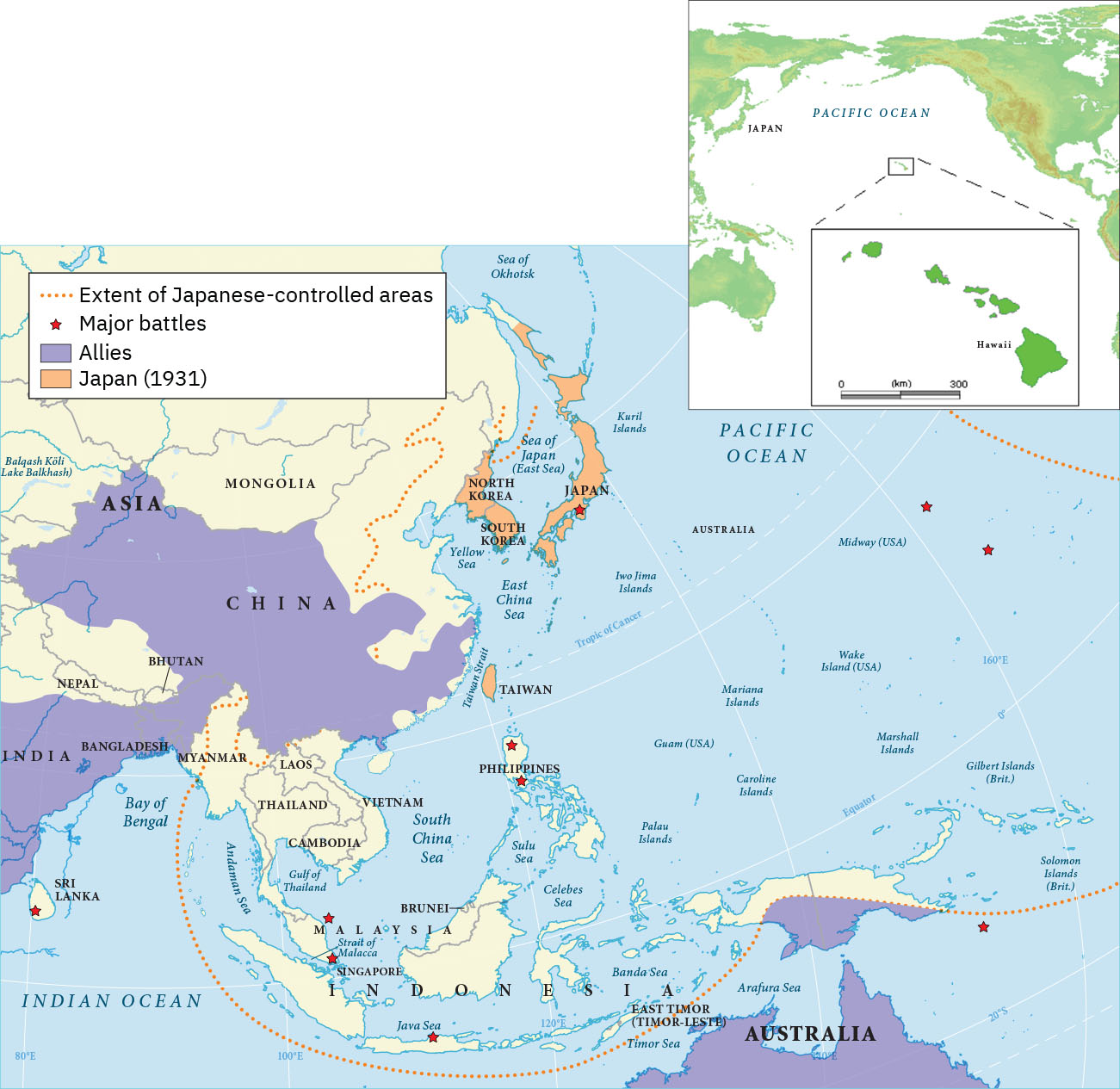
Five months into 1942, the Japanese had gathered a significant portion of Burma, Malaya and the Straits Settlements, Indonesia, French Indochina, and the Philippines into the Greater East Asia Co-Prosperity Sphere (Figure 13.12). While deconstructing White colonial rule, the Japanese began to systematically exploit the liberated areas for their resources in support of a greater Japan. However impressive the Greater East Asia Co-Prosperity Sphere was on paper, however, the Japanese military and civilian administrators were hard-pressed to solve significant problems. The extent of the area under control and the size of the captive population presented governance issues, while geography severely strained communication and transportation networks. Puppet regimes were an attempt to solve some of these problems, such as the collaborationist regime in China under Wang Jingwei in 1940, the Ba Maw government in Burma during the Japanese occupation, and the administration of José P. Laurel in the defeated Philippines.
英語のヒント
1942年に入って5カ月で、日本はビルマのかなりの地域、マラヤと海峡植民地、インドネシア、フランス領インドシナ、フィリピンを大東亜共栄圏に組み込んでいた(図13.12)。白人の植民地支配を解体する一方、日本は大日本帝国を支えるため、「解放」した地域の資源を組織的に搾取し始めた。しかし、大東亜共栄圏が紙の上ではどれほど壮大に見えても、日本の軍人・文官の統治担当者は、重大な問題の解決に苦しんだ。支配地域の広さと支配下の人口の多さが統治上の難題を生み、地理的条件が通信・輸送網に重い負担をかけた。傀儡政権の設置は、その一部を解決しようとする試みだった。1940年に中国で成立した汪兆銘の対日協力政権、日本占領下のビルマのバー・モウ政府、敗北したフィリピンでのホセ・P・ラウレル政権などがその例である。
Japan in the Pacific Theater.太平洋戦域の日本
(attribution: Copyright Rice University, OpenStax, under CC BY 4.0 license; credit upper-right: modification of work "Locator map of the Big island of Hawaiʻi" by M. Minderhoud/Wikimedia Commons, Public Domain) · CC BY 4.0 + Public Domain
Figure 13.12 Between 1937 and 1942, Japan launched attacks against and gained control of far-flung territory throughout East Asia, Southeast Asia, and the Pacific. (attribution: Copyright Rice University, OpenStax, under CC BY 4.0 license; credit upper-right: modification of work "Locator map of the Big island of Hawaiʻi" by M. Minderhoud/Wikimedia Commons, Public Domain)
図13.12 1937年から1942年にかけ、日本は東アジア、東南アジア、太平洋に広がる遠隔の領域へ攻撃を加え、支配下に置いた。(出典:著作権者ライス大学、OpenStax。CC BY 4.0ライセンス。右上図のクレジット:M. Minderhoud/Wikimedia Commons「Locator map of the Big island of Hawaiʻi」を改変。パブリックドメイン)
Successes were short-lived, however, because in June 1942, the United States decisively won what became the turning point of the war in the Pacific—the Battle of Midway, which stopped Japan’s advance across the Pacific. The Japanese lost four aircraft carriers and a heavy cruiser, and other ships were severely damaged. The balance of power clearly shifted toward the Allies, and the Japanese navy never recovered its momentum.
英語のヒント
しかし、成功は長続きしなかった。1942年6月、太平洋の戦争の転換点となるミッドウェー海戦で、米国が決定的な勝利を収め、日本の太平洋での進撃を止めたからである。日本は空母4隻と重巡洋艦1隻を失い、ほかの艦艇も大きな損傷を受けた。戦力の均衡は明らかに連合国側へ傾き、日本海軍はその後、勢いを取り戻せなかった。
Pursuing an island-hopping campaign to roll back Japanese seizures of land, the United States frequently had to engage the Japanese in dense jungle terrains. For years, the Japanese army had relied on a doctrine that heroic determination would overcome the technology and other advantages of any foe. Thus, fierce Japanese resistance extended these battles, as in the Battle of Guadalcanal, which raged on the Pacific island for six months between August 1942 and February 1943 before Japan finally retreated.
英語のヒント
日本が占領した土地を奪い返すため、米国は島々を順に攻略する作戦を進め、しばしば密林の地形で日本軍と交戦しなければならなかった。日本陸軍は長年、英雄的な決意があれば、どんな敵の技術やその他の優位にも打ち勝てるという教義に頼っていた。そのため日本軍の激しい抵抗が、各地の戦いを長引かせた。太平洋のガダルカナル島でも、1942年8月から1943年2月まで6カ月にわたり戦闘が続き、ようやく日本軍が撤退した。
The Japanese military made many missteps across the Pacific. An early attempt to capture part of the Aleutian Islands failed. The defensive perimeters of Japan’s home islands were constantly redrawn over 1942 and 1943. Without reevaluating its strategies, Japan transferred forces from China to plug holes punched in this perimeter. Its total losses in the China campaign, from its initial invasion in 1937 to its surrender in 1945, approached 500,000. (The Chinese lost as many as ten million. Historians disagree regarding how many millions of people were displaced by the war.) An attempted Japanese invasion of India beginning in March 1944 was called off after massive losses in July 1944. The Greater East Asia Co-Prosperity Sphere began to evaporate into chaos and confusion. Because Prime Minister Hideki Tojo was the face of the war party both abroad and at home, it seemed clear that no peace settlement with the Allies was conceivable if he were in power. Therefore, in July 1944, having lost the support of the emperor for the failure of his strategies, Tojo was forced to resign.
英語のヒント
日本軍は太平洋各地で多くの失策を犯した。初期にアリューシャン列島の一部を奪おうとした試みは失敗した。1942年から1943年にかけ、日本本土を守る防衛線は何度も引き直された。日本は戦略を再検討することなく、中国から兵力を移し、防衛線に開けられた穴を埋めた。1937年の侵攻開始から1945年の降伏まで、中国戦線における日本の損失は50万人近くに達した。中国側は最大1000万人を失った。戦争で住まいを追われた人が何百万人いたのかについては、歴史家の見解が分かれている。1944年3月に始まった日本のインド侵攻の試みは、大きな損失を出した後、同年7月に中止された。大東亜共栄圏は、混乱の中で消え去り始めた。東條英機首相は国内外で戦争推進派を代表する顔と見なされていたため、彼が権力の座にある限り、連合国との和平は考えられないように見えた。そのため、戦略の失敗で天皇の支持を失った東條は、1944年7月、辞任に追い込まれた。
Though the war proved devastating to China, with a severe loss of population, it was able to continue its fight against the Japanese. The western Allied powers hoped China could play a major role in defeating the Axis powers. To that end, Chiang Kai-shek was invited to a conference in Cairo along with other Allied leaders in 1943. In the last phase of the war, Chinese forces were able to advance through Burma and reopen the major road between China and India. Further offensives took back other Japanese-held territory. By the end of the war, China had reclaimed all the land Japan had occupied and emerged as a significant country in world affairs.
英語のヒント
中国は戦争によって壊滅的な被害を受け、多くの人口を失ったが、日本との戦いを続けることができた。西側の連合国は、枢軸国を倒す上で、中国が重要な役割を果たすことを期待した。そのため、蒋介石は1943年、ほかの連合国指導者とともにカイロ会談へ招かれた。戦争の最終段階、中国軍はビルマを通って前進し、中国とインドを結ぶ主要道路を再開通させた。さらに攻勢を加え、ほかの日本占領地域も奪還した。終戦までに、中国は日本に占領された土地をすべて取り戻し、国際社会の重要な国として姿を現した。
South and Southeast Asia南アジアと東南アジア
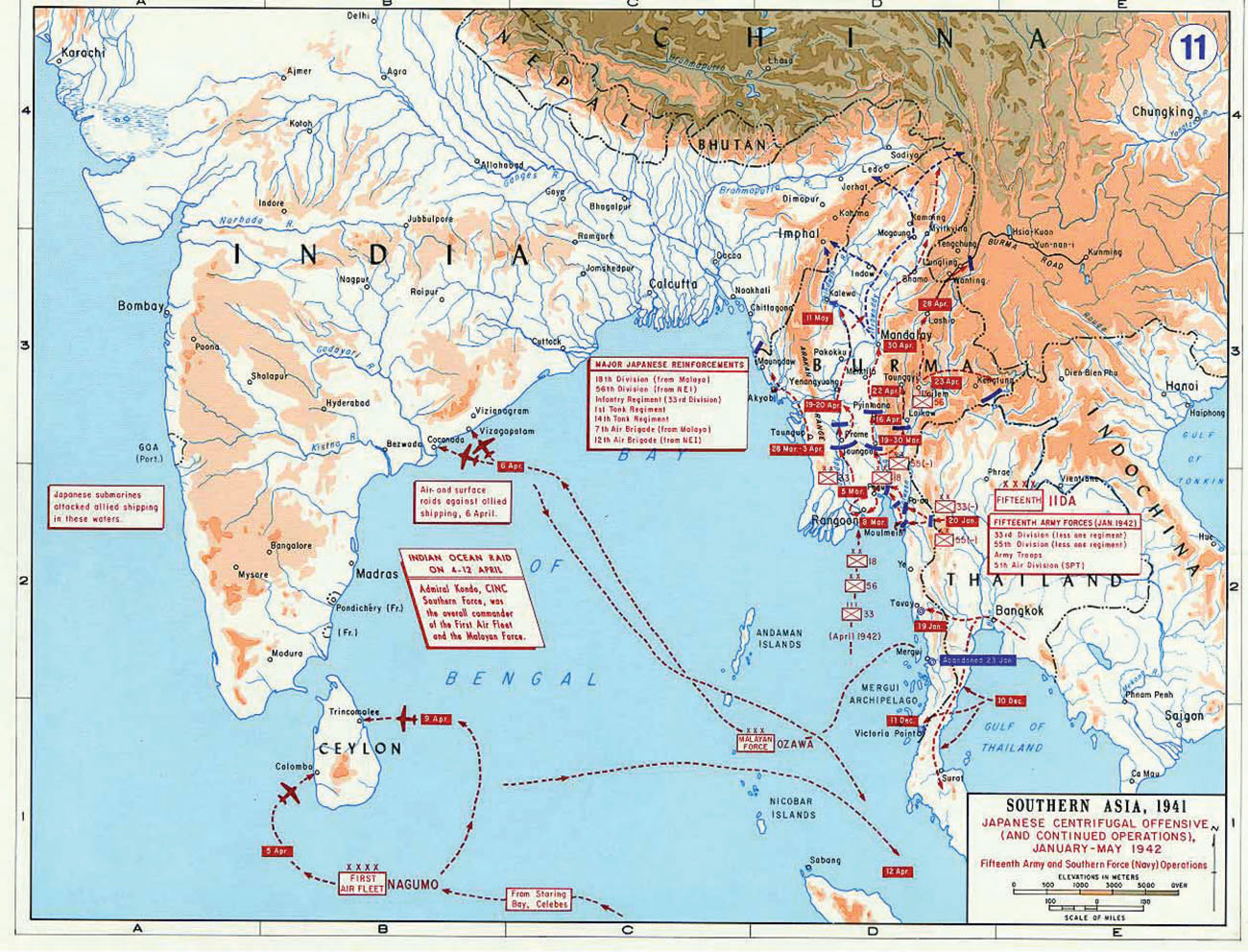
As Japan moved through Southeast Asia, it promised the inhabitants that it ultimately supported independent governments there. In fact, new governments were established in Vietnam, Burma, and other places, and though they were always clearly under the thumb of the Japanese military, there was some optimism that “Asia for Asians” might prove to truly work (Figure 13.13).
英語のヒント
日本は東南アジアへ進出する際、最終的には各地の独立政府を支持すると住民に約束した。実際にベトナム、ビルマなどでは新政府が設けられた。いずれも明らかに日本軍の支配下にあったが、「アジア人のためのアジア」が本当に実現するかもしれないという期待もあった(図13.13)。
Japan in Southeast Asia.東南アジアの日本
(credit: “Pacific War - Southern Asia 1942” by U.S. Army/Wikimedia Commons, Public Domain) · Public Domain
Figure 13.13 In an effort to drive the British out of their colonial possessions in South Asia and gain control of them for their own use, the Japanese launched numerous attacks in the region. This map shows that the Japanese focused their offensive in the region on Burma in particular. (credit: “Pacific War - Southern Asia 1942” by U.S. Army/Wikimedia Commons, Public Domain)
図13.13 南アジアのイギリス植民地からイギリス勢力を追い出し、自らの利用のために支配しようとして、日本はこの地域で多数の攻撃を行った。この地図は、日本が特にビルマへ攻勢を集中させたことを示している。(クレジット:米陸軍/Wikimedia Commons「Pacific War - Southern Asia 1942」。パブリックドメイン)
In many ways, however, the colonial experience continued for these areas, because their natural resources were simply redirected to the Japanese government’s needs rather than to Europe’s. Japanese occupation proved abusive and high-handed, marked by the denigration of local religions and customs and sometimes by physical abuse, such as against workers building the Burma-Thailand Railway. It became clear to many nationalists that they now had an enemy in the Japanese. In Vietnam, Ho Chi Minh raised his nationalist (and communist) forces against the Japanese in a guerrilla war aided by the United States. In Malaysia, similar guerrilla movements developed to oust the Japanese.
英語のヒント
しかし、多くの面で、これらの地域の植民地としての経験は続いた。天然資源の行き先が、ヨーロッパの需要から日本政府の需要へ、単に変わっただけだったからである。日本の占領統治は虐待的で高圧的なものとなり、現地の宗教や慣習をおとしめ、ときには泰緬鉄道建設の労働者に対するような身体的虐待も加えた。多くの民族主義者にとって、日本が新たな敵となったことは明らかだった。ベトナムでは、ホー・チ・ミンが民族主義と共産主義の勢力を率いて、日本軍に対するゲリラ戦を起こし、米国の支援を受けた。マレーシアでも、日本軍を追い出すため、同様のゲリラ運動が展開した。
The 1935 India Act had granted significant autonomy to the British provinces of India and introduced directly elected provincial assemblies. Fascism, communism, and nationalist desires for full independence all gained adherents among Indians beginning to more fully engage in politics. The political parties in India were either frustrated over broken British promises or anxious to see what rewards India might obtain for active and full support of Britain. For example, the Muslim League often leveraged its support for Britain for political advantage against the Hindu majority population.
英語のヒント
1935年インド統治法は、イギリス領インドの各州に大幅な自治を認め、直接選挙による州議会を導入していた。政治にいっそう積極的に関わり始めたインド人の間では、ファシズム、共産主義、完全独立を求める民族主義のいずれも支持者を得た。インドの政党は、イギリスが約束を破ったことに不満を募らせるか、イギリスを積極的かつ全面的に支援することで、インドがどのような見返りを得られるかを強く気にかけていた。たとえばムスリム連盟は、しばしばイギリスへの協力を使い、人口の多数を占めるヒンドゥー教徒に対して政治的な優位を得ようとした。
Meanwhile, by mid-1940, anti-British sentiments had begun to erupt across India. In the summer of 1942, while Japanese and Allied forces were sparring in neighboring Burma, Britain’s security concerns about India grew, and its attempts to repress Indian agitation heightened political tensions there. In August 1942, the Congress Party, the largest political party in India, granted leadership to the committed nationalist Mohandas (Mahatma) Gandhi and supported his nonviolent “Quit India” movement. Immediately the British arrested Gandhi and other Congress Party leaders and detained them through most of the war.
英語のヒント
その一方、1940年半ばまでに、インド全土で反英感情が噴き出し始めた。1942年夏、隣国ビルマで日本軍と連合軍が戦う中、イギリスはインドの安全保障への懸念を強めた。インド人の運動を抑え込もうとするイギリスの試みは、現地の政治的緊張を高めた。1942年8月、インド最大の政党である国民会議派は、強い信念を持つ民族主義者モーハンダース(マハトマ)・ガンディーに指導を委ね、非暴力の「インドを立ち去れ」運動を支持した。イギリスは直ちにガンディーとほかの国民会議派指導者を逮捕し、戦争の残りの大半の期間、拘束した。
A devastating famine in Bengal reached a peak in 1943. It was caused by the dispatch of Indian food supplies to support the war effort in Europe, natural disasters toward the end of 1942, an influx of refugees fleeing the Japanese offensives in Burma, and general governmental mismanagement. The famine added fuel to the Indian desire for independence.
英語のヒント
ベンガル地方の壊滅的な飢饉は、1943年に頂点に達した。その原因には、ヨーロッパでの戦争遂行を支えるためインドの食料を送り出したこと、1942年末ごろの自然災害、ビルマでの日本軍の攻勢を逃れた難民の流入、政府の全般的な失政があった。飢饉は、インド人の独立への思いをいっそう強めた。
Continuing to assert its intention to liberate Asia from White rule, Japan successfully recruited the support of the Indian nationalist Subhas Chandra Bose, a political rival of Gandhi and former president of the Indian National Congress. Bose assembled a Free India Legion of fighters that eventually grew into the Indian National Army (INA), about forty thousand strong. Fighting to liberate India, the INA assisted Japanese military operations in Burma. When the Japanese seized the Andaman Islands in the Bay of Bengal in 1942, they set up Bose as the leader of the Provisional Government (Azad Hind) of India, and the State of Burma became another subordinate partner and ally in the Greater East Asia Co-Prosperity Sphere until Japan’s defeat in 1945.
英語のヒント
日本はアジアを白人支配から解放する意図を主張し続け、インドの民族主義者スバス・チャンドラ・ボースの支持を得ることに成功した。ボースはガンディーの政敵であり、インド国民会議の元議長だった。ボースは自由インド軍団を組織し、これは最終的に約4万人を擁するインド国民軍(INA)へと成長した。インド解放のために戦うインド国民軍は、ビルマで日本軍の作戦を支援した。1942年に日本軍がベンガル湾のアンダマン諸島を占領すると、日本はボースを自由インド仮政府(アーザード・ヒンド)の指導者に据えた。ビルマ国もまた、大東亜共栄圏における従属的な協力国・同盟国となり、1945年の日本の敗北までその地位にあった。