第14章パクス・モンゴリカ――モンゴルの草原帝国Pax Mongolica: The Steppe Empire of the Mongols
The Ayyubids and the Crusadersアイユーブ朝と十字軍
The land the crusaders had intended to invade was ruled by the heirs of Salah al-Din and called the Ayyubid dynasty. Although Salah al-Din had directed that his empire be split among his brothers and sons upon his death in 1193, his brother al-Adil I had centralized it under his own control by around 1200. The actual power of any Ayyubid ruler rested on his ability to maintain the loyalty of mamluk armies; mamluks were soldiers, generally enslaved men taken from the peoples of the Eurasian Steppe as boys or adolescents. They had limited property and marriage rights and could move into high administrative and leadership posts if talented. They had no loyalties to the populations they policed and defended, and they were much less likely to rebel than members of communities that might become unhappy with the caliph’s rule. Their position and future completely depended on the continuation of their owner’s rule. Many caliphs thus preferred mamluk armies to civilian ones.
英語のヒント
十字軍が侵攻しようとした土地は、サラーフ・アッディーンの後継者が治め、アイユーブ朝と呼ばれた。サラーフは1193年の死に際して、帝国を兄弟と息子たちへ分けるよう指示したが、弟アーディル1世は1200年ごろまでに、自分の支配へまとめた。アイユーブ朝の君主の実際の力は、マムルーク軍の忠誠を維持する能力にかかっていた。マムルークは、一般に少年期から青年期に、ユーラシアの草原の人々の間から連れてこられ、奴隷にされた男性の兵士である。財産と結婚については限られた権利を持ち、有能なら高い行政職や指導者の地位へ進むことができた。取り締まり、防衛する住民とは忠誠関係を持たず、カリフの支配に不満を持つことのある共同体の出身者より、はるかに反乱を起こしにくかった。地位も将来も、主人の統治が続くことに全面的に依存したからである。そのため多くのカリフは、一般の住民による軍より、マムルーク軍を好んだ。
With Jerusalem still in Muslim hands after the Fourth Crusade, Pope Innocent called for a Fifth Crusade, dedicating church funds to avoid the financial issues that had lured the Fourth Crusade off course. Reusing the intended strategy of the Fourth Crusade, the Fifth Crusade departed for Egypt in 1217. Taking advantage of the turmoil caused by al-Adil I’s death in late 1218 and the ensuing rebellion against his son al-Kamil, the crusaders captured Damietta in 1219. With his lands in disarray, al-Kamil tried to bribe the crusaders to leave Egypt. He offered them all of what had been the former crusader state centered around Jerusalem and a thirty-year truce between Muslims and Christians in the Holy Land.
英語のヒント
第4回十字軍のあともイェルサレムはムスリムの手にあったため、インノケンティウスは第5回十字軍を呼びかけた。第4回を進路からそらした財政問題を避けるため、教会の資金を充てた。第4回の当初の戦略を再び採り、第5回十字軍は1217年にエジプトへ向けて出発した。1218年末のアーディル1世の死と、続く息子カーミルへの反乱が生んだ混乱に乗じ、1219年にダミエッタを奪った。領内が混乱するなか、カーミルは、代償を与えて十字軍をエジプトから退かせようとした。イェルサレムを中心とした旧十字軍国家の全域と、聖地のムスリム・キリスト教徒間の30年の休戦を、提供すると申し出た。
Confident they could defeat him, the crusaders rejected al-Kamil’s offer, a choice that proved unwise. By 1221, al-Kamil and his brothers had reasserted control over their father’s empire and joined together to trap the crusader army in the Nile delta. Faced with the threat of death by arms or by drowning, the crusaders agreed to withdraw from their conquests and return to Europe, ending the Fifth Crusade in yet another failure.
英語のヒント
勝てると確信した十字軍は、カーミルの提案を拒んだが、それは賢明でない選択だった。1221年までに、カーミルと兄弟たちは、父の帝国の支配を回復し、協力して十字軍をナイル・デルタに閉じ込めた。武力で殺されるか、溺れるかという危機に直面し、十字軍は征服地から撤退してヨーロッパへ帰ることに同意した。第5回もまた失敗に終わった。
To placate the papacy, Hohenstaufen ruler Frederick II agreed to lead a new crusade, but personal misfortune and lack of enthusiasm among Europe’s vassals hindered his ability to get underway. The delays were so severe that the exasperated Pope Gregory IX excommunicated him, cutting him off from the church and its sacred rites. Even after Frederick set sail in 1228, Gregory condemned his venture as an unjust war, not a holy crusade.
英語のヒント
教皇側をなだめるため、ホーエンシュタウフェン家のフリードリヒ2世は、新たな十字軍を率いることに同意した。しかし個人的な不運と、ヨーロッパの封臣たちの熱意不足で、出発は遅れた。遅延があまりにひどかったため、いら立った教皇グレゴリウス9世は彼を破門し、教会とその聖なる儀式から切り離した。1228年にフリードリヒが出航したあとも、教皇は、その遠征を聖なる十字軍ではなく、不正な戦争として非難した。
Breaking with the strategy of the four previous crusades, Frederick landed in Acre, the main port still in Christian hands. His slow pace allowed word of his excommunication to precede him, causing him to be greeted with suspicion by his fellow Christians. Recognizing the power balance between Christians and the Ayyubids, Frederick fell back on his highly effective diplomatic skills to obtain the crusade’s objectives, concluding the Treaty of Jaffa with Sultan al-Kamil in 1219 (Figure 14.13).
英語のヒント
フリードリヒは、以前の四つの十字軍の戦略とは異なり、まだキリスト教徒の手にある主要港アッコンへ上陸した。進み方が遅かったため、破門の知らせが先に届き、同じキリスト教徒から疑いの目で迎えられた。キリスト教徒とアイユーブ朝の力の釣り合いを理解したフリードリヒは、非常にすぐれた外交手腕を頼りに十字軍の目的を果たし、1219年、スルタン・カーミルとヤッファ条約を結んだ(図14.13)。
Al-Kamil and Frederick II.カーミルとフリードリヒ2世。
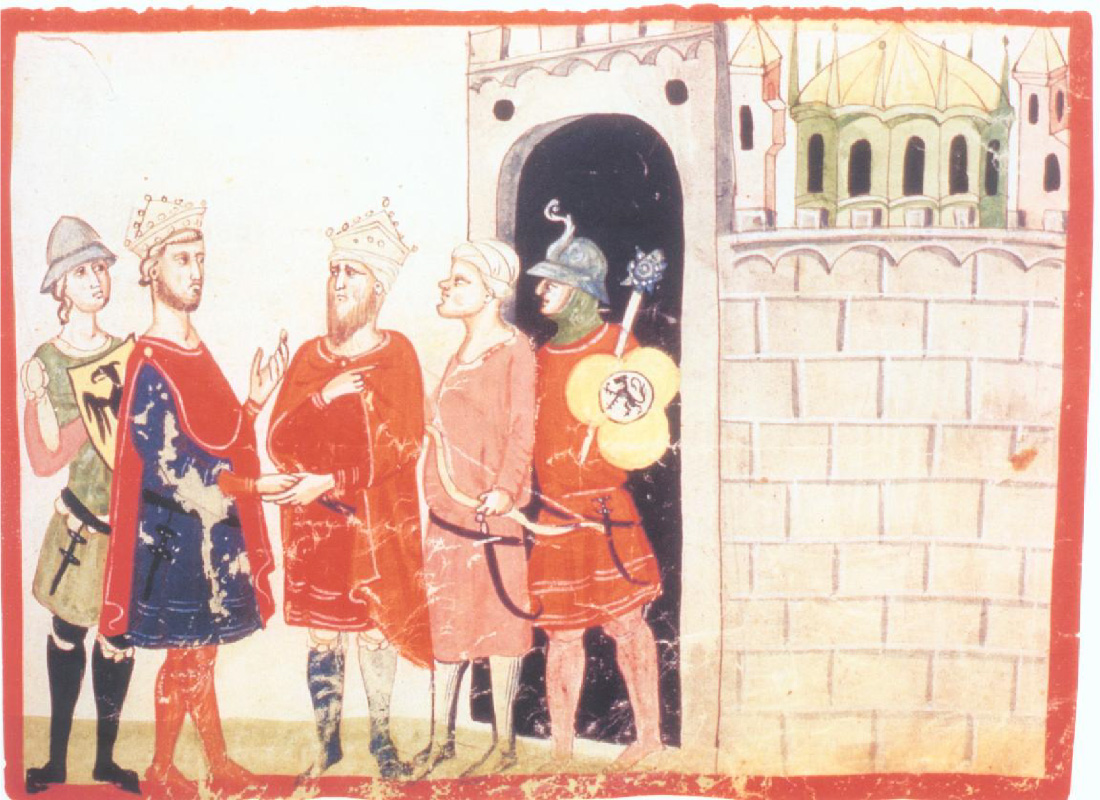
(credit: “Friedrich II. mit Sultan al-Kamil” by I Villani illustrato/Wikimedia Commons, Public Domain) · Public Domain
Figure 14.13 This image from a fourteenth-century Italian manuscript depicts the Holy Roman emperor, Frederick II (second from left), and the Ayyubid sultan al-Kamil (center) signing the Treaty of Jaffa decades earlier in 1229. Although the figures are similar in appearance, note the turban and curved swords that identify the two on the right as Muslims. (credit: “Friedrich II. mit Sultan al-Kamil” by I Villani illustrato/Wikimedia Commons, Public Domain)
図14.13 14世紀のイタリアの写本に描かれた、神聖ローマ皇帝フリードリヒ2世、左から2人目と、中央のアイユーブ朝スルタン・カーミル。数十年前の1229年に、ヤッファ条約を結んだ場面である。人物の外見は似ているが、右の2人をムスリムと示す、ターバンと湾曲した剣に注目しよう。(出典:I Villani illustrato/Wikimedia Commons「Friedrich II. mit Sultan al-Kamil」、パブリックドメイン)
The agreement allowed Frederick to be the titular king of Jerusalem, though with limited power. Muslims were under the rule of local Islamic scholars, not Christian officials; they could not be expelled or have their wealth confiscated, they could practice Islam, and the Islamic holy sites of the Al-Aqsa Mosque and Dome of the Rock remained under Muslim control. The treaty prohibited Jerusalem’s city walls, destroyed in the course of the crusades, from being rebuilt, leaving the city defenseless if Muslims attacked. A ten-year truce between Muslims and Christians was put in place.
英語のヒント
合意によって、フリードリヒは名目上のイェルサレム王となったが、権限は限られた。ムスリムは、キリスト教の役人ではなく、現地のイスラーム学者に治められた。追放や財産没収を受けず、イスラームを信仰できた。イスラームの聖地アル・アクサー・モスクと岩のドームも、ムスリムの管理下に残った。条約は、十字軍の間に破壊されたイェルサレムの城壁を再建することを禁じたため、ムスリムが攻撃すれば、都市には防御がなかった。両宗教の側の間に、10年の休戦が設けられた。
The agreement was widely seen as a capitulation by both Muslims and Christians. Frederick’s decision to favor negotiation over battle sapped morale among the crusaders and furthered mistrust of him among the Holy Land’s Christians. Nevertheless, a Christian was king of Jerusalem, more Christians were under Christian rule than had been the case for at least two generations, and all had been accomplished without spilling a single drop of human blood.
英語のヒント
この合意は、ムスリムにもキリスト教徒にも、広く屈服と受け止められた。フリードリヒが戦闘より交渉を選んだことで、十字軍の士気は衰え、聖地のキリスト教徒の間では、彼への不信が強まった。それでも、キリスト教徒がイェルサレムの王となり、少なくとも過去2世代にないほど多くのキリスト教徒が、キリスト教徒の支配下へ入った。しかも、人の血を一滴も流さず、すべてが成し遂げられた。
By the time the truce expired, al-Kamil’s sons were fighting each other and ambitious generals for control. New crusaders arrived sporadically, augmenting Christian forces in the area. They tried to expand Christian territory by playing rival Ayyubid factions against each other, but it was all for naught. Al-Kamil’s son al-Salih stabilized his rule over the Ayyubid Empire, retook Jerusalem, and pushed the Christians back to a strip of coastal ports by 1244. He owed much of his success to bands of wandering Turks who had been displaced by Mongol expansion into central Asia and whom he incorporated into the Ayyubid mamluk army. While helpful for the moment, however, these additional soldiers entered the status of mamluk as independent adult refugees, not as adolescents with no life experience to compare mamluk service to.
英語のヒント
休戦が切れるころには、カーミルの息子たちが、互いに、また野心的な将軍たちと、支配権を争っていた。新たな十字軍勢力が散発的に到着し、現地のキリスト教軍を増強した。彼らはアイユーブ朝の敵対勢力を互いに争わせ、領土を広げようとしたが、すべてむだに終わった。カーミルの息子サーリフが支配を安定させ、イェルサレムを奪い返し、1244年までに、キリスト教徒を沿岸の港の帯状地域へ押し戻した。成功の多くは、モンゴルの中央アジア進出で住む場所を失い、さまようテュルク系の集団のおかげだった。サーリフは彼らを、アイユーブ朝のマムルーク軍へ組み入れた。しかし、当面は役立っても、この増援は、マムルークとしての勤務以外の人生経験を持たない青年ではなく、自立した成人の難民として、マムルークの身分へ入った人々だった。
While al-Salih consolidated his power, the French king Louis IX called for another crusade to liberate Jerusalem from Islamic rule, hoping to repeat the initial successes of the Fifth Crusade by taking Damietta in Egypt. He succeeded, but while Salih’s death in 1249 gave the crusaders hope, they met the same fate as their predecessors almost thirty years earlier. The Ayyubid mamluk army, led by al-Salih’s son Turan Shah, trapped the crusaders in the unfamiliar terrain of the Nile delta, capturing Louis and much of his army in 1250. Those deemed sick or unworthy of ransom were killed. Louis and the vassals with him were held hostage until Damietta was abandoned by the crusaders and a ransom of 6.4 million ounces of silver (more than USD$134 million at 2020 prices) was paid in advance, with the crusaders pledging to pay an equal amount later. This and the later crusades were often failures for a variety of reasons, which included unfamiliarity with the land and its peoples and more than a century of distrust that had continued to build between the crusaders and the indigenous eastern Christians.
英語のヒント
サーリフが権力を固める間、フランス王ルイ9世は、イェルサレムをイスラームの支配から解放するため、新たな十字軍を呼びかけた。エジプトのダミエッタを奪い、第5回の初期の成功を繰り返そうとした。ダミエッタの攻略には成功した。しかし1249年のサーリフの死に希望を抱いても、十字軍は約30年前の先行者と同じ運命をたどった。サーリフの息子トゥーラーン・シャーに率いられたアイユーブ朝のマムルーク軍は、不慣れなナイル・デルタの地形に十字軍を閉じ込め、1250年、ルイとその軍の多くを捕らえた。病気の者や、身代金に値しないと判断された者は殺された。ルイと同行の封臣は、十字軍がダミエッタを放棄し、銀640万オンス、2020年の価格で1億3400万米ドル超の身代金を前払いするまで、人質にされた。十字軍はさらに、同額を後日払うと誓った。この遠征も、後の十字軍も、さまざまな理由で失敗することが多かった。土地や住民をよく知らなかったこと、十字軍と現地の東方キリスト教徒の間で、1世紀以上、不信が積み重なっていたことなどが理由だった。