第14章パクス・モンゴリカ――モンゴルの草原帝国Pax Mongolica: The Steppe Empire of the Mongols
The Conquest Movement of Chinggis Khanチンギス・カンの征服活動
The yassa and the social-military organization put in place by Chinggis Khan removed many sources of strife from the Mongol Empire. But they also prohibited traditional activities, such as raiding other clans, that had led to social mobility. Chinggis Khan believed that without new sources of wealth and glory, people might grow restless and reject the peace he tried to create. His life experience had given him no concept of settled economic development or ways to redirect his people’s energy to that goal. From the time he joined Ong Khan’s attack on the Tatars and saw the luxuries acquired from the Jin and the Song, Chinggis knew settled peoples were a source of wealth ripe for the Mongol Empire to take, and for him as their leader to distribute. In his eyes, conquering these peoples or intimidating them into giving tribute was the next logical step.
英語のヒント
チンギス・カンが整えたヤサと社会・軍事組織は、モンゴル帝国内の争いの原因を多く取り除いた。しかし、他氏族の襲撃のように、それまで社会的上昇を可能にしていた伝統的な活動も禁じた。チンギス・カンは、富や栄光を得る新たな道がなければ、人々は不満を募らせ、自分が作ろうとした平和を拒むかもしれないと考えた。彼の人生経験には、定住社会の経済発展や、民の力をその目標へ向け直す方法の発想はなかった。オン・カンのタタル攻撃に加わり、金や宋から得たぜいたく品を見たときから、定住民は、モンゴル帝国が奪い、指導者である自分が分配するのにうってつけの富の源だと知っていた。彼にとって、その人々を征服するか、威圧して貢納させるかが、次の当然の一歩だった。
As word spread of Chinggis Khan’s coronation, some warriors in the settled kingdoms between the steppe and Song China left to join the Mongol Empire. The Kara-Khitan, assuming resistance would not go well, offered tribute to Chinggis Khan. After a coup in 1210, the new Xi Xia ruler accepted tributary status on terms similar to those of the Kara-Khitan.
英語のヒント
チンギス・カン即位の知らせが広まると、草原と宋の間にある定住王国の戦士の一部は、国を去ってモンゴル帝国へ加わった。西遼は、抵抗してもうまくいかないと考え、チンギス・カンへの貢納を申し出た。1210年の政変後、西夏の新しい支配者も、西遼と同様の条件で従属国としての地位を受け入れた。
The Jin, however, were another matter. In 1210, a new Jin emperor demanded Chinggis Khan submit to him and send tribute, so Chinggis marched his smaller but superior army south to invade (Figure 14.9). A master at exploiting his opponents’ weaknesses, he realized that his linguistic cousins, the Khitan, resented the rule of the Jurchen Jin dynasty, so he portrayed his army as a liberating force for them. With their army swelling with Jin defectors, the Mongols were able to lay siege to Zhongdu, the Jin capital, and eventually seize the starving city. Chinggis Khan ordered the city thoroughly looted, tens of thousands enslaved, and untold numbers of others massacred.
英語のヒント
しかし、金は別だった。1210年、金の新しい皇帝がチンギス・カンに、服属して貢納するよう求めた。そこでチンギスは、数では劣るが能力では勝る軍を南へ進め、侵攻した(図14.9)。敵の弱点を突く名人だった彼は、言語的な同族である契丹人が、女真の金王朝の支配に不満を持つことを見抜き、自分の軍を契丹の解放軍として示した。金から離反する者が加わって軍が膨らむと、モンゴル軍は金の首都・中都を包囲し、ついには飢えた都市を奪った。チンギス・カンは、徹底した略奪、数万人の奴隷化、さらに数えきれない人々の虐殺を命じた。
The Mongol Empire.モンゴル帝国。
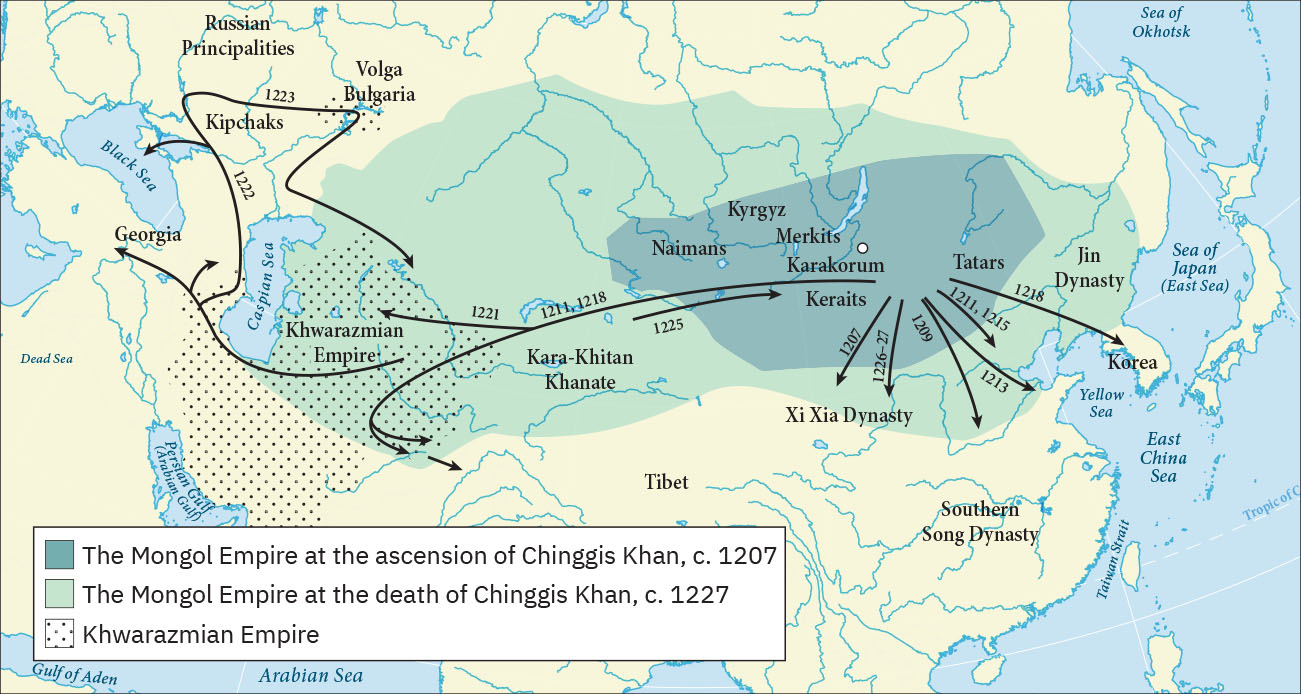
(attribution: Copyright Rice University, OpenStax, under CC BY 4.0 license) · CC BY 4.0
Figure 14.9 This map shows the areas conquered by the Mongol Empire under Chinggis Khan’s leadership from 1207 to 1227. The black arrows depict the paths his army took, including exploratory campaigns outside the empire’s boundaries to the west. In areas of northern China, Chinggis Khan had to invade areas he had already conquered that rebelled. (attribution: Copyright Rice University, OpenStax, under CC BY 4.0 license)
図14.9 1207年から1227年に、チンギス・カンの指導下でモンゴル帝国が征服した地域を示す。黒い矢印は軍の進路で、西の帝国外への探索的な遠征も含む。中国北部では、いったん征服した地域が反乱を起こし、再び侵攻しなければならないこともあった。(著作権:Rice University, OpenStax、CC BY 4.0)
Once the spoils from Zhongdu had been gathered, Chinggis Khan and his army headed back to the steppe, leaving the campaign against the Jin mostly in the hands of his Khitan allies. Forces loyal to Chinggis Khan continued to subdue the Yellow River basin and expanded north into the Jurchen homeland, even venturing to the Korean Peninsula. By 1223, these areas were pacified and providing tribute to the Mongol Empire and its allies who occupied them. Ironically, this vast amount of looted goods forced Chinggis Khan to build the first permanent structures on the steppe, a warehouse complex to hold war booty so it could be preserved and distributed or traded over time.
英語のヒント
中都の戦利品を集め終えると、チンギス・カンと軍は草原へ戻り、金との戦いの大半を契丹の同盟者に任せた。チンギスに忠実な軍は、黄河流域の征服を続け、北の女真の故地へ勢力を広げ、朝鮮半島へまで進出した。1223年までに、これらの地域は鎮圧され、モンゴル帝国と、そこを占領する同盟勢力へ貢納するようになった。皮肉にも、膨大な略奪品のために、チンギス・カンは草原に初めて恒久的な建物を造らざるをえなくなった。戦利品を保存し、時間をかけて分配したり取引したりできるようにする、倉庫群である。
The Kara-Khitan kingdom caught Chinggis Khan’s attention in 1213 when the son of the Naiman leader he had defeated a decade earlier took control. The Kara-Khitan were already not meeting tribute expectations, and now a once-defeated rival led them. The Mongols quickly triumphed over the Kara-Khitan and absorbed them into the empire. Their conquests were wide, however, and not limited to China and the East. Mongol armies moved westward and likely seemed an unstoppable force to many.
英語のヒント
1213年、西遼で、10年前にチンギス・カンが倒したナイマンの指導者の息子が権力を握り、チンギスの注意を引いた。西遼はすでに、期待された貢納を納めていなかった。そのうえ、かつて敗れた敵が支配者になったのである。モンゴル軍は速やかに西遼を破り、帝国へ併合した。しかし征服は広範で、中国や東方に限られなかった。モンゴル軍は西へ進み、多くの人々には、止められない力に見えたことだろう。
The vast amount of wealth seized from the Jin fundamentally changed the mindset of the Mongol leadership, which demanded ever more goods, food, grazing lands, and raw materials. These new needs prompted Chinggis Khan to seek trading and raiding opportunities farther west. The absorption of the Kara-Khitan into the Mongol Empire had provided a direct border with the Islamic world through Khwarazmia, a realm stretching from Persia through central Asia. Around 1218, Chinggis Khan sent a caravan of a few hundred of his Muslim subjects to the leader of Khwarazmia, Allah al-Din Muhammad, with a letter requesting the establishment of trade relations and a great many valuable goods to show what he could offer.
英語のヒント
金から奪った莫大な富は、モンゴルの指導部の考え方を根本から変えた。彼らは、さらに多くの物品、食料、牧草地、原料を求めるようになった。こうした新たな需要から、チンギス・カンは、さらに西に交易や襲撃の機会を探した。西遼の併合によって、モンゴル帝国は、ペルシアから中央アジアへ広がるホラズムを通じて、イスラーム世界と直接国境を接した。1218年ごろ、チンギス・カンは、臣下のムスリム数百人からなる隊商を、ホラズムの君主アラー・アッディーン・ムハンマドへ送った。通商関係の樹立を求める書簡と、自分が何を提供できるかを示す、多数の貴重な品を携えさせた。
Before the caravan reached the Khwarazmian ruler, however, his governor of Otrar confiscated the goods and killed the traders. In a grave miscalculation, Allah al-Din Muhammad then killed most of the emissaries Chinggis Khan sent to demand compensation, returning only a couple of them, disfigured. This did not just mean war to Chinggis Khan; it meant a war of revenge of the utmost brutality. This included the decimation of the cities of Herat, Merv, and Nishapur, which for centuries had been three of the most important and prominent cities of the eastern Islamic world. By 1223, Allah al-Din Muhammad had been killed while fleeing Mongol troops on an island in the Caspian Sea. Chinggis Khan divided the Khwarazmian state up to be administered by his sons and generals.
英語のヒント
しかし隊商がホラズムの君主に会う前に、オトラルの総督が商品を没収し、商人たちを殺した。アラー・アッディーン・ムハンマドは、さらに重大な判断ミスをした。チンギス・カンが補償を求めて送った使節の大半を殺し、数人だけ、身体を損なわれた姿で送り返したのである。チンギス・カンにとって、これは単なる戦争の理由ではなかった。極限の残虐さを伴う復讐戦争の理由となった。ヘラート、メルヴ、ニーシャープールは壊滅的な破壊を受けた。何世紀にもわたり、東方イスラーム世界で最も重要で著名な都市に数えられていた三都市である。1223年までに、アラー・アッディーン・ムハンマドは、モンゴル軍を逃れる途中、カスピ海の島で殺されていた。チンギス・カンはホラズムの国土を分け、息子や将軍に統治させた。
Reconnaissance for launching surprise attacks against Khwarazmia brought the Mongols into unfamiliar territory. To the south, they discovered India’s Delhi Sultanate in one of its rare periods of unity and growth. These Muslims were not part of the Khwarazmian realm, however, so attacking them would have been an unnecessary distraction. Seeking a route to surprise the Khwarazmians from the north, two of Chinggis’s most trusted generals, Jebe and Subutai, had crossed through the Georgian Kingdom, then the lands of the Rus, Slavic ancestors of modern Russians who had ruled the agricultural lands east of Hungary and Poland. They quickly annihilated the Khwarazmian and Rus forces, forcing both groups to become tributaries to Chinggis Khan.
英語のヒント
ホラズムに奇襲をかけるための偵察で、モンゴル軍は未知の地域へ入った。南方では、まれな統一と成長の時期にあった、インドのデリー・スルタン朝を見いだした。しかし、このムスリム国家はホラズムの領域に属さないので、攻撃すれば、不必要に力を他へそらすことになっただろう。北からホラズムを不意打ちする経路を探した、チンギスの最も信頼する将軍二人、ジェベとスブタイは、ジョージア王国を抜け、続いてルーシの土地を通過した。ルーシは、ハンガリーとポーランドの東の農地を支配してきた、現代ロシア人のスラヴ系の祖先である。二将はホラズム軍とルーシ軍を速やかに壊滅させ、両者をチンギス・カンへ貢納する従属勢力にした。