第14章パクス・モンゴリカ――モンゴルの草原帝国Pax Mongolica: The Steppe Empire of the Mongols
The Last Gasp of Mongol Expansionモンゴル拡張の最後の大きな波
It took until 1251 for majority support to coalesce around Chinggis Khan’s grandson Mongke. While Mongke successfully expanded Mongol domains, his reign would mark the end of continued conquest while also signaling the end of a united Mongol Empire.
英語のヒント
チンギス・カンの孫モンケに、多数派の支持がまとまったのは、1251年になってからだった。モンケはモンゴルの領土を広げることに成功したが、その治世は、征服の連続が終わりを迎え、統一されたモンゴル帝国も終わりへ向かう画期となった。
Blending the best elements of Chinggis Khan and Ogedei, Mongke was poised to re-create the greatness of unified Mongol rule. He stabilized the empire, ordering a census to assess not just taxes but also the natural and human resources of his domains. To increase the empire’s wealth and dissipate potential restless energy that might be turned on him, he undertook multidirectional expansion. His brother Hulagu Khan was asked to subdue the Islamic world, while another brother, Kublai Khan, was sent to Song China.
英語のヒント
モンケは、チンギス・カンとオゴデイのよい点を組み合わせ、モンゴルの統一支配の偉大さをよみがえらせようとしていた。帝国を安定させ、税だけでなく、領内の天然資源と人材も把握するため、人口調査を命じた。帝国の富を増やし、自分へ向かいかねない潜在的な不満の力を発散させるため、複数の方向へ拡張を進めた。弟フレグにはイスラーム世界の征服を命じ、もう一人の弟クビライは宋へ送った。
Hulagu was enormously successful; like his grandfather in northern China, he exploited existing conflicts, which included resentment by the minority Shia Muslims against the Sunni caliph. Combining this strategy with the Mongols’ usual offer to spare from destruction those who would acknowledge Mongol rule and submit tribute without struggle, Hulagu was able to gain control of much of the caliph’s lands, especially Shia areas. By late 1257, his forces had surrounded Baghdad, and the city fell in early 1258, its physical defenses undermined. Tens, possibly hundreds, of thousands were massacred, and the caliph himself was killed.
英語のヒント
フレグは大きな成功を収めた。北中国の祖父と同じく、既存の対立を利用した。その一つが、少数派のシーア派ムスリムが、スンナ派のカリフに抱く不満だった。この戦略に、抵抗せずモンゴルの支配を認めて貢納すれば破壊を免れるという、モンゴルのいつもの提案を組み合わせ、カリフの領土の多く、とりわけシーア派の地域を掌握した。1257年末までに軍はバグダードを囲み、1258年初め、防衛施設を破られた都市は陥落した。数万人、あるいは数十万人が虐殺され、カリフ自身も殺された。
Meanwhile, Kublai was also successful, conquering areas of Tibet and southwestern China. During the campaign, he began to favor Tibetan Buddhism, although not to the point of dismissing or persecuting other faiths. Mongke then moved him to administer the former Jin areas that were conquered by his grandfather, while Mongke himself, seeing the Song’s vulnerability, launched a broader attack against them in 1256. In 1259, as reports reached Mongke that Kublai was establishing a power base in northern China, he ordered Kublai to join him in the war against the Song, probably also wanting to keep close watch over him.
英語のヒント
一方、クビライも成功し、チベットと中国南西部の地域を征服した。遠征中、チベット仏教を好むようになったが、ほかの信仰を退けたり迫害したりするほどではなかった。モンケはその後、祖父が征服した旧金領の行政をクビライに任せた。モンケ自身は宋の弱みを見て、1256年に、より広範な攻撃を始めた。1259年、クビライが中国北部に独自の権力基盤を築いているという報告が届くと、モンケは宋との戦いに合流するよう命じた。おそらくクビライを近くで監視したいという意図もあった。
Before Kublai could reach him, however, Mongke died, likely from dysentery. His cousin Ariq Boke, another of Chinggis Khan’s grandsons and the one who had been left to administer the Mongol homeland, declared himself the new khan of the Mongol Empire ahead of a kurultai. Upon hearing this, Kublai, who was returning for the kurultai, also declared himself the new khan. While Kublai would prove a powerful and capable ruler, much had begun to change since the days of Chinggis, and the stage was set for the end of a unified Mongol Empire and a single khan who dominated the entirety of the territories they had conquered. Continued success in conquest had been a major factor in keeping rivals from unnecessarily challenging the rule of the chosen great khan or devolving his power. With this period of expansion over, these rivals were presented with new opportunities to claim more power for themselves, especially with the size and diversity of the empire the Mongols now ruled.
英語のヒント
しかしクビライが到着する前に、モンケは、おそらく赤痢で死んだ。モンゴルの故地の行政を任されていた、チンギス・カンのもう一人の孫で、モンケのいとこであるアリク・ブケは、クリルタイに先立って自らを帝国の新しいカンと宣言した。それを聞いたクビライも、クリルタイへ戻る途中で、自ら新しいカンを名乗った。クビライは強力で有能な君主になるが、チンギスの時代から多くのことが変わり始めていた。帝国の統一と、征服した全領域を一人のカンが治める時代が、終わる条件は整っていた。征服が続けて成功していたことは、対抗者が、選ばれた大カンの支配へむやみに挑み、権限を奪おうとするのを防ぐ大きな要因だった。拡張期が終わると、対抗者には、より大きな権力を自分のものにする新たな機会が生まれた。モンゴルが支配する帝国の大きさと多様性が、とりわけその機会を広げた。
The last kurultai of the Mongol Empire failed and led to the permanent splitting of the realm. Hulagu stood with his brother Kublai. The Golden Horde, now led by Batu’s younger brother Berke, supported Ariq Boke. This left Orghina, sister-in-law to Hulagu and granddaughter of Chinggis Khan, in a position to choose which of her cousins would rule the Mongol Empire. Orghina, acting as regent for her son who was too young to assume a leadership role, chose neutrality, endorsing neither claimant. The fact that she was making this decision, not advising a man who would make the choice, shows the strides women had made under the yassa. Kublai ultimately prevailed, since his bonds with the army conquering China and his resource-rich power base in the northeast left him well situated to repulse Ariq Boke’s attacks. In 1264, Ariq Boke rode to Kublai’s capital and surrendered. He died under house arrest a couple of years later, probably having been poisoned.
英語のヒント
モンゴル帝国の最後のクリルタイは失敗し、領域の恒久的な分裂へつながった。フレグは兄クビライを支持した。バトゥの弟ベルケが率いるジョチ・ウルスは、アリク・ブケを支持した。その結果、フレグの義理の姉妹で、チンギス・カンの孫娘オルガナが、いとこたちのどちらに帝国を治めさせるかを選べる立場となった。まだ指導者には幼すぎる息子の摂政を務めたオルガナは、中立を選び、どちらの候補も支持しなかった。男性に助言するのではなく、彼女自身が決定したという事実は、ヤサの下で女性の地位がどれほど前進したかを示す。最終的にはクビライが勝った。中国を征服中の軍との結びつきと、北東の資源豊かな基盤によって、アリク・ブケの攻撃を退けるのに有利な立場にあったからである。1264年、アリク・ブケはクビライの首都へ来て降伏した。数年後、おそらく毒を盛られ、軟禁中に死んだ。
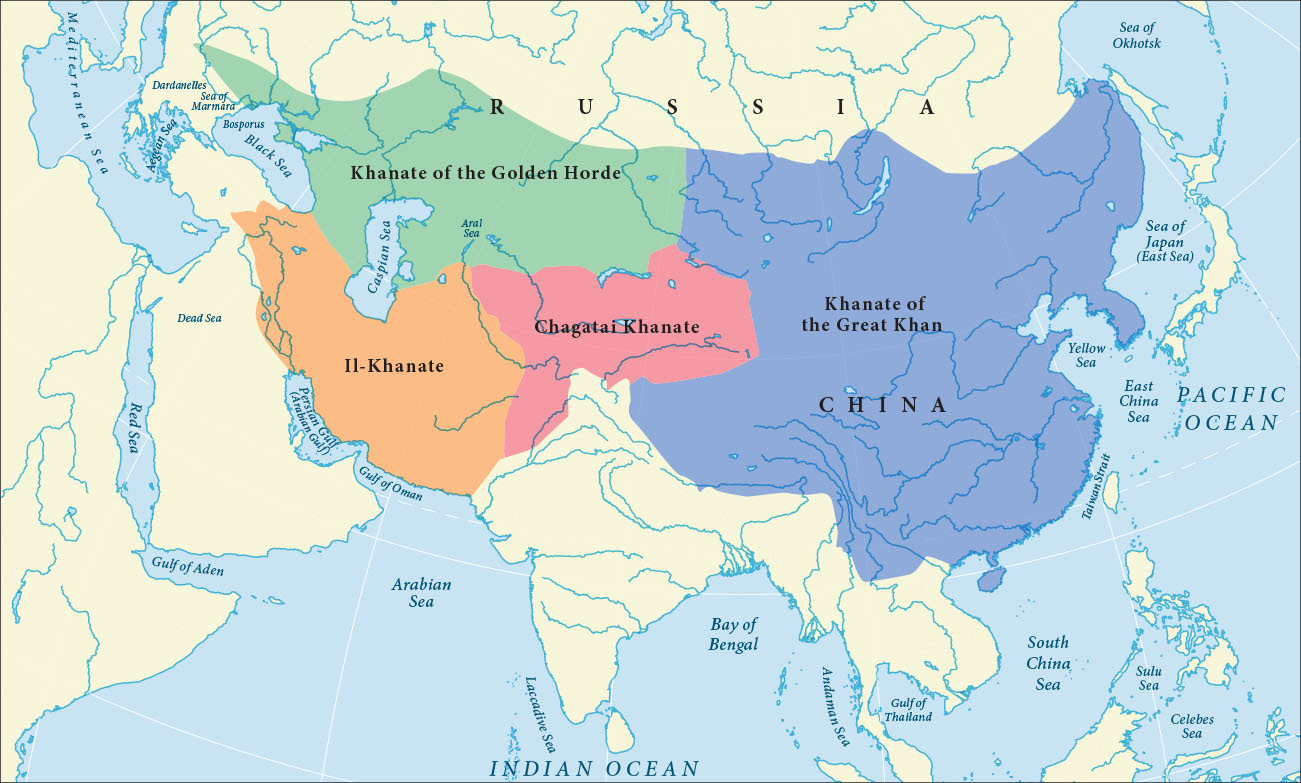
Hulagu recognized Kublai as the great khan, calling himself il-khan (lesser khan) and his realm the Il-Khanate. He and his successors pursued their own policies independently, however, and Kublai’s hold on the Chagatai Khanate remained only as strong as the armies he devoted to enforcing it. The Golden Horde was well out of his reach. From this point on, the parts of the once-united Mongol Empire were administered separately and evolved differently (Figure 14.10). Historians refer to them as khanates—the Khanate of the Golden Horde, Il-Khanate, Chagatai Khanate, and the Khanate of the Great Khan—to distinguish them from the prior period of unity.
英語のヒント
フレグはクビライを大カンと認め、自らをイル・カン、すなわち小カンと呼び、その領国をイル・ハン国と呼んだ。しかしフレグと後継者は、独自の政策を追求した。クビライのチャガタイ・ハン国への支配も、それを強制するために投入する軍の力が及ぶ範囲に限られた。ジョチ・ウルスには、まったく手が届かなかった。以後、かつて一つだったモンゴル帝国の各部分は、別々に統治され、それぞれ異なる発展を遂げた(図14.10)。歴史家は、かつての統一期と区別して、ジョチ・ウルス、イル・ハン国、チャガタイ・ハン国、大カンのハン国を、それぞれハン国と呼ぶ。
The Four Khanates of the Mongol Empire.モンゴル帝国の四つのハン国。
(attribution: Copyright Rice University, OpenStax, under CC BY 4.0 license) · CC BY 4.0
Figure 14.10 This map shows the areas ruled by the four Mongol khanates after the death of Kublai Khan in 1294. For all intents and purposes, these were separate sovereign states. Hulagu’s Il-Khanate was the only one to recognize Kublai as great khan. (attribution: Copyright Rice University, OpenStax, under CC BY 4.0 license)
図14.10 1294年のクビライ・カンの死後、四つのモンゴルのハン国が支配した地域を示す。実際には、別々の主権国家だった。クビライを大カンと認めたのは、フレグのイル・ハン国だけだった。(著作権:Rice University, OpenStax、CC BY 4.0)
The struggle for power between Kublai and Ariq Boke also reflected a divide between Mongols willing to live as settled people and those who sought to preserve traditional nomadic ways. Kublai and Hulagu represented Mongols willing to adopt some aspects of settled life. Their successors, especially Kublai’s, embraced the settled lifestyle even more. Ariq Boke embodied the spirit of their traditional nomadic culture, the weaknesses of which had been under attack since Temujin had become Chinggis Khan and had sought to promote harmony and justice in ways traditional Mongol customs and practices did not. While Mongol armies were a formidable force in open battles on broad plains, it was only with the help of settled people and their technologies that they could take down the world’s richest cities and bring their riches to the Mongolian plain and, more importantly, create bureaucratic systems to keep it flowing and distribute it.
英語のヒント
クビライとアリク・ブケの権力争いは、定住民として暮らす意思のあるモンゴル人と、伝統的な遊牧生活を守ろうとする人々との分裂も表していた。クビライとフレグは、定住生活の一部を取り入れる人々を代表した。その後継者、とりわけクビライの後継者は、いっそう定住生活を受け入れた。アリク・ブケは、伝統的な遊牧文化の精神を体現した。しかし、その文化の弱点は、テムジンがチンギス・カンとなり、従来の慣行では実現しなかった形で調和と公正を促そうとして以来、攻撃にさらされていた。モンゴル軍は、広い平原での野戦では恐るべき力だった。しかし、世界で最も豊かな都市を攻略し、その富をモンゴルの草原へ運ぶには、定住民とその技術の助けが欠かせなかった。さらに重要なのは、その富が流れ続けるようにし、分配する官僚機構を作るうえでも、その助けが必要だったことである。