第14章パクス・モンゴリカ――モンゴルの草原帝国Pax Mongolica: The Steppe Empire of the Mongols
The Almohad Caliphateムワッヒド朝
Since the 1170s, Islamic Iberia had been ruled by the Almohad Caliphate, but they struggled to unify Muslims throughout the region and at times struggled to assert their authority. The Almohads were Imazighen (Berbers) from what is now southern Morocco. Leadership positions and economic advantage disproportionately went to members of the tribe from which the Almohad movement originated, often causing resentment. Support for the Almohads among other Muslims in North Africa and Iberia was broad but not especially strong.
英語のヒント
1170年代以来、イベリアのイスラーム地域はムワッヒド朝に治められていた。しかし王朝は、地域全体のムスリムをまとめることに苦労し、ときには自らの権威を確立するのにも苦しんだ。ムワッヒド朝の人々は、現在のモロッコ南部出身のイマジゲン、いわゆるベルベル人だった。指導者の地位や経済的な利益は、ムワッヒド運動が生まれた部族の構成員に偏って与えられ、しばしば不満を生んだ。北アフリカとイベリアのほかのムスリムの支持は、広くはあったが、特別に強くはなかった。
Pope Innocent III arranged a truce among the Iberian Christian kingdoms in the early thirteenth century, convincing them to crusade to restore Christian rule to Iberia. In 1212, the Christian kingdoms devastated the Almohads at the Battle of Las Navas de Tolosa. Within a year, the Almohad caliph died without an heir, plunging the Muslim states in Iberia into a civil war from which they never recovered.
英語のヒント
教皇インノケンティウス3世は、13世紀初め、イベリアのキリスト教王国間に休戦を取り決め、半島にキリスト教の支配を戻す十字軍を行うよう説得した。1212年、キリスト教諸国は、ラス・ナバス・デ・トロサの戦いで、ムワッヒド朝を大敗させた。1年以内に、ムワッヒド朝のカリフは後継者を残さずに死に、イベリアのムスリム諸国は、二度と立ち直れない内戦へ陥った。
Squabbling among Iberia’s Christian kings caused their alliance to collapse. Nevertheless, over the next forty years or so, each kingdom expanded independently into what had been Almohad territory. By the late 1260s, only the area around Granada, about 5 percent of the peninsula, remained under Muslim control. Even there, however, the rulers swore vassalage to the secular kings of Castile.
英語のヒント
イベリアのキリスト教王たちのいさかいで、同盟は崩壊した。それでも、その後の約40年間に、各王国は独自に、かつてのムワッヒド領へ勢力を広げた。1260年代末までに、ムスリム支配に残ったのは、半島の約5パーセントに当たるグラナダ周辺だけになった。そこでも、支配者はカスティーリャの世俗の王へ臣従を誓った。
Iberian Muslims now under Christian rule were generally not driven out and could work and practice Islam. The less fundamentalist Islamic law of pre-Almohad days was brought back for them, though church law called for discriminatory segregation in dealing with non-Christians. To ensure that minimal interaction occurred, for instance, Muslims were required to wear distinctive dress. They also had to pay taxes to the Christian church and observe Sabbath restrictions on Sundays, although they were not compelled to work on their own holy day of Friday. Muslims could work in Christian businesses but not in Christian households. Marriage between Christians and Muslims and Jews was forbidden, as was trying to convert Christians.
英語のヒント
キリスト教徒の支配下となったイベリアのムスリムは、一般には追放されず、働き、イスラームを信仰できた。彼らには、ムワッヒド朝以前の、原理主義色の弱いイスラーム法が再び適用された。ただし教会法は、非キリスト教徒を差別的に隔離するよう求めた。たとえば接触を最小限にするため、ムスリムには見分けのつく服装が義務づけられた。キリスト教会へ税を払い、日曜日には安息日の制限に従う必要もあったが、自分たちの聖日である金曜日に働くことまでは強制されなかった。キリスト教徒の事業所では働けたが、家内で働くことはできなかった。キリスト教徒とムスリムやユダヤ教徒との結婚は禁じられ、キリスト教徒を改宗させようとすることも禁じられた。
The Later Crusades and the Limits of Mongol Rule後期の十字軍とモンゴル支配の限界
Although Muslims lost ground to Christians in Iberia in the early thirteenth century, they were much more successful against them in their heartland. Despite incessant conflicts over which individuals should rule the Levant for Islam, Muslims rebuffed Christian attempts to reassert control of the Holy Land (modern Israel). Meanwhile, Catholic and Orthodox Christians killed each other in the struggle that mortally wounded Byzantium, known as the Fourth Crusade. By midcentury, several more crusades had been defeated, and Muslims seemed well positioned to expel Christians from the Levant and make gains against the dying Byzantine Empire.
英語のヒント
13世紀初め、イベリアのムスリムはキリスト教徒に土地を奪われたが、イスラーム世界の中心部では、はるかによく戦った。イスラームのためにレヴァントを誰が治めるかという争いは絶えなかったが、聖地、現在のイスラエルへの支配を取り戻そうとするキリスト教徒を、ムスリムは退けた。その間、カトリックと正教のキリスト教徒は、第4回十字軍として知られる争いで互いに殺し合い、ビザンツ帝国に致命傷を与えた。世紀半ばまでには、その後の数回の十字軍も破られ、ムスリムは、キリスト教徒をレヴァントから追い出し、衰弱するビザンツ帝国に対して前進するのに有利な立場に見えた。
After the Third Crusade, crusaders held only Tyre, Acre, and scattered fortifications in the interior of the Holy Land. Pope Innocent III, hoping to regain the Holy Land for western Christendom, and by virtue of that victory to convince the eastern churches to accept papal sovereignty, called for a Fourth Crusade soon after assuming the papacy in 1198. The plan was to attack the Muslims through Egypt to seize Jerusalem, as the last two (failed) crusades had attempted.
英語のヒント
第3回十字軍のあと、十字軍側が保持していたのは、ティルス、アッコン、そして聖地内陸部に散在する要塞だけだった。教皇インノケンティウス3世は、西方キリスト教世界のために聖地を奪回し、その勝利によって東方教会に教皇の主権を受け入れさせたいと望んだ。1198年に教皇となると、まもなく第4回十字軍を呼びかけた。計画は、前の二つの失敗した十字軍と同じく、エジプトを通じてムスリムを攻め、イェルサレムを奪うものだった。
The Fourth Crusade never made it to Egypt, however, much less the holy lands of the eastern Mediterranean. The expense of transportation and supplies left the crusaders in debt to Venetian merchants, who insisted they settle the obligation by reconquering the city of Zadar (in modern Croatia, called “Zara” by the Venetians) for Venice. Pope Innocent was opposed to the idea. Not only was it a distraction from retaking the Holy Land, but Zadar was a Catholic city. Nevertheless, the crusaders agreed, taking the city in 1202.
英語のヒント
しかし、第4回十字軍はエジプトへさえ着かず、まして東地中海の聖地には届かなかった。輸送と物資の費用で、十字軍はヴェネツィア商人に借金を負った。商人たちは、その返済として、現在のクロアチアにあるザダル、ヴェネツィア人がザラと呼ぶ都市を、ヴェネツィアのために再征服するよう求めた。教皇インノケンティウスは反対した。聖地奪回からそれるばかりか、ザダル自体がカトリックの都市だったからである。それでも十字軍は同意し、1202年に都市を奪った。
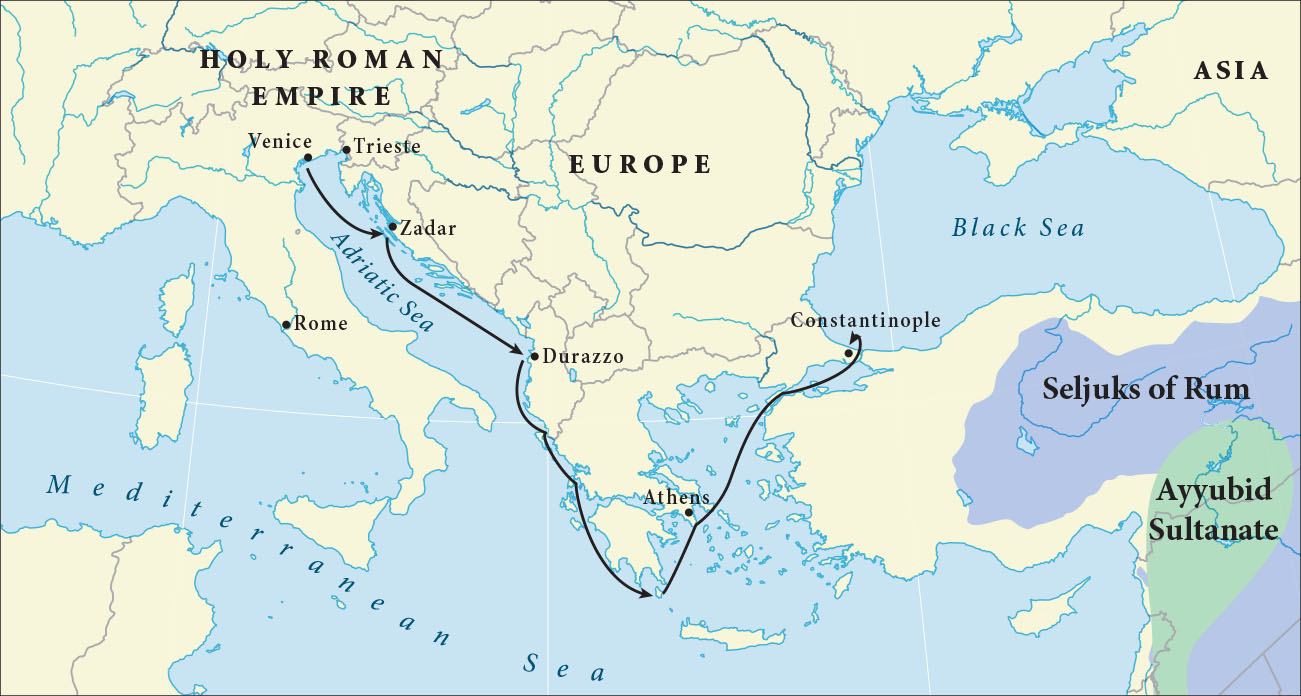
While wintering in Zadar, the crusaders were offered the opportunity to make more money and recruit Byzantine soldiers for the crusade if they installed the son of a recently deposed Byzantine emperor on the throne in Constantinople. Perhaps to forestall Innocent’s objections, the Byzantines’ offer also included subordination of the Orthodox churches to Catholicism, a long-term goal of the western crusaders. Pope Innocent ordered the crusaders to go on to the Holy Land, but they accepted the Byzantines’ offer and made their way to Constantinople instead (Figure 14.12).
英語のヒント
ザダルで冬を越す間、十字軍は提案を受けた。最近廃位されたビザンツ皇帝の息子をコンスタンティノープルの帝位に就ければ、さらに金を得られ、ビザンツの兵を十字軍へ募ることもできるという。おそらく教皇の反対を先回りして封じるため、その提案には、正教会をカトリックに従属させるという、西方の十字軍勢力の長年の目標も含まれた。インノケンティウスは聖地へ向かうよう命じたが、十字軍はこの提案を受け入れ、代わりにコンスタンティノープルへ進んだ(図14.12)。
The Fourth Crusade.第4回十字軍。
(attribution: Copyright Rice University, OpenStax, under CC BY 4.0 license) · CC BY 4.0
Figure 14.12 This map shows the route of the Fourth Crusade in the early thirteenth century. Distracted by other goals in Zadar and Constantinople, the crusaders never reached the Holy Land. (attribution: Copyright Rice University, OpenStax, under CC BY 4.0 license)
図14.12 13世紀初めの第4回十字軍の経路。ザダルとコンスタンティノープルで別の目標へそれたため、十字軍は聖地へたどり着かなかった。(著作権:Rice University, OpenStax、CC BY 4.0)
After a great deal of bungling and confusion on both sides, the crusaders were able to put their young patron on the throne of Byzantium as Alexius IV in the summer of 1203. It turned out, however, that Alexius could come up with only half the promised money, and his attempts to raise the remainder provoked a coup that ended in his death. As they awaited payment from the Byzantines, the crusaders found their expenses increasing, and getting to Egypt looked increasingly daunting. Defeating the heirs of Salah al-Din would be no easy task. The Byzantine army had already fled before them, and many crusaders had not seen their homes for almost three years. Clergy among them pointed out, however, that bringing a usurper (Salah al-Din) to justice was a holy cause that could fulfill their vows of fighting for causes aligned with Christian principles and God’s will, and one that would guarantee their entrance into heaven. However, restoring a legitimate ruler to the Byzantine Empire became the mission of the Fourth Crusade, accomplished in short order in the spring of 1204.
英語のヒント
両陣営が多くの失策と混乱を重ねた末、1203年夏、十字軍は若い後援者を、アレクシオス4世としてビザンツの帝位に就けた。しかし、アレクシオスは約束した金の半分しか用意できなかった。残りを集めようとすると政変が起き、彼は殺された。支払いを待つ十字軍の出費は増え、エジプトへ行くのは、ますます難しく見えた。サラーフ・アッディーンの後継者を倒すのは容易でなかった。ビザンツ軍は、すでに十字軍の前から逃げていた。そして十字軍兵士の多くは、ほぼ3年、故郷を見ていなかった。しかし、そのなかの聖職者は、簒奪者サラーフ・アッディーンに正義の裁きを下すことは、聖なる大義だと説いた。それによって、キリスト教の原則と神の意思にかなう目的のために戦うという誓いを果たし、天国へ入ることを保証されるというのである。しかし結局、ビザンツ帝国に正統な君主を復帰させることが、第4回十字軍の使命となり、1204年春、短期間で達成された。
This new mission of the Fourth Crusade was radically different from that of the previous crusades, which had focused on expelling Muslim rulers from formerly Christian lands. The First Crusade, near the end of the eleventh century, had been the most successful, reestablishing Christian control over areas of Palestine and Syria and creating four Christian-ruled sovereign states in the Levant. After Muslims reclaimed much of the area, two more crusades occurred in the late twelfth century. Neither was able to reassert Christian dominance over Jerusalem or other key Christian sites. The Fourth Crusade had sought to complete the mission, but now it shifted to righting the supposed moral wrongs of Byzantium’s latest internal intrigues.
英語のヒント
第4回十字軍のこの新しい使命は、かつてのキリスト教徒の土地からムスリム君主を追い出すことを目指した、以前の十字軍とは根本的に異なった。11世紀末の第1回十字軍は最も成功し、パレスチナとシリアの一部にキリスト教徒の支配を回復して、レヴァントに四つの独立したキリスト教国家を作った。ムスリムが地域の多くを取り戻すと、12世紀後半に、さらに二つの十字軍が行われた。しかし、どちらもイェルサレムや、ほかの重要なキリスト教の聖地への支配を回復できなかった。第4回十字軍は、その使命を果たそうとしていたが、今や、ビザンツの最近の内紛にあるとされた道徳的な不正を、正すことへと転じた。
Once they had stripped Constantinople bare, the crusaders appointed a new Byzantine emperor and one of their own priests as Patriarch of Orthodox Christianity, thus putting the leadership of the Byzantine church in the hands of someone loyal to the papacy. Within a year, most of them had drifted back to their original homes, taking a share of Byzantium’s wealth with them. As they expected, Pope Innocent accepted the reimposition of Catholicism on Eastern Christianity as sufficient for fulfilling a crusader’s vows, even if not a single drop of Muslim blood had been shed or an inch of Islamic territory added to Christendom.
英語のヒント
コンスタンティノープルを徹底的に略奪すると、十字軍は新しいビザンツ皇帝を立て、自分たちの司祭の一人を正教会の総主教に任命した。こうしてビザンツ教会の指導権を、教皇に忠実な人物に渡した。1年以内に、十字軍の大半は、ビザンツの富の分け前を持って故郷へ戻った。彼らの期待どおり、インノケンティウスは、東方キリスト教にカトリックの権威を再び課したことを、十字軍の誓いを果たすのに十分と認めた。ムスリムの血は一滴も流されず、イスラームの領土は一寸もキリスト教世界へ加わらなかったにもかかわらずである。