第14章パクス・モンゴリカ――モンゴルの草原帝国Pax Mongolica: The Steppe Empire of the Mongols
The Rise of Chinggis Khan and Mongol Unificationチンギス・カンの台頭とモンゴルの統合
While an increasing number of steppe people gathered in settled communities, many still lived as nomads. The clan, a small group of several families that shared an encampment and herded or hunted together, was the basic unit of steppe society. Each clan had a ruling lineage from which leaders were selected and that intermarried with other lineages to avoid in-breeding. Thus, the ruling lineages formed an aristocracy of sorts. Clans could split apart, creating a ruling lineage for a new clan, so it was possible to move from commoner to aristocrat, although founding and leading a clan was no small feat.
英語のヒント
定住集落に集まる草原の人々が増えるなかでも、多くは遊牧を続けていた。草原社会の基本単位は氏族だった。数家族からなる小集団で、同じ宿営地を使い、一緒に放牧や狩猟をした。それぞれの氏族には支配的な家系があり、そこから指導者を選んだ。近親婚を避けるため、他の家系と婚姻関係を結んだ。したがって、これらの支配家系は、一種の貴族層をなしていた。氏族が分裂すれば、新しい氏族の支配家系ができたので、一般の人から貴族になることも可能だった。しかし、氏族を創設して率いるのは、並大抵のことではなかった。
Given the high mortality among the steppe peoples, the adoption of children and widows was commonplace. Polygamy was practiced by men who could support multiple wives and the children they would produce, and most households included some enslaved people. Children, wives, enslaved people, and livestock were often obtained by raiding weaker, underprepared clans.
英語のヒント
草原の人々は死亡率が高かったため、子どもや寡婦を家に引き取ることは、ごく普通だった。複数の妻と、その妻たちが産む子どもを養える男性は、一夫多妻を行った。大半の家には奴隷にされた人もいた。子ども、妻、奴隷、家畜は、より弱く、備えの不十分な氏族を襲って手に入れることが多かった。
Clans joined together to form tribes under a single leader to better protect their herds and households, cooperate on resource management and migration, and engage in united actions like raids on other clans. Eurasian tribes were loosely organized, often multiethnic and multilingual, not exclusive to a kinship network, and open to any who were willing to obey the leader. Clans drifted in and out of tribes depending on their needs and wishes. Multiple tribes periodically united around a single skillful or charismatic leader, creating a larger confederation. This unity was very short-lived, rarely lasting beyond a generation or two.
英語のヒント
氏族は、一人の指導者の下にまとまって部族を作った。家畜や家族をよりよく守り、資源の管理や移動に協力し、他の氏族への襲撃などを共同で行うためである。ユーラシアの部族は緩やかな組織で、複数の民族や言語を含むことも多かった。特定の血縁関係だけに限られず、指導者に従う意思がある人なら受け入れた。氏族は、必要や希望に応じて、部族に入ったり抜けたりした。複数の部族が、すぐれた能力やカリスマ性を持つ一人の指導者を中心に、時折まとまって、より大きな連合を作ることもあった。しかし、この結束は長続きせず、1、2世代を超えることはまれだった。
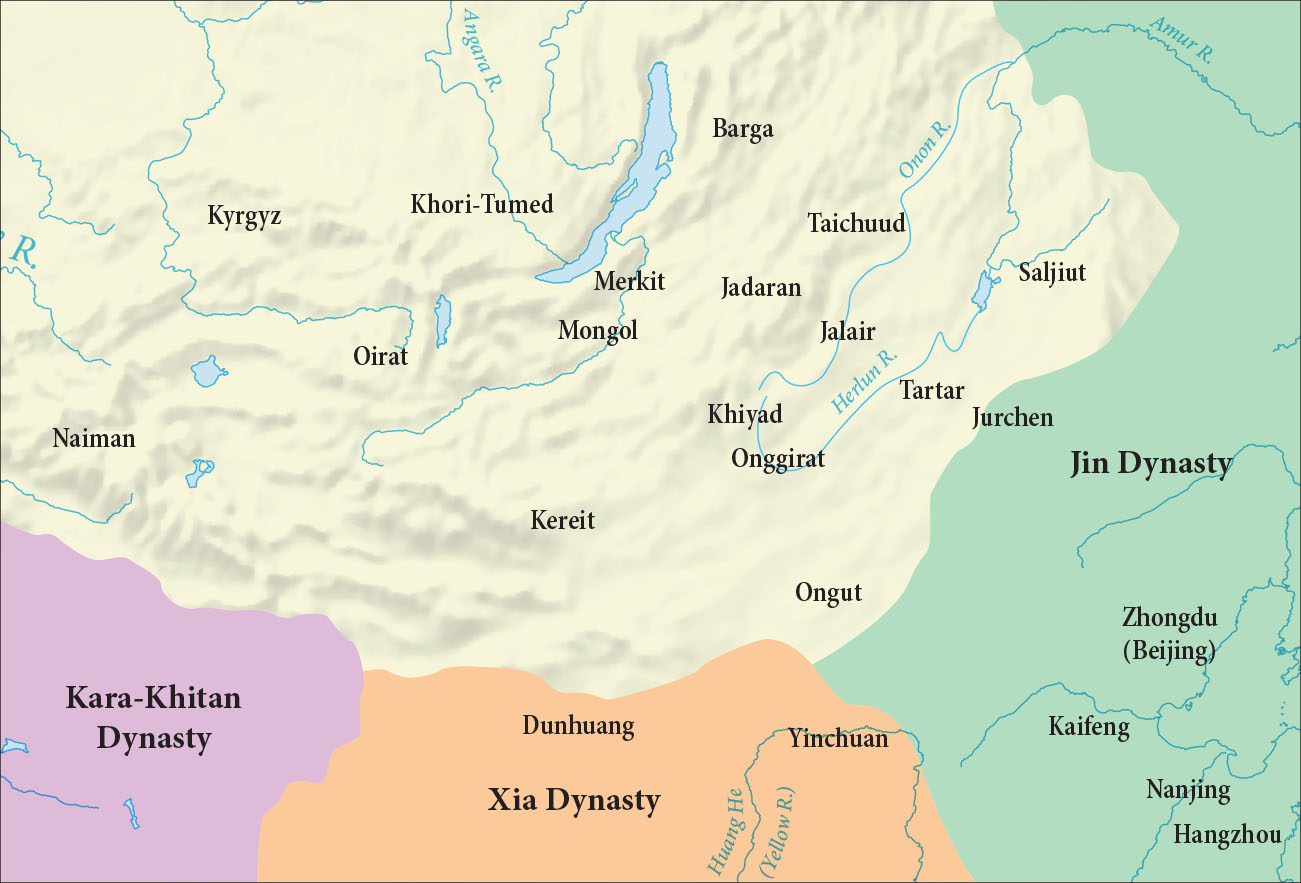
Many clans and dozens of tribes occupied the Mongolian grasslands in the late twelfth century (Figure 14.7). Settled peoples like the Jin and Song had long incited these nomadic groups against one another, adding to the turmoil of incessant clan raids. In 1161, concerned that a confederation led by Mongolian speakers was growing too powerful, the Jin encouraged and supported a confederation led by Tatars to attack the Mongol-led confederation. Tatar was a Turkish language spoken by many inhabitants of the grasslands north of China. (The fluidity of membership in clans, tribes, and confederations makes it problematic to consider a group led by a speaker of one language as truly having a common ethnic heritage or long-standing communal bond such as a modern nation has. Nevertheless, perhaps for the sake of simplicity, scholars tend to refer to confederations of seminomads by the primary language of their leader.)
英語のヒント
12世紀末のモンゴル草原には、多くの氏族と数十の部族がいた(図14.7)。金や宋のような定住民は、長くこれらの遊牧集団を互いに争わせ、絶え間ない氏族間の襲撃による混乱を強めていた。1161年、モンゴル語を話す人々の率いる連合が強大になりすぎることを恐れた金は、タタル人の率いる連合に、モンゴル側の連合を攻撃するよう促し、支援した。タタル語は、中国の北の草原の多くの住民が話すテュルク系言語だった。(氏族、部族、連合の構成員は流動的だった。したがって、ある言語を話す指導者が率いる集団を、現代の国民のように共通の民族的な伝統や長年の共同体としての絆を実際に持つものとみなすのは、問題がある。それでも研究者は、おそらく話を簡単にするため、半遊牧民の連合を、指導者が主に話す言語によって呼ぶ傾向がある。)
Mongol Tribes and the Three Steppe Kingdoms.モンゴル諸部族と草原の三つの王国。
(attribution: Copyright Rice University, OpenStax, under CC BY 4.0 license) · CC BY 4.0
Figure 14.7 This map shows (in yellow) the areas that various Mongol tribes considered their lands in the late twelfth century and where they were in relation to the three settled kingdoms of the Kara-Khitan, Xia, and Jin between the steppe and the Southern Song dynasty. (attribution: Copyright Rice University, OpenStax, under CC BY 4.0 license)
図14.7 12世紀末、さまざまなモンゴルの部族が自分たちの土地とみなしていた地域を黄色で示す。草原と南宋の間にある三つの定住王国、西遼、西夏、金との位置関係も分かる。(著作権:Rice University, OpenStax、CC BY 4.0)
The Tatar attack on the Mongol confederation scattered its clans, forcing them to form new tribes and seek to join other confederations. It was in this context that a son was born to Hoelun, primary wife of one of the clan leaders of the recently defeated Mongol confederation in their camp between the Onon and Herlen Rivers. The child, born as Temujin, is better known today by the title he acquired later in life and that history most remembers him by: Chinggis Khan, meaning “universal ruler.” He completely altered the relationships between the nomadic groups on the Eurasian Steppe and radically changed the trajectory of world history.
英語のヒント
タタルの攻撃でモンゴルの連合は散り散りになり、氏族は新しい部族を組織したり、別の連合に加わろうとしたりせざるをえなくなった。このような状況のなか、敗れたばかりのモンゴル連合の氏族長の一人と、その正妻ホエルンの間に、オノン川とヘルレン川の間の宿営地で男児が生まれた。テムジンと名付けられたこの子は、今日では、のちに得た称号であり、歴史に最もよく記憶される名で知られている。「普遍的な支配者」を意味するチンギス・カンである。彼は、ユーラシアの草原の遊牧集団同士の関係を一変させ、世界史の進路を根本から変えた。
There are no historical records of Temujin before he became known as Chinggis Khan, the powerful ruler of the world’s largest empire in his time. A work called The Secret History of the Mongols, likely written after his death, is the most potentially reliable source, though it is suspect because it is based solely on oral history interpreted by non-Mongols.
英語のヒント
テムジンが、当時世界最大の帝国の強大な君主、チンギス・カンとして知られるようになる前の歴史記録は、存在しない。彼の死後に書かれたと考えられる『モンゴル秘史』という作品は、最も信頼できる可能性のある史料である。ただし、モンゴル人ではない人々が解釈した口承の歴史だけに基づくため、その信頼性には疑問もある。
Whereas The Secret History of the Mongols recounts many heroic exploits in Temujin’s family’s struggle to survive, it paints a bleak picture of their existence on the steppe. Temujin was briefly enslaved by the rival clan until a sympathetic family helped him escape. Not long after Temujin married, raiders from the Merkit Mongol tribe attacked and kidnapped his wife, Borte. Temujin sought help from Ong Khan, leader of the Kereit Mongol confederation, to retrieve her, and she gave birth to a son not long after. The timing made it unclear who the father was; nevertheless, Temujin accepted the child as his. At some point in the early 1180s, Temujin broke with his friend and clan leader Jamukha and formed a new clan with himself as head.
英語のヒント
『モンゴル秘史』は、テムジンの家族が生き延びるために行った数々の英雄的な活躍を語ると同時に、草原での彼らの暮らしを、厳しいものとして描いている。テムジンは、敵対する氏族によって一時奴隷にされ、同情した家族に助けられて逃れた。結婚して間もなく、メルキトの襲撃者が妻ボルテをさらった。テムジンは、ケレイト連合の指導者オン・カンに助けを求め、妻を取り戻した。ボルテはその後間もなく男児を産んだ。時期からみて父親ははっきりしなかったが、テムジンは自分の子として受け入れた。1180年代初めのある時点で、テムジンは友人でもあり氏族の指導者でもあったジャムカと決別し、自分を長とする新しい氏族を作った。
By 1187, Temujin had such an impressive force and reputation that Ong Khan turned to him when the Jin induced Ong Khan to attack the Tatar Confederation. Ong Khan and Temujin defeated the Tatars and acquired goods more luxurious than Temujin’s people had ever seen. This drew even more people to his clan. As the clans allied with Temujin grew, Jamukha expanded his clan to keep up with him. Soon those in the Mongol-speaking part of the steppe were left with the choice of joining Temujin, joining Jamukha, or risking attack by one or the other.
英語のヒント
1187年までに、テムジンは大きな勢力と名声を得ていた。金がオン・カンを促してタタル連合を攻撃させた際、オン・カンがテムジンへ助力を求めるほどだった。オン・カンとテムジンはタタルを破り、テムジンの人々が見たこともないような、ぜいたくな品々を手に入れた。それを見て、さらに多くの人が彼の氏族へ集まった。テムジンと結ぶ氏族が増えると、ジャムカも遅れを取るまいと自分の氏族を拡大した。まもなく、草原のモンゴル語が話される地域の人々は、テムジンにつくか、ジャムカにつくか、それともどちらかに攻撃される危険を冒すか、という選択を迫られた。
Temujin made drastic changes to traditional Mongol practices, in part as a reaction to the hardships he suffered growing up, which laid the groundwork for his creation of a huge multiethnic empire. As he engaged in warfare with a wider array of rivals, he considered class differences. He punished those who led any resistance and executed the leaders of rival clans, but he often spared the common people and integrated the men into his army. He ordered his fighters to refrain from looting and raping and instead to pursue any fleeing warriors to capture or kill them, minimizing future retaliatory raids by those who escaped. Rather than enslaving the captured adult males, he put the members of aristocratic lineages on trial for committing whatever affront he had used to justify the attack. Once found guilty, which was the general outcome, they were executed. Temujin then divided the spoils of the raid equally between the participants and the households of his men killed in the raid. By assuring his soldiers that their widows and orphans would not be at the mercy of whoever took them in, he reduced the incentive to desert.
英語のヒント
テムジンは、モンゴルの伝統的慣行を大きく変えた。その一因は、育つ過程で経験した苦難への反発だった。これらの変化が、巨大な多民族帝国を築く土台になった。敵対勢力の幅が広がるにつれ、彼は階層の違いを考慮した。抵抗を率いた者を罰し、敵の氏族の指導者を処刑する一方、一般の人々は助命することが多く、男たちを自分の軍へ組み入れた。兵士には、略奪や強姦を控え、代わりに逃げる戦士を追い、捕らえるか殺すよう命じた。逃亡者がのちに報復の襲撃をする可能性を、できるだけ小さくするためだった。捕らえた成人男性を奴隷にする代わりに、貴族の家系に属する者を、彼が攻撃の正当化に用いた何らかの侮辱行為を犯したとして、裁判にかけた。たいていそうなったが、有罪とされれば処刑した。その後、襲撃で得た戦利品を、参加者と、戦死した自軍の兵の家族に平等に分配した。兵士には、自分の死後、寡婦や遺児が、引き取る者の思いのままに扱われることはないと保証した。そのため、兵士が脱走しようとする動機は弱まった。
Temujin also divided his warriors into units of ten, each bound to the others by oaths of loyalty, and then units of one hundred and one thousand that chose their own leaders and swore similar oaths. Only at the highest level, ten units of one thousand warriors, did he appoint commanders, and he did so on the basis of merit and loyalty to him, not kinship or clan identity. The groups drilled precision moves and learned simple musical chants that identified the formations their commanders desired in the heat of battle. This innovative organization not only forged a deadly, efficient fighting force; it also provided all males with a shared and classless role in society and unified an increasingly ethnically and linguistically diverse portion of the steppe people, whom Temujin began to call the People of the Felt Walls in a reference to their fabric-covered homes.
英語のヒント
テムジンはまた、戦士を10人単位の組に分け、互いに忠誠を誓わせた。その上に百人隊と千人隊を設け、自ら指導者を選び、同様の誓いを立てさせた。千人隊10組からなる最上位の部隊だけは、彼が指揮官を任命した。基準は能力と自分への忠誠であり、血縁や氏族への帰属ではなかった。部隊は正確な動きを訓練し、戦闘の最中に指揮官が求める陣形を伝える、簡単な節の付いた掛け声を覚えた。この新しい編成は、殺傷力と効率の高い戦力を作っただけではない。すべての男性に、階層によらない共通の社会的役割を与え、民族的・言語的にますます多様になる草原の人々を統合した。テムジンは、布で覆った住まいにちなんで、彼らを「フェルトの壁に住む民」と呼び始めた。
Temujin’s reforms introduced a new division in steppe civilization that today might be called class warfare. People from aristocratic lineages began to fear Temujin and joined with Jamukha, but commoners sought the protection and rewards of joining the People of the Felt Walls. The aging Ong Khan disapproved of Temujin’s attack on tradition and aristocratic privilege and began favoring Jamukha. After Ong Khan tried to lure him into a trap, Temujin fled to a rendezvous with his top leaders, who swore renewed loyalty to each other in the Baljuna Covenant. The covenant became a rallying point and symbol of Mongol nationalism for future generations.
英語のヒント
テムジンの改革は、草原の文明に新しい対立を持ち込んだ。今日の言葉なら、階級闘争とも呼べるものだった。貴族の家系の人々はテムジンを恐れ、ジャムカに合流するようになった。一方、一般の人々は、「フェルトの壁に住む民」に加わることで得られる保護と報いを求めた。老いたオン・カンは、テムジンが伝統と貴族の特権を攻撃することに反対し、ジャムカを支持するようになった。オン・カンに罠へ誘い込まれかけたテムジンは、主要な指導者たちとの合流地点へ逃れた。彼らはバルジュナの盟約で、改めて互いの忠誠を誓った。この盟約は、後世にモンゴルの民族意識をまとめる拠り所、象徴となった。
The men who swore to the covenant came from nine different clans and represented at least four religions: Buddhism, Christianity, Islam, and the traditional Mongol worship of Tengri, the Eternal Blue Sky. The glue that held the People of the Felt Walls together was not kinship, ethnicity, or religion but devotion to the civil society Temujin had created. Word went out from Baljuna to the scattering People of the Felt Walls to regroup and to find Temujin and the others in a remote part of the steppe.
英語のヒント
盟約を誓った男たちは九つの異なる氏族の出身で、少なくとも四つの信仰を持っていた。仏教、キリスト教、イスラーム、そして永遠なる青い天・テングリへのモンゴルの伝統的な信仰である。「フェルトの壁に住む民」を結びつけたのは、血縁、民族、宗教ではなく、テムジンが作った市民的な社会への献身だった。バルジュナから、散り散りになった民へ知らせが送られた。再び集まり、草原の奥地にいるテムジンたちを探し出せ、という知らせだった。
Ong Khan believed Temujin was hiding out a weeks’ ride away in the east. Temujin and his followers were much closer, however. They surrounded Ong Khan’s forces, using the element of surprise to launch an attack that lasted three days. Demoralized, many of Ong Khan and Jamukha’s followers began to join Temujin. Ong Khan was killed while crossing alone into territory controlled by the Naiman, the last confederation that could oppose Temujin.
英語のヒント
オン・カンは、テムジンが馬で1週間かかる東方に隠れていると思っていた。しかし、テムジンとその支持者は、はるかに近くにいた。彼らはオン・カンの軍を包囲し、不意を突いて、3日間に及ぶ攻撃を始めた。士気を失ったオン・カンとジャムカの支持者の多くが、テムジンの側へ移り始めた。オン・カンは一人で、テムジンに対抗しうる最後の連合、ナイマンの支配地へ入ろうとして殺された。
With Temujin expanding and the Naiman harboring Jamukha and other refugees from Ong Khan, war between the two groups was inevitable. Temujin’s discipline and tactical training of his troops paid off, and in 1204 the Naiman collapsed, its leadership dead or in flight. The survivors joined the People of the Felt Walls. Jamukha was eventually turned in by his followers and executed, along with those who had betrayed him, since Temujin felt their treachery to their lord deserved punishment.
英語のヒント
テムジンが勢力を伸ばす一方、ナイマンはジャムカや、オン・カン側から逃れてきた人々をかくまっていたため、両者の戦争は避けられなかった。テムジンが軍に施した規律と戦術訓練は成果を上げ、1204年、ナイマンは崩壊した。指導者は死ぬか逃亡し、生き残った人々は「フェルトの壁に住む民」へ加わった。ジャムカは、ついには自分の支持者に引き渡され、彼を裏切った者たちと共に処刑された。テムジンは、主人に対するその裏切りも、罰に値すると考えたからである。