第14章パクス・モンゴリカ――モンゴルの草原帝国Pax Mongolica: The Steppe Empire of the Mongols
14.3 The Mongol Empire Fragments14.3 モンゴル帝国の分裂
Learning Objectives学習の目標
By the end of this section, you will be able to:
この節を読み終えると、次のことができるようになる。
Analyze the extent to which Chinggis Khan’s vision for the future of Eurasia was realized by his grandsons
ユーラシアの未来についてのチンギス・カンの構想が、孫たちによって、どこまで実現したか分析する。
Explain why Islam was successful in gaining converts in the Mongol Empire
モンゴル帝国で、イスラームが改宗者を増やすことに成功した理由を説明する。
Analyze the degree to which Yuan China was a continuation of traditional Chinese civilization
元代の中国が、伝統的な中国文明をどの程度引き継いだか分析する。
While the ascension of Mongke Khan in 1251 gave hope for the realization of a Mongol Empire overseeing Eurasian trade, it proved only a temporary rebirth, since a lust for power consumed Chinggis Khan’s grandsons. The rulers of three of the four khanates—the Chagatai Khanate, the Khanate of the Golden Horde, and the Il-Khanate—eventually converted to Islam along with many of their people, but having a common religion did not keep them from fighting one another. By the mid-fourteenth century, two khanates had completely fragmented. Sporadic efforts were made to expand against the Delhi Sultanate but failed. Kublai conquered China and established the Yuan dynasty, also known as the Great Khanate of Yuan China, in the 1270s. However, in the fourteenth century, China too was dealing with serious internal divisions.
英語のヒント
1251年のモンケ・カン即位は、ユーラシアの交易を統括するモンゴル帝国の実現に希望を与えた。しかし、それは一時的な再生に終わった。チンギス・カンの孫たちが、権力への欲望に取りつかれたからである。四つのハン国のうち、チャガタイ・ハン国、ジョチ・ウルス、イル・ハン国の三つでは、やがて支配者が、多くの民と共にイスラームへ改宗した。しかし、同じ宗教を持つことは、互いに戦うのを防がなかった。14世紀半ばまでに、二つのハン国は完全に分裂した。デリー・スルタン朝へ領土を広げようとする試みも散発的に行われたが、失敗した。クビライは中国を征服し、1270年代に元を建てた。元代中国は、大カンのハン国とも呼ばれる。しかし中国も、14世紀には深刻な内部分裂に直面していた。
Islam and the Mongolsイスラームとモンゴルの人々
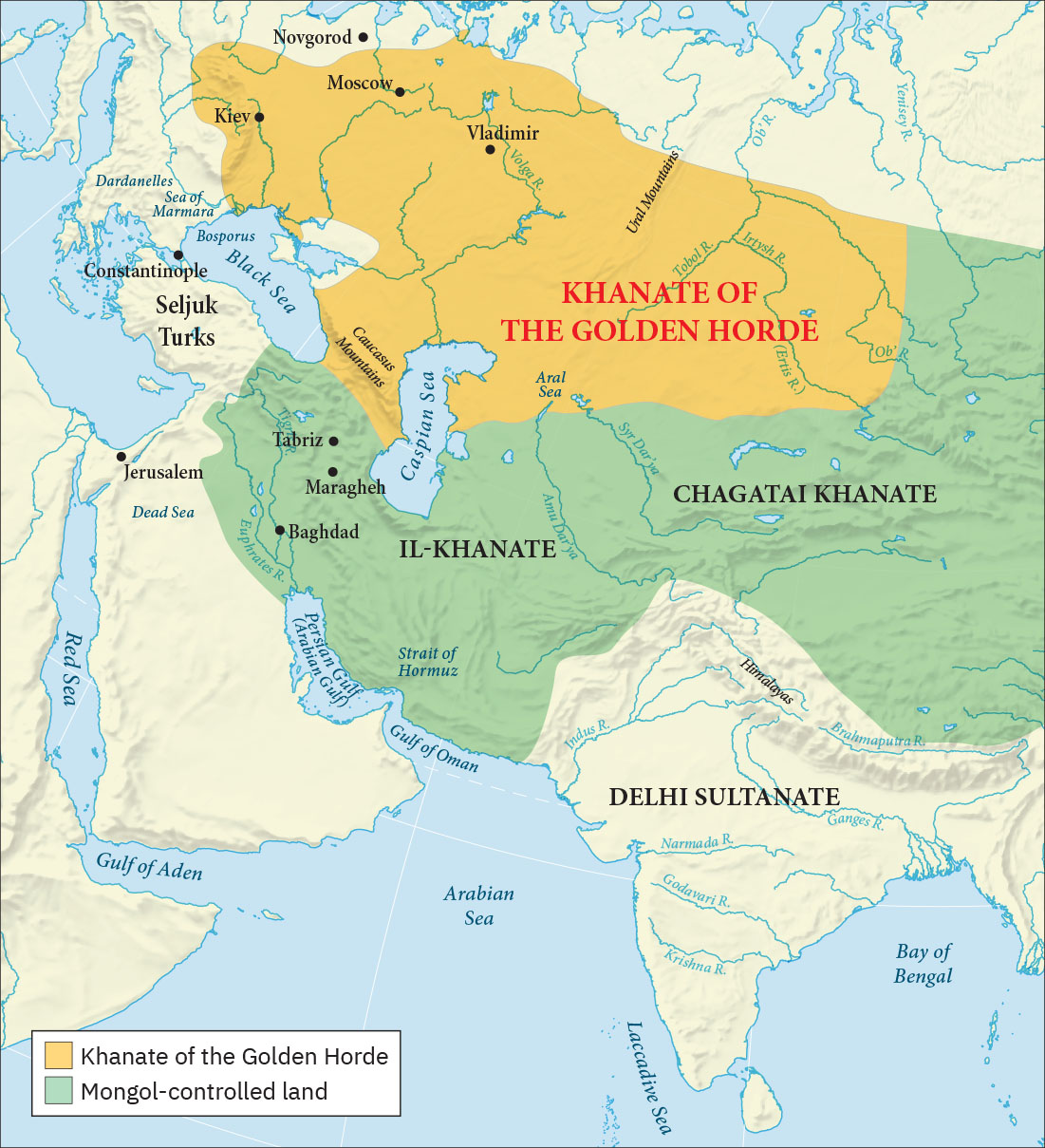
While the lands of the Eurasian Steppe were always a place of great religious heterogeneity, Islam was the faith of most of the people living there. Except in the Slavic areas of the Golden Horde, the lands west of the Volga River, the endorsement of the ruling Mongol elite added to the attractions of Islam, leading the majority of the population to convert. The other faiths were relegated to small, scattered communities (Figure 14.11).
英語のヒント
ユーラシアの草原は、つねに宗教的に非常に多様な場所だったが、住民の大半が信仰したのはイスラームだった。ジョチ・ウルスのうち、ヴォルガ川の西にあるスラヴ人の地域を除くと、支配するモンゴル人エリートの支持もイスラームの魅力を高め、人口の大半が改宗した。ほかの信仰は、小さく散在する共同体に限られるようになった(図14.11)。
The Western Mongol Empire.モンゴル帝国の西部。
(attribution: Copyright Rice University, OpenStax, under CC BY 4.0 license) · CC BY 4.0
Figure 14.11 This map shows the western Mongol Empire after its final fragmentation into four parts, which included the Great Khanate of the Yuan in China (not depicted here). The areas west of the Volga River, populated largely by Orthodox Christians, were the only ones that did not see the majority convert to Islam, and they remain so to this day. (attribution: Copyright Rice University, OpenStax, under CC BY 4.0 license)
図14.11 帝国が最終的に四つへ分かれたあとの、西部のモンゴル諸国を示す。四つのうち、中国の元の大カン国は、この地図にはない。主に正教徒が住むヴォルガ川以西だけは、人口の大半がイスラームへ改宗せず、その状態が今日も続いている。(著作権:Rice University, OpenStax、CC BY 4.0)
By spreading throughout much of western and southern Asia over the centuries since its founding, Islam had often influenced—and been influenced by—local cultures. This exchange could lead to the formation of unique sects of the faith. One such set of beliefs was Sufism, a strain of Islam that emphasized asceticism and meditation as the path to a level of divine understanding that brought a rapturous feeling of love for God. Sufism played an important role in the Islamification of the Mongols and other peoples of the Inner Asian Steppe. While Sufis often sought to live lives of spiritual and moral perfection, their ultimate belief was that God was best worshipped through deep thought and reflection. Living a life strictly adhering to Quranic law was not an end in itself but a means to remove distractions so that the intense contemplation necessary to know God at the level they sought could occur.
英語のヒント
イスラームは、成立以来の数世紀にわたって西アジアと南アジアの広い範囲へ広がるなかで、地域文化へ影響を与え、また地域文化から影響を受けた。この相互作用から、独自の信仰の流れが生まれることがあった。その一つがスーフィズムである。禁欲と瞑想を重んじ、神への恍惚とした愛を感じるほどの、深い神的理解に至ろうとする、イスラームの一潮流だった。スーフィズムは、モンゴル人と、内陸アジアの草原のほかの人々のイスラーム化に、重要な役割を果たした。スーフィーは、精神的・道徳的に完全な生き方を求めることが多かったが、究極には、深い思考と省察によって神を最もよく礼拝できると信じた。クルアーンの法に厳密に従う生活は、それ自体が目的ではない。気をそらすものを取り除き、目指す深さで神を知るための、集中的な観想を可能にする手段だった。
Sufis were instructed in the movement’s practices by spiritual guides and often formed communities. The disruptions of the Mongol conquests caused many of these communities to scatter into the steppe, where they intermingled with people of the Mongol Empire, and where Sufi spiritual guides seemed similar to the shamans Mongols knew as the guardians of worship of Tengri. The Sufi emphasis on a mystical path of meditation and reflection also allowed Mongols to continue to live under the yassa and accept Sufi teachings and practices. As Muslims and Mongols interacted and formed families, Sufism made the conversion to Islam seem more of an evolution and less of a dramatic change.
英語のヒント
スーフィーは精神的な師に実践を教わり、しばしば共同体を作った。モンゴルの征服による混乱で、こうした共同体の多くが草原へ散り、帝国の人々と交わった。モンゴル人には、スーフィーの師が、自分たちの知るテングリ崇拝の守り手、シャマンに似て見えた。瞑想と省察による神秘的な道を重視するスーフィズムなら、モンゴル人はヤサの下で暮らし続けながら、その教えと実践を受け入れることもできた。ムスリムとモンゴル人が交流し、家族を作るなかで、スーフィズムは、イスラームへの改宗を、劇的な変化よりも、徐々の発展のように感じさせた。
The Fate of Hulagu’s Il-Khanateフレグのイル・ハン国の行方
Hulagu Khan had to balance several conflicts once civil war broke out after the death of Mongke Khan in 1259. The most serious threat was war with the Golden Horde, led by Batu’s younger brother Berke. A convert to Islam, Berke had become deeply disturbed by Hulagu’s destruction of Baghdad and the murder of the caliph. There were also disputes about whether Hulagu or the Horde should receive tribute from areas on which Hulagu had reimposed stability. Not surprisingly, Hulagu and Berke ended up on different sides of the civil war to succeed Mongke. Their conflict lasted nearly four years, until both men died in 1265, and their successors moved on to other pursuits.
英語のヒント
1259年、モンケ・カンの死後に内戦が起こると、フレグ・カンは、複数の対立の間で釣り合いを取らなければならなかった。最大の脅威は、バトゥの弟ベルケが率いるジョチ・ウルスとの戦争だった。イスラームに改宗していたベルケは、フレグのバグダード破壊とカリフ殺害に、深く憤っていた。フレグが安定を回復させた地域の貢納を、フレグとジョチ・ウルスのどちらが受け取るかでも、対立があった。二人が、モンケの後継をめぐる内戦で敵味方に分かれたのも、驚くことではない。対立は、1265年に両者が死ぬまで約4年続き、その後、後継者たちは別の目標へ向かった。
For decades, the leaders of the Il-Khanate remained in frequent but intermittent conflict with the Golden Horde and the Mamluks of Egypt, who were sometimes joined by the Seljuks operating out of Anatolia and the Chagatai khans. Repulsing these attacks consumed most of the Il-Khanate’s efforts and resources, a situation compounded by periodic bouts of civil war over succession and making further expansion out of the question. The Il-Khans constantly struggled to hold the Tigris-Euphrates basin, leaving the Nile delta and lands holy to the Abrahamic religions in the Levant forever beyond their grasp.
英語のヒント
何十年も、イル・ハン国の指導者は、ジョチ・ウルスやエジプトのマムルーク朝と、断続的ながら頻繁に戦った。敵方には、ときにアナトリアを拠点とするセルジューク勢力や、チャガタイ家のカンたちも加わった。これらの攻撃を退けるだけで、イル・ハン国の努力と資源の大半が費やされた。後継者争いによる内戦も周期的に起こり、状況をさらに悪化させ、いっそうの拡張は問題外となった。イル・カンたちは、ティグリス・ユーフラテス流域を保つために絶えず苦闘し、ナイル・デルタと、アブラハム系の宗教にとって神聖なレヴァントの土地は、ついにその支配の届かないままとなった。
Most of the population of the Il-Khanate had become Muslim centuries before. The need to concentrate on defense led the Il-Khans to leave most of the work of government in the hands of the religious scholars called the ulama, reinforcing traditional Islamic law and custom. Ghazan Khan, who ruled from 1295 to 1304, firmly favored Islam. His brother Oljaitu (who took the Muslim name Khodabandeh) promoted Shia Islam, further entrenching its presence in what is today eastern Iraq and Iran. Despite this, conflict with its Muslim neighbors continued as the Il-Khanate sought to take more resources for itself at their expense.
英語のヒント
イル・ハン国の住民の大半は、何世紀も前からムスリムだった。防衛へ力を集中する必要から、イル・カンたちは、政府の仕事の大半を、ウラマーと呼ばれる宗教学者に任せた。その結果、伝統的なイスラーム法と慣習が強まった。1295年から1304年まで治めたガザン・カンは、明確にイスラームを優遇した。弟オルジェイトゥは、ムスリム名ホダーバンデを名乗り、シーア派を奨励した。これによって、現在のイラク東部とイランに、シーア派はいっそう根づいた。それでも、イル・ハン国が隣国の犠牲の上に、より多くの資源を自分のものにしようとしたため、ムスリムの隣国との対立は続いた。
Overall, the economy was slow to recover from the devastation of Hulagu’s attack, especially with frequent warfare continuing to destroy the irrigation and urban infrastructure. There were chronic labor shortages in the first generations after Hulagu’s conquest because of wide-scale murder, enslavement, and relocation, as well as substantial emigration to neighboring Islamic lands. Ghazan’s reign laid the groundwork for a generation of prosperity and cultural flowering relative to the tumultuous periods before and after. This prosperity was centered east of Baghdad and the Tigris-Euphrates basin, around Maragha and Tabriz in modern Iran. The Il-Khanate rulers tried to live up to Chinggis and Ogedei Khan’s dream of a world united in trade by negotiating trade deals, most famously with Venice and Genoa on the Italian Peninsula. They were also able to maintain secure trade with Mongolian China. This prosperity, however, was not enough to overcome the peril of succession struggles. After the son of Ghazan died without an heir in 1335, the Il-Khanate fell into a civil war from which it never emerged. While several men claimed to be il-khan in subsequent years, none exercised control over more than a fraction of the lands Hulagu had conquered.
英語のヒント
経済全体は、フレグの攻撃による荒廃から、なかなか回復しなかった。とりわけ、頻繁な戦争が、灌漑施設と都市の基盤施設を破壊し続けていた。征服直後の数世代は、大量殺害、奴隷化、移住の強制に加え、隣接するイスラームの土地へ多くの人が移ったため、慢性的な労働力不足があった。ガザンの治世は、その前後の混乱期と比べれば、1世代にわたる繁栄と文化の開花の基礎を築いた。繁栄の中心は、バグダードとティグリス・ユーフラテス流域の東、現在のイランのマラーガとタブリーズ周辺だった。イル・ハン国の君主は、交易で世界を結ぶというチンギスとオゴデイの夢に応えようと、通商協定を交渉した。特に有名なのは、イタリア半島のヴェネツィアとジェノヴァとの協定である。モンゴルが治める中国とも、安全な交易を保った。しかし、その繁栄でも、継承争いの危険は克服できなかった。1335年、ガザンの息子が後継者を残さず死ぬと、イル・ハン国は内戦に入り、二度と抜け出せなかった。その後、イル・カンを名乗る者は何人も現れたが、フレグの征服地のごく一部を超えて支配できた者はいなかった。