第14章パクス・モンゴリカ――モンゴルの草原帝国Pax Mongolica: The Steppe Empire of the Mongols
The Inner Asian Steppe and Chinese Dynastic Struggles内陸アジアの草原と中国諸王朝の争い
Steppe peoples organized themselves under widely varying degrees of centralized authority. At one end were small self-governing nomadic clans with fluctuating membership and modest herds in remote parts of the steppe. At the other extreme were settled societies with fixed capital cities, centralized administrations funded by routine taxation, and a writing system for their language. In between were larger groups of seminomadic tribes that were mostly preliterate, with more loosely fixed memberships and territorial ranges than the settled societies. In the wake of the Tang dynasty collapse at the beginning of the tenth century, some seminomadic tribes seeking the prosperity and technology of China transitioned to more settled and centralized civilizations.
英語のヒント
草原の人々の組織では、権力が中心へ集まる程度に大きな幅があった。一方の端には、草原の奥地で比較的少数の家畜を飼い、構成員が入れ替わる、小さな自治的遊牧氏族があった。他方の端には、固定した首都、定期的な課税で支える中央集権的な行政組織、自分たちの言語を記す文字を持つ定住社会があった。その中間には、より大きな半遊牧の部族集団があり、大半はまだ文字を使わず、構成員や活動領域も、定住社会ほどには固定されていなかった。10世紀初めに唐が滅んだあと、中国の繁栄や技術を求める一部の半遊牧部族は、定住性と中央集権性の高い文明へと移行した。
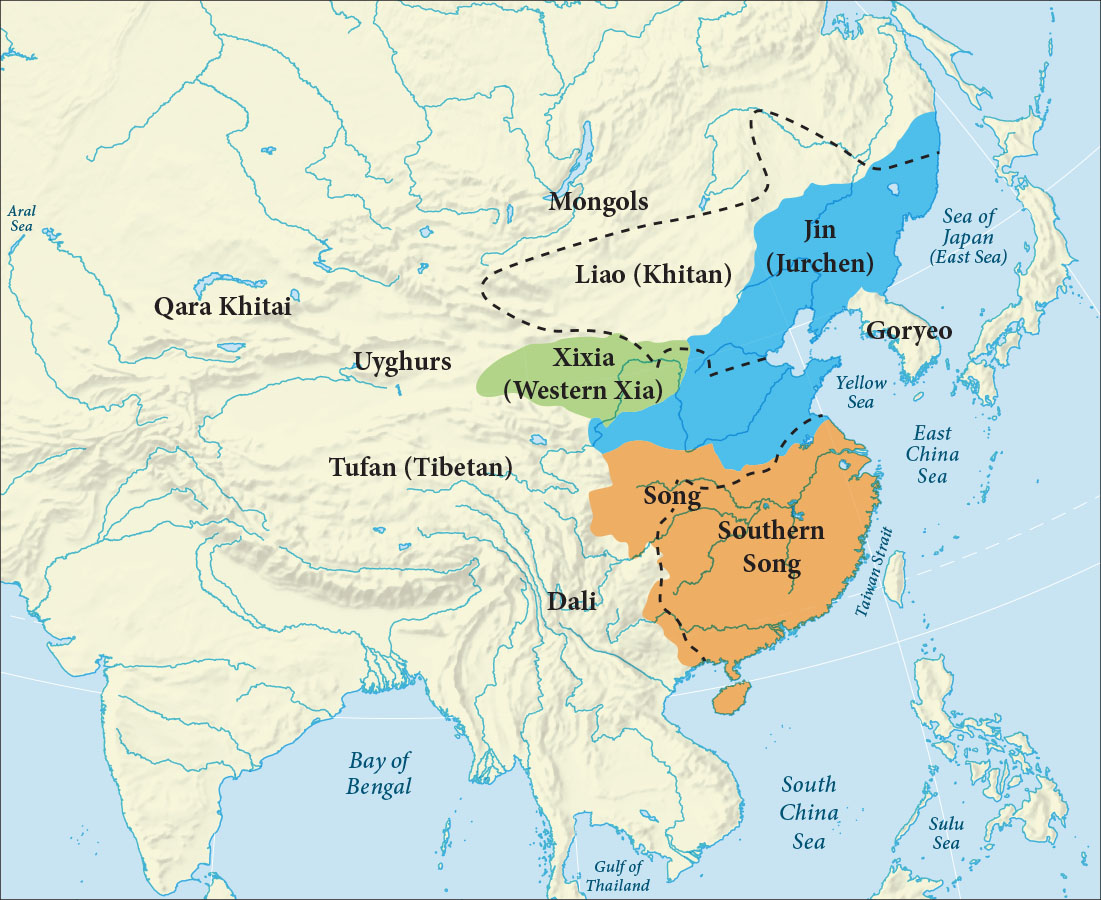
Taking advantage of the power vacuum caused by the collapse of the Tang dynasty, two steppe peoples extended their rule from the Inner Asian Steppe into northern China: the Khitan Liao, linguistically a Mongolian people who formed the Liao kingdom, and the Xia, sometimes called the Tangut, linguistically a Tibetan people who formed the Xi Xia kingdom. These kingdoms became a bridge between the long-established, highly centralized, and sedentary civilization of China and the nomadic tribes of the steppe (Figure 14.5).
英語のヒント
唐の崩壊が生んだ権力の空白を利用して、草原の二つの集団が、内陸アジアの草原から中国北部へ支配を広げた。一つは、言語の点ではモンゴル系で、遼を建てた契丹人である。もう一つは、タングートとも呼ばれ、言語の点ではチベット系で、西夏を建てた人々だった。これらの王国は、古くから高度に中央集権化した中国の定住文明と、草原の遊牧部族をつなぐ橋となった(図14.5)。
The Collapse of the Tang Dynasty.唐王朝の崩壊。
(attribution: Copyright Rice University, OpenStax, under CC BY 4.0 license) · CC BY 4.0
Figure 14.5 Multiple sovereign political units emerged from the chaos of the Tang dynasty’s collapse in the early tenth century. Note the loss of Song territory—which previously occupied much of the blue area in the northeast—as a new dynasty, the Jurchen Jin, expanded southward, displacing the Khitan Liao and taking many Song lands. (attribution: Copyright Rice University, OpenStax, under CC BY 4.0 license)
図14.5 10世紀初め、唐の崩壊による混乱から、複数の主権を持つ政治勢力が生まれた。女真の新王朝・金が南へ拡張し、契丹の遼を押しのけ、宋の領土を多く奪ったため、宋が領土を失ったことに注目しよう。宋は、それ以前には北東の青い部分の多くを占めていた。(著作権:Rice University, OpenStax、CC BY 4.0)
The eight tribes of the Khitan Liao spent the chaotic years between the Tang and the Song making a transition to life as a settled people with administrative institutions. Establishing a permanent capital city in the north in 918, their leader abandoned the traditional elections in favor of a hereditary monarchy. A dual system of administration was adopted, using traditional tribal practices of governance in areas populated predominantly by steppe people, while a system of exams similar to that used by the mandarins selected officials in the majority-Chinese parts of the kingdom. The processes of centralized administration required a written script, which was finalized in 920. The Liao dynasty also promoted economic development by moving Chinese workers skilled in technologies that steppe people did not practice, like metallurgy, to teach their crafts to those living in the steppe.
英語のヒント
契丹の遼を構成した八つの部族は、唐と宋の間の混乱期に、行政機構を備えた定住民の暮らしへ移行した。918年に北方に恒久的な首都を設けた指導者は、従来の選挙をやめ、世襲君主制を採用した。統治には二重の行政制度が用いられた。主に草原出身者が暮らす地域では、伝統的な部族の統治慣行に従った。中国人が多数を占める地域では、中国の文官登用に似た試験制度で官吏を選んだ。中央集権的な行政には文字が必要で、920年に文字体系が完成した。遼は経済発展も促した。草原の人々が行っていなかった冶金などの技術を持つ中国人労働者を移住させ、草原に暮らす人々へ技を教えさせた。
In 1004, the Song and the Liao agreed to the Treaty of Shanyuan. This pact highlighted the changing relationship between the steppe people and the Chinese between the Tang and the Song dynasties. In it, both the Song and the Liao emperors were referred to as Sons of Heaven. The two states were recognized as equals, each having the rights and obligations of border control and extradition, and neither allowed to alter the waterways that flowed between them. Tellingly, however, on the issue of tribute, the Song were obligated to give the Liao an annual payment of 200,000 bolts of silk and 130,000 ounces of silver (worth about USD$2.7 million in 2020 prices). No reciprocal obligation of the Liao to give tribute to the Song was specified.
英語のヒント
1004年、宋と遼は澶淵の盟を結んだ。この協定は、唐から宋にかけての、草原の人々と中国人との関係の変化をよく示している。そこでは、宋と遼の皇帝の両者が天子と呼ばれた。両国は対等と認められ、それぞれが国境管理と逃亡者の引き渡しの権利・義務を持ち、両国間を流れる川の流路を変えることは、どちらにも認められなかった。しかし貢納については、力関係を物語る条件があった。宋には、毎年、絹20万反と銀13万オンスを遼へ支払う義務が課された。銀は2020年の価格で約270万米ドルに相当する。遼が宋へ貢納する、対応した義務は規定されなかった。
The Song resented this relationship with the Liao, and in 1120 they bankrolled the revolt of one of Khitan Liao’s tributary states, the Jurchen, a steppe people who were themselves transitioning to more centralized, sedentary structures apart from their traditional tribal organization. Once the Liao and the Jurchen were locked in combat, the Song attacked from the south. Exploiting divisions within the Liao kingdom, the Song and the Jurchen were victorious by 1125. The remnants of the Liao royal family fled west with supporters and founded the Kara-Khitan state. The Jurchen assumed rule of the former Liao lands as the Jin dynasty.
英語のヒント
宋は遼とのこの関係を不満に思い、1120年、遼の従属勢力の一つ、女真による反乱に資金を提供した。草原出身の女真人自身も、従来の部族組織から、より中央集権的で定住的な組織へ移行しつつあった。遼と女真が戦闘に入ると、宋は南から攻撃した。遼の内部分裂を利用して、宋と女真は1125年までに勝利した。遼の王族の生き残りは支持者と西へ逃れ、カラ・キタイ、すなわち西遼を建てた。女真は金王朝として旧遼領を治めるようになった。
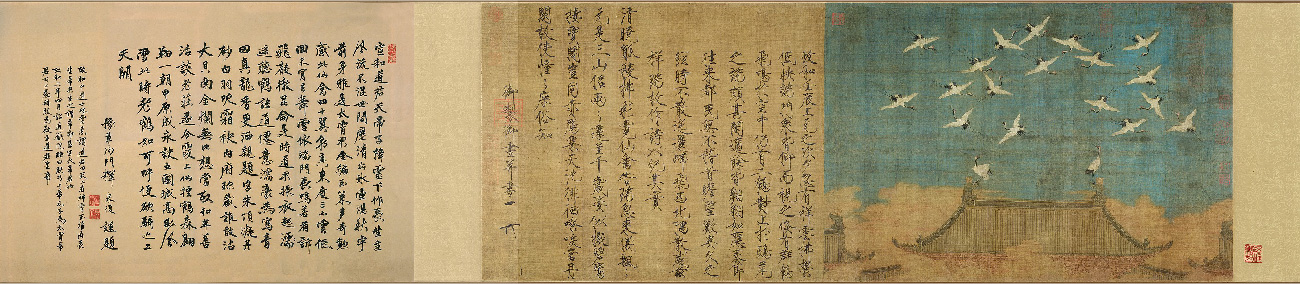
The Jin were not content to supplant the Liao. The Song had already been paying them a modest tribute of luxury goods, and the Song need for help to defeat the Liao convinced the Jin that, while seemingly rich and prosperous, the Song were militarily weak. Their perception would certainly have been reinforced if they had been aware of the temperament of the Song emperor Huizong. In power since 1100, Emperor Huizong was more renowned as a Daoist poet and artist than an effective ruler. His most famous work, a poem and painting titled Auspicious Cranes, depicts the sighting of a flock of cranes, a traditional Chinese symbol of greatness and longevity and one of the links between humanity and the heavens in Daoism (Figure 14.6). Huizong interpreted the sighting as a sign his reign would be glorious and long. The Jin had other ideas, however, and attacked the Song in 1126. Huizong quickly abdicated in favor of his eldest son, Qinzong, who proved no more adept in military matters than his father. With Jin forces occupying large parts of Song territory north of the Yellow River valley and laying siege to the capital, Qinzong dispatched a peace mission, led by his half-brother Gaozong. The Jin took the mission hostage and extracted a hefty ransom and annual tribute to release its members and end the hostilities.
英語のヒント
金は、遼に取って代わるだけでは満足しなかった。宋はすでに金へ少量のぜいたく品を貢納していた。宋が遼を倒すのに援助を必要としたことから、金は、宋は一見豊かで繁栄していても、軍事的には弱いと確信した。宋の皇帝・徽宗の性格を知っていたなら、その見方はいっそう強まったに違いない。1100年から位にあった徽宗は、有能な統治者としてよりも、道教に親しむ詩人・画家として名高かった。最も有名な詩画作品『瑞鶴図』は、鶴の群れが現れた光景を描く。鶴は中国で偉大さと長寿の象徴とされ、道教では人間と天をつなぐ存在の一つだった(図14.6)。徽宗はその出現を、自らの治世が輝かしく長く続く兆しと解した。しかし金の考えは違い、1126年に宋を攻めた。徽宗はすぐ長男の欽宗へ譲位したが、欽宗の軍事的手腕も父と変わらなかった。金軍が黄河流域以北の広い宋領を占領し、首都を包囲すると、欽宗は異母弟の高宗を長とする和平使節を送った。金は使節を人質に取り、その解放と戦闘の停止の見返りに、多額の身代金と毎年の貢納を取り立てた。
Auspicious Cranes.瑞鶴図。
(credit: modification of work “Auspicious Cranes” by Liaoning Provincial Museum/Wikimedia Commons, Public Domain) · Public Domain
Figure 14.6 Emperor Huizong’s poem and painting from 1112 uses ink and paint on silk to commemorate a good omen , the reported sighting of a flock of cranes on one of the palace buildings. (credit: modification of work “Auspicious Cranes” by Liaoning Provincial Museum/Wikimedia Commons, Public Domain)
図14.6 1112年の徽宗の詩画。宮殿の建物に鶴の群れが現れたという吉兆を記念し、絹に墨と絵具で描いた。(出典:遼寧省博物館/Wikimedia Commons「Auspicious Cranes」を改変、パブリックドメイン)
The peace proved short-lived as Qinzong tried to entice the former Liao mandarins, who were now working in service to the Jin, to revolt. They reported Qinzong’s clumsy intrigues to the Jin emperor, who launched a more protracted attack. Bent on conquest and revenge this time, the Jin refused to be bought, and in 1127 they took the Song capital and seized the entire imperial household, goods, and people, including Huizong and Qinzong. In what became known as the Jingkang incident, the Jin went on a three-week rampage of raping and looting throughout the city.
英語のヒント
和平は長続きしなかった。欽宗が、当時は金に仕えていた旧遼の文官たちを、反乱へ誘おうとしたからである。彼らは欽宗の稚拙な策謀を金の皇帝へ報告し、皇帝は、さらに長期に及ぶ攻撃を始めた。今度の金は征服と報復を固く決意し、金品で退くことを拒んだ。1127年、宋の首都を奪い、徽宗と欽宗を含む皇室の全員、財産、関係する人々を捕らえた。靖康の変として知られるこの事件では、金軍は3週間にわたり、都の各地で強姦と略奪をほしいままにした。
Gaozong, who proved much more politically adept than his father or his brother, had been sent south to lead reinforcements back to the capital. Upon learning of the capital’s fall, Gaozong united the military and mandarins behind him, proclaimed himself emperor, and rallied Song forces to halt the Jin advance. This event is considered the beginning of the Southern Song dynasty. War continued to rage until the 1140s, when the two sides agreed to the Treaty of Shaoxing, in which Gaozong ceded all Song territory north of the Huai River to the Jin, acknowledged the Song’s tributary status to the Jin, and agreed to pay an annual tribute of 250,000 bolts of silk and 325,000 ounces of silver (more than USD$6.7 million today). Huizong died in captivity before the treaty was signed. Perhaps as a statement of contempt for his incompetence, Gaozong did not negotiate for his elder half-brother’s release, condemning him to live out his remaining twenty years as a Jin captive.
英語のヒント
父や兄よりはるかに政治手腕のある高宗は、援軍を率いて首都へ戻るため、南へ派遣されていた。首都陥落を知ると、軍と文官を自分のもとにまとめ、自ら皇帝を名乗り、宋軍を結集して金の進撃を止めた。これを南宋の始まりとする。戦争は1140年代まで激しく続き、両国は紹興の和議に合意した。高宗は淮河以北の宋領をすべて金へ譲り、宋が金の従属国として貢納する地位を認め、毎年、絹25万反と銀32万5000オンスを支払うことを約束した。銀は今日の価格で670万米ドルを超える額に相当する。徽宗は条約が結ばれる前に、囚われたまま死んだ。高宗は、おそらく異母兄の無能さへの侮蔑を示すため、兄の釈放を交渉しなかった。欽宗は、残された20年を金の捕虜として生きることになった。
Within a dozen years of conquering the Liao Empire, the Jin began embracing the institutions and structures of the Song Confucian state. Landed aristocrats, generally descended from tribal chieftains, were replaced by mandarins selected by Confucian exams. The capital was relocated from the traditional Jurchen homeland in northeast Asia to Zhongdu, around contemporary Beijing. Confucian texts and Chinese literature were translated into Jurchen to speed the spread of Chinese culture and values, and the mandarin exams began to be given in Jurchen as well as proto-Chinese. Jurchen families were bribed (or forced) to relocate into former Liao and Song areas to mix with the Han population.
英語のヒント
遼を征服してから十数年もしないうちに、金は宋の儒教国家の制度や組織を取り入れ始めた。一般に部族の首長の子孫だった土地持ちの貴族は、儒教経典の試験で選ばれる文官に取って代わられた。首都も、東北アジアにある女真の伝統的な故地から、現在の北京周辺の中都へ移された。中国の文化や価値観を速やかに広めるため、儒教経典と中国文学が女真語へ訳され、官僚登用試験は、当時の中国語に加え、女真語でも行われるようになった。女真の家々は金品による誘導、あるいは強制によって、旧遼領・旧宋領へ移住させられ、漢人と混住した。
Meanwhile, despite the huge setbacks and defeats of the second quarter of the twelfth century, Gaozong and his immediate successors were able to unite and stabilize the Song dynasty. The long period of warfare allowed many ethnic Chinese to move south as refugees, where government assistance enabled them to find land or employment. By 1200, the Southern Song population was roughly the same size as it had been under the last census of the Song, despite encompassing much less land, and the economy seemed to have recovered to prewar levels.
英語のヒント
一方、12世紀第2四半期には大きな後退と敗北を経験したものの、高宗とその直後の後継者たちは、宋をまとめ、安定させることができた。長く続いた戦争の間に、多くの漢人が難民として南へ移り、政府の援助で土地や仕事を見つけた。1200年までに、南宋の人口は、領土がはるかに狭くなっていたにもかかわらず、かつて宋が最後に行った人口調査のころと、ほぼ同じ規模になった。経済も戦前の水準へ回復したように見える。